GateUser-c7ab0120

vip
Age 0.2 Year
Peak Tier 0
No content yet
#US-IranTalksStall
US-Iran Peace Talks Stall: A Comprehensive Analysis
The peace negotiations between the United States and Iran have reached a critical impasse, with the first face-to-face high-level talks since 1979 ending without agreement in Islamabad, Pakistan. This diplomatic failure represents a fundamental blow to hopes of finding an off-ramp to the ongoing crisis that began on February 28, 2026.
Reasons for the Talks Failure
The negotiations collapsed due to two primary sticking points that remain irreconcilable between the parties. First, the United States demanded that Iran provide
HighAmbition
#US-IranTalksStall
US-Iran Peace Talks Stall: A Comprehensive Analysis
The peace negotiations between the United States and Iran have reached a critical impasse, with the first face-to-face high-level talks since 1979 ending without agreement in Islamabad, Pakistan. This diplomatic failure represents a fundamental blow to hopes of finding an off-ramp to the ongoing crisis that began on February 28, 2026.
Reasons for the Talks Failure
The negotiations collapsed due to two primary sticking points that remain irreconcilable between the parties. First, the United States demanded that Iran provide a firm commitment not to develop nuclear weapons, which Tehran refused to offer. Vice President JD Vance, who led the American delegation, stated that Iran had chosen not to accept the US proposal, leaving Washington with what he described as a final and best offer on the table.
Second, the management of the Strait of Hormuz emerged as a major obstacle. Iran insists on maintaining sovereign control over this critical waterway, demanding military oversight and toll collection from ships passing through. This position is unacceptable to the United States, Gulf states, and most other nations who view the strait as an international passage through which approximately one-fifth of global oil and liquefied natural gas flows.
Iranian officials attributed the talks failure to what they characterized as excessive American demands. The Iranian perspective holds that Washington entered negotiations seeking a quick solution following a two-week ceasefire implementation, while Tehran typically approaches diplomacy with a long-term negotiating strategy. This fundamental mismatch in diplomatic timelines and expectations created an unbridgeable gap.
Iranian Foreign Minister's Pakistan Visit and US Delegation
In a significant development, Iranian Foreign Minister Abbas Araghchi arrived in Islamabad on Friday, April 24, 2026, leading a small delegation for what officials described as bilateral consultations with Pakistani authorities. The visit was scheduled for approximately 10 PM local time, raising hopes that negotiations might resume.
However, Iranian state media clarified that Araghchi's visit was primarily bilateral in nature, intended for discussions with Pakistani officials rather than immediate direct talks with American negotiators. The Iranian proposal would be conveyed to the United States through Pakistani intermediaries.
President Donald Trump dispatched a US delegation led by Special Envoy Steve Witkoff and Jared Kushner to Pakistan for fresh talks with Iranian leadership. This represented a shift from Vice President Vance's earlier leadership of negotiations. The American delegation's arrival was contingent upon Iran's willingness to engage, which remained uncertain throughout the week.
Will There Be Peace or Escalation
The current trajectory suggests continued tension rather than immediate resolution. President Trump announced he was indefinitely extending the ceasefire with Iran while awaiting what he termed a unified proposal from Tehran. However, he simultaneously declared it highly unlikely he would extend the two-week ceasefire if no agreement is reached, stating he would not be rushed into making a bad deal.
Iran has taken provocative actions that complicate diplomatic efforts. Iranian forces seized ships in the Strait of Hormuz and opened fire on a container vessel, tightening their grip on the strategic waterway. The US Navy maintains its blockade of Iranian ports, which Tehran considers a violation of the ceasefire agreement.
Iranian Revolutionary Guard officials have issued threatening statements warning regional neighbors that if their territories are used to attack Iran, they must say goodbye to oil production in the Middle East. This rhetoric suggests Tehran is prepared to escalate rather than compromise on core demands.
Analysts assess that Iran could run out of oil storage capacity by April 26, 2026, creating additional pressure for resolution. However, Iran appears to calculate that maintaining its chokehold on the global economy through Strait of Hormuz control provides leverage that outweighs immediate economic costs.
Oil Prices and Global Market Impact
The diplomatic stalemate has sent shockwaves through global energy markets. Brent crude oil is trading at approximately 105.33 to 105.88 dollars per barrel, having surged roughly 12 percent in recent trading sessions. West Texas Intermediate crude stands near 94.40 dollars per barrel. These elevated prices represent some of the highest levels seen since the war began.
The Energy Information Administration forecasts that Brent crude prices will peak at 115 dollars per barrel in the second quarter of 2026 before potentially moderating. JPMorgan analysts project that oil prices still have further to rise because the market has not yet forced sufficient demand destruction to offset supply losses from the Iran conflict.
The Strait of Hormuz closure affects approximately 20 percent of global oil shipments and a significant portion of liquefied natural gas trade. Traffic through the waterway remains near standstill, and analysts caution that even if the strait reopens soon, Gulf oil production will require considerable time to ramp back up to normal levels.
Bitcoin Current Price and Forecast
Bitcoin is currently trading at approximately 77,602 dollars, showing remarkable resilience despite geopolitical turmoil. The cryptocurrency experienced only a modest 1.6 percent pullback following Iran's reimposition of controls on the Strait of Hormuz, significantly outperforming both oil markets and traditional equities.
Technical analysis indicates Bitcoin trades within an intraday range of approximately 77,265 to 78,479 dollars. The four-hour moving averages show a bullish configuration with MA7 exceeding MA30 and MA120, suggesting short-term upward momentum. However, daily chart indicators present a more mixed picture with the SAR indicator positioned above recent average highs.
Institutional flows remain supportive of Bitcoin prices. US spot Bitcoin ETFs absorbed approximately 1.9 billion dollars in net inflows over the past week, representing the strongest five-day stretch since early February. BlackRock's IBIT ETF alone captured 612 million dollars in inflows, with the asset manager reportedly purchasing roughly 280 million dollars worth of Bitcoin daily during peak flow periods.
Market sentiment analysis reveals predominantly bullish positioning, with approximately 66 percent of social media discussions expressing positive sentiment versus 18 percent negative. The Crypto Fear and Greed Index registers at 31, indicating cautious but not panic-driven market conditions.
Traders' Perspective and Market Sentiment
Professional traders and institutional investors are viewing the Iran conflict volatility as another notch on the belt of market challenges they have navigated over the past fifteen months. JPMorgan strategists note that markets have successfully absorbed numerous shocks including trade wars, government shutdowns, tariff escalations, and previous military conflicts.
Bitcoin's shrinking sell-off magnitude with each Iran-related shock suggests cryptocurrency markets may have largely priced in geopolitical tail risks. The spot ETF bid has emerged as a more reliable price floor than the futures-driven weekend gaps that characterized earlier market cycles. Traders are now monitoring bond yields, dollar strength, and key technical levels around 74,000 to 73,000 dollars to confirm Bitcoin's role as a geopolitical shock absorber.
However, some analysts question Bitcoin's safe-haven narrative, noting that it continues to trade more like a high-beta risk asset than a defensive hedge in the current environment. The cryptocurrency demonstrated this characteristic when it declined 4 percent following the House of Representatives' razor-thin rejection of a resolution to curb presidential war powers regarding Iran.
Consumer sentiment has plummeted to record lows, with the University of Michigan survey registering 47.6, lower than readings observed during the Great Recession, pandemic downturn, or subsequent inflation surge. Survey respondents specifically cited the Iran conflict as responsible for unfavorable economic changes.
Conclusion
The US-Iran peace talks stall reflects fundamental disagreements over nuclear non-proliferation commitments and control of strategic waterways. While both sides maintain rhetorical openness to continued dialogue, the practical obstacles to agreement remain substantial. Iran's Foreign Minister visit to Pakistan represents a potential diplomatic opening, but the pathway to substantive negotiations remains uncertain.
Oil prices will likely remain elevated above 100 dollars per barrel until supply disruptions resolve, creating inflationary pressures globally. Bitcoin has demonstrated resilience but faces conflicting narratives as both a safe-haven asset and a risk-correlated instrument. Traders should anticipate continued volatility across all asset classes until diplomatic clarity emerges or military escalation occurs.
The coming days represent a critical window as ceasefire deadlines approach and both sides evaluate whether compromise serves their strategic interests better than continued confrontation.
repost-content-media
  • Reward
  • Comment
  • Repost
  • Share
#WCTCTradingKingPK
Advanced Multi-Timeframe Momentum Strategy for WCTC S8 Individual PK Competition
The Individual PK Competition in WCTC S8 demands a trading approach that balances aggressive return generation with disciplined risk management. This comprehensive strategy guide presents a multi-timeframe momentum system specifically optimized for the high-pressure environment of head-to-head trading battles where performance is measured over compressed time periods.
Core Strategy Philosophy
The foundation of this strategy rests on capturing explosive price movements while maintaining strict c
HighAmbition
#WCTCTradingKingPK
Advanced Multi-Timeframe Momentum Strategy for WCTC S8 Individual PK Competition
The Individual PK Competition in WCTC S8 demands a trading approach that balances aggressive return generation with disciplined risk management. This comprehensive strategy guide presents a multi-timeframe momentum system specifically optimized for the high-pressure environment of head-to-head trading battles where performance is measured over compressed time periods.
Core Strategy Philosophy
The foundation of this strategy rests on capturing explosive price movements while maintaining strict capital preservation protocols. Unlike traditional swing trading that might hold positions for days or weeks, PK competition trading requires rapid decision-making and quick profit realization. The strategy employs a three-layer confirmation system that filters noise and identifies high-probability momentum bursts across multiple timeframes.
Timeframe Architecture
The strategy utilizes four distinct timeframes working in concert. The monthly and weekly charts provide structural context for major support and resistance zones. The daily chart identifies the primary trend direction and key decision levels. The four-hour chart serves as the main execution timeframe where entry and exit signals are generated. Finally, the one-hour chart provides micro-structure for precise entry timing and stop-loss placement.
This multi-timeframe approach ensures that trades align with the broader market structure while allowing for tactical precision in execution. Trading against the higher timeframe trend significantly reduces win probability, so the strategy enforces strict trend alignment rules before any position is considered.
Technical Indicator Configuration
The primary momentum identification tool combines the Relative Strength Index with volume analysis. The RSI is configured with a 14-period setting on the four-hour chart, with overbought and oversold thresholds adjusted to 75 and 25 respectively to account for cryptocurrency market volatility. Volume confirmation requires the current candle to exceed the 20-period average volume by at least fifty percent, ensuring that momentum signals coincide with genuine market participation rather than low-liquidity noise.
A secondary confirmation layer employs the Moving Average Convergence Divergence indicator with standard 12, 26, and 9 period settings. The strategy requires MACD histogram alignment with price momentum, meaning that bullish entries only trigger when both price and MACD histogram are making higher lows, while bearish entries require both to make lower highs.
The third confirmation element tracks exponential moving averages with 20, 50, and 200 period settings. The strategy mandates that price action must respect the 20-period EMA as dynamic support in uptrends and resistance in downtrends. Entries are only permitted when price pulls back to test the 20 EMA and demonstrates rejection through candlestick patterns.
Entry Protocol
Long entries trigger when four conditions align simultaneously. First, the daily chart must show a clearly defined uptrend with higher highs and higher lows. Second, the four-hour RSI must pullback from overbought territory to the 40-50 zone, indicating a healthy correction within the trend. Third, the MACD histogram must show bullish divergence or flattening before resuming upward expansion. Fourth, price must touch or slightly pierce the 20-period EMA on the four-hour chart and form a reversal candlestick pattern such as a hammer, morning star, or bullish engulfing.
Short entries follow the inverse logic with corresponding bearish requirements. The daily trend must be downward, the four-hour RSI must bounce from oversold to the 50-60 zone, MACD must show bearish characteristics, and price must reject from the 20 EMA with appropriate bearish candlestick confirmation.
Position Sizing and Risk Management
Capital allocation follows a dynamic position sizing model based on account equity and volatility conditions. The base position size starts at two percent of total trading capital per trade. This percentage increases to three percent when the Average True Range over fourteen periods falls below its 50-period average, indicating compressed volatility that often precedes explosive moves. Conversely, position size reduces to one percent when ATR exceeds its average by more than fifty percent, signaling elevated volatility and increased risk.
Stop-loss placement utilizes a dual-layer approach. The initial stop-loss sits at the swing low prior to entry for long positions or the swing high for short positions, ensuring that the trade invalidation point represents a genuine structural break rather than normal market noise. A secondary trailing stop activates once the position achieves a risk-to-reward ratio of one-to-one, locking in profits while allowing winners to run.
Profit Target Framework
The strategy employs a tiered profit-taking system designed to capture momentum while protecting gains. The first profit target sits at a one-point-five risk-to-reward ratio, where twenty-five percent of the position is closed. This initial partial exit ensures that the trade becomes risk-free while maintaining exposure to further gains. The second target at a two-point-five risk-to-reward ratio triggers closure of another fifty percent of the position. The final twenty-five percent trails with a stop-loss set at the second target level, capturing extended moves while protecting accumulated profits.
PK Competition Specific Adaptations
The Individual PK format introduces unique constraints that require strategic modifications. Competition rounds operate on fixed timeframes, typically ranging from hours to days, unlike normal trading where positions can be held indefinitely. This compressed timeline necessitates more aggressive entry criteria and faster profit realization.
The strategy adapts by reducing the confirmation period requirements. While standard implementation waits for daily candle closes, competition trading utilizes four-hour closes with one-hour micro-confirmation. This accelerates signal generation while maintaining structural validity.
Additionally, the PK environment benefits from correlation analysis across multiple trading pairs. When Bitcoin demonstrates strong momentum, altcoins often follow with amplified moves. The strategy monitors Bitcoin's four-hour structure as a leading indicator, entering altcoin positions only when Bitcoin confirms directional bias. This correlation filter significantly improves win rates by ensuring trades align with broad market sentiment.
Psychological Discipline Protocols
High-stakes competition trading amplifies emotional responses that destroy rational decision-making. The strategy incorporates specific protocols to maintain psychological equilibrium. Pre-session preparation includes reviewing trade rules, visualizing execution scenarios, and setting maximum daily loss limits at four percent of account equity. Once this limit triggers, all trading ceases regardless of market conditions or perceived opportunities.
During active trading, the strategy enforces a mandatory five-minute break after any losing trade. This cooling-off period prevents revenge trading and emotional escalation. Similarly, after three consecutive winning trades, a ten-minute break is required to prevent overconfidence and sloppy execution.
Market Condition Filters
Not all market environments support momentum trading effectively. The strategy identifies three distinct market regimes and adjusts accordingly. Trending markets with clear directional bias and healthy pullbacks represent ideal conditions where the strategy operates at full capacity. Choppy, range-bound markets with overlapping price action trigger a reduction in position size and wider stop-loss placement. Strongly trending markets with parabolic price action activate aggressive profit-taking and trailing stop protocols to protect against sudden reversals.
The Average Directional Index serves as the primary regime identification tool. Readings above thirty indicate trending conditions suitable for full strategy deployment. Readings between twenty and thirty suggest choppy conditions requiring caution. Readings below twenty signal ranging markets where the strategy remains inactive.
Execution Checklist
Every trade requires completion of a pre-entry checklist ensuring all conditions align. The checklist verifies trend alignment across timeframes, indicator confirmation, volume validation, risk-to-reward ratio minimum of one-to-two, and position size calculation. No trade proceeds without checklist completion, eliminating impulsive decisions and emotional overrides.
Post-trade analysis follows every closed position, documenting entry and exit rationale, emotional state, market conditions, and lessons learned. This continuous feedback loop drives strategy refinement and performance improvement over the competition period.
Advanced Techniques for Competitive Edge
Experienced traders can enhance the core strategy with additional techniques. Order flow analysis through volume profile identifies high-probability reaction zones where institutional participation concentrates. Market structure analysis tracks break of structure and change of character patterns that signal trend continuation or reversal. Multiple timeframe confluence zones where daily, four-hour, and one-hour support or resistance align provide exceptional risk-to-reward opportunities.
Correlation arbitrage between spot and perpetual futures markets occasionally presents risk-free profit opportunities during funding rate anomalies. While these situations are rare, monitoring funding rates every eight hours can capture additional returns without directional risk.
Performance Expectations and Reality
Successful implementation of this strategy in PK competition environments typically produces win rates between forty-five and fifty-five percent. While this appears modest, the asymmetric risk-to-reward structure ensures profitability. Average wins should exceed average losses by a factor of two to one or greater. This mathematical edge, compounded over multiple trades, generates the returns necessary for competitive performance.
Traders must abandon the pursuit of perfect trades and high win rates. Consistency, discipline, and adherence to proven mathematical edges outperform intuitive genius over time. The strategy provides the framework, but execution discipline determines ultimate success.
Final Implementation Notes
This strategy represents a complete trading system, not a collection of isolated indicators. Successful implementation requires thorough backtesting on historical data, paper trading to verify execution capability, and gradual capital deployment as proficiency develops. Modifying individual elements without understanding their systemic relationships typically degrades performance rather than improving it.
The WCTC S8 Individual PK Competition rewards traders who combine technical skill with psychological resilience. This strategy provides the technical foundation, but consistent application under pressure separates winners from participants. Master the system, trust the process, and let probability work in your favor over the competition timeline.
repost-content-media
  • Reward
  • Comment
  • Repost
  • Share
#ETHMemeCoinFLORKSurges
ETH Meme Coin FLORK: The Surge That Captured Trader Attention
The cryptocurrency market has witnessed another remarkable meme coin phenomenon with FLORK, an Ethereum-based token that has experienced explosive growth in recent days. This article provides a comprehensive analysis of the surge, current pricing, forecast expectations, and strategic trading approaches that traders are currently considering.
Understanding the FLORK Surge
FLORK represents a fascinating case study in the meme coin sector. According to recent market data, this Ethereum chain meme coin achieved
HighAmbition
#ETHMemeCoinFLORKSurges
ETH Meme Coin FLORK: The Surge That Captured Trader Attention
The cryptocurrency market has witnessed another remarkable meme coin phenomenon with FLORK, an Ethereum-based token that has experienced explosive growth in recent days. This article provides a comprehensive analysis of the surge, current pricing, forecast expectations, and strategic trading approaches that traders are currently considering.
Understanding the FLORK Surge
FLORK represents a fascinating case study in the meme coin sector. According to recent market data, this Ethereum chain meme coin achieved an extraordinary 80% surge within just one hour, pushing its market capitalization beyond $15 million at its peak. The token has demonstrated remarkable resilience with a 24-hour gain exceeding 110% and trading volume reaching $11.2 million during the same period. At current levels, FLORK maintains a market cap around $12.7 million, showing sustained interest from the trading community.
The surge was not merely a random pump but was catalyzed by significant social media exposure. The token gained substantial traction when Nikita Bier, Head of Product at X (formerly Twitter), featured the Flork logo in a video demonstration for the platform's new Custom Timelines feature. This exposure transformed FLORK from an obscure token trading around $100,000-$116,000 market cap into a multi-million dollar asset, delivering over 100x returns for early adopters who recognized the narrative potential.
Current Price Position and Market Structure
As of the latest data, FLORK trades at approximately $0.000108 with significant volatility characteristics typical of meme coins. The token has established a 24-hour trading range between $0.000028 and $0.000110, demonstrating the extreme price swings that define this asset class. The current market capitalization stands at approximately $12-13 million, positioning it as a mid-tier meme coin with room for further appreciation.
The trading volume of $11.2 million in 24 hours indicates strong liquidity and active market participation. This volume level suggests genuine trading interest rather than artificial pumping, providing some confidence for traders considering entry positions. The token has also secured listings on centralized exchanges including KCEX and Poloniex, expanding accessibility beyond decentralized platforms.
Price Forecast and Growth Potential
Analysts and market observers have presented varying forecasts for FLORK's trajectory. Conservative estimates suggest the token could reach $0.000333 by 2025, representing modest growth from current levels. However, more optimistic projections based on meme coin historical patterns indicate potential for significantly higher valuations if the narrative momentum continues.
The technical setup suggests FLORK could experience further appreciation if it maintains community engagement and social media presence. Targets in the $25-50 million market cap range appear achievable if the current momentum persists, representing potential gains of 2-4x from current levels. Some community members speculate about even higher valuations, though such projections remain highly speculative and dependent on continued viral growth.
Traders should note that FLORK has already demonstrated the ability to recover from significant pullbacks. After reaching peaks around $15-18 million market cap, the token experienced corrections to approximately $3-8 million range before stabilizing and showing signs of renewed accumulation. This pattern suggests underlying support from committed holders who believe in the token's longer-term potential.
Trading Strategy Considerations
Successful trading of FLORK requires understanding the unique dynamics of meme coin markets. The following strategic approaches have emerged from analyzing trader behavior and market patterns:
Entry strategies should focus on either breakout momentum or strategic dip buying. Breakout entries work best when the token closes above recent resistance levels with volume confirmation exceeding twice the average hourly trading activity. Dip buying opportunities emerge during 20-40% corrections from recent highs, particularly when support levels around $6-8 million market cap are tested.
Risk management remains paramount given the extreme volatility inherent in meme coins. Position sizing should remain conservative, with individual trades representing no more than 1-2% of total portfolio value. Stop-loss levels should be established 15-25% below entry points to protect against rapid drawdowns that can occur when sentiment shifts.
Profit-taking strategies benefit from tiered approaches rather than single exit points. Taking 30% of position off at 1.5x gains locks in initial profits while maintaining exposure to further upside. Additional 30% can be removed at 3x targets, with final 40% reserved for potential moonshot scenarios if the token achieves $50 million or higher valuations.
Timing considerations favor high-liquidity periods during US and European trading sessions. Weekend trading often shows reduced volume and increased volatility, making position management more challenging. Traders should monitor social media sentiment continuously, as meme coins derive significant value from community engagement and viral narrative development.
What Traders Are Thinking
The trader community exhibits mixed but generally optimistic sentiment toward FLORK. Bullish participants emphasize the token's OG status on Ethereum, the X platform connection through Nikita Bier's involvement, and the organic community growth that has developed around the Flork frog meme narrative. The token's association with X's unofficial meme category positioning provides a unique value proposition that distinguishes it from countless other meme coins.
Concerns among more cautious traders center on the typical risks associated with meme coin investments. The lack of fundamental utility, dependence on social media sentiment, and history of dramatic price corrections create significant downside risks. Some traders note that FLORK's rapid appreciation may have already captured much of the easy gains, leaving limited upside for late entrants.
The broader ETH meme coin ecosystem currently shows rotation patterns, with traders moving between tokens like ASTEROID, PUNK, WOJAK, and FLORK based on which narrative gains temporary dominance. FLORK's positioning as a potential X platform mascot gives it staying power that many competitors lack, though this advantage requires continued validation through platform developments and community engagement.
Next Steps and Strategic Planning
Traders considering FLORK should establish clear entry criteria based on technical levels and volume patterns. Current support zones around $8-9 million market cap offer potential accumulation opportunities, while resistance near previous highs around $15-18 million will test the strength of bullish conviction.
Monitoring tools should include DexScreener for real-time price action, BubbleMaps for whale wallet tracking, and LunarCrush for social sentiment analysis. X platform monitoring remains essential given the token's dependence on social media narrative development.
The path forward for FLORK depends heavily on continued community engagement and any additional endorsements or integrations with the X platform. Traders should remain prepared for extreme volatility, with price swings of 50% or more occurring within single trading sessions. Success in this market requires emotional discipline, strict risk management, and willingness to exit positions when momentum shifts regardless of unrealized gains.
FLORK represents the high-risk, high-reward nature of meme coin trading in its purest form. While the surge has already delivered life-changing returns for early participants, the token's future trajectory remains highly uncertain and dependent on factors largely outside traditional financial analysis. Traders should approach with appropriate position sizing, clear risk parameters, and full awareness that meme coins can lose 90% or more of their value rapidly when sentiment turns negative.
repost-content-media
  • Reward
  • Comment
  • Repost
  • Share
#WCTCTradingKingPK
Advanced Multi-Timeframe Momentum Strategy for WCTC S8 Individual PK Competition
The Individual PK Competition in WCTC S8 demands a trading approach that balances aggressive return generation with disciplined risk management. This comprehensive strategy guide presents a multi-timeframe momentum system specifically optimized for the high-pressure environment of head-to-head trading battles where performance is measured over compressed time periods.
Core Strategy Philosophy
The foundation of this strategy rests on capturing explosive price movements while maintaining strict c
HighAmbition
#WCTCTradingKingPK
Advanced Multi-Timeframe Momentum Strategy for WCTC S8 Individual PK Competition
The Individual PK Competition in WCTC S8 demands a trading approach that balances aggressive return generation with disciplined risk management. This comprehensive strategy guide presents a multi-timeframe momentum system specifically optimized for the high-pressure environment of head-to-head trading battles where performance is measured over compressed time periods.
Core Strategy Philosophy
The foundation of this strategy rests on capturing explosive price movements while maintaining strict capital preservation protocols. Unlike traditional swing trading that might hold positions for days or weeks, PK competition trading requires rapid decision-making and quick profit realization. The strategy employs a three-layer confirmation system that filters noise and identifies high-probability momentum bursts across multiple timeframes.
Timeframe Architecture
The strategy utilizes four distinct timeframes working in concert. The monthly and weekly charts provide structural context for major support and resistance zones. The daily chart identifies the primary trend direction and key decision levels. The four-hour chart serves as the main execution timeframe where entry and exit signals are generated. Finally, the one-hour chart provides micro-structure for precise entry timing and stop-loss placement.
This multi-timeframe approach ensures that trades align with the broader market structure while allowing for tactical precision in execution. Trading against the higher timeframe trend significantly reduces win probability, so the strategy enforces strict trend alignment rules before any position is considered.
Technical Indicator Configuration
The primary momentum identification tool combines the Relative Strength Index with volume analysis. The RSI is configured with a 14-period setting on the daily chart to identify overbought and oversold conditions. Readings above 70 indicate overbought conditions suitable for short entries, while readings below 30 signal oversold conditions for long entries. However, the strategy only acts on these signals when they align with the higher timeframe trend direction.
Volume analysis uses the On-Balance Volume indicator to confirm momentum strength. Rising OBV during price advances confirms genuine buying interest, while falling OBV during price declines confirms selling pressure. Divergences between price and OBV serve as early warning signals for potential reversals.
Moving averages provide trend structure and dynamic support-resistance levels. The strategy employs the 50-period and 200-period exponential moving averages on the daily chart. Price above both averages indicates a strong uptrend, while price below both signals a strong downtrend. The 50 EMA acts as dynamic support in uptrends and resistance in downtrends.
Entry Signal Generation
Long entries trigger when three conditions align simultaneously. First, the daily RSI must read below 40, indicating the pair has pulled back from overbought conditions but maintains bullish structure. Second, price must test or slightly penetrate the 50 EMA on the daily chart, creating a high-probability support bounce scenario. Third, the four-hour chart must show a bullish engulfing candle or hammer pattern confirming buyer emergence at support.
Short entries reverse these conditions. The daily RSI must read above 60, price must test the 50 EMA from below as resistance, and the four-hour chart must display bearish engulfing or shooting star patterns confirming seller dominance at resistance.
Stop Loss Placement
Initial stop losses are placed 1.5 times the average true range below entry for long positions and above entry for short positions. This placement accounts for normal volatility while protecting against genuine trend reversals. The ATR uses a 14-period setting on the entry timeframe.
As trades move favorably, stops trail using a chandelier exit approach. The stop moves to the highest high minus three ATRs for long positions, or the lowest low plus three ATRs for short positions, calculated over the past five periods. This trailing method captures sustained trends while protecting accumulated profits.
Take Profit Strategy
The strategy employs a tiered profit-taking approach. The first 50 percent of the position closes at a 1.5 risk-reward ratio, securing base profits and reducing exposure. The remaining 50 percent continues with a trailing stop, capturing extended moves while maintaining upside participation.
For PK competition environments where rapid performance matters, an alternative aggressive approach closes 75 percent at 1.2 risk-reward and trails the final 25 percent with a tight 1 ATR stop. This method prioritizes quick wins while maintaining lottery ticket exposure to explosive moves.
Risk Management Framework
Individual trade risk is limited to 2 percent of account equity per position. This sizing allows for sustained performance even during losing streaks. The strategy expects win rates between 45 and 55 percent, making risk-reward ratios the primary profit driver.
Daily loss limits cap total account drawdown at 6 percent. Reaching this limit triggers mandatory trading cessation until the next session. This rule prevents emotional revenge trading that destroys accounts during adverse conditions.
Maximum position concentration limits exposure to any single trading pair at 25 percent of total account equity. This diversification prevents catastrophic losses from individual pair breakdowns or unexpected news events.
Market Selection Criteria
The strategy performs best on major cryptocurrency pairs with deep liquidity and tight spreads. BTC/USDT and ETH/USDT provide optimal conditions for consistent execution. These pairs exhibit clear trending behavior while maintaining sufficient volatility for meaningful profit generation.
Avoid trading during major news events or scheduled announcements. The strategy relies on technical patterns and momentum, which can be disrupted by fundamental shocks. Check economic calendars daily and reduce exposure ahead of high-impact events.
Session timing matters for execution quality. Asian session hours often provide cleaner technical setups with reduced noise. European and US sessions offer higher volatility but increased spread widening and slippage. Adapt position sizing to account for session-specific conditions.
Psychological Preparation
PK competition creates unique psychological pressures. The visible opponent and real-time performance comparison trigger competitive instincts that can override rational decision-making. Establish pre-competition routines that create mental clarity and emotional stability.
Develop specific trading plans before each session. Define which pairs you will trade, the conditions required for entry, and your maximum intended risk exposure. Having predetermined rules prevents impulsive decisions during fast-moving market conditions.
Accept that losses are part of the process. Even perfectly executed trades can fail due to random market behavior. Focus on process adherence rather than outcome obsession. Long-term profitability comes from consistent execution, not individual trade results.
Execution Checklist
Before entering any trade, verify all conditions align. Confirm higher timeframe trend direction matches your intended position. Check that RSI readings support the setup. Verify price action patterns on the execution timeframe. Calculate position size based on stop distance and risk limits. Place stop loss before entering the position. Define profit targets and exit strategy.
After entry, monitor price action without emotional attachment. Let stops and targets execute automatically. Avoid moving stops away from original placement unless following the trailing stop rules. Document each trade including entry reasoning, emotional state, and outcome for post-session review.
Competition-Specific Adaptations
PK competitions measure performance over fixed periods, creating different incentives than normal trading. Consider increasing position frequency while maintaining strict risk limits. Multiple small wins can accumulate faster than infrequent large wins in this environment.
Monitor your opponent's visible activity if the interface provides such information. Adapt your aggression level based on relative performance. If trailing significantly, consider selective size increases on high-conviction setups. If leading substantially, reduce risk to protect gains.
Time management matters in PK formats. Ensure you have adequate time remaining to execute your strategy. Avoid taking marginal setups late in competition periods when time constraints force premature exits.
Backtesting and Optimization
Validate the strategy through historical backtesting before deploying real capital. Test across multiple market conditions including trending, ranging, and volatile periods. Verify that performance remains positive across different cryptocurrency market cycles.
Optimize parameters periodically based on changing market conditions. However, avoid over-optimization that creates curve-fitted results. Focus on robust parameters that perform adequately across diverse conditions rather than perfect parameters that fail in live trading.
Paper trade the strategy for at least two weeks before PK competition participation. This practice familiarizes you with signal generation, entry timing, and emotional responses without financial risk.
Final Implementation Notes
Success in PK competition requires more than technical strategy. Physical preparation including adequate sleep, nutrition, and exercise directly impacts decision-making quality. Ensure your trading environment is free from distractions and technical issues.
Maintain detailed records of all trading activity. Review both winning and losing trades for lessons. Identify patterns in your decision-making that correlate with positive and negative outcomes. Continuous improvement separates consistent performers from occasional winners.
The WCTC S8 Individual PK Competition rewards traders who combine technical skill with emotional discipline. This strategy provides a framework for systematic decision-making, but ultimate success depends on your execution and adaptation to real-time market conditions. Trade with confidence, manage risk relentlessly, and let the results reflect your preparation.
repost-content-media
  • Reward
  • Comment
  • Repost
  • Share
#TradingStrategiesInChoppyMarkets
Trading Strategies in Choppy Markets: A Comprehensive Guide to Defense, Survival, and Psychological Mastery
The cryptocurrency market is known for volatility, but sideways and choppy conditions are equally challenging. When price moves within a range, traders feel the urge to force trades, often leading to losses and mental pressure. This guide focuses on three key areas: defining defense levels, avoiding traps, and managing trading anxiety.
Understanding the Nature of Sideways Markets
Sideways markets occur when price moves between support and resistance wit
BTC-0.61%
ATR-3.91%
HighAmbition
#TradingStrategiesInChoppyMarkets
Trading Strategies in Choppy Markets: A Comprehensive Guide to Defense, Survival, and Psychological Mastery
The cryptocurrency market is known for volatility, but sideways and choppy conditions are equally challenging. When price moves within a range, traders feel the urge to force trades, often leading to losses and mental pressure. This guide focuses on three key areas: defining defense levels, avoiding traps, and managing trading anxiety.
Understanding the Nature of Sideways Markets
Sideways markets occur when price moves between support and resistance without a clear trend. Price action looks random, with frequent fake breakouts that trap traders. These phases often appear after strong trends or during uncertainty.
The real danger isn’t lack of movement—it’s the illusion of opportunity. Small moves look like trends, pushing traders into overtrading. Survival depends not on trading more, but on knowing when not to trade.
My Essential Defense Level in Sideways Markets
My defense strategy focuses on capital protection through three pillars:
1. Reduced Risk Exposure
In trending markets, risk per trade may be 2–3%. In choppy markets, I reduce it to 1% max, with daily exposure capped at 3%. This limits losses and forces selective trading.
2. Volatility-Based Position Sizing
Using ATR (Average True Range), I adjust position size based on volatility. If volatility increases, position size decreases. If volatility compresses, I become cautious as breakouts may follow.
3. Cooling-Off Rule
After 2 consecutive losses, I take a 2-hour break. After 3 losses, I stop trading for the day. This prevents emotional revenge trading.
Additional rules:
Minimum 3 touches on support/resistance
Volume should expand at range edges
Risk-reward must be at least 3:1
If conditions aren’t met, I skip the trade.
Avoiding Dumps and Wick Traps
One of the biggest lessons I learned is proper stop-loss placement.
Most traders place stops at obvious levels, making them easy targets. Large players often push price into these zones to collect liquidity.
My solution: Volatility Buffer Strategy
Instead of placing stops directly at support/resistance, I use ATR:
Bitcoin: 2× ATR buffer
Altcoins: 2–3× ATR buffer
This allows room for natural price movement and avoids fake wicks.
Other protection methods:
Multi-timeframe confirmation (entry + higher + lower timeframe)
Position scaling (enter in parts instead of full size)
Time-based exits (close trade if no movement in 4–8 hours)
These methods reduce unnecessary losses and improve survival.
Managing Anxiety Without Trading
The hardest part of choppy markets is not trading.
1. Reframing Mindset
I treat sideways markets as recovery periods, not missed opportunities.
2. Stay Engaged Without Risk
I use paper trading and journaling instead of real trades.
3. Physical & Mental Control
Exercise and breathing techniques help reduce stress and improve focus.
4. Process-Based Success
I measure success by discipline, not profit.
5. Pre-Planned Rules
I define clear no-trade conditions before the week starts.
6. Urge Control
Instead of reacting, I observe the urge to trade—it usually fades.
7. Productive Alternatives
Backtesting, journaling, and learning replace impulsive trading.
Final Integration
Defense, protection, and psychology work together. Smaller risk allows wider stops, reducing stop-outs and stress. Better mindset improves decision-making.
The goal in choppy markets isn’t profit—it’s survival.
Successful traders don’t trade all the time. They wait for high-probability setups and protect capital during uncertain phases.
Markets will always shift between trending and sideways conditions. Those who master both environments build long-term success.
repost-content-media
  • Reward
  • Comment
  • Repost
  • Share
#CryptoMarketSeesVolatility
Crypto Market Volatility: A Comprehensive Analysis of Current Dynamics and Future Trajectory
The cryptocurrency market is currently experiencing significant volatility driven by a complex interplay of geopolitical tensions, macroeconomic uncertainty, and shifting institutional sentiment. Understanding these dynamics requires examining multiple interconnected factors that are reshaping the digital asset landscape.
Understanding Market Volatility: The Core Drivers
Market volatility in the crypto space stems from several fundamental sources. First, the inherent nature
HighAmbition
#CryptoMarketSeesVolatility
加密市场波动性:当前动态与未来走势的全面分析
加密货币市场目前正经历由地缘政治紧张局势、宏观经济不确定性和机构情绪转变等复杂因素共同驱动的显著波动。理解这些动态需要分析多种相互关联的因素,这些因素正在重塑数字资产格局。
理解市场波动性:核心驱动因素
加密领域的市场波动性源自几个基本因素。首先,作为新兴资产类别的加密货币本质上对情绪变化和流动性流动高度敏感。不同于拥有数十年成熟模式的传统市场,加密市场仍在探索其平衡点。其次,与传统资产相比,市值较低意味着大型机构的动向可能引发过度的价格影响。当像贝莱德或策略这样的主要参与者采取重大行动时,整个市场都能感受到涟漪效应。
当前波动性的加剧尤为引人注目,因为它与更广泛的全球不确定性同步发生。主要经济体之间的贸易紧张局势、货币政策的转变以及地缘政治冲突共同制造了一个“完美风暴”,传统避险资产受到质疑,加密货币在风险偏好与风险规避情绪的交叉火力中被卷入。
美伊停火协议:最新进展与市场影响
围绕美伊停火的地缘政治局势已成为影响市场情绪的关键因素。据最新报道,2026年4月8日,巴基斯坦调解下,美伊双方最初达成停火协议,持续两周。然而,局势迅速演变,对全球市场产生重大影响。
特朗普总统宣布,停火将于华盛顿时间周三晚上到期,表示如果在截止日期前未达成协议,延长几乎不可能。这一强硬立场在全球市场中造成了巨大不确定性。伊朗外交部表示,该国没有立即重新与美国接触的计划,暗示外交渠道仍然紧张。
局势进一步复杂化的是霍尔木兹海峡的军事行动。伊朗革命卫队在这一关键水道开火,击伤一艘集装箱船,显著升高了风险。这次袭击紧随美国军方扣押伊朗船只的行动之后。霍尔木兹海峡仍是全球石油运输的关键咽喉,一旦中断,立即在能源市场和风险资产(包括加密货币)中引发连锁反应。
特朗普坚持认为伊朗港口封锁将继续,并暗示如果停火未达成全面协议,将恢复攻击。他还声称伊朗已同意停止资助哈马斯和真主党,并会交出铀,但伊朗官员否认了这些说法。谈判的下一步尚不明确,原计划在巴基斯坦举行的会谈未能如期举行。
油价与全球需求:能源市场的联系
油市与加密货币波动之间的联系不容忽视。油价和全球需求模式是衡量更广泛经济健康状况的领先指标,直接影响风险资产表现,包括加密货币。
当前油市动态展现出复杂的局面。根据国际能源署的数据,全球油需求增长显著放缓。2025年第三季度,需求仅增加了80万桶/天,年增长率仅为0.7%。尽管价格相对较低,布伦特原油在2025年8月平均约为每桶68美元,连续第三个月价格下跌。
世界银行指出,油市出现供应过剩,产量激增而需求疲软,压低了价格。这一过剩局面为能源市场营造了看跌环境。然而,伊朗冲突引入了显著的供应风险溢价。来自Gunvor集团和Trafigura等主要交易商的警告显示,战争带来的需求破坏可能会大幅加深。Gunvor估计,因需求减少,可能需要将消耗量翻倍至每日至少500万桶,约占全球供应的5%,如果霍尔木兹海峡关闭三个月,可能引发全球经济衰退。
能源冲击已开始波及全球贸易,摩根士丹利报告指出,油供应中断和航运风险推高了价格,增加了企业和消费者的成本,同时威胁全球需求和增长。这种能源不确定性营造出风险偏好下降的环境,通常会压低加密货币价格,投资者转向传统资产寻求安全。
比特币现状与价格分析
比特币目前交易价格约为77,615 USDT,24小时内下跌约0.84%。24小时交易区间在77,265至78,480 USDT之间,交易量约为4.43亿USDT。在过去七天,比特币上涨了约5.17%,而30天表现显示出接近16.88%的强劲上升趋势。
技术分析显示出复杂的图景。在15分钟图上,指标显示超买状态,CCI为108.97,WR为负6.96,暗示短期可能出现疲惫。15分钟图上的SAR指标显示空头信号,SAR点高于近期平均高点。然而,4小时图显示更偏多头,MA7高于MA30,且都高于MA120,形成看涨排列,暗示上行动能。日线SAR显示看跌情绪,点位高于近期高点,提示当前水平需谨慎。
市场情绪分析显示,整体偏多,68%的内容为正面,16%为负面,净正面差异为52%。但恐惧与贪婪指数目前为31,处于恐惧区间,通常意味着市场参与者应保持谨慎。
机构活动仍是亮点。迈克尔·塞勒的策略已正式超越贝莱德,成为最大单一实体比特币持有者,策略持有81.5万BTC,而贝莱德为80.3万BTC。贝莱德客户持续买入,比特币近期的购买额分别为1.6745亿和2.4686亿美元。这种机构积累为价格提供了基础支撑,即使在波动期间也是如此。
价格预测与交易策略
鉴于当前市场状况,比特币的短期走势存在几种可能性。立即的阻力位在83,000 USDT左右,这是一个关键的心理和技术关卡。突破该水平可能开启向90,000 USDT甚至更高的100,000 USDT的路径,后者在今年早些时候曾被突破。
然而,下行风险依然显著。77,000 USDT作为即时支撑位,若跌破,目标可能在72,000至75,000 USDT之间。4小时均线显示77,185 USDT的MA30提供动态支撑,空头必须捍卫这一点以维持当前的上升趋势。
在交易策略方面,考虑到波动性,区间交易似乎最为稳妥。在77,000至79,000 USDT区间内进行短线交易,设置紧止损,可以捕捉短期波动,同时限制下行风险。对于波段交易者,逢低在75,000至77,000 USDT区域逐步建仓,目标在82,000至85,000 USDT,风险收益比相对有利。
风险管理在此环境中至关重要。仓位规模应比平常减少,止损点不应超过入场价的3%至5%。高波动性意味着几小时内可能出现5%至10%的价格变动,纪律性风险控制对资金保值至关重要。
未来走势:前景展望
加密市场的未来路径在很大程度上取决于几个未解决的因素。首先,美伊冲突的解决或升级将极大影响风险情绪。和平解决可能引发风险资产的缓解反弹,而升级则可能推动更多风险规避,压低加密价格。
其次,机构采纳的轨迹依然关键。贝莱德和策略等主要参与者的持续积累提供了需求底线,但新机构进入的速度将决定这种支撑是否能转化为持续的价格升值。
第三,监管动态,尤其是在美国,将影响市场的准入和情绪。任何关于加密货币监管的明确性、潜在的比特币储备战略或有利政策的出台,都可能成为下一轮价格变动的催化剂。
第四,宏观经济状况,包括通胀趋势、美联储政策和全球增长前景,将影响加密货币所处的更广泛风险资产环境。
结论
当前的加密市场波动反映了地缘政治不确定性、能源市场扰动和机构情绪转变的复杂交汇。比特币目前在77,600 USDT左右,处于多空力量微妙平衡之中。交易者应以谨慎态度应对,严格风险管理,保持灵活性,以适应不断变化的地缘政治和宏观经济环境。未来几周尤为关键,随着美伊局势的发展和机构资金流的持续变化,市场动态将受到深远影响。
repost-content-media
  • Reward
  • Comment
  • Repost
  • Share
#rsETHAttackUpdate
🚨 rsETH Incident 2026 – The Day DeFi Didn’t Break… But Everyone Realized It Can
There are days in crypto when nothing really changes — charts move, traders trade, noise continues — and then there are days like this, when suddenly the market goes quiet for a moment, not because nothing is happening, but because everyone is thinking at the same time, trying to process whether what just happened is a temporary disruption… or a deeper warning about the system itself.
The rsETH incident was not just another event — it was a reality check, a moment where confidence didn’t collap
ETH-0.45%
HighAmbition
#rsETHAttackUpdate
🚨 rsETH Incident 2026 – The Day DeFi Didn’t Break… But Everyone Realized It Can
There are days in crypto when nothing really changes — charts move, traders trade, noise continues — and then there are days like this, when suddenly the market goes quiet for a moment, not because nothing is happening, but because everyone is thinking at the same time, trying to process whether what just happened is a temporary disruption… or a deeper warning about the system itself.
The rsETH incident was not just another event — it was a reality check, a moment where confidence didn’t collapse, but it paused, where belief didn’t disappear, but it questioned itself, and where the biggest realization wasn’t about loss… but about how easily trust can be tested in a system built on layers of assumptions.
🔥 Let’s Be Honest — This Wasn’t “Just Another Incident”
At the surface, it looks like a technical issue tied to rsETH, with an impact crossing $290 million, but if you reduce it to just numbers, you completely miss the point — because what actually happened here was something far more important:
👉 The system accepted something it shouldn’t have
👉 The ecosystem reacted after the fact
👉 And users realized how much they rely on things they never fully analyze
And that creates a very uncomfortable thought:
How many other risks exist that simply haven’t been triggered yet?
⚠️ The Part Nobody Likes To Talk About
We often celebrate DeFi for being permissionless, open, and innovative — but we rarely talk about the trade-off:
👉 More freedom = more responsibility
👉 More innovation = more unknowns
👉 More yield = more hidden complexity
And this incident exposed exactly that — not loudly, not dramatically, but quietly and effectively — by showing that sometimes the biggest risks are not in what we see… but in what we assume is safe without questioning it.
🧠 The Debate That’s Dividing The Market Right Now
Let’s address the elephant in the room — because this is where things get interesting.
🔴 Side A — “This Is A Structural Warning”
This side isn’t panicking — they’re observing carefully, and their argument is simple but powerful:
If one weak point in a system can allow invalid value to move across protocols, interact with liquidity, and influence markets, then maybe the system is not as robust as we think — maybe complexity has moved faster than security, and maybe users are operating in environments where the true risk is not visible at the surface level.
And their biggest concern is not this incident —
It’s the next one.
🟢 Side B — “This Is Exactly How Systems Improve”
The other side sees this completely differently — not as a failure, but as a necessary stress event, because no system becomes strong without being tested, and no weakness gets fixed until it is exposed.
From this perspective, what happened is not the breakdown of DeFi — it is the process of refining it, strengthening it, and forcing it to evolve beyond theoretical security into real-world resilience.
💡 So Who’s Right? Here’s The Truth…
Both sides are right — and that’s what makes this moment so important.
Because this isn’t a black-and-white situation.
👉 DeFi is not broken
👉 DeFi is not perfect
👉 DeFi is being tested
And the outcome of this test will define the next phase of the market.
📊 Now Let’s Talk About What Really Matters — PRICE
Because in the end, markets don’t lie — sentiment, fear, confidence… everything shows up in price.
💰 Ethereum Current Price: ~$2318
Now pause for a second and think about this…
After a major DeFi shock, after headlines, after uncertainty…
👉 ETH is still holding above $2300
👉 Monthly trend is still positive (~+16%)
👉 Market structure is still intact
That is not weakness.
That is controlled strength.
🔍 Expanded Price Zones (Where The Game Is Being Played)
📍 Support Levels (Where Buyers Defend):
• $2300 → Key psychological level
• $2280 → Short-term reaction zone
• $2250 → Strong support (if tested, high attention area)
📍 Resistance Levels (Where Sellers React):
• $2332 → Immediate breakout trigger
• $2360 → Supply pressure zone
• $2400 → Major psychological barrier
• $2500 → Momentum expansion target
📈 What The Chart Is Really Saying
This is not a trending market…
This is not a collapsing market…
👉 This is a decision zone
Price is compressing, volatility is tightening, and the market is preparing for a move — the only question is direction.
And here’s the key insight most traders miss:
👉 Big moves don’t start with noise
👉 They start with silence and compression
🏦 Smart Money Isn’t Loud — But It’s Active
While retail traders are reacting emotionally, smart money is doing something very different:
👉 Not rushing in
👉 Not running away
👉 Just positioning quietly
This is what rebalancing looks like — not panic, not hype, but calculated patience.
⚡ The Brutal Truth Most Traders Ignore
Let’s be real for a second —
Most people in DeFi are not losing money because of hacks…
They’re losing because they:
• Don’t understand what they’re using
• Chase returns without thinking
• Ignore risk until it hits
And this incident didn’t create that problem —
It just exposed it.
📈 Strategy Right Now — This Is Where You Win Or Lose
This is not the time to be emotional.
This is the time to be precise.
🟢 If You’re Careful:
Wait for confirmation above $2332 — don’t guess, react
🟡 If You’re Strategic:
Look at $2300 zone for controlled entries with risk defined
🔴 If You’re Aggressive:
Trade short-term, take profits fast, don’t overstay
👉 One rule above all:
Survive first. Profit second.
🚀 What Happens Next — The Bigger Picture
This moment will shape the future of DeFi, not because something went wrong, but because now:
• Builders will tighten systems
• Investors will think deeper
• Risk will be priced more accurately
• Weak structures will get exposed
👉 And that’s how systems evolve.
💬 Final Thought — Read This Carefully
The biggest danger in crypto is not volatility.
It’s not even technical failure.
👉 It’s false confidence.
repost-content-media
  • Reward
  • Comment
  • Repost
  • Share
#美伊谈判陷入僵局
US-Iran Talks Stall: The Current Standoff
The diplomatic efforts between the United States and Iran have reached a critical impasse. Peace talks that were being mediated in Islamabad, Pakistan, have stalled as both sides maintain hardened positions. The United States has imposed a naval blockade on Iranian ports, which President Trump claims is costing Iran approximately 500 million dollars daily while the United States sustains minimal losses. In response, Iran has taken aggressive countermeasures including laying additional naval mines in the Strait of Hormuz, seizing commercial v
HighAmbition
#美伊谈判陷入僵局
US-Iran Talks Stall: The Current Standoff
The diplomatic efforts between the United States and Iran have reached a critical impasse. Peace talks that were being mediated in Islamabad, Pakistan, have stalled as both sides maintain hardened positions. The United States has imposed a naval blockade on Iranian ports, which President Trump claims is costing Iran approximately 500 million dollars daily while the United States sustains minimal losses. In response, Iran has taken aggressive countermeasures including laying additional naval mines in the Strait of Hormuz, seizing commercial vessels, and firing on ships traversing the vital waterway.
The fundamental disagreement centers on sequencing. Iran demands the lifting of the US blockade as a precondition for any meaningful negotiations, while the United States insists on Iranian compliance with its terms before easing sanctions. President Trump has explicitly ruled out nuclear options but has threatened lethal force against Iranian mine-laying operations. This creates a dangerous deadlock where neither side appears willing to make the first concession.
Question 1: Will the Ceasefire End and Could the Strait of Hormuz Close?
My Detailed Assessment:
The ceasefire between the United States and Iran, which was set to expire, has been extended but remains extremely fragile. Based on current developments, I assess the situation as follows:
The ceasefire will likely hold in the immediate term but faces significant risk of collapse if diplomatic progress stalls further. Both sides have incentives to avoid full-scale military confrontation. The United States has invested considerable diplomatic capital in the negotiation process and would face domestic and international criticism for escalating to open warfare. Iran, despite its aggressive rhetoric, understands that direct military conflict with the United States would be catastrophic for its regime and economy.
However, the Strait of Hormuz closure is a distinct and more probable scenario. Iran has already demonstrated its willingness to restrict traffic through the strait, which handles approximately twenty percent of global oil shipments and liquefied natural gas supplies. The Iranian National Security Council has explicitly stated that Iran will maintain supervision and control over strait traffic until definitive peace is achieved and the US blockade is lifted.
The strait is effectively experiencing partial closure already. Iranian actions including mine-laying, vessel seizures, and direct attacks on commercial shipping have created a de facto blockade that has severely disrupted traffic. Maritime insurance costs have skyrocketed, and many shipping companies are avoiding the route entirely. Clearance of naval mines, if Iran deploys them extensively, could take up to six months even after hostilities cease.
My Opinion: The ceasefire will likely be extended repeatedly in short increments as both sides use the time to negotiate, but a comprehensive deal remains distant. The Strait of Hormuz will likely remain partially restricted for the foreseeable future, with Iran using control over the waterway as its primary leverage in negotiations. A full closure remains unlikely as it would trigger severe international backlash and potentially military intervention, but the current level of disruption is already sufficient to impact global energy markets significantly.
*Question 2: Impact of Escalation on Oil Prices and Global Markets
Oil Price Trajectory:
Current oil prices have already responded dramatically to the tensions. Brent crude has surged above one hundred dollars per barrel, reaching approximately one hundred three dollars, representing an increase of over four percent. West Texas Intermediate crude has climbed to around ninety-four dollars per barrel.
If the conflict escalates further, particularly if the Strait of Hormuz experiences complete closure or sustained major disruption, oil prices could spike significantly higher. Analysts suggest that in a worst-case scenario involving prolonged strait closure, crude oil prices could surge toward two hundred dollars per barrel. This would represent a doubling from current levels and would trigger one of the most severe energy crises in decades.
The International Energy Agency has warned of historic supply shortages, with up to thirteen million barrels per day at risk. This represents a substantial portion of global supply that cannot be easily replaced through alternative routes or increased production from other regions.
Global Market Impact:
Energy Markets: The impact extends beyond crude oil to refined products, natural gas, and electricity markets. European and Asian markets are particularly vulnerable given their dependence on Middle Eastern energy supplies. Natural gas prices in Europe, already elevated, would face additional pressure.
**Inflation and Monetary Policy:** Higher energy costs would reignite inflationary pressures globally. Central banks, including the Federal Reserve, European Central Bank, and Bank of England, would face difficult choices between controlling inflation and supporting economic growth. This could lead to prolonged higher interest rates, affecting borrowing costs for governments, corporations, and consumers.
**Equity Markets:** Stock markets have already shown sensitivity to the conflict. Major indices including the Nasdaq and Dow Jones have experienced volatility, with technology stocks particularly affected due to their sensitivity to interest rate expectations. Prolonged conflict would likely trigger a broader risk-off sentiment, with investors moving toward safe-haven assets.
Cryptocurrency Markets: The crypto market has demonstrated complex reactions to the geopolitical tensions. Bitcoin initially dipped to approximately seventy-six thousand dollars during peak tension but rebounded above seventy-eight thousand dollars on ceasefire extension hopes. Ethereum and altcoins have followed similar patterns.
The relationship between geopolitical conflict and crypto is nuanced. On one hand, crypto faces risk-off pressure as investors seek safety in traditional havens like the US dollar and gold. On the other hand, Iran and other sanctioned nations have increasingly used cryptocurrencies to circumvent financial restrictions, creating underlying demand. Additionally, concerns about fiat currency debasement and inflation could drive long-term interest in Bitcoin as a hedge.
Commodity Markets: Beyond energy, other commodities including agricultural products and industrial metals would face price pressure due to higher transportation costs and supply chain disruptions.
Regional Economies: Countries in the Middle East, particularly Gulf states, would face economic disruption despite being oil exporters. Tourism, trade, and financial services would suffer. European economies, already struggling with energy costs, would face additional headwinds that could push some regions into recession.
Shipping and Insurance: Maritime insurance premiums for vessels traversing the Strait of Hormuz have increased dramatically. Container shipping rates have widened significantly as shippers price in uncertainty and risk. Alternative routes around Africa add significant time and cost to shipments between Asia and Europe.
Conclusion:
The US-Iran standoff represents one of the most significant geopolitical risks to global markets in recent years. While full-scale war appears unlikely given the costs to both sides, the prolonged diplomatic stalemate and partial closure of the Strait of Hormuz create sustained uncertainty that markets must price in.
Oil prices have already breached one hundred dollars per barrel and could climb substantially higher if tensions escalate. The crypto market, while volatile, has shown resilience and may benefit from both risk-off flows and its utility in circumventing sanctions.
Investors should prepare for continued volatility across all asset classes. The situation remains fluid, with rapid developments possible as negotiations continue or break down. Monitoring diplomatic signals, military movements, and energy market indicators will be crucial for navigating this uncertain environment.
repost-content-media
  • Reward
  • 1
  • Repost
  • Share
GateUser-2e7fb402:
Today feels like one of those days where everything just aligns 👀 $SHIRO quietly doing its thing in the background content rolling out community staying active momentum building step by step 🐾 nothing forced, nothing rushed just a project moving the right way #SHIRO
#BTCMarketAnalysis
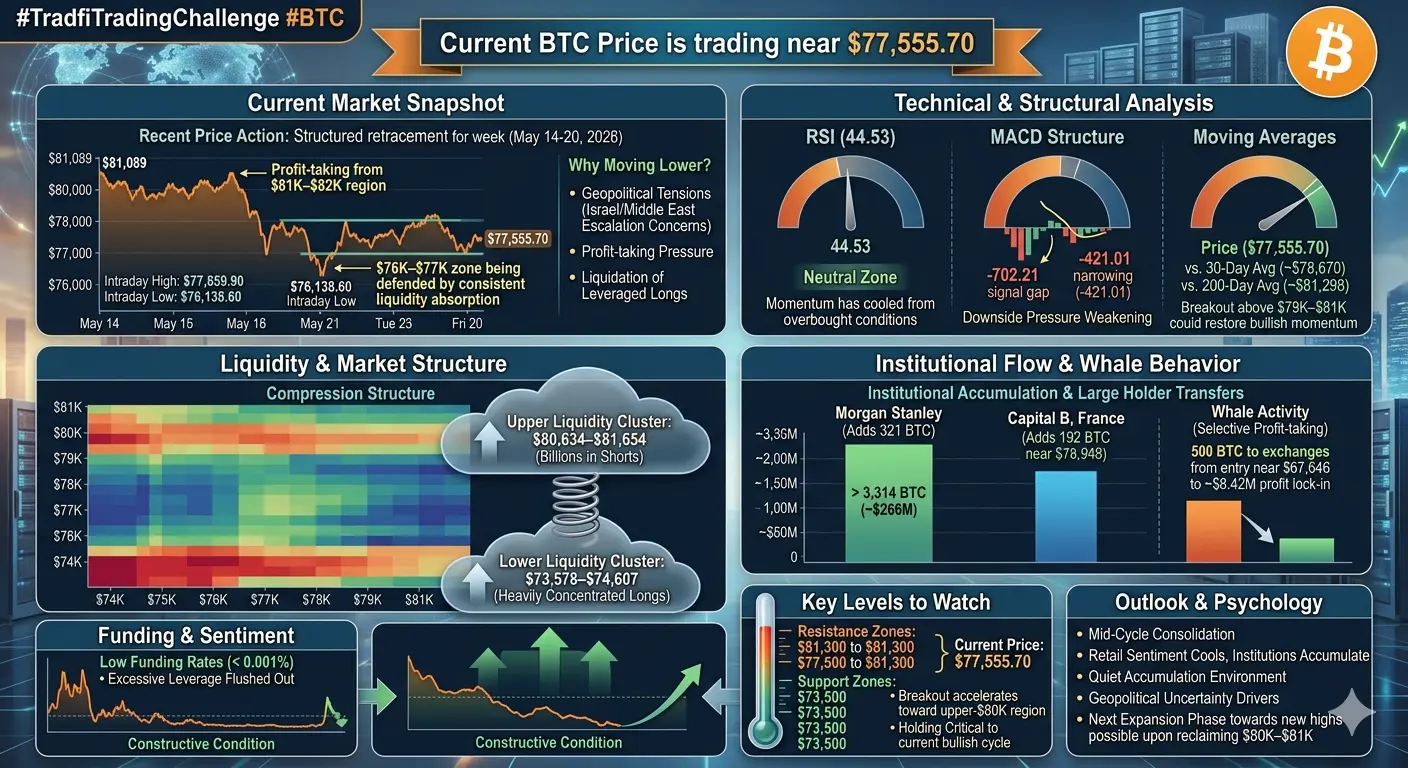
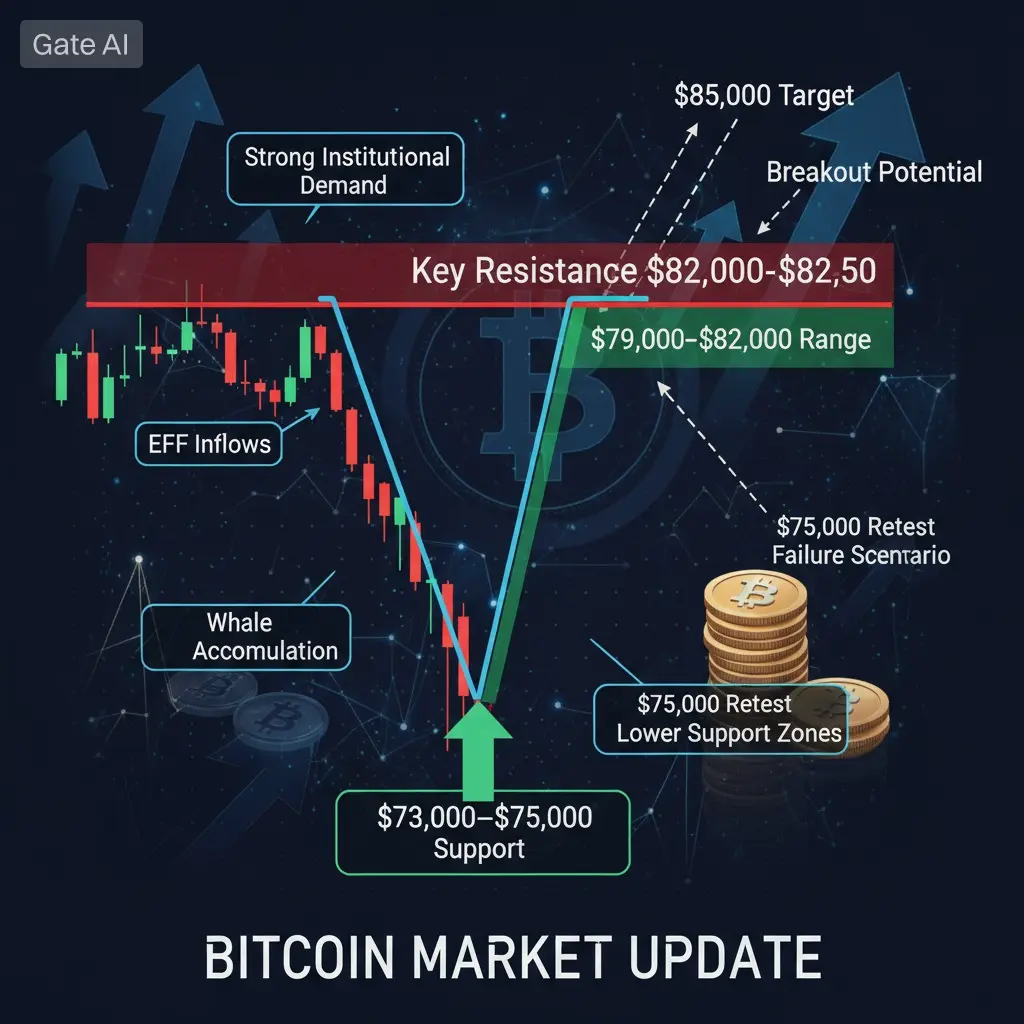
Bitcoin is currently trading around $77,680, after recently touching highs near $79,500 and failing to break the major $80,000 psychological resistance. This rejection is not just a simple pullback; it reflects a combination of technical pressure, liquidity barriers, and cautious market sentiment that is shaping the current market structure.
The $78,000 to $80,000 zone has become one of the most important resistance areas in the market right now. This region aligns with previous highs formed in late January and early February, which means a large number of traders previousl
BTC-0.61%
HighAmbition
#BTCMarketAnalysis
Bitcoin is currently trading around $77,680, after recently touching highs near $79,500 and failing to break the major $80,000 psychological resistance. This rejection is not just a simple pullback; it reflects a combination of technical pressure, liquidity barriers, and cautious market sentiment that is shaping the current market structure.
The $78,000 to $80,000 zone has become one of the most important resistance areas in the market right now. This region aligns with previous highs formed in late January and early February, which means a large number of traders previously entered positions here. As price revisits this zone, many of those participants are exiting their positions at breakeven or small profit, creating strong selling pressure. At the same time, volume profile analysis shows the Point of Control (POC) near $80,500, meaning this is where the highest trading activity occurred historically. Such levels often act as magnets for price but also require strong momentum to break through.
Liquidity data further strengthens this bearish pressure in the short term. There are heavy sell walls stacked between $80,000 and $84,000, indicating that even if Bitcoin manages to break $80K, it will not be an easy continuation. Without sustained institutional inflows and strong spot demand, any breakout attempt may face quick rejection.
Another critical signal comes from the derivatives market. Funding rates remain negative despite price moving upward toward $79K. This is an unusual divergence because, in strong bullish trends, funding typically turns positive. The current situation suggests that spot buyers are pushing the price up, while leveraged traders are either cautious or actively shorting the market. This creates a fragile rally structure where upward movement lacks strong conviction and can reverse quickly if buying pressure slows down.
At the macro level, geopolitical developments have become the dominant driver of Bitcoin’s recent price action. The temporary ceasefire between the United States and Iran triggered a strong risk-on move, pushing Bitcoin from the low $70,000 range to nearly $79,000 within a short time. This move was supported by approximately $1.4 billion in institutional inflows, highlighting how quickly sentiment can shift when global tensions ease. Additionally, the rally caused over $330 million in short liquidations, creating a chain reaction of forced buying that accelerated the upward move.
However, the situation remains unstable. Reports of renewed tensions, including the seizure of an Iranian cargo vessel, caused Bitcoin to briefly fall below $74,000, showing how sensitive the market currently is to geopolitical headlines. While temporary stability has returned, the lack of a permanent resolution keeps uncertainty high.
🔍 Scenario Breakdown:
🔴 Bearish Scenario (Geopolitical Escalation):
If tensions rise again or the ceasefire collapses, markets may shift into risk-off mode. In this case, Bitcoin could drop toward $73,000 – $70,000, especially as CME gaps remain open in that range. Initially, BTC may move in correlation with equities to the downside before stabilizing.
🟢 Bullish Scenario (De-escalation & Stability):
If peace talks progress and uncertainty fades, Bitcoin could break above $80,000 with strong momentum. This could open the path toward $82,000 – $84,000, and in an extended rally, the $90,000 – $100,000 range could come into focus as institutional demand strengthens.
📊 Inflation & Federal Reserve Influence:
Recent CPI data has shown signs of easing inflation, which supports risk assets like Bitcoin. Lower inflation increases the likelihood of future interest rate cuts, which improves liquidity conditions and supports bullish momentum.
However, risks still remain. Core inflation is still relatively sticky, and any unexpected increase could push the Federal Reserve to maintain higher interest rates for longer. This would reduce liquidity and potentially slow down Bitcoin’s upward movement.
In addition, discussions around potential Federal Reserve leadership changes and policy direction are adding another layer of uncertainty that traders must monitor closely.
📈 Trading Strategies:
Bullish Breakout Strategy:
Wait for a confirmed breakout above $78,300 – $79,000 with strong volume and rising open interest.
Targets: $80K → $82K → $84K
Stop Loss: Below $76,200 or $75,500
Confirmation: Funding turning positive + strong spot demand
Bearish Rejection Strategy:
Look for rejection signals near $79K – $80K (e.g., long wicks, bearish divergence).
Targets: $76K → $73.5K → $71K
Stop Loss: Above $80K
Range Trading Strategy:
Market is currently range-bound, so traders can:
Buy near $75,100 – $73,600
Sell near $78,600+
Avoid $76K – $78K zone due to choppy movement
📦 On-Chain & Market Structure:
On-chain data continues to show strong long-term confidence:
+303,000 BTC accumulated by long-term holders
-290,000 BTC reduced by short-term holders
This indicates a shift from weak hands to strong hands, which is typically a bullish sign for the long-term trend.
Institutional participation is also increasing, with major players and corporations continuing to accumulate Bitcoin, reinforcing the broader bullish structure.
⚠️ Risk Management:
The current market environment is highly sensitive and driven by external factors. Traders should:
Use proper position sizing
Avoid over-leveraging
Wait for confirmation before entering trades
Stay updated on geopolitical and macro developments
🔮 Final Outlook:
Bitcoin remains in a larger uptrend, but is currently facing a strong resistance barrier. The $80,000 level is the key trigger point for the next major move.
A strong breakout above this level could lead to rapid upside expansion, while repeated rejection may push price back toward the $70,000 support region.
In this phase, patience and discipline are more important than aggressive trading. The market is offering opportunities, but only to those who can manage risk and adapt quickly to changing conditions.
repost-content-media
  • Reward
  • Comment
  • Repost
  • Share
#USIranTalksProgress .
US-Iran Talks Progress: Current Situation and Market Impact Analysis
The negotiations between the United States and Iran have entered a critical phase in April 2026, with both sides sending mixed signals about the prospects for a lasting peace agreement. The talks, which began in April 2025 under the mediation of Oman and later moved to venues including Rome, Geneva, and most recently Islamabad, Pakistan, have faced numerous setbacks despite intermittent progress.
Current Status of Negotiations
The fourth round of negotiations in 2026 concluded on April 7, 2026, with bot
HighAmbition
#USIranTalksProgress .
US-Iran Talks Progress: Current Situation and Market Impact Analysis
The negotiations between the United States and Iran have entered a critical phase in April 2026, with both sides sending mixed signals about the prospects for a lasting peace agreement. The talks, which began in April 2025 under the mediation of Oman and later moved to venues including Rome, Geneva, and most recently Islamabad, Pakistan, have faced numerous setbacks despite intermittent progress.
Current Status of Negotiations
The fourth round of negotiations in 2026 concluded on April 7, 2026, with both sides agreeing to a two-week ceasefire. However, the situation remains volatile. President Trump has expressed confidence that a deal is close, stating that the US would acquire Iran's enriched uranium and that no money would exchange hands. Meanwhile, Iran's top negotiator Mohammad Bagher Ghalibaf has indicated progress in talks, though Iranian officials continue to criticize what they perceive as US violations of the ceasefire terms.
The core sticking points remain Iran's nuclear program and the US demand for comprehensive inspections. Iran has offered to build additional nuclear reactors as part of a broader agreement, but concerns persist about Tehran's commitment to transparency. The US naval blockade of Iranian ports continues despite Iran's announcement that the Strait of Hormuz is open for commercial shipping, creating confusion about the actual status of maritime traffic through this critical waterway.
Strait of Hormuz: The Geopolitical Flashpoint
The Strait of Hormuz remains the central flashpoint in this conflict. This narrow waterway handles approximately one-fifth of global crude oil shipments, making it one of the most strategically important maritime passages in the world. Iran has repeatedly opened and closed the strait in response to developments in negotiations, creating significant uncertainty for global energy markets.
The US has maintained a naval presence in the region, with reports indicating that American forces have turned back over 30 vessels attempting to violate the blockade. President Trump ordered the Navy to shoot and kill Iranian boats laying mines in the strait, raising tensions further. Iran has responded by seizing cargo ships and threatening retaliation against what it calls US armed piracy.
Iran's Strategic Calculations
Iran faces a complex strategic dilemma. On one hand, the country seeks relief from crippling economic sanctions and the US naval blockade that has severely impacted its oil exports. The war has pushed over 30 million Iranians back into poverty according to UN estimates, creating immense domestic pressure for a resolution. On the other hand, Iranian leadership remains deeply suspicious of US intentions, viewing the negotiations as potentially leading to a surrender rather than a genuine peace agreement.
The Iranian parliamentary speaker has criticized Trump for imposing what he calls a siege while claiming to seek peace, suggesting that Tehran views the US approach as contradictory. Iran's supreme leader has warned against enemy media operations, indicating concerns about internal stability during this sensitive period.
Bitcoin Market Analysis: Current Status
Bitcoin has demonstrated remarkable resilience amid the geopolitical turbulence, though it has experienced significant volatility. The cryptocurrency reached a monthly high of approximately $78,922 following the announcement of the ceasefire extension, representing a rally of about 10.4% in 24 hours. However, the price has since pulled back to around $74,000-$76,000 range as tensions flared again.
The current Bitcoin price stands at approximately $78,408, with modest 24-hour gains of 0.09%. The cryptocurrency has shown a 7-day increase of about 3.6% and a 30-day surge of nearly 14%, indicating underlying strength despite geopolitical headwinds. The Fear and Greed Index has reached 63, suggesting growing optimism among market participants.
Institutional adoption continues to provide support for Bitcoin prices. Spot Bitcoin ETFs have logged six consecutive days of inflows, with BlackRock's IBIT ETF leading with substantial daily purchases. MicroStrategy acquired 34,164 BTC on April 20, 2026, demonstrating continued corporate confidence in the asset. Total crypto market capitalization has risen above $2.7 trillion, reflecting broad-based strength across digital assets.
Oil Market Dynamics: XTI and Brent Prices
The oil market has experienced extreme volatility due to the Strait of Hormuz disruptions. Brent crude oil prices have surged above $95 per barrel, with some analysts predicting prices could reach $130 per barrel if disruptions continue through June 2026. West Texas Intermediate (WTI) crude is trading around $93-$96 per barrel, representing a significant premium over pre-conflict levels.
Citi analysts have outlined three scenarios for oil prices based on Strait of Hormuz developments. In the best-case scenario where ceasefire extension is signed and flows gradually resume, prices could stabilize around current levels. The worst-case scenario involves prolonged disruption lasting eight to nine weeks, which would push crude inventories to record lows and maintain prices around $130 per barrel until the third quarter.
The US Energy Information Administration has raised its 2026 oil price forecast significantly due to the supply disruptions. Major oil companies including Chevron and Shell have warned about the physical manifestations of the strait closure working their way through global supply chains. The impact extends beyond crude oil to affect fertilizer costs, transportation, and virtually every production chain worldwide.
Interconnected Market Dynamics
The relationship between geopolitical developments, oil prices, and cryptocurrency markets has become increasingly complex. Bitcoin has shown a decoupling from traditional risk assets, with smaller sell-offs during each Iran-related shock suggesting that crypto may have largely priced in geopolitical tail risk. This resilience contrasts with the more pronounced reactions in equity markets and oil prices.
Arthur Hayes and other prominent crypto analysts have suggested that the Federal Reserve may eventually need to print money to fund the Iran war, which could drive Bitcoin higher as a hedge against monetary expansion. Institutional investors appear to be actively using Bitcoin as protection against the contagion effects of the geopolitical crisis, with BlackRock and MicroStrategy engaged in what some observers describe as an arms race for remaining Bitcoin supply.
Potential Market Scenarios
If the ceasefire proves successful and a comprehensive agreement is reached, several market outcomes appear likely. Bitcoin could experience a significant rally as geopolitical risk premium dissipates, potentially testing the $80,000 level and beyond. The cryptocurrency has shown resilience during previous de-escalations, and a lasting peace agreement could trigger renewed institutional interest.
Oil prices would likely decline substantially from current elevated levels, potentially returning to the $70-$80 per barrel range if Strait of Hormuz traffic normalizes. This would provide relief to global inflation pressures and support equity markets. Traditional safe-haven assets like gold and the US dollar might face headwinds as risk appetite returns.
Conversely, if negotiations fail and military escalation resumes, Bitcoin could face renewed selling pressure despite its recent resilience. Oil prices would likely spike above $100 per barrel and potentially reach the $130 level predicted by Citi analysts. Global equity markets would face significant headwinds, and recession probabilities would increase substantially.
Conclusion
The US-Iran negotiations represent a critical juncture for global markets. While both sides have expressed optimism about reaching an agreement, substantial obstacles remain. The Strait of Hormuz continues to serve as both a bargaining chip and a potential trigger for wider conflict. Bitcoin has demonstrated unexpected resilience amid the turmoil, though its ability to maintain current levels depends heavily on the negotiation outcome. Oil markets remain extremely sensitive to developments, with prices reflecting significant risk premium that could unwind quickly if peace is achieved or intensify further if conflict escalates. Investors across all asset classes are watching these negotiations with intense interest, understanding that the outcome will have profound implications for global economic stability in the months ahead.
repost-content-media
  • Reward
  • Comment
  • Repost
  • Share
#US-IranTalksStall
The recent breakdown in negotiations between the United States and Iran represents one of the most significant geopolitical developments affecting global markets in 2026. The talks, which were held in Islamabad, Pakistan, collapsed after marathon 21-hour negotiations failed to produce a truce deal, with both sides trading accusations and escalating tensions.
Reasons Behind the Talks Stall
The primary sticking points that led to the collapse of negotiations are multifaceted. First and foremost, Iran's refusal to commit to abandoning its nuclear ambitions remains the central
BTC-0.61%
HighAmbition
#US-IranTalksStall
The recent breakdown in negotiations between the United States and Iran represents one of the most significant geopolitical developments affecting global markets in 2026. The talks, which were held in Islamabad, Pakistan, collapsed after marathon 21-hour negotiations failed to produce a truce deal, with both sides trading accusations and escalating tensions.
Reasons Behind the Talks Stall
The primary sticking points that led to the collapse of negotiations are multifaceted. First and foremost, Iran's refusal to commit to abandoning its nuclear ambitions remains the central obstacle. US Vice President JD Vance explicitly stated that Tehran would not accept Washington's terms regarding nuclear weapons development. The US demands an affirmative commitment that Iran will not seek nuclear weapons or the tools to quickly achieve them.
The Strait of Hormuz has emerged as another critical flashpoint. Iran continues to essentially control this vital waterway through which approximately 20 percent of global oil shipments pass. President Trump announced that the US would impose a naval blockade on Iranian ports in response to Iran's closure of the strait since the beginning of hostilities on February 28, 2026. This blockade has sent oil prices spiraling worldwide and created significant economic pressure on Iran.
Iran has expressed frustration over Trump's decision to maintain the naval blockade even after Tehran announced it would reopen the strait following a 10-day ceasefire between Israel and Lebanon. Iranian officials have threatened to forgo negotiations entirely after the US military seized an Iranian-flagged vessel attempting to defy the blockade over the weekend.
The scope of Iran's nuclear enrichment program has also been contentious. The proposed enrichment program was based on what analysts describe as an overly ambitious 10-year reactor plan, including enriching uranium up to 20 percent with advanced centrifuges. The International Atomic Energy Agency has tracked Iran's nuclear fuel and documented that Iran had 45.5 kilograms of uranium enriched to 20 percent, representing roughly a seven-to-eight-year supply for the reactor.
Why Iran is Stalling the Talks
Iran's negotiating position appears driven by several factors. The regime is seeking to maintain leverage by controlling the Strait of Hormuz, which gives them significant geopolitical power. Additionally, Iran views the US blockade as a violation of the ceasefire agreement, creating a Catch-22 situation where neither side is willing to make the first concession.
The Iranian leadership, under Supreme Leader Mojtaba Khamenei, faces domestic pressure to appear strong against American demands. The country's economy has been devastated by sanctions, and any deal that appears to capitulate to US demands could undermine the regime's legitimacy. Furthermore, Iran's strategic alliances with regional actors and its position within the Axis of Resistance create additional constraints on its negotiating flexibility.
Impact on Crypto Markets
The breakdown in US-Iran talks has created significant ripples throughout cryptocurrency markets. Bitcoin, which had touched the 79,000 USDT level, has retreated to approximately 77,700 USDT, reflecting the risk-off sentiment that typically accompanies geopolitical uncertainty.
The correlation between geopolitical tensions and crypto market volatility has become increasingly pronounced. When traditional safe-haven assets like gold and the US dollar strengthen during times of crisis, cryptocurrencies often experience sell pressure as investors seek liquidity and stability. The current situation is no exception, with Bitcoin struggling to maintain momentum above key resistance levels.
The Strait of Hormuz crisis has particular implications for crypto markets because it affects global energy prices. Higher oil prices typically lead to inflationary pressures, which can influence Federal Reserve policy decisions. Any indication that the Fed might maintain higher interest rates for longer due to inflation concerns tends to weigh on risk assets, including cryptocurrencies.
BTC Current Price Analysis and Forecast
Bitcoin is currently trading around 77,700 USDT, having retreated from the 79,000 USDT resistance level. Technical analysis reveals a mixed picture. On the 4-hour timeframe, moving averages show a bullish alignment with MA7 above MA30 above MA120, indicating an overall upward trend. However, there are concerning signals as well.
The 4-hour chart displays a MACD top divergence pattern, where price made a new high while the MACD histogram decreased, suggesting potential pullback risk. Daily indicators show overbought conditions with CCI at 114.97 and WR at negative 19.51, indicating the market may be due for a correction.
Short-term indicators on the 15-minute timeframe show oversold conditions with CCI at negative 153.55 and WR at negative 87.26, suggesting potential for a bounce. However, the price has fallen below the 20-period moving average, indicating short-term weakness.
Volume analysis shows significant participation with 24-hour trading volume exceeding 522 million USDT, suggesting strong market interest at current levels. The fear and greed index sits at 39, indicating a neutral to slightly fearful sentiment among market participants.
Trading Strategy and Price Targets
Given the current geopolitical uncertainty and technical setup, a cautious approach is warranted. The immediate support level to watch is around 76,900 USDT, which represents the recent low. If this level holds, Bitcoin could attempt another push toward the 79,000 USDT resistance.
However, if the US-Iran situation deteriorates further and oil prices spike, Bitcoin could face additional downside pressure. In a risk-off scenario, support levels at 75,000 USDT and 72,000 USDT come into play. The 200-day moving average around 73,000 USDT represents a critical long-term support zone.
For upside targets, a break above 79,000 USDT could open the door to 82,000 USDT and potentially 85,000 USDT. However, given the overbought daily conditions and geopolitical risks, the probability of immediate new highs appears limited.
Strategic Recommendations
Traders should consider reducing position sizes during periods of heightened geopolitical uncertainty. Setting stop-losses below the 76,000 USDT level would help protect against a deeper correction. For those looking to accumulate, dollar-cost averaging on dips toward the 75,000-76,000 USDT zone may be prudent.
The correlation between traditional markets and crypto has been increasing, so monitoring developments in oil prices, the US dollar index, and equity markets will provide valuable context for crypto trading decisions. Any resolution to the US-Iran tensions could spark a relief rally, while escalation could trigger a broader risk-off move affecting all asset classes.
In conclusion, the US-Iran talks stall represents a significant geopolitical risk factor for crypto markets in the near term. While Bitcoin's long-term fundamentals remain intact, short-term volatility is likely to persist until there is clarity on the diplomatic front. Traders should remain vigilant, manage risk appropriately, and be prepared for rapid shifts in market sentiment as the situation evolves.
repost-content-media
  • Reward
  • Comment
  • Repost
  • Share
#rsETHAttackUpdate :
The rsETH Attack: A $292M DeFi Shock That Redefined Crypto Security in 2026
The crypto market was violently shaken on April 18, 2026, when KelpDAO’s rsETH ecosystem suffered a devastating exploit worth approximately $292 million. This was not just another DeFi hack—it became a systemic stress test for the entire decentralized finance ecosystem, exposing structural weaknesses in cross-chain infrastructure, collateral design, and protocol interdependence.
What followed was not only a token collapse—but a liquidity shock, confidence crisis, and a forced global reassessment o
ETH-0.45%
AAVE0.45%
ARB-1.49%
BTC-0.61%
HighAmbition
#rsETHAttackUpdate :
The rsETH Attack: A $292M DeFi Shock That Redefined Crypto Security in 2026
The crypto market was violently shaken on April 18, 2026, when KelpDAO’s rsETH ecosystem suffered a devastating exploit worth approximately $292 million. This was not just another DeFi hack—it became a systemic stress test for the entire decentralized finance ecosystem, exposing structural weaknesses in cross-chain infrastructure, collateral design, and protocol interdependence.
What followed was not only a token collapse—but a liquidity shock, confidence crisis, and a forced global reassessment of DeFi risk models.
🧠 Understanding rsETH and Its Role in DeFi
rsETH is a liquid restaking token issued by KelpDAO, allowing users to stake Ethereum while keeping liquidity active across DeFi platforms.
In simple terms:
Users stake ETH → receive rsETH
rsETH is used in lending, borrowing, and yield strategies
It acts as collateral across multiple DeFi ecosystems
This makes rsETH a systemically important asset in DeFi, meaning any instability affects not just one protocol—but many interconnected markets.
⚠️ How the $292M Exploit Happened
The attack exploited a critical flaw in KelpDAO’s cross-chain verification system, specifically within a LayerZero bridge adapter.
🔴 Core vulnerability:
KelpDAO used a single-verifier DVN (Decentralized Verifier Network) configuration.
Instead of requiring multiple independent confirmations, only one verifier approval was needed to validate cross-chain messages.
That single point of trust became the entry point for attackers.
🧨 Attack Execution Flow
The exploit unfolded in a highly structured sequence:
1. Fake Cross-Chain Messages
Attackers injected forged messages into the system, pretending legitimate deposits occurred across chains.
2. Minting Unbacked rsETH
The system incorrectly minted:
~116,500 rsETH tokens
Worth approximately $292 million
With no real ETH backing
3. DeFi Collateral Abuse
The attackers used rsETH as collateral on major lending protocols (including Aave) and borrowed real assets:
~52,834 WETH (Ethereum mainnet)
~29,782 WETH + 821 wstETH (Arbitrum)
4. Extraction of Real Liquidity
This created a massive imbalance between synthetic collateral and real assets, leading to systemic exposure.
📉 Immediate Market Reaction
The impact was instant:
rsETH sharply depegged from ETH
Ethereum experienced short-term pressure
DeFi tokens (especially lending protocols) dropped significantly
Trading volumes surged due to panic repositioning
Ethereum Price Context (Current Market)
At the time of market stabilization:
ETH Price: ~$2,320–$2,380 range
Market remained in a consolidation phase between $2,100–$2,400 zones
Despite the exploit, ETH remained structurally stable because the issue was not Ethereum itself—but a layered DeFi dependency failure.
💣 Systemic Impact: The DeFi Liquidity Shock
The most dangerous outcome was not the hack itself—but the liquidity chain reaction.
Key consequences:
Massive withdrawals from DeFi lending protocols
Sudden liquidity contraction across multiple chains
Collateral reassessment across lending platforms
Risk repricing across all synthetic assets
This resembled a “digital bank-run effect”, where fear spreads faster than technical fixes.
Aave and other lending platforms faced:
Rising bad debt exposure
Emergency asset freezes
Collateral re-evaluation processes
🛡️ Emergency Protocol Responses
🔹 KelpDAO Actions:
Paused rsETH minting and transfers
Suspended cross-chain operations
Began full reserve reconciliation
🔹 Aave Actions:
Froze rsETH collateral markets
Removed borrowing power from rsETH
Initiated risk containment procedures
🔹 Ecosystem Response:
Major DeFi players created emergency liquidity support pools to stabilize rsETH backing and reduce systemic damage.
📊 Ethereum Trading Strategy (Post-Exploit Market Structure)
Despite the chaos, ETH continues to trade within a structured macro range.
🟢 Current ETH Market Zone:
Range: $2,200 – $2,450
Bias: Neutral to slightly bearish consolidation
Volatility: Moderate, event-driven spikes
📈 ETH Trading Strategy (Simplified Institutional Approach)
1. Accumulation Zone Strategy
Range: $2,100 – $2,250
Considered long-term value accumulation zone
Suitable for gradual spot entry
Ideal for DCA (Dollar Cost Averaging)
2. Breakout Strategy
Trigger: Above $2,450
Confirms bullish expansion phase
Targets: $2,600 → $2,800
Momentum continuation likely if volume supports
3. Risk/Downside Strategy
If breakdown below $2,100:
Market enters deeper correction phase
Next support: $1,950–$2,000
Defensive positioning recommended
⚖️ Market Sentiment Shift After rsETH Attack
The event has permanently shifted market psychology:
Before:
High trust in cross-chain composability
Aggressive leverage usage
Strong confidence in synthetic collateral systems
After:
Increased skepticism toward bridged assets
Lower leverage appetite
Strong preference for native collateral (ETH, BTC)
Higher demand for protocol insurance models
🔍 Key Lessons for Crypto Investors
1. Composability is powerful—but fragile
One weak link can destabilize entire systems.
2. Cross-chain bridges remain high-risk infrastructure
Even advanced protocols can fail if verification is centralized.
3. Collateral ≠ safety
Synthetic assets require deeper risk analysis than native assets.
4. DeFi is now entering “risk maturity phase”
Security will matter more than speed or innovation.
📌 Final Outlook
The rsETH exploit is more than a hack—it is a defining moment for DeFi evolution.
While the immediate damage was severe, the long-term outcome may actually strengthen the ecosystem through:
Better bridge security standards
Improved collateral frameworks
Stronger risk management systems
More realistic leverage controls
Ethereum and DeFi markets have survived this shock—but the rules of the game are changing.
🚀 Closing Insight
In crypto, innovation always moves faster than regulation or security. The rsETH incident is a reminder that:
The future of DeFi will not be defined by how fast it grows—but by how well it survives its own complexity.
repost-content-media
  • Reward
  • 2
  • Repost
  • Share
CryptoDiscovery:
To The Moon 🌕
View More
#CryptoMarketSeesVolatility
🚨 Crypto Market Enters High Volatility Phase Amid Iran Geopolitical Crisis, Institutional Liquidity Flow, and Structural Market Compression
The global cryptocurrency market is currently experiencing a sustained high-volatility environment, where price action is being influenced by a combination of geopolitical instability, macroeconomic risk repricing, derivatives positioning, and institutional accumulation patterns, creating a complex market structure in which short-term movements appear highly reactive while the underlying long-term trend remains dependent on li
HighAmbition
#CryptoMarketSeesVolatility
🚨 Crypto Market Enters High Volatility Phase Amid Iran Geopolitical Crisis, Institutional Liquidity Flow, and Structural Market Compression
The global cryptocurrency market is currently experiencing a sustained high-volatility environment, where price action is being influenced by a combination of geopolitical instability, macroeconomic risk repricing, derivatives positioning, and institutional accumulation patterns, creating a complex market structure in which short-term movements appear highly reactive while the underlying long-term trend remains dependent on liquidity absorption and macro resolution.
At present, Bitcoin is trading around $77,700, while Ethereum is trading near $2,300–$2,320, and both assets are showing completely different short-term behavior patterns despite sharing the same macro environment, which clearly indicates that market dynamics are being driven more by asset-specific liquidity conditions and positioning structures rather than uniform directional sentiment across the entire crypto sector.
📊 Current Market Structure and Price Behavior Analysis
Bitcoin continues to trade in a relatively tight but volatile range between $76,900 and $78,600, where price repeatedly tests both support and resistance levels without establishing a sustained breakout direction, suggesting that the market is currently in a liquidity compression phase, where both buyers and sellers are actively defending key levels while larger institutional participants gradually absorb supply in the background.
Ethereum, on the other hand, is showing slightly weaker short-term momentum as it fluctuates within the range of $2,285 to $2,358, reflecting mild downside pressure of approximately -1% in the last 24 hours, however this movement does not represent structural breakdown but rather short-term repositioning within a broader accumulation structure where staking activity and long-term holding behavior continue to provide underlying price stability.
The overall market condition can therefore be described as sideways consolidation with high intraday volatility spikes, where price remains range-bound but reacts sharply to external macro triggers, which is a typical characteristic of markets transitioning between uncertainty-driven contraction and liquidity-driven expansion phases.
🌍 Geopolitical Shock: Iran–US Tension as Primary Macro Catalyst
The dominant driver behind current market volatility remains the escalating geopolitical tension between the United States and Iran, particularly following the breakdown of nuclear negotiations and increasing instability in the Strait of Hormuz, which plays a critical role in global oil transportation and energy supply chains, and any disruption in this region has historically resulted in immediate risk repricing across global financial markets including equities, commodities, and digital assets.
This situation has created a global risk-off sentiment environment, where capital temporarily shifts away from high-volatility assets such as cryptocurrencies and moves toward safer instruments, while at the same time increasing volatility due to rapid repositioning of leveraged positions, derivatives exposure adjustments, and liquidity redistribution across exchanges.
As a result, crypto markets are not reacting in isolation but are instead behaving as part of a broader macro liquidity system where geopolitical uncertainty directly influences risk appetite and capital allocation behavior.
🧠 Market Sentiment: Fear Zone but Early Accumulation Behavior Emerging
The Fear and Greed Index currently sitting at 39 (Fear Zone) indicates that market sentiment is cautious and uncertain, however historically such levels have often coincided with early accumulation phases rather than deep capitulation events, especially when supported by strong institutional inflows and declining exchange reserves.
This creates a critical divergence between retail sentiment and institutional behavior, where retail participants are primarily reacting to uncertainty by reducing exposure, while institutional investors are gradually increasing exposure during volatility, thereby creating a silent transfer of assets from weaker hands to stronger hands.
🏦 Institutional Activity: Silent but Strong Accumulation Trend
Despite short-term price fluctuations, institutional accumulation continues to remain one of the strongest underlying forces in the current market structure, as large Bitcoin wallets have accumulated approximately 270,000 BTC over the past 30 days, while exchange reserves continue to decline to multi-year lows, indicating that available liquid supply is steadily decreasing.
Additionally, spot Bitcoin ETFs have maintained consistent inflows, reflecting sustained institutional interest, and suggesting that large capital allocators are treating current volatility as an accumulation opportunity rather than a distribution phase.
This behavior strongly indicates that while price remains range-bound, structural demand is quietly increasing beneath the surface, which is a historically significant precursor to long-term bullish expansion phases.
🔵 Ethereum Market Dynamics: Mixed Short-Term Pressure but Strong Structural Foundation
Ethereum is currently displaying a mixed market structure where short-term price weakness coexists with strong underlying fundamental strength, as evidenced by increasing staking participation levels reaching approximately 32% of total supply, continued growth in network activity exceeding 200 million transactions in Q1 2026, and sustained institutional accumulation trends that suggest long-term confidence in Ethereum’s ecosystem remains intact.
However, in the short term, Ethereum is facing resistance in the $2,350–$2,400 range, while maintaining key support around $2,200–$2,250, which creates a defined trading structure where price is likely to remain range-bound until a broader macro or liquidity-driven catalyst triggers a breakout in either direction.
⚡ Why Volatility Remains Elevated Across Crypto Markets
The current high-volatility environment is not the result of a single factor but rather a combination of multiple overlapping structural forces, including geopolitical uncertainty increasing global risk premiums, derivatives market imbalances creating leveraged position unwinding, funding rate fluctuations indicating mixed long and short positioning, and technical compression across Bitcoin and Ethereum that builds energy for eventual breakout movements.
Additionally, the presence of both negative and neutral funding rates suggests that short positioning remains structurally active, which increases the probability of short squeeze scenarios if upward momentum begins to build unexpectedly, thereby amplifying volatility in both directions.
📉 Market Psychology: A Silent Battle Between Fear and Accumulation
The current market psychology reflects a clear divergence between retail and institutional behavior, where retail traders remain cautious due to geopolitical uncertainty and short-term price instability, while institutional participants continue to accumulate strategically during volatility phases, creating a silent but powerful redistribution cycle within the market structure.
This environment is typically characterized by low conviction breakouts, frequent fake moves, and sharp liquidity-driven reversals, all of which serve to eliminate weak leveraged positions before a more sustainable trend direction emerges.
📊 Trading Structure and Liquidity-Based Market View
From a structural perspective, the market can currently be divided into three phases: the first phase being fear-driven volatility expansion where uncertainty dominates price action, the second phase being the current accumulation zone where price remains range-bound while liquidity is absorbed, and the third phase being the eventual expansion phase where breakout momentum develops once liquidity imbalance reaches a critical threshold.
Bitcoin’s current trading behavior between $76,900 and $78,600, combined with Ethereum’s range between $2,285 and $2,358, strongly supports the interpretation that the market is in a controlled compression phase rather than a directional breakdown or full bullish breakout phase.
🔮 Forward-Looking Market Outlook
Looking ahead, the direction of the cryptocurrency market will remain heavily dependent on geopolitical developments related to Iran–US negotiations, global energy stability, and broader macroeconomic liquidity conditions, while simultaneously being supported by structural tailwinds such as continued Bitcoin ETF inflows, declining exchange reserves, and post-halving supply dynamics that historically contribute to long-term bullish cycles.
If geopolitical tensions begin to stabilize, the market is likely to transition into a strong liquidity-driven expansion phase where Bitcoin could break above $80,000, Ethereum could move toward $2,600+, and altcoins could follow with delayed but amplified momentum, whereas continued escalation may result in prolonged sideways volatility with periodic downside liquidity tests before structural recovery resumes.
🚀 Final Conclusion
The current cryptocurrency market should not be interpreted as a simple bullish or bearish environment, but rather as a liquidity-driven equilibrium phase under macro uncertainty, where price is temporarily compressed while institutional capital continues to accumulate beneath the surface, and where volatility is not a sign of weakness but rather a reflection of active capital redistribution within a structurally evolving financial system.
Ultimately, the key takeaway is that in crypto markets, fear does not destroy value but instead redistributes it, and the current phase represents a critical accumulation window where smart capital positions itself before the next major directional expansion begins.
💡 Key Insight
In modern crypto markets, price is only the visible layer, while liquidity flow, institutional positioning, and macro uncertainty determine the real direction, and the current environment clearly shows that while volatility is high, structural accumulation is even stronger beneath the surface.
repost-content-media
  • Reward
  • Comment
  • Repost
  • Share
#MAGAHits$20MMarketCap
MAGA Hits $20 Million Market Cap: A Viral Meme Coin Surge Reshaping Crypto Sentiment
The rapid rise of the MAGA meme coin to a $20 million market capitalization marks one of the most striking short-term breakouts in the current crypto cycle. Market capitalization, calculated by multiplying a coin’s price by its circulating supply, reflects the total value of a project. For a meme coin, reaching this level is not just growth—it’s a signal of powerful momentum, intense speculation, and expanding market attention.
What Makes MAGA Unique in a Crowded Market
MAGA, meaning “M
SOL-0.97%
HighAmbition
#MAGAHits$20MMarketCap
MAGA Hits $20 Million Market Cap: A Viral Meme Coin Surge Reshaping Crypto Sentiment
The rapid rise of the MAGA meme coin to a $20 million market capitalization marks one of the most striking short-term breakouts in the current crypto cycle. Market capitalization, calculated by multiplying a coin’s price by its circulating supply, reflects the total value of a project. For a meme coin, reaching this level is not just growth—it’s a signal of powerful momentum, intense speculation, and expanding market attention.
What Makes MAGA Unique in a Crowded Market
MAGA, meaning “Make Aliens Great Again,” is a meme coin built on the Solana blockchain. Its uniqueness lies in combining political symbolism linked to Donald Trump with trending global curiosity around UFO disclosures. This blend of culture, controversy, and humor creates a compelling narrative that spreads quickly across digital platforms.
Unlike traditional crypto projects that rely on utility, MAGA thrives on storytelling. In today’s market, attention is often more valuable than fundamentals—and MAGA captured that attention at the perfect time.
Why This Rally Happened So Fast
The speed of MAGA’s growth can be traced to three powerful forces: narrative, timing, and distribution. The UFO discussion created a trending topic, social media amplified it, and crypto traders quickly capitalized on the momentum. Within days, the coin moved from near obscurity to a multi-million-dollar valuation.
This type of movement highlights a key truth about modern crypto markets: capital flows where attention goes. Once a coin starts trending, it enters a feedback loop where hype attracts buyers, and buyers create more hype.
Impact on the Crypto Market
The effect of MAGA’s surge extends beyond just one token. It has reignited activity across the meme coin sector, encouraging traders to search for the next breakout opportunity. This increases liquidity, boosts trading volumes, and brings fresh participants into the market.
At the same time, the Solana blockchain ecosystem benefits significantly. Higher transaction activity, increased user engagement, and renewed developer interest all contribute to strengthening the network. Meme coins often act as gateways, bringing new users who later explore other areas of crypto such as DeFi and NFTs.
However, there is also a cautionary side. Rapid inflows into speculative assets can create unstable conditions. When attention shifts, liquidity can disappear just as quickly, leading to sharp corrections across similar tokens.
Twitter and Social Media Sentiment
On platforms like X (Twitter), sentiment around MAGA has been largely bullish, especially among retail traders and meme coin enthusiasts. Many users are celebrating the rapid gains and promoting the coin as the next big opportunity. Influencers and smaller accounts are actively sharing price targets, memes, and hype-driven content.
At the same time, more experienced traders are expressing caution. Some are pointing out that such rapid growth often leads to profit-taking phases. There is also discussion about sustainability, with questions around how long the narrative can hold attention.
This split in sentiment—excitement vs caution—is typical in meme coin rallies. It reflects a market driven by both opportunity and risk.
Investor Behavior and Market Psychology
Reaching a $20 million market cap creates a psychological shift. New investors see it as validation, while early investors begin evaluating exit opportunities. This dynamic often leads to increased volatility, as buying pressure and profit-taking collide.
FOMO plays a major role during this phase. Many traders enter late, driven by the fear of missing gains, which can push prices higher temporarily but also increases the risk of sharp reversals.
Risks Behind the Hype
Despite the excitement, meme coins like MAGA carry significant risks. Their value is largely dependent on social momentum rather than fundamental utility. If the narrative weakens or attention moves elsewhere, prices can drop rapidly.
Large holders, often referred to as whales, can also influence price movements. A single large sell-off can trigger panic and accelerate a downward trend. This makes risk management essential for anyone participating in such assets.
What This Means for the Future of Crypto
MAGA’s rise highlights a broader evolution in the crypto industry—where attention, culture, and community are becoming central to value creation. It shows that markets are no longer driven purely by technology, but also by narratives and collective behavior.
This trend is likely to continue, especially as social media becomes even more integrated with financial markets. Meme coins will remain a key part of this ecosystem, acting as both entry points for new users and high-risk opportunities for traders.
Final Takeaway: Opportunity with Awareness
The journey of MAGA to a $20 million market cap is a powerful example of how quickly fortunes can change in crypto. It demonstrates the strength of narrative-driven growth, the influence of social media, and the importance of timing.
At the same time, it serves as a reminder that high rewards come with high risks. Success in this space requires not just spotting trends, but understanding them, managing risk, and staying disciplined in the face of market hype.
repost-content-media
  • Reward
  • Comment
  • Repost
  • Share
#BitcoinBouncesBack
Bitcoin's Tense Standoff: Navigating the $76K Rebound Amidst Geopolitical Uncertainty
The cryptocurrency market finds itself at a critical juncture as Bitcoin has staged an impressive recovery, reclaiming the $76,000 level after a volatile weekend triggered by escalating tensions between the United States and Iran. This rebound comes at a time when geopolitical uncertainty remains the dominant narrative, with President Trump signaling that an extension of the ceasefire is unlikely while simultaneously suggesting he would broker peace if given the opportunity. The juxtaposi
HighAmbition
#BitcoinBouncesBack
Bitcoin's Tense Standoff: Navigating the $76K Rebound Amidst Geopolitical Uncertainty
The cryptocurrency market finds itself at a critical juncture as Bitcoin has staged an impressive recovery, reclaiming the $76,000 level after a volatile weekend triggered by escalating tensions between the United States and Iran. This rebound comes at a time when geopolitical uncertainty remains the dominant narrative, with President Trump signaling that an extension of the ceasefire is unlikely while simultaneously suggesting he would broker peace if given the opportunity. The juxtaposition of these conflicting signals has created a complex trading environment where traditional safe-haven dynamics are being tested against Bitcoin's evolving role as a macro hedge.
The recent price action tells a compelling story of market resilience. Bitcoin had surged to approximately $78,300 late Friday, marking its highest level since early February, before the weekend brought renewed volatility. The catalyst for this turbulence was the US military's seizure of an Iranian cargo ship, which immediately put pressure on the fragile ceasefire agreement between the two nations. This development caused Bitcoin to retreat below $74,000 on Sunday, erasing the weekend gains and testing investor conviction. However, the subsequent rebound to $76,387 demonstrates the underlying strength in the market, with the price currently trading in a defined range between $74,800 and $76,900 over the past 24 hours.
Several fundamental factors are supporting this recovery and warrant careful consideration when assessing where this rebound might ultimately top out. Institutional accumulation continues at an unprecedented pace, with Strategy alone deploying $2.54 billion in a single week to acquire 34,164 additional Bitcoin. This follows a broader trend where BlackRock, Morgan Stanley, and other major financial institutions have been systematically positioning Bitcoin as a geopolitical and inflation hedge. The technical development of Bitcoin Core v31.0, which has optimized mempool logic and enhanced privacy broadcast features, represents ongoing protocol improvements that strengthen the network's fundamentals.
Perhaps most significantly, on-chain data reveals a sustained pattern of supply tightening. Exchange reserves have declined for seven consecutive weeks, now sitting at approximately 2.681 million Bitcoin. This indicates that coins are migrating from short-term traders to long-term holders, a classic accumulation signal that typically precedes significant price movements. The Coinbase Bitcoin premium index has remained positive for twelve consecutive days, reflecting persistent buying pressure from US-based investors. These structural factors suggest that even in the face of geopolitical headwinds, the underlying demand dynamics remain robust.
Where This Rebound Could Top Out
Determining the potential ceiling for this rebound requires a multi-layered analysis of technical levels, macro catalysts, and sentiment indicators. From a technical perspective, the immediate resistance zone sits between $77,000 and $78,500, which represents the recent high from Friday's surge. A decisive break above $78,500 would open the path toward the psychologically significant $80,000 level, which has historically acted as both a magnet for price action and a formidable barrier.
Should bullish momentum persist and geopolitical tensions ease, the next major resistance cluster emerges around $82,000 to $85,000. This range aligns with the previous all-time high vicinity and would likely trigger significant profit-taking from long-term holders who accumulated during the 2022-2023 bear market. The Fear and Greed Index currently reads 33, indicating a state of fear that typically precedes sustained rallies rather than marking tops. This suggests there remains room for sentiment improvement before reaching euphoric levels that historically coincide with major peaks.
However, the path forward is not without obstacles. The ongoing negotiations between the US and Iran represent a binary risk event that could dramatically alter market trajectory. If the ceasefire collapses completely and military escalation follows, risk assets including Bitcoin could face sharp corrections regardless of underlying fundamentals. Conversely, a breakthrough in negotiations that produces a durable peace agreement could catalyze a risk-on rally across all markets, potentially pushing Bitcoin toward new all-time highs above $85,000.
The timing of these developments is particularly critical as the ceasefire deadline approaches. Market participants are likely to position defensively ahead of this inflection point, which could create choppy, range-bound price action until clarity emerges. The current trading range of $72,000 to $78,000 appears to be a consolidation phase where liquidity is being redistributed between different market participants, with long-term holders and institutions absorbing supply from shorter-term traders.
Positioning Strategy Ahead of the Ceasefire Deadline
Given the uncertainty surrounding the US-Iran situation, a prudent positioning strategy should balance opportunity capture with risk management. For those looking to participate in potential upside while protecting against downside scenarios, several approaches merit consideration.
Dollar-cost averaging remains a time-tested strategy in volatile environments. Rather than deploying capital all at once, splitting intended purchases across multiple entry points over the coming days can reduce the impact of timing risk. This approach is particularly suitable given the binary nature of the upcoming geopolitical events, where outcomes are genuinely uncertain and price reactions could be extreme in either direction.
For more active traders, maintaining a core long-term position while trading around shorter-term fluctuations may be appropriate. The current range between $74,000 and $78,000 offers clear levels for tactical entries and exits. Accumulating on dips toward the lower end of this range, particularly near $74,800 where recent support held, while taking partial profits on rallies toward $77,000 to $78,000 resistance, allows for participation in range-bound volatility.
Risk management takes on heightened importance in this environment. Position sizing should reflect the genuine possibility of sharp moves in either direction. Setting stop-losses below recent support levels around $74,000 provides downside protection while allowing for normal market fluctuations. Conversely, taking partial profits on rallies prevents giving back gains if the market reverses suddenly on geopolitical developments.
Diversification beyond Bitcoin should also be considered. While Bitcoin has demonstrated its resilience, maintaining exposure to other asset classes including traditional safe havens like gold or stablecoins can provide balance. The TradFi markets available through platforms like Gate offer access to traditional assets that may behave differently than crypto during geopolitical stress, providing useful portfolio diversification.
For those with existing Bitcoin positions, the decision to hold, add, or reduce exposure depends on individual risk tolerance and investment horizon. Long-term holders with conviction in Bitcoin's macro thesis may view any dips as accumulation opportunities, while those with shorter time horizons may prefer to reduce exposure until geopolitical clarity emerges. The key is making intentional decisions rather than reactive ones based on headline-driven volatility.
The options market provides additional tools for navigating this uncertainty. Protective puts can insure existing long positions against severe downside, albeit at a cost. For those expecting continued volatility but uncertain about direction, volatility strategies may be appropriate. More sophisticated traders might consider structured products that offer defined risk-reward profiles suited to their specific market views.
Looking beyond the immediate ceasefire deadline, the structural case for Bitcoin remains compelling regardless of short-term geopolitical outcomes. The continued institutional adoption, supply dynamics of decreasing exchange reserves, and Bitcoin's evolving narrative as a hedge against both inflation and geopolitical instability suggest that any corrections may prove temporary. However, the path between current prices and higher levels is likely to remain volatile, requiring patience and disciplined risk management.
In conclusion, Bitcoin's rebound to $76,000 represents a significant technical recovery that is supported by strong underlying fundamentals. The potential for this rally to extend toward $80,000 or beyond exists, particularly if geopolitical tensions resolve favorably. However, the binary risk of the US-Iran situation demands respect, and positioning should reflect this uncertainty. A balanced approach that maintains core exposure while managing risk through appropriate position sizing, diversification, and tactical trading around key levels offers the best probability of navigating the days ahead successfully. The market is sending clear signals about Bitcoin's resilience, but prudent investors will remain vigilant and adaptable as the geopolitical situation unfolds.
repost-content-media
  • Reward
  • 2
  • Repost
  • Share
ybaser:
2026 GOGOGO 👊
View More
#GatePreIPOsLaunchesWithSpaceX
Gate Pre-IPOs Launches With SpaceX:
Gate.io has taken a major step in connecting crypto markets with traditional finance by launching its first Pre-IPO product featuring SpaceX (SPCX). This move is seen as an important development in tokenized equities, allowing crypto users to gain exposure to private company valuation before an actual IPO.
The SpaceX Pre-IPO Launch: Overview and Structure
Gate officially introduced its Pre-IPO product on April 15, 2026, with SpaceX as the underlying asset. This marks the platform’s entry into the tokenized equity sector, wher
SPCX-0.35%
HighAmbition
#GatePreIPOsLaunchesWithSpaceX
Gate Pre-IPOs Launches With SpaceX:
Gate.io has taken a major step in connecting crypto markets with traditional finance by launching its first Pre-IPO product featuring SpaceX (SPCX). This move is seen as an important development in tokenized equities, allowing crypto users to gain exposure to private company valuation before an actual IPO.
The SpaceX Pre-IPO Launch: Overview and Structure
Gate officially introduced its Pre-IPO product on April 15, 2026, with SpaceX as the underlying asset. This marks the platform’s entry into the tokenized equity sector, where it competes with private market platforms while offering retail users access to early-stage investment opportunities.
The SPCX token works as a mirror-based instrument that tracks the estimated valuation of SpaceX, which is around $1.4 trillion. It does not represent direct ownership but provides price exposure through a crypto-based derivative structure.
Subscription Details and Allocation Structure
The subscription period ran for 48 hours from April 20 to April 22, 2026. During this time, users could commit funds to participate in the allocation process.
The total supply was very limited, with only 33,900 SPCX tokens available at a fixed price of $590 each, making the total pool around $20 million USDT equivalent. Allocation followed a pro-rata system, meaning larger or earlier commitments had better weight in distribution.
Subscription Performance: Massive Demand
The demand for SPCX exceeded expectations significantly. Total subscriptions reached around $368 million, which is nearly 17 times higher than the available supply.
This shows strong retail interest in gaining early exposure to SpaceX before its expected IPO. However, this also means most participants will receive reduced allocations due to oversubscription pressure.
Timeline and Key Milestones
After the subscription phase ended, certificate distribution was scheduled shortly after. These certificates then move into pre-market trading, allowing users to trade positions before the official IPO.
The expected SpaceX IPO is targeted for June 2026, with a projected valuation of $1.75 trillion and a possible large-scale public offering. This timeline creates multiple phases of potential liquidity for SPCX holders.
SpaceX Valuation Context
SpaceX is currently valued at around $1.4 trillion, making it one of the most valuable private companies in the world. Its business includes rocket launches, satellite internet through Starlink, and expansion into artificial intelligence through xAI integration.
The company’s strong revenue model and dominance in space technology are key factors behind its high valuation and investor interest.
Governance Structure and Control
A major aspect of SpaceX is its dual-class share structure. Elon Musk maintains majority voting control even while holding a lower percentage of total equity.
This structure means that while investors can benefit from price exposure, they have limited influence over company decisions, which is an important factor for risk evaluation.
Investor Interest and Market Sentiment
The oversubscription of $368 million shows strong demand from retail investors who want early exposure to high-growth private companies.
Positive sentiment is driven by SpaceX’s market dominance, Starlink’s subscription growth, and Elon Musk’s track record with previous companies. However, some concerns remain regarding valuation and governance structure.
Product Mechanics and Exit Options
SPCX holders have multiple exit options depending on market conditions. Before IPO completion, trading can happen through pre-market systems. After IPO and lock-up periods, users may exit through token conversion or USDT settlement.
In extreme cases like delays or restructuring, positions may be settled based on fair valuation mechanisms set by the platform.
Risk Considerations
Despite strong interest, SPCX carries several risks. It is not direct equity ownership but a derivative product issued by the platform.
Key risks include valuation uncertainty, liquidity limitations, oversubscription dilution, and dependency on SpaceX successfully completing its IPO process.
Competitive Landscape
Gate is now competing in a growing tokenized equity market alongside traditional private equity platforms and other crypto exchanges exploring similar products.
Its short subscription window and crypto-native structure make it different from traditional investment platforms, offering faster access but higher risk exposure.
Bonus Incentives and Participation Benefits
Gate has also added extra incentives such as airdrops, staking rewards, and yield programs to encourage participation. These benefits are designed to attract both new and experienced users into the ecosystem.
Conclusion
The Gate SpaceX Pre-IPO launch is a major step toward merging traditional equity markets with crypto-based investment systems. With high demand, limited supply, and strong retail interest, it highlights growing demand for early-stage exposure to major private companies.
However, investors must understand that SPCX is a derivative product with risks such as dilution, valuation uncertainty, and limited control rights. Overall, it represents both a high-interest opportunity and a high-risk financial instrument in the evolving crypto ecosystem.
repost-content-media
  • Reward
  • Comment
  • 1
  • Share
#USIranTalksProgress
US-Iran Nuclear Talks: Current Status and Crypto Market Impact Analysis
The US-Iran nuclear negotiations have reached a critical juncture with significant uncertainty hanging over the crypto markets. Here is a comprehensive analysis of the current situation:
Current Status of Talks (As of April 22, 2026)
The second phase of high-level US-Iran negotiations was scheduled to take place in Islamabad, Pakistan on April 21, 2026. However, Iran has shown reluctance to participate. According to Iranian state media and sources close to the negotiating team, Iran currently has no p
BTC-0.61%
HighAmbition
#USIranTalksProgress
US-Iran Nuclear Talks: Current Status and Crypto Market Impact Analysis
The US-Iran nuclear negotiations have reached a critical juncture with significant uncertainty hanging over the crypto markets. Here is a comprehensive analysis of the current situation:
Current Status of Talks (As of April 22, 2026)
The second phase of high-level US-Iran negotiations was scheduled to take place in Islamabad, Pakistan on April 21, 2026. However, Iran has shown reluctance to participate. According to Iranian state media and sources close to the negotiating team, Iran currently has no plans to attend these talks. The Islamic Revolutionary Guard Corps (IRGC) has reportedly consolidated control over Iran's negotiation policy, creating additional complications.
The 14-day ceasefire between the US, Israel, and Iran is set to expire on April 22, 2026, adding pressure to the diplomatic timeline. Mediators are pushing for a compromise on three main sticking points: Iran's nuclear program, the Strait of Hormuz, and compensation for wartime damages.
Three Possible Scenarios and Market Impacts
Scenario 1: Talks Fail to Happen
If negotiations collapse before they begin, the crypto market would likely face immediate negative pressure. Risk assets including Bitcoin typically sell off during geopolitical escalations. BTC could test support levels around 72,000-74,000 USDT as investors flee to safer assets. The market is already showing signs of stress, and this scenario would amplify volatility.
Scenario 2: Talks Occur But End Without Agreement
Even if talks proceed but fail to produce a deal, the market reaction would be moderately bearish. The uncertainty would persist, keeping institutional investors cautious. BTC might consolidate in the 74,000-78,000 range with elevated volatility. The key concern here is that failed negotiations often lead to renewed tensions, which could trigger gradual risk-off sentiment.
Scenario 3: Successful Agreement Reached
A breakthrough deal would be bullish for crypto markets. Reduced geopolitical risk typically benefits risk assets. BTC could break above the 78,000 resistance and target 80,000-82,000 in the short term. However, this scenario appears less likely given Iran's current stance and the IRGC's hardline position.
BTC Current Market Analysis
Bitcoin is currently trading at approximately 76,177 USDT, showing a modest 0.22% gain over 24 hours. The technical picture presents mixed signals:
Bullish Factors:
4-hour timeframe shows a bullish alignment with MA7 > MA30 > MA120
Price remains above the 20-day moving average at 75,849
Daily RSI at 61.5 indicates healthy momentum without extreme overbought conditions
Market sentiment shows 72% positive social sentiment versus 13% negative
Bearish/Cautionary Signals:
15-minute timeframe shows MACD bearish divergence (price making higher highs while MACD momentum weakens)
Both 15-minute and 4-hour CCI indicators are in overbought territory
WR (Williams %R) indicators showing overbought conditions on multiple timeframes
The 90-day performance remains negative at -15%, indicating the broader downtrend since the February highs
Volume Analysis:
24-hour trading volume stands at approximately 413 million USDT, which is below the 7-day average. This suggests that the current price level lacks strong conviction from buyers, making BTC vulnerable to sudden moves on geopolitical headlines.
Strategic Outlook
The crypto market is indeed under stress as you noted. The combination of geopolitical uncertainty, upcoming ceasefire expiration, and Iran's apparent reluctance to engage creates a fragile environment. Traders should monitor:
1. Any confirmation of Iran's participation in Pakistan talks
2. Statements from US officials regarding the blockade and Hormuz Strait
3. Technical support at 74,000-75,000 range
Given the high uncertainty, risk management remains paramount. The market could see sharp moves in either direction depending on how the diplomatic situation unfolds in the coming 24-48 hours.
repost-content-media
  • Reward
  • Comment
  • Repost
  • Share
#GateSquareAprilPostingChallenge
Geopolitical Tensions Between US and Iran: Market Impact and Asset Comparison
The ongoing geopolitical standoff between the United States and Iran has emerged as one of the most significant market-moving events of2026. The conflict, which intensified in early March2026 with the closure of the Strait of Hormuz, has created ripple effects across global financial markets, particularly impacting safe-haven assets like gold and cryptocurrencies, as well as energy commodities. Understanding how these tensions affect different asset classes is crucial for traders nav
HighAmbition
#GateSquareAprilPostingChallenge
Geopolitical Tensions Between US and Iran: Market Impact and Asset Comparison
The ongoing geopolitical standoff between the United States and Iran has emerged as one of the most significant market-moving events of2026. The conflict, which intensified in early March2026 with the closure of the Strait of Hormuz, has created ripple effects across global financial markets, particularly impacting safe-haven assets like gold and cryptocurrencies, as well as energy commodities. Understanding how these tensions affect different asset classes is crucial for traders navigating the current volatile environment.
Current Geopolitical Situation
The US-Iran conflict has entered a critical phase as a fragile two-week ceasefire is set to expire, with diplomatic efforts underway to prevent further escalation. Iranian officials have been engaging with Pakistan's military leadership to discuss messages exchanged between Iran and the US, while Israel and Lebanon are also holding historic talks for the first time in decades. The Strait of Hormuz, which handles more than half of the world's oil shipments, remains a focal point of tension. Iran has reimposed controls on this crucial waterway, preventing tankers from using the passage and creating significant supply concerns for global energy markets.
The market reaction has been immediate and pronounced. When Iran reimposed controls over the weekend, Brent crude jumped5.7% while Bitcoin experienced only a modest1.6% pullback to $74,335. This divergence suggests that different asset classes are pricing geopolitical risk differently, with traditional markets still reacting to Middle East uncertainty while cryptocurrency markets appear to have largely absorbed the geopolitical tail risk.
XAUT (Tether Gold) Analysis
XAUT, a gold-backed stablecoin, is currently trading at $4,736.6, reflecting a24-hour decline of1.21%. Over the past30 days, XAUT has gained4.31%, demonstrating its role as a safe-haven asset during periods of uncertainty. However, the90-day performance shows a decline of5.19%, indicating that gold has faced headwinds despite geopolitical tensions.
Technical analysis reveals mixed signals for XAUT. The4-hour chart shows CCI in the oversold territory at -109.94, suggesting potential buying opportunities. The daily SAR indicator remains below recent average lows, indicating a bullish trend with support around $4,658. However, the15-minute chart shows MACD bearish divergence with prices making new highs while momentum wanes, suggesting short-term correction risks.
The fundamental outlook for gold remains supported by central bank demand and ongoing geopolitical risk, which should establish a price floor above recent correction lows. However, gold prices have actually extended declines recently as investors remain cautious over the negotiations to end the near-two-month war. This creates a paradox where gold should theoretically benefit from safe-haven demand, but the uncertainty around diplomatic outcomes is causing hesitation among investors.
Trading Strategy for XAUT
Traders should watch the support level at $4,658 closely. A break below this level could see XAUT test lower support around $4,600. On the upside, resistance exists at $4,795. Given the current geopolitical uncertainty, XAUT serves as a portfolio hedge rather than a speculative position. Conservative traders might accumulate on dips toward $4,650-$4,700, while risk-tolerant traders could wait for clearer directional signals from the diplomatic negotiations.
Bitcoin (BTC) Analysis
Bitcoin is currently trading at $76,260.5, showing remarkable resilience with only a0.33% gain over24 hours but an impressive8.08% surge over the past30 days. The7-day performance shows a modest1.48% gain, indicating consolidation after the recent rally.
Technical indicators paint a bullish picture for Bitcoin. The4-hour chart shows a golden cross formation with MA7 above MA30 above MA120, indicating a strong upward trend. The15-minute SAR is positioned above recent average highs, suggesting short-term bearish pressure, but the4-hour SAR remains below average lows, confirming the broader bullish structure. Volume analysis shows significant participation with24-hour trading volume at $413.6 million, and the price is currently holding above the20-day moving average at $75,874.
What is particularly noteworthy is Bitcoin's behavior during the latest Iran-related flare-up. While traditional markets repriced Middle East risk with oil jumping and equities falling, Bitcoin slipped only modestly. This shrinking of sell-offs with each Iran shock suggests that cryptocurrency may have largely priced in geopolitical tail risk. Either holders who were going to sell on Iran headlines have already sold, or the spot ETF bid has become a more reliable floor than the futures-driven weekend gaps that characterized earlier cycles.
Social sentiment data shows bullish dominance with72% positive content versus13% negative, and the fear and greed index reading of32 indicates cautious optimism. The discussion heat remains steady with751 social posts over the past three days.
Trading Strategy for BTC
Bitcoin appears to be acting as a geopolitical shock absorber, with strong support established around $74,000-$73,000. Traders should monitor whether Bitcoin can maintain its role as a diversifier during traditional market stress. The current technical structure supports continued upside, with resistance targets at $76,891 (24-hour high) and potentially $78,000 if momentum continues. Risk management is crucial, with stop-losses recommended below $74,000. The ETF bid provides a structural floor, but traders should remain alert to any breakdown in diplomatic talks that could trigger broader risk-off sentiment.
XTI (Oil/WTI Crude) Analysis
West Texas Intermediate (WTI) crude oil, represented by XTI, has been the most directly impacted asset by the US-Iran tensions. Current Brent crude prices are around $96.5 per barrel, with analysts forecasting that both crude benchmarks are expected to average above $60 per barrel this year, representing an increase of about $1.50 per barrel compared to forecasts from just a month ago.
The oil market is experiencing a complex dynamic where supply disruptions from the Strait of Hormuz closure are competing with hopes for diplomatic resolution. The price consolidation shows that the energy market remains highly volatile, with WTI trading in a range between $80 to $120. The technical structure shows Brent crude has broken above the $90 resistance level, which was previously the ceiling of a descending broadening wedge pattern, suggesting bullish momentum if geopolitical tensions persist.
However, the oil market faces a binary outcome scenario. If diplomatic talks succeed and the Strait of Hormuz reopens, oil prices could see significant downward pressure as supply concerns ease. Conversely, if negotiations fail and military escalation occurs, prices could spike well above $100 per barrel. Analysts note that even if a lasting deal emerges, it could take months for oil shipments to return to normal levels.
**Trading Strategy for XTI**: Oil traders are currently caught between supply shocks and macroeconomic changes. The short-term outlook favors volatility within the $80-$120 range. Traders might consider range-bound strategies, buying dips toward $85-$90 support and taking profits near $100-$105 resistance. However, given the binary nature of the diplomatic outcome, position sizing should be conservative. A breakthrough above $100 would signal potential for a run toward $120, while a breakdown below $80 could see prices retreat toward $70 if supply concerns resolve.
Comparative Analysis and Portfolio Considerations
The three assets present distinct risk-return profiles in the current geopolitical environment. XAUT offers traditional safe-haven characteristics but has shown recent weakness as investors weigh diplomatic outcomes. Bitcoin demonstrates emerging safe-haven properties with reduced volatility during geopolitical shocks, potentially benefiting from its decentralized nature and ETF institutional support. XTI remains the most sensitive to headline risk, offering the highest potential returns but also the greatest downside risk if tensions de-escalate.
For traders considering allocation across these assets, a balanced approach might involve using XAUT as a portfolio stabilizer during extreme volatility, Bitcoin as a growth component with improving risk-adjusted returns, and XTI as a tactical play on geopolitical developments. The correlation dynamics are shifting, with Bitcoin showing decreasing correlation to traditional risk assets during geopolitical stress, while gold's safe-haven status is being tested by the unusual combination of inflation concerns and potential diplomatic resolution.
What Traders Are Thinking
Market participants are currently focused on several key factors. For XAUT, traders are weighing whether the traditional safe-haven bid will return if diplomatic talks falter, or whether gold will continue to face pressure from a potential resolution. The technical setup suggests accumulation opportunities on weakness, but conviction remains low until geopolitical clarity emerges.
Bitcoin traders are increasingly viewing the cryptocurrency as a mature asset class that has absorbed geopolitical risks. The spot ETF flows provide a structural bid that did not exist in previous cycles, potentially explaining the reduced volatility during Iran-related headlines. However, traders remain cautious about a potential breakdown below $74,000, which could trigger stop-loss selling and test the $70,000-$72,000 support zone.
Oil traders are positioned for continued volatility, with many maintaining long positions as a hedge against supply disruption while remaining alert to any diplomatic breakthrough that could trigger sharp reversals. The consensus view appears to be that oil prices will remain elevated until there is concrete evidence of Strait of Hormuz reopening, with $90-$100 serving as the near-term trading range.
Outlook and Key Levels to Watch
The coming weeks will be critical as diplomatic efforts intensify. For XAUT, support at $4,658 and resistance at $4,795 will determine near-term direction. A diplomatic breakthrough could pressure gold toward $4,600, while escalation might drive it back toward $4,800-$4,850.
Bitcoin's key support zone remains $74,000-$73,000, with resistance at $76,891 and $78,000. The ability to hold gains during traditional market stress will be crucial for cementing its status as a portfolio diversifier.
For XTI, the $90 level has become critical support, with $100 serving as psychological resistance. A sustained break above $100 could open the path to $110-$120, while a failure to hold $90 might signal a retreat toward $85-$80.
Traders should remain nimble, as headline risk remains elevated. Position sizing should reflect the binary nature of the diplomatic outcome, with wider stops to account for potential gap moves on breaking news. The interaction between these three assets will provide valuable insights into how markets are pricing geopolitical risk and whether traditional correlations are shifting in the current environment.
repost-content-media
  • Reward
  • Comment
  • Repost
  • Share
#HKUnveilsNewCryptoRules
Hong Kong significantly tightened cryptocurrency regulations in 2025–2026 as part of its strategy to become a leading digital asset hub in Asia. Below is a step-by-step explanation of the complete framework.
Hong Kong New Crypto Rules: Complete Analysis
1. Regulatory Framework Overview
Hong Kong has adopted the principle of “same activity, same risks, same regulation,” meaning activities regulated in traditional finance are now also applied to virtual assets.
Key Regulatory Bodies:
Securities and Futures Commission (SFC): Regulates Virtual Asset Trading Platforms (VAT
BTC-0.61%
ETH-0.45%
HighAmbition
#HKUnveilsNewCryptoRules
Hong Kong significantly tightened cryptocurrency regulations in 2025–2026 as part of its strategy to become a leading digital asset hub in Asia. Below is a step-by-step explanation of the complete framework.
Hong Kong New Crypto Rules: Complete Analysis
1. Regulatory Framework Overview
Hong Kong has adopted the principle of “same activity, same risks, same regulation,” meaning activities regulated in traditional finance are now also applied to virtual assets.
Key Regulatory Bodies:
Securities and Futures Commission (SFC): Regulates Virtual Asset Trading Platforms (VATPs) and securities-related crypto activities
Hong Kong Monetary Authority (HKMA): Supervises stablecoins and banking-related crypto operations
2. Major Regulatory Changes Step by Step
Step 1: VASP Licensing Regime (2022–2023)
In December 2022, Hong Kong passed the Anti-Money Laundering and Counter-Terrorist Financing (Amendment) Bill 2022. Under this, all Virtual Asset Service Providers (VASPs) must obtain a license from the SFC.
Step 2: Travel Rule Implementation
Hong Kong implemented the FATF Travel Rule. For transactions above HKD 8,000 (approximately USD 1,000), VASPs must share sender and receiver information for AML/CFT compliance.
Step 3: Enhanced Custody Standards (2025)
In 2025, the SFC introduced stricter custody requirements for licensed crypto exchanges due to weaknesses found in cybersecurity systems. Strong asset protection and cybersecurity measures became mandatory.
Step 4: ASPIRe Strategy (February 2025)
The SFC launched the ASPIRe roadmap at Consensus 2025. It stands for:
Access
Safeguards
Products
Infrastructure
Relationships
This framework addresses liquidity fragmentation, regulatory arbitrage, and market volatility.
Step 5: Tokenized Investment Products Framework (April 2026)
On April 20, 2026, the SFC launched a pilot framework for secondary market trading of tokenized products. It includes 13 publicly available products with approximately USD 10.7 billion AUM.
Step 6: Stablecoin Ordinance (August 2025 – April 2026)
The Stablecoin Ordinance became effective in August 2025. On April 10, 2026, the HKMA issued the first stablecoin licenses to:
HSBC (The Hongkong and Shanghai Banking Corporation Limited)
Anchorpoint Financial Limited (a joint venture of Standard Chartered, HKT Limited, and Animoca Brands Limited)
Only 2 approvals were granted out of 36 applicants, showing very high compliance standards.
3. Current Market Impact Analysis
Institutional Adoption Boost:
Clear regulations have increased institutional confidence. Major banks like HSBC and Standard Chartered can now issue stablecoins, bridging traditional finance and crypto.
Licensed Exchange Growth:
Currently, 11 licensed VATPs operate in Hong Kong, with expectations of further growth due to regulatory clarity.
Tokenized Assets Market:
SFC-authorized tokenized products have around USD 10.7 billion in AUM, boosting Real World Asset (RWA) tokenization.
4. Current Crypto Market Prices
Bitcoin (BTC):
Current Price: USD 76,298.50
24h Change: +0.72%
7-day Change: +1.53%
30-day Change: +8.13%
Market Cap: USD 1.52 trillion
Rank: #1
Technical Analysis:
4-hour trend remains bullish (MA7 > MA30 > MA120)
Slight overbought conditions in short term
Volume expansion indicates institutional participation
Ethereum (ETH):
Current Price: USD 2,322.12
24h Change: +0.59%
7-day Change: -1.10%
30-day Change: +7.69%
Market Cap: USD 279.8 billion
Rank: #2
Technical Analysis:
Short-term uptrend remains intact
Underperforming compared to BTC
Some negative sentiment due to recent DeFi exploits
5. Market Sentiment Analysis
Fear and Greed Index:
32 (Fear zone), but showing gradual recovery.
Social Sentiment:
BTC: 70% positive, 14% negative
ETH: 56% positive, 34% negative
Institutional interest has increased after Hong Kong’s regulatory announcements.
6. Impact on Global Crypto Market
Positive Impacts:
Regulatory clarity reduces uncertainty globally
Institutional adoption increases via major banks
Hong Kong strengthens its position as Asia’s compliance-first crypto hub
RWA tokenization gains strong momentum
Challenges:
Very high licensing barriers (only 2 of 36 approved)
Limited retail investor access (mostly professional investors)
Innovation may slow due to strict compliance, though risks reduce significantly
7. Future Outlook
The HKMA expects regulated stablecoins to launch in mid to late 2026, further integrating digital assets into financial systems.
The SFC’s ASPIRe strategy will continue expanding regulated products, strengthening Hong Kong’s position in the global digital asset ecosystem.
Conclusion
Hong Kong’s crypto regulations represent a balanced approach that supports innovation while ensuring investor protection and financial stability. Strict licensing improves legitimacy, but only strong and compliant players are likely to survive in the long term.
Current data shows BTC around USD 76,300 with positive momentum, while ETH trades near USD 2,322. Institutional participation is rising following regulatory clarity, and this trend is expected to continue.
repost-content-media
  • Reward
  • Comment
  • Repost
  • Share
  • Pin