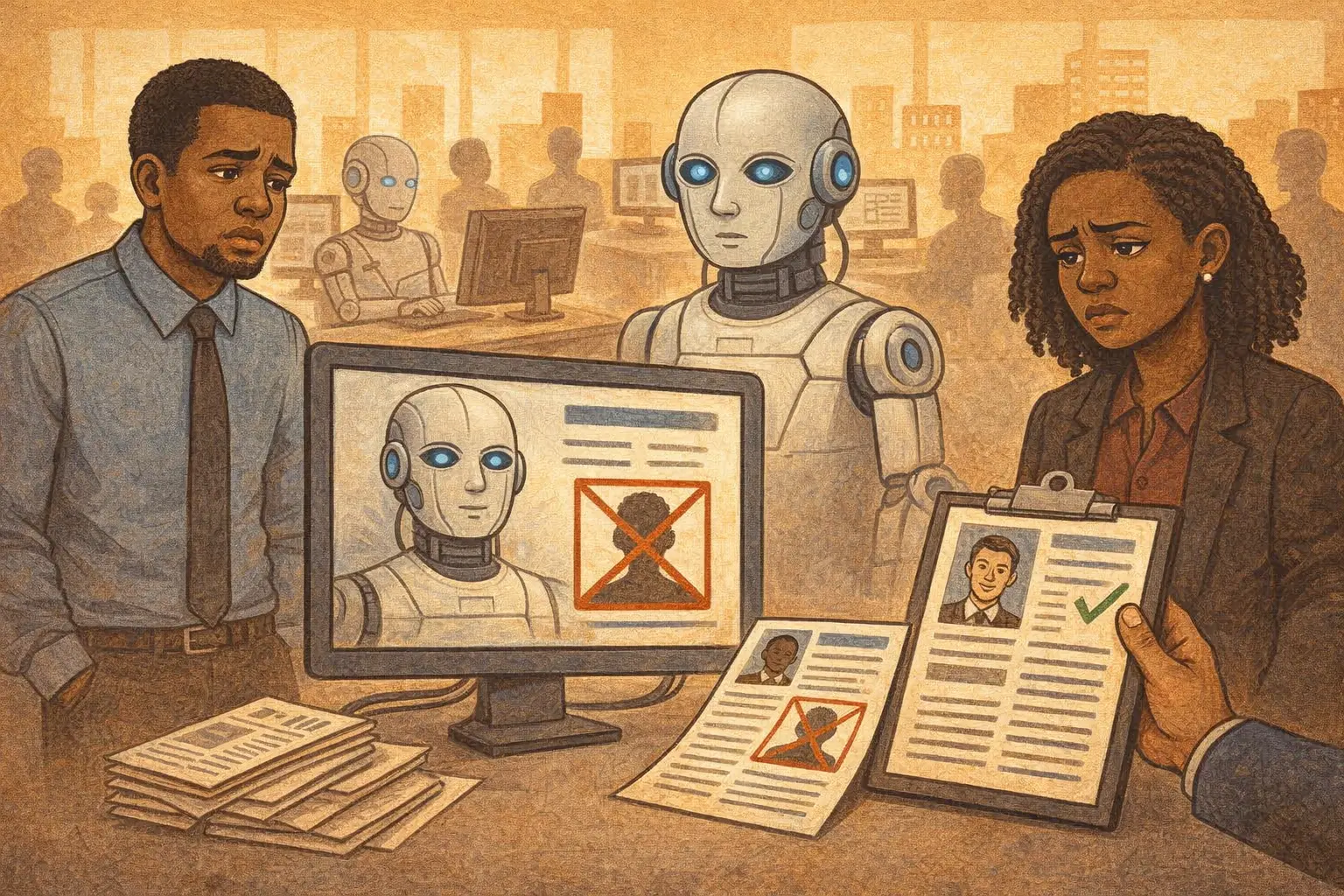
Stanford University’s Human-Centered Artificial Intelligence Institute (Stanford HAI) released in June the largest real-world study to date of AI hiring algorithms, finding that 26% of Black job applicants and 15% of Asian job applicants applied for positions where the AI screening system discriminated against the racial groups in a way that meets the definition of discrimination under the U.S. Equal Employment Opportunity Commission (EEOC) “four-fifths rule.” The most favored group is typically white job applicants.
The study tracks 3.4 million job seekers, 4 million applications, covering 150 employers across 11 industries
The study covers 3.4 million job seekers, 4 million applications, 1,700 jobs, 150 employers, and 11 industries, making it the largest real-world study of AI hiring algorithms currently in existence globally. The control group consists of 108 Fortune 500 companies and 83,000 applications; these companies did not use AI screening, and systematic “outright rejection” is almost nonexistent in the control group.
The EEOC “four-fifths rule” states that if a group’s selection rate for hiring recommendations is less than 80% of the selection rate of the highest-rate group, it constitutes a legal threshold for “adverse impact.” Based on this standard, the study finds that if Black and Asian job applicants were recommended at fair ratios, an additional 40,000 applications would be advanced to the human review stage.
The study also reveals the “numerical hiding mechanism” of discrimination: if recommendation rates across all jobs are mixed and averaged, discrimination nearly disappears in the numbers—for example, an AI system may favor recommending Black applicants for warehousing and logistics but not for financial roles; when these are combined, the overall average approaches a fairness baseline. Only by breaking down the analysis by job and by racial group can discrimination be made visible.
Concentrated algorithmic problems: 90% of U.S. employers use AI screening, Workday faces a class-action lawsuit
Among four companies using the same AI vendor, 10% of job applicants applied to all four companies but were rejected by all of them; this phenomenon is almost nonexistent in the control group that did not use AI screening. The researchers attribute this to “algorithmic monoculture”: the same set of algorithmic biases is deployed across hundreds of companies, systematically excluding certain groups of job seekers from the employment market, and job seekers usually have no way to know.
The researchers identified three high-risk characteristics that already exist in AI screening tools:
Pervasively Adopted: About 90% of U.S. employers have used them in hiring processes
Highly Consequential: They directly determine whether a job seeker can enter the human review stage
Opaque to the public: Job seekers cannot know whether they are filtered out by algorithms, and employers may not necessarily know the tools’ real performance across different job category types
Workday’s AI screening tool is currently facing a class-action lawsuit, with allegations covering discrimination based on race, age, and disability.
Colorado AI Act takes effect in June; the “reasonable care” standard is not yet clear
Colorado’s AI Act officially takes effect in June 2026. It is one of the few state-level pieces of legislation in the U.S. that clearly includes compliance requirements specifically for AI hiring tools, requiring developers to take “reasonable care” measures to prevent discrimination. However, the specific content of “reasonable care” and its enforcement mechanism still need to be established.
The research team notes that the premise for studies like this is access to data, while hiring data is often controlled by vendors and employers. The study also points out that the graduating class of 2026 is facing one of the toughest job markets in recent years: the number of applications for entry-level openings is 3 times that of 2022, and the share of AI screening tool usage is rising in parallel.
Frequently asked questions
What is the EEOC “four-fifths rule,” and how does this study use it to identify discrimination?
The “four-fifths rule” states that if a group’s hiring recommendation rate is lower than 80% of the highest-rate group’s hiring recommendation rate, it meets the legal threshold for “adverse impact.” The Stanford HAI study uses this standard to break down the AI screening data by job and by group. It finds that among 26% of Black job applicants applying for positions and 15% of Asian job applicants applying for positions, the AI system discriminated against the racial groups in a way that meets the definition above.
Why has AI hiring discrimination been difficult to detect in the past?
The core reason is the statistical “disappearance” of discrimination. When recommendation rates for all jobs are mixed and averaged, an AI system’s higher recommendation rate for one type of job can cancel out its lower recommendation rate for another type, pulling the overall average toward a fairness baseline. Only through fine-grained analysis by job and by group—like the Stanford HAI study—can discrimination emerge from the numbers.
What are the specific requirements of the Colorado AI Act for AI hiring tools?
The Colorado AI Act took effect in June 2026 and requires developers of AI hiring tools to take “reasonable care” measures to prevent discrimination. This makes it one of the few AI hiring laws at the state level in the U.S. that has already gone into effect. The bill’s specific “reasonable care” standards and corresponding enforcement mechanisms still await further clarification by the relevant regulatory authorities.


