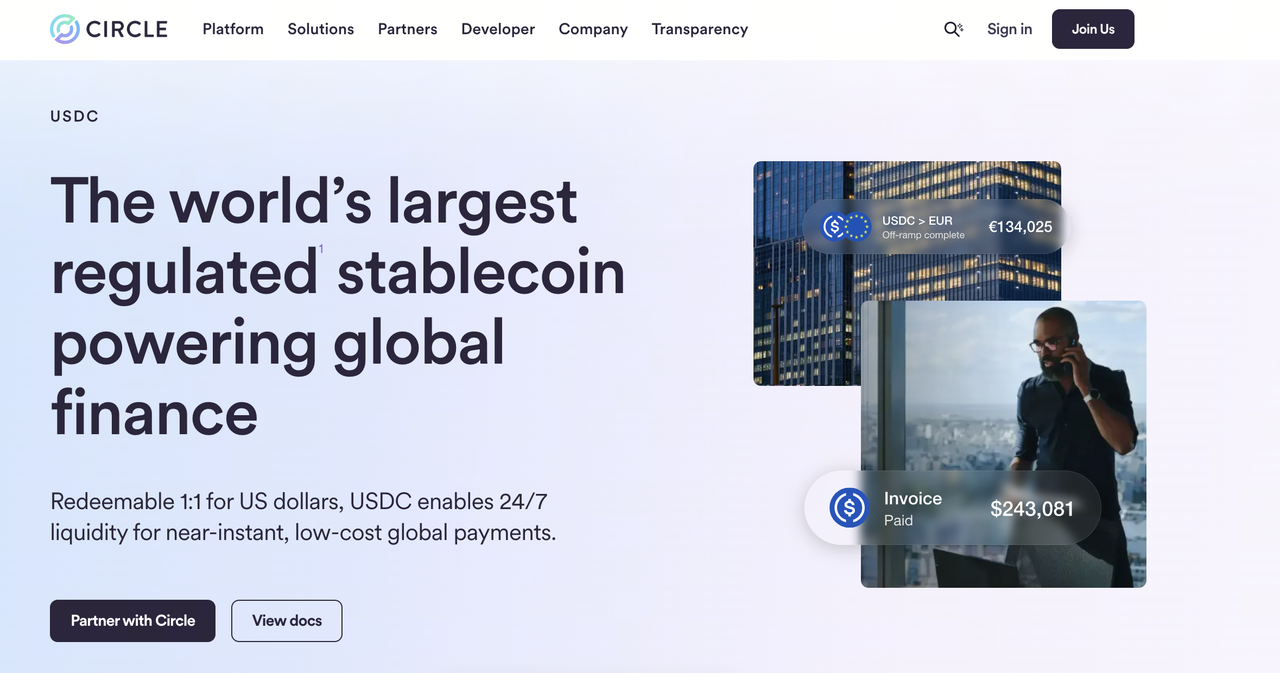
 Source: USDC Official Website
In the crypto market, the vast majority of prices, positions, and contracts ultimately rely on some form of "unit of account and settlement" for interpretation. This unit is often not a direct on-chain representation of sovereign currencies, but rather tokens pegged to the price of the US dollar (or other fiat currencies)—commonly referred to as stablecoins. Lesson 1 does not discuss which type of stablecoin is "better," but instead answers three more fundamental questions: why stablecoins emerged, what functions they serve in the ecosystem, and why having "stable" in the name does not mean their risk structures are the same.
1. Stablecoins Solve "Valuation and Circulation," Not "Volatility"
The design goal of native crypto assets like Bitcoin is not to become a daily unit of account, but to serve as a decentralized medium for value transfer and storage. Their price volatility means that, for short-term settlements, leveraged margin, market making quotes, and other uses, a more stable reference is needed.
The core functions of stablecoins can be summarized in four categories:
-
The "Dollar Substitute" for Trading and Derivatives Settlement: On both centralized and decentralized exchanges, USDT, USDC, and similar stablecoins are often used as quote currencies, margin assets, and units for P&L settlement. Traders can hold purchasing power in stablecoins without converting back to bank fiat every time they rebalance.
-
Medium for On-Chain Payments and Transfers: Compared to traditional cross-border wire transfers, on-chain stablecoin transfers offer advantages in speed and programmability (while also involving chain selection, compliance, and counterparty risk—these will be discussed in later lessons).
-
The Collateral and Liquidity Foundation of DeFi: Lending, market making, derivatives, and yield strategies heavily rely on stablecoins as collateral, debt units, or one side of liquidity pools. The credit quality of stablecoins directly transmits to systemic risk in DeF1.
-
A "Temporary Safe Harbor" During Shifts in Risk Appetite: During periods of high market volatility, funds often flow from high-risk assets into stablecoins as a form of "risk-off"—but note: this is shifting from coin-denominated risk to issuer credit and depegging risk, not to risk-free cash.
Therefore, stablecoins are not tools to "eliminate crypto volatility," but foundational infrastructure that allows the crypto market to operate with acceptable valuation stability.
2. "Pegged to $1" Has Three Distinct Meanings
A common phrase in the market is stable = 1 USD. Mechanistically, however, there are at least three different types of "pegs":
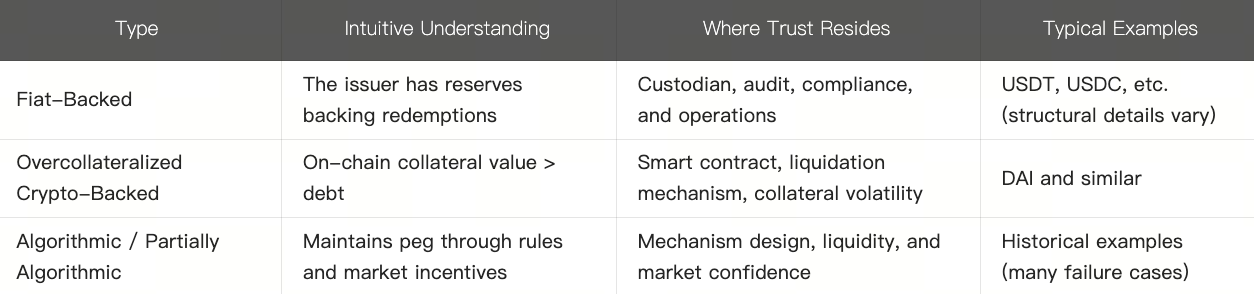
The "typical representatives" in the same table are only for intuitive understanding and do not mean their mechanisms are identical. For example, USDT and USDC differ significantly in reserve transparency, regulatory paths, and freeze permissions; DAI has also evolved to include RWA and hybrid collateral with centralized stablecoins. Lesson 2 will provide a detailed breakdown.
For Lesson 1, just remember: "Stablecoin" is a product category label—not a uniform security rating.
3. Why Does Crypto Especially Rely on a "Dollar Anchor" Instead of a "Euro Anchor" or "Gold Anchor"?
In practice, dollar-pegged stablecoins dominate for several reasons:
-
The global tradition of pricing foreign exchange and commodities in dollars;
-
The deepest liquidity is in dollars; OTC, institutional, and cross-border settlements are accustomed to using USD;
-
Early crypto infrastructure and trading pairs centered on USDT and similar tokens, creating path dependency;
-
Risk parameters for DeFi and centralized platforms have long been built around dollar stablecoins.
There are euro-pegged stablecoins, Singapore dollar-pegged stablecoins, and tokenized gold attempts, but these represent a much smaller share in mainstream trading and DeF1. For learners, the key is not to memorize all fiat-pegged varieties but to understand that network effects of dominant currencies amplify the systemic impact of their credit events—this is one reason why fluctuations in USDT or USDC often affect the entire market.
4. Comparing Stablecoins with "Bank Deposits" and "Money Market Funds": Where the Analogy Ends
For easier understanding, stablecoins are often compared to bank deposits or money market funds—but there are clear boundaries to this analogy:
Similarities
-
All pursue nominal value stability;
-
All can serve as short-term value storage and payment mediums;
-
All depend on the credit behind the issuer or mechanism.
Key Differences
-
Deposit insurance and regulatory frameworks (which vary by country and product) are not equivalent to on-chain stablecoin rules;
-
On-chain transfers are irreversible; address errors cannot be undone;
-
Blacklisting and on-chain freezing are real features for some centralized stablecoins;
-
There may be no "lender of last resort" during depegging—market confidence relies on arbitrage and reserve disclosure; recovery can be rapid or slow.
Treating stablecoins as "on-chain dollar cash" works operationally; from a risk perspective, their issuance structure, chain, compliance, and liquidity must be carefully considered.
5. Roles Within the Ecosystem: Who Uses Stablecoins and How?
-
Traders: Use stablecoins as margin collateral, units of account, and short-term position containers; focus on liquidity, withdrawal channels, and platform support.
-
Long-term Holders: May use stablecoins to avoid price volatility but assume issuer credit and depegging risks; must distinguish between "risk-off" and "risk-free."
-
DeFi Participants: Deposit stablecoins into lending protocols, LPs, or yield aggregators; risks extend from issuer credit to smart contract, collateral, and strategy risks.
-
Cross-Border Payments & Merchants: Focus on settlement speed, fees, compliance, and rejection risk; boundaries with licensed payment products (like gateways) require separate understanding.
-
Institutions & Market Makers: Focus on minting/redemption channels, large OTC deals, audits, and custody disclosures; sensitive to on-chain supply and reserve changes.
The risk checklist for the same token varies by role. Lesson 6 will connect "token selection" with specific roles.
6. Three Core Understandings for Lesson 1
Understanding 1: Stablecoins Are Infrastructure—Not Homogeneous Assets
Selection must return to mechanism and trust assumptions—not just ticker or market cap ranking.
Understanding 2: Pegging Is a Goal—Not a Guarantee
$1 is maintained jointly by market price and mechanism; deviations may occur during stress periods, with differences in magnitude and duration across coins.
Understanding 3: Stablecoins Also Have a "Total Cost"
Holding and transferring involve chain fees, gas costs, exchange spreads, approvals, and opportunity cost; "nominal stability" does not mean "zero usage cost."
Summary
The core conclusions from Lesson 1 are as follows. First, stablecoins are foundational infrastructure for valuation, settlement, DeFi collateralization, and risk management in crypto—their value lies in circulation efficiency rather than eliminating volatility itself. Second, being "pegged to USD" corresponds to fundamentally different trust structures—fiat-backed collateralization, over-collateralization, algorithms—and should not be conflated due to similar names. Third, the dominance of dollar stablecoins comes from global liquidity and path dependence—making their credit events systemically significant. Fourth, analogies with bank deposits help understanding but differences such as on-chain irreversibility, freeze permissions, and depegging mechanisms must be included in risk assessments. With this framework established, we can move to Lesson 2 for an in-depth analysis of specific mechanisms.