The first three lessons covered credit and pegging; the fourth lesson focuses on usage costs. Many holders treat USDT and USDC as "$1 cash," but encounter reduced credited amounts, wrong path selection, soaring gas fees, or slippage even when exchanging between stablecoins during cross-chain transfers, withdrawals, exchanges, and on-chain operations. The goal of this session is to break down the total holding cost of stablecoins into verifiable items, making it easier to include in decision-making during selection and portfolio composition, rather than just comparing "which is closer to $1."
1. Stablecoin Costs Go Beyond the "Issuer": A Comprehensive Ledger
The costs involved in a single "stablecoin use from A to B" can be summarized as:
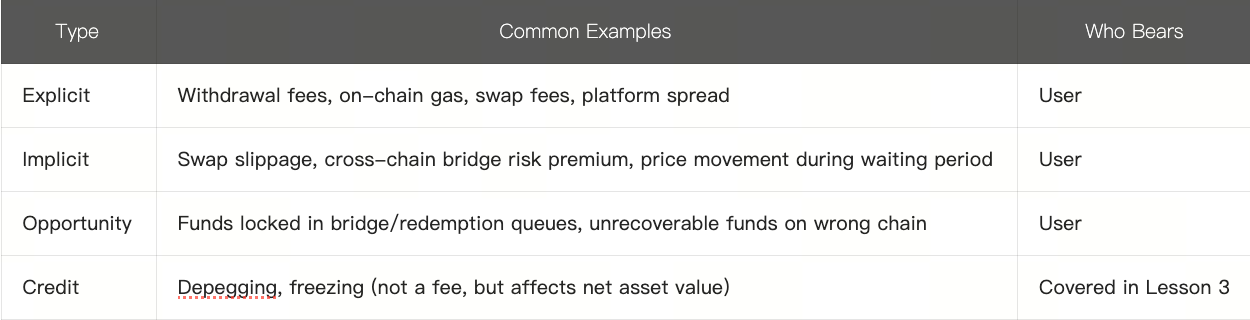
Actual purchasing power ≈ Nominal face value − various fees − slippage/spread loss − de-pegging loss (if any)
Thus, two stablecoins both pegged to the dollar can have very different real costs depending on the chain and platform.
2. Multi-Chain Issuance: Same Token, Different Chains, Different Risks and Costs
USDT, USDC, etc. circulate on multiple chains like Ethereum, Tron, BSC, Arbitrum, Solana, etc. Key points to note:
1. Different Contract Addresses
The same ticker is a different contract on each chain; transferring to the wrong chain or address may result in inaccessible assets (recovery depends on platform policy; do not assume assets can always be retrieved).
2. Different Liquidity and Depth
Main chains (such as Ethereum) usually have greater depth but higher gas fees; side chains/L2s offer lower gas but more complex bridging and exit paths, and some exchanges may not support certain chains yet.
Selecting the wrong network when withdrawing from a centralized exchange is a common mistake. Teaching principle: Before withdrawing, verify the network, address, and memo (if needed).
4. "Local De-Pegging" Due to Chain Isolation
When a chain bridge is congested or liquidity dries up, stablecoins on that chain may trade at a discount or premium compared to other chains—a manifestation of friction costs, not necessarily global credit collapse.
3. Cross-Chain: Bridges, Official Cross-Chain Channels, and CEX Transfers
Cross-Chain Bridges
Transferring assets from chain A to chain B typically involves locking/burning, validation, minting/releasing. Costs and risks include:
-
Fees (bridge fee + gas on both sides)
-
Time (minutes to hours; longer during congestion)
-
Smart contract and validator risk (bridges have been attacked historically)
-
Limits and KYC (some bridges restrict large amounts)
Official/Issuer Cross-Chain Channels
Some stablecoin issuers or partners provide official cross-chain channels with different rules than third-party bridges; always check supported chains, minimum amounts, and arrival times.
CEX Transfers (Common Practical Path)
Deposit on chain A to exchange → internal transfer → withdraw to chain B. Costs include deposit confirmation time, withdrawal fees, whether the platform supports the chain. The advantage is mature routes; the trade-off is centralized counterparties and withdrawal review.
Teaching Conclusion
There is no "free cross-chain"; when choosing a path, compare fees, time, security history, and certainty of funds arrival.
4. Exchange Friction: Stablecoin-to-Stablecoin Is Not Always 1:1
Holders often believe USDT can always be exchanged for USDC at 1:1. In reality:
1. Trading Pairs and Depth
USDT/USDC spot markets are usually close to 1 most of the time but can diverge under stress; large trades still incur slippage.
2. DEX Pools
Stablecoin pools (like 3pool) may become imbalanced or receive de-pegged coins in extreme market conditions, worsening exchange rates; LPs also face impermanent loss (covered in Lesson 5 on DeFi wrapping).
3. Aggregator Routes
Multi-hop routing may involve intermediary tokens, increasing gas and price risk.
4. Fiat On/Off-Ramps
OTC, bank cards, P2P channels have exchange rates, fees, limits, and compliance costs unrelated to on-chain 1:1 rates.
Therefore, "switching to another stablecoin" should account for exchange cost + time cost, especially during de-pegging or panic periods.
5. Gas and On-Chain Operations: "Proportional Tax" for Small Transfers
On high-gas chains like Ethereum mainnet, transferring 10 USDT can incur a disproportionately high gas cost; on chains like Tron, energy/bandwidth mechanisms differ with different cost structures.
Influencing Factors
-
Network congestion
-
Contract transfers vs native transfers (ERC-20 is usually more expensive)
-
Two-step cost of authorization (Approve) and subsequent actions
-
L2s have low gas but bridging in/out costs must be allocated
Strategic Implications
-
Frequent on-chain micro adjustments during high gas periods incur heavy friction
-
Batch operations, choosing L2s or chains with lower gas is part of cost management—not stinginess but net yield management
Even without cross-chain transfers, within exchanges or payment products there may be:
-
Deposit/withdrawal limits and approval waiting
-
Internal exchange spread
-
Minimum withdrawal fee for small amounts
-
Increased withdrawal fee for specific chains (due to congestion or policy)
-
Temporary fund freezes or risk control blocking (not a fee but affects liquidity)
When used as margin collateral, also note: whether the platform discounts certain stablecoins in margin calculations or suspends them as collateral—this is a trading rule cost unrelated to on-chain gas.
V2. How to Factor Costs into Selection: Three Practical Principles
Principle 1: Choose Chains Based on Usage
-
Long-term storage: prioritize chains/tokens with good depth and clear redemption paths
-
High-frequency DeFi: prioritize gas costs and protocol concentration
-
Cross-border transfers: compare arrival time and total fees—not just the ticker
Principle 2: Minimize Conversion Steps
Each additional "chain swap, token swap, platform switch" adds another layer of fees and operational risk. Portfolios should aim for direct arrival at target chain/platform.
Principle 3: Assume Increased Friction During Stress Periods
During de-pegging or congestion periods, gas, slippage, bridge time may all worsen; net loss from "market-price swapping" can exceed apparent spread (links with Lesson 3 discipline).
Summary
Lesson 4 emphasizes: Stablecoins are "stable" in their peg target—not in zero cost. Total costs include withdrawal fees, gas fees, exchange fees, slippage, cross-chain bridge time/risk, platform spreads, and operational risks like wrong chain selection. Multi-chain issuance makes the same ticker operate in different execution environments across chains; cross-chain transfers require comparison of bridge channels, official routes, and CEX transfer total costs. Exchanging stablecoins during stress periods may result in losses; small transactions on high-gas chains face disproportionately high friction. Factoring costs into selection and route planning completes the decision chain together with Lesson 3's de-pegging monitoring and Lesson 5's yield packaging. The next lesson will discuss yield-generating stablecoins and DeFi packaging: where yields come from and which layers risks accumulate.