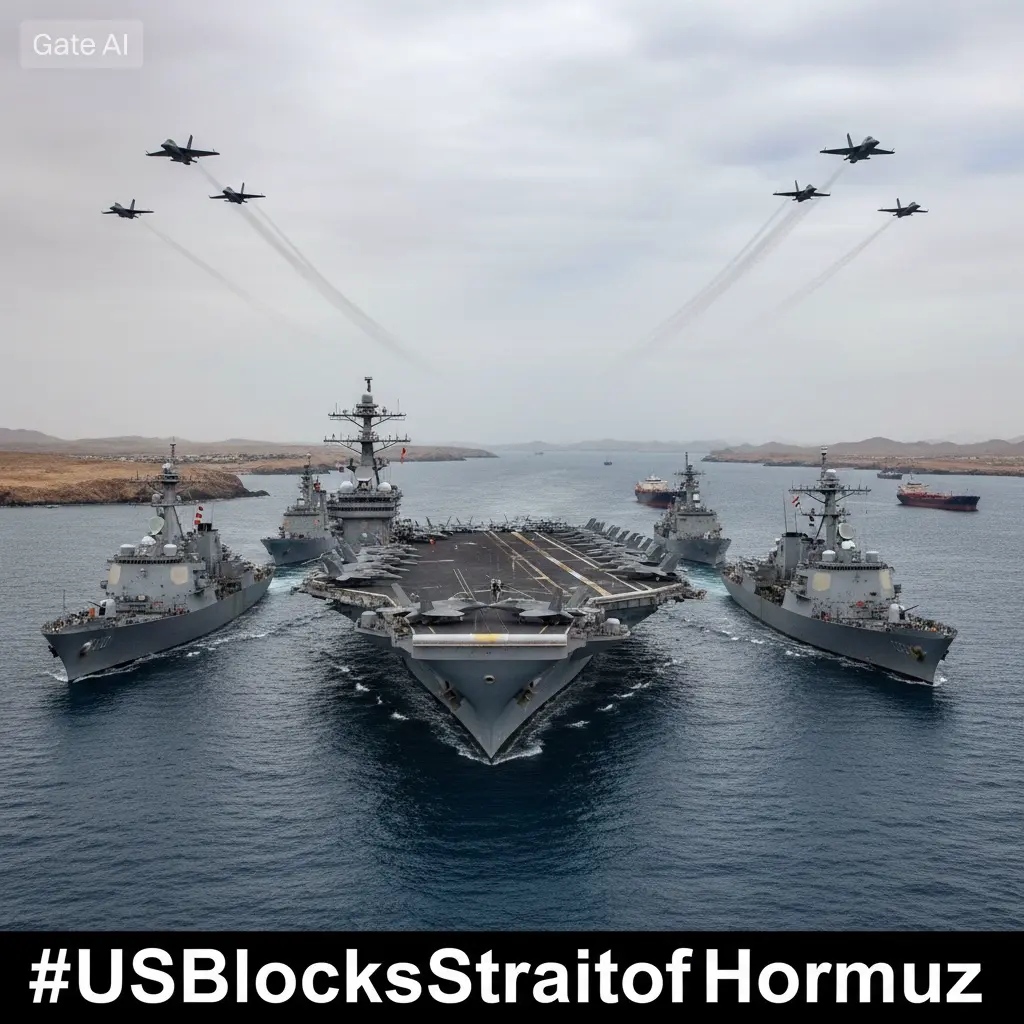
#USBlocksStraitofHormuz
April 2026 is rapidly shaping into one of those rare macro turning points where geopolitics, energy markets, and digital assets are no longer separate narratives—they are converging into a single global story.
The reported U.S. pressure around the Strait of Hormuz is not just about regional control. It represents a direct challenge to one of the most critical arteries of global trade. Nearly one-fifth of the world’s oil supply moves through this narrow passage. Any disruption—even perceived—forces markets to react instantly, not rationally.
⚡ The Hidden Layer: Shipping & Supply Chain Shock
Beyond oil prices, a deeper disruption is already unfolding in global logistics. Tanker rerouting, rising insurance costs, and extended delivery times are beginning to stress supply chains. This doesn't just affect crude—it impacts refined fuels, petrochemicals, and even food supply chains dependent on energy inputs.
As shipping risk premiums climb, global trade slows down. And when trade slows, growth expectations weaken. This creates a dangerous mix: slowing growth + rising costs = stagflation pressure.
💰 Central Banks Are Now Trapped
Central banks, especially the Federal Reserve, now face a tightening dilemma. Inflation driven by energy is not something interest rates can easily fix.
Cut rates → risk fueling inflation further
Raise rates → risk crushing already fragile growth
This “policy trap” historically leads to prolonged uncertainty in financial markets. Liquidity becomes selective, not abundant.
📉 Liquidity Rotation Is Already Happening
Global capital is quietly rotating:
From emerging markets → into safe-haven currencies
From equities → into commodities and defensive assets
From high-risk crypto positions → into stablecoins
This explains why even strong crypto setups fail during macro shocks. It’s not weakness—it’s capital repositioning.
🪙 Bitcoin’s Dual Identity Is Being Tested
Bitcoin is once again caught between two roles:
Risk Asset (Short-Term)
In the immediate phase, Bitcoin behaves like tech stocks—sensitive to liquidity withdrawals.
→ Result: volatility, sharp drops, liquidation events
Macro Hedge (Long-Term)
As inflation persists and trust in fiat weakens, Bitcoin’s fixed supply becomes more relevant.
→ Result: gradual accumulation by institutions and smart money
This duality is why Bitcoin often drops before it rises in crisis cycles.
🌍 The Rise of “Parallel Finance”
One of the most under-discussed effects of geopolitical tension is the acceleration of parallel financial systems.
Stablecoins like Tether and USD Coin become critical in regions facing banking restrictions
Cross-border payments shift from SWIFT to blockchain rails
DeFi platforms see increased adoption in high-risk jurisdictions
This is not speculation—it’s survival behavior. When traditional systems restrict access, people move to permissionless alternatives.
🧠 Institutional Strategy Shift
Large institutions are not reacting emotionally—they are positioning structurally:
Increasing exposure to energy and commodities
Hedging currency risk via gold and digital assets
Gradually building crypto positions during dips
This silent accumulation phase often goes unnoticed by retail traders focused on short-term price action.
📊 What Comes Next? (3-Phase Market Structure)
1. Shock Phase (Already Happened)
Oil spike
Crypto sell-off
Volatility explosion
2. Uncertainty Phase (Current Stage)
Sideways markets
Fake breakouts
News-driven moves
3. Reallocation Phase (Coming Next)
Strong assets separate from weak ones
Bitcoin regains strength if macro instability persists
Capital flows into alternative systems
🔑 The Real Takeaway
This is not just about oil.
This is not just about war.
This is about control vs decentralization.
The more pressure traditional systems face, the stronger the long-term case becomes for crypto—not as speculation, but as infrastructure.
Markets may remain unstable in the short term, but structurally, this type of crisis often accelerates adoption rather than destroys it.
If escalation continues around the Strait of Hormuz, expect deeper liquidity stress, higher inflation, and stronger narratives for decentralized finance.
If de-escalation occurs, markets will recover—but the shift in perception toward crypto will not reverse.
Either way, April 2026 is no longer just another month in the market cycle.
It is becoming a macro reset moment.
#CreatorCarnival #Gate13周年 #GateSquareAprilPostingChallenge
April 2026 is rapidly shaping into one of those rare macro turning points where geopolitics, energy markets, and digital assets are no longer separate narratives—they are converging into a single global story.
The reported U.S. pressure around the Strait of Hormuz is not just about regional control. It represents a direct challenge to one of the most critical arteries of global trade. Nearly one-fifth of the world’s oil supply moves through this narrow passage. Any disruption—even perceived—forces markets to react instantly, not rationally.
⚡ The Hidden Layer: Shipping & Supply Chain Shock
Beyond oil prices, a deeper disruption is already unfolding in global logistics. Tanker rerouting, rising insurance costs, and extended delivery times are beginning to stress supply chains. This doesn't just affect crude—it impacts refined fuels, petrochemicals, and even food supply chains dependent on energy inputs.
As shipping risk premiums climb, global trade slows down. And when trade slows, growth expectations weaken. This creates a dangerous mix: slowing growth + rising costs = stagflation pressure.
💰 Central Banks Are Now Trapped
Central banks, especially the Federal Reserve, now face a tightening dilemma. Inflation driven by energy is not something interest rates can easily fix.
Cut rates → risk fueling inflation further
Raise rates → risk crushing already fragile growth
This “policy trap” historically leads to prolonged uncertainty in financial markets. Liquidity becomes selective, not abundant.
📉 Liquidity Rotation Is Already Happening
Global capital is quietly rotating:
From emerging markets → into safe-haven currencies
From equities → into commodities and defensive assets
From high-risk crypto positions → into stablecoins
This explains why even strong crypto setups fail during macro shocks. It’s not weakness—it’s capital repositioning.
🪙 Bitcoin’s Dual Identity Is Being Tested
Bitcoin is once again caught between two roles:
Risk Asset (Short-Term)
In the immediate phase, Bitcoin behaves like tech stocks—sensitive to liquidity withdrawals.
→ Result: volatility, sharp drops, liquidation events
Macro Hedge (Long-Term)
As inflation persists and trust in fiat weakens, Bitcoin’s fixed supply becomes more relevant.
→ Result: gradual accumulation by institutions and smart money
This duality is why Bitcoin often drops before it rises in crisis cycles.
🌍 The Rise of “Parallel Finance”
One of the most under-discussed effects of geopolitical tension is the acceleration of parallel financial systems.
Stablecoins like Tether and USD Coin become critical in regions facing banking restrictions
Cross-border payments shift from SWIFT to blockchain rails
DeFi platforms see increased adoption in high-risk jurisdictions
This is not speculation—it’s survival behavior. When traditional systems restrict access, people move to permissionless alternatives.
🧠 Institutional Strategy Shift
Large institutions are not reacting emotionally—they are positioning structurally:
Increasing exposure to energy and commodities
Hedging currency risk via gold and digital assets
Gradually building crypto positions during dips
This silent accumulation phase often goes unnoticed by retail traders focused on short-term price action.
📊 What Comes Next? (3-Phase Market Structure)
1. Shock Phase (Already Happened)
Oil spike
Crypto sell-off
Volatility explosion
2. Uncertainty Phase (Current Stage)
Sideways markets
Fake breakouts
News-driven moves
3. Reallocation Phase (Coming Next)
Strong assets separate from weak ones
Bitcoin regains strength if macro instability persists
Capital flows into alternative systems
🔑 The Real Takeaway
This is not just about oil.
This is not just about war.
This is about control vs decentralization.
The more pressure traditional systems face, the stronger the long-term case becomes for crypto—not as speculation, but as infrastructure.
Markets may remain unstable in the short term, but structurally, this type of crisis often accelerates adoption rather than destroys it.
If escalation continues around the Strait of Hormuz, expect deeper liquidity stress, higher inflation, and stronger narratives for decentralized finance.
If de-escalation occurs, markets will recover—but the shift in perception toward crypto will not reverse.
Either way, April 2026 is no longer just another month in the market cycle.
It is becoming a macro reset moment.
#CreatorCarnival #Gate13周年 #GateSquareAprilPostingChallenge