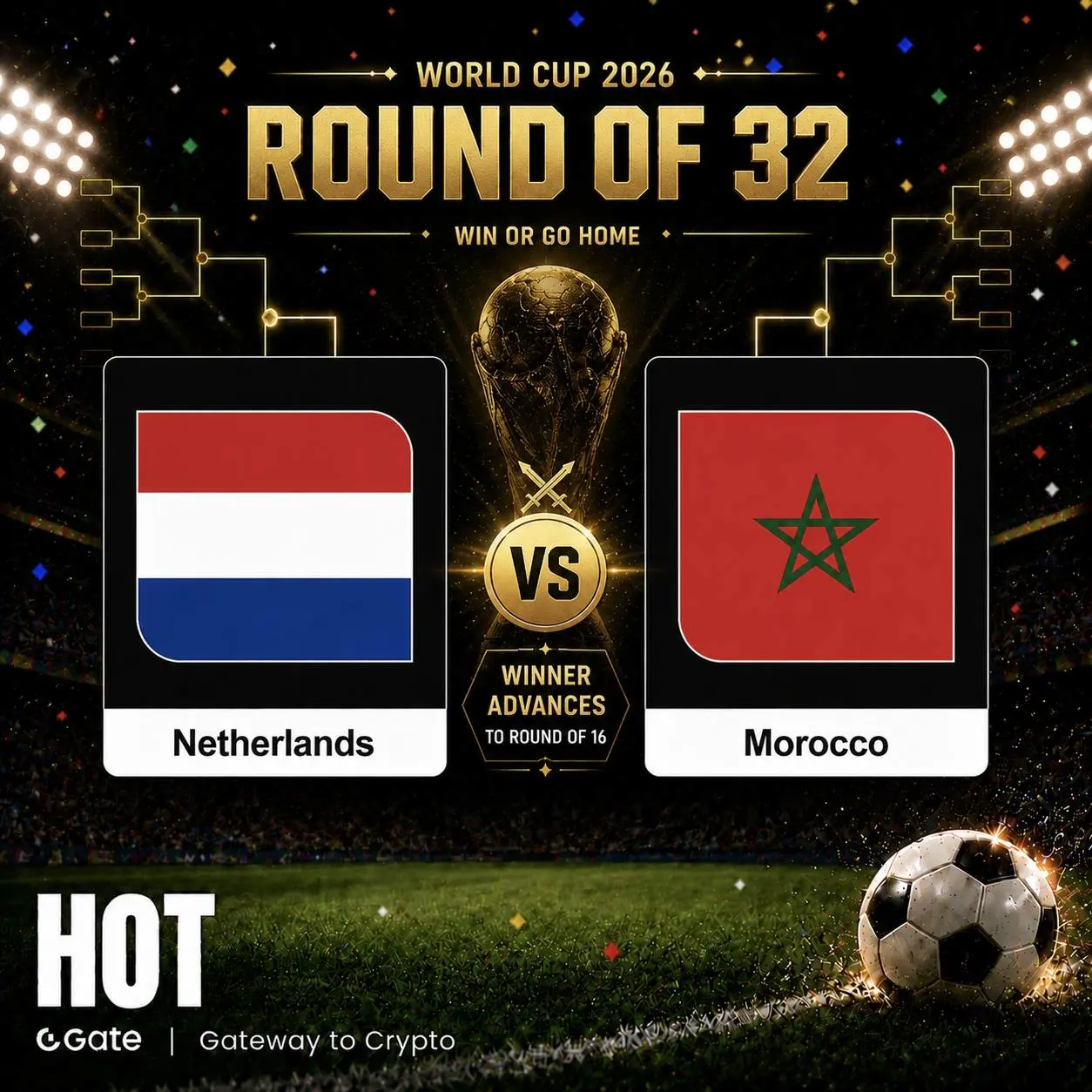
From the pricing logic of the prediction market, combined with the group stage performances, tactical systems, and key player form of both teams, we break down the signal meaning behind the 43%-32%-27% structure and explore whether there are mispriced trading opportunities.
Market Structure: 43% Is Not a "Favorite" but a "Signal"
The 43% Netherlands win rate given by the Gate Prediction Market first needs to be correctly understood.
In the pricing system of prediction markets, probability itself does not directly equal "strength assessment" — it is the collective judgment of market participants expressed with real money on the likelihood of an event occurring. 43% means: the market believes the probability of the Netherlands winning in regular time is slightly below 50%. This is not the pricing that a dominant favorite should have. For reference, in the concurrent match Brazil vs Japan, Brazil's win rate was priced at 58% — that is where a "strong favorite" structure should be.
A more accurate definition of 43% is a "Soft Favorite": the market acknowledges that the Netherlands has a slight edge on paper, but this edge is far from constituting confidence. This signal is highly consistent with the group stage performances of both teams — although the Netherlands scored 10 goals, tying with Germany and France for the most goals in the group stage, their defense has not kept a single clean sheet in seven matches so far in 2026; Morocco, on the other hand, drew 1-1 with Brazil in the group stage, showing their ability to compete with top teams.
The core message conveyed by 43% is: the market has a systematic doubt about the Netherlands' attacking efficiency. The Netherlands has one of the strongest attacks in the group stage, but persistent defensive vulnerabilities significantly dilute the certainty of a "win" outcome.
Draw at 32%: A Structural Signal of Systematic Overpricing
32% is the most noteworthy number in this data set.
In football, the long-term historical probability of a draw in regular time is typically around 25%. 32% means the market has systematically raised the draw probability by about 7 percentage points. This premium is not random fluctuation but a collective market judgment on the match's structure.
Three factors jointly push up the implied probability of a draw:
First, tactical matchup. The Netherlands adheres to a possession-based 4-3-3 system, emphasizing wing attacks and midfield control; Morocco uses defensive counterattacks as its core weapon, with players like Achraf Hakimi and Brahim Díaz possessing top-level transition speed. This "possession vs counterattack" matchup structure naturally leans toward low-scoring, highly contested matches.
Second, highly symmetrical group stage data. Both teams have 7 points, with a minimal goal difference. Opta's supercomputer, in 25,000 pre-match simulations, gave the Netherlands a 47.6% win rate and Morocco 25.0% — very close to the 43%-27% structure of the Gate Prediction Market. Cross-validation from multiple independent models indicates that the high weight on the draw is not an isolated pricing anomaly.
Third, psychological factors in knockout stages. The Round of 32 knockout stage leaves no room for error. For Morocco, dragging the match into extra time or even penalties is a viable strategy; for the Netherlands, facing a team with sharp counterattacks, overcommitting means exposing defensive gaps. This two-way risk aversion further pushes up the market price of a draw.
The 32% draw probability can thus be interpreted as a "tug-of-war model" signal — the market expects the match to unfold at a low pace, with few goals and high physical confrontation.
Morocco at 27%: Underrated or Fairly Priced?
The Gate Prediction Market gives Morocco a 27% win rate — this is neither an upset (usually considered below 20%) nor completely ignored by the market (if ignored, the probability would be below 15%).
27% means the market recognizes that Morocco has the following abilities: keeping the match in a low-score range, creating chances through set pieces or transition attacks, and maintaining sufficient defensive discipline. Morocco's group stage performances validated these abilities — drawing 1-1 with Brazil, beating Scotland 1-0, and defeating Haiti 4-2 — but also exposed defensive instability under sustained pressure.
The pricing logic of 27% can be understood as: Morocco is given the weight of a "spoiler" but not the "initiative." The market believes Morocco can make the match difficult but does not believe they can actively control the match's flow. This judgment aligns with the tactical approach of Morocco's coach, Mohamed Ouahbi — he rotated the squad in the last group stage match against Haiti to preserve energy for the knockout stage, but his tactical system is essentially "adapting to the opponent" rather than "dominating the match."
Trading Logic of the Three-Way Structure
The 43%-32%-27% pricing structure offers three different trading perspectives for market participants:
Anti-draw trade. If you believe the 32% draw probability is systematically overestimated — i.e., the match is more likely to have a winner in regular time — then the strategic direction leans toward a Netherlands win or Morocco win. The core assumption of this strategy is that the market has overpriced the "stalemate" scenario and underestimated the possibility of one side resolving the match in regular time. For every 1 percentage point downward revision in draw probability, the implied probabilities of a Netherlands win and Morocco win rise correspondingly.
Netherlands as a "risky favorite." The 43% win rate means the Netherlands is not a direction to take a "heavy position." Even if the market pricing is accurate, the Netherlands' chance of winning in regular time is less than half. For participants seeking directional exposure, the Netherlands' odds structure offers positive expected value — but only if one agrees with the judgment that "the Netherlands' attacking firepower is enough to cover its defensive vulnerabilities."
Morocco's low-probability value. The 27% win rate is suitable for small position, high-odds structural allocations. Morocco's "low probability, high odds" characteristic does not stem from the market misjudging its strength, but from the natural ceiling of its tactical system — counterattacking teams' win rates are typically systematically depressed because "winning via counterattacks" is itself a low-probability event.
Gate Prediction Market: Participate in World Cup Match Predictions
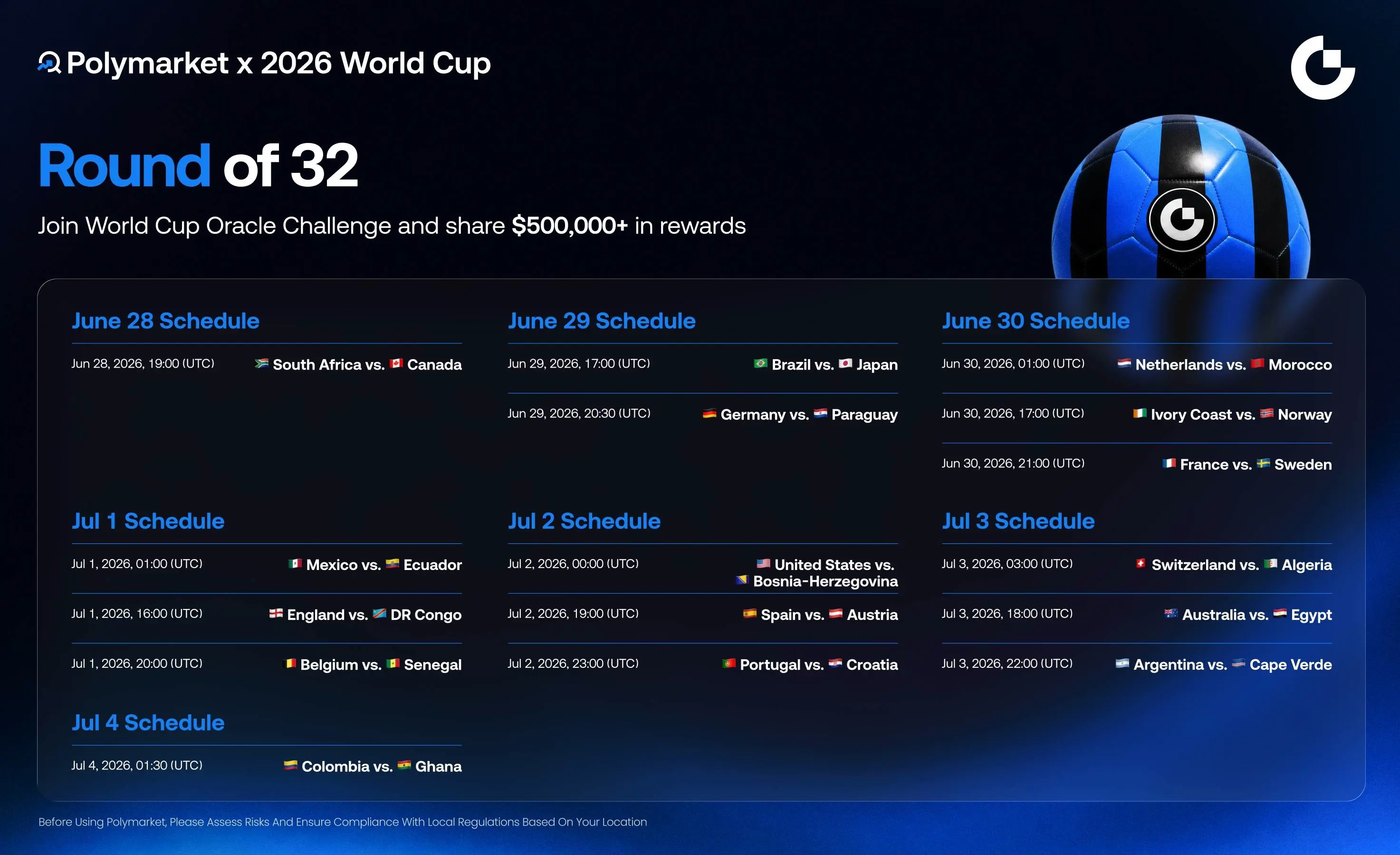
The Gate Prediction Market has built daily prediction challenges spanning the entire 2026 World Cup tournament. On June 30, the featured match is Brazil vs Japan (01:00 UTC+8).
During the event, users who participate in daily featured match predictions are eligible for rewards — no need to predict correctly; simply complete a prediction trade of no less than 50 USDT to receive a 10 USDT reward (limited to the first 100 users per day). New users participating in the Gate Prediction Market for the first time, after completing a prediction on any World Cup featured match with a trade volume of no less than 20 USDT, can receive a 10 USDT new user reward. Additionally, users whose cumulative World Cup prediction trade volume reaches 500 USDT will automatically qualify for the lucky draw, sharing a 5,000 USDT prize pool.
The core mechanism of the prediction market is to convert "whether an event will occur" into tradable probability contracts. Users express their views on an outcome by buying "Yes" or "No" shares, with share prices reflecting the market's collective judgment in real time.
Source: Gate 预测市场
FAQ
Q: What does the 43%-32%-27% pricing in the Gate Prediction Market mean?
It means the market believes the probability of the Netherlands winning in regular time is 43%, a draw is 32%, and Morocco winning is 27%. 43% is a "soft favorite" rather than a dominant favorite; the 32% draw probability is significantly higher than the historical baseline, suggesting the market expects a low-scoring, highly contested tug-of-war match.
Q: Is the 32% draw overestimated?
This requires an independent judgment. Arguments for "overestimated" include that the historical baseline for draws in football is about 25%, so 32% represents a premium of about 7 percentage points. Arguments for "reasonable" include the tactical matchup (possession vs counterattack), highly symmetrical group stage data (both on 7 points), and two-way risk aversion in knockout stages. The current market pricing is the result of these factors combined.
Q: What does Morocco's 27% win rate mean?
27% means Morocco is seen by the market as a "competitive challenger" rather than an "upset." This probability reflects the market's recognition of Morocco's defensive resilience, counterattack speed, and set-piece ability, but also indicates that the market does not believe Morocco can actively control the match's flow.
Q: How to participate in the World Cup events on the Gate Prediction Market?
Users need to register and complete identity verification on the Gate platform, enter the "Prediction Market (Prediction Market)" section, select World Cup-related markets, and use USDT to make prediction trades. During the event, participating in daily featured match predictions and meeting the trade volume requirements will qualify for rewards.