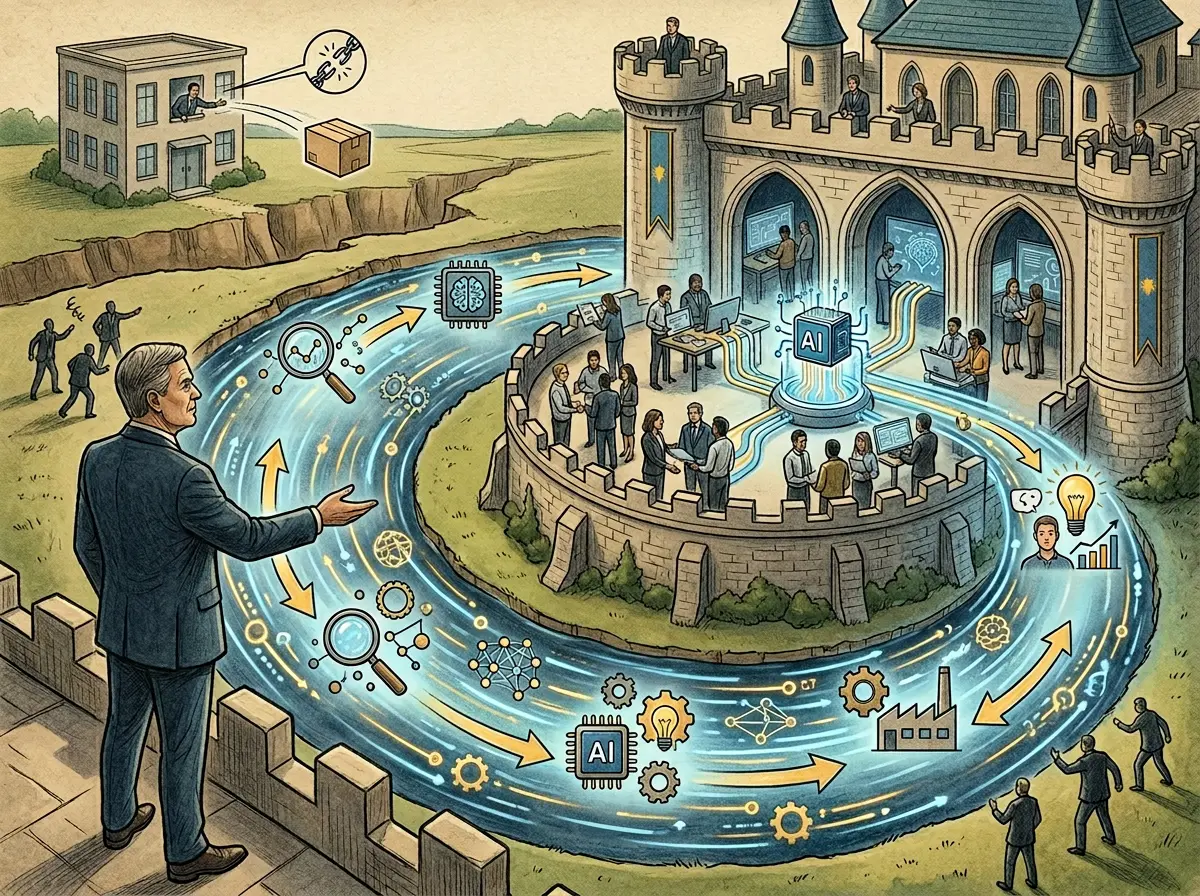
Microsoft CEO Satya Nadella published a personal article titled “Unstable at the Frontier Without an Ecosystem” on June 15, arguing that in the AI era, a company’s real competitive moat is not about choosing which model, but about whether it can build a learning loop in which human capital and AI capabilities continuously reinforce each other. She said: “You can outsource tasks, and even outsource work, but you can never outsource your own learning.”
Nadella’s Core Framework: Human Capital and Token Capital
The framework Nadella proposed in the article defines (all of the following are Nadella’s personal frameworks, not common industry definitions):
Human Capital: Employees’ knowledge, judgment, relationship networks, creativity, and pattern recognition ability. Nadella’s view is that as Token capital grows, human capital will not become less important; it becomes even more critical—humans set goals, connect clues across domains, build relationships, and identify the truly important patterns; “Without human direction pulling things forward, compute power will just spin in place.”
Token Capital: The AI capabilities that a company builds and owns itself—AI system capabilities accumulated by the company within the learning loop.
Learning Loop: The system Nadella describes is one in which human capital and Token capital grow via mutual compounding; its standard is: “Even after switching to a generalist model, the company will still not lose the company-veteran style professional experience that has settled in its learning system.”
Requirements for the Learning Loop’s Architecture: Nadella’s Three Suggestions in the Article
Nadella’s three specific architectural suggestions for enterprises to build a learning loop are:
Private Evaluation: Measure whether models truly get better on the business outcomes the enterprise cares about, rather than relying only on external benchmark tests.
Private Reinforcement Learning Environment: Make models stronger based on real internal organizational trajectories, rather than using generic training data.
Enterprise Knowledge Base: Make institutional memory (implicit organizational knowledge) queryable, and improve the efficiency of Token usage.
Nadella describes this learning loop as a “climbing machine,” noting that every improvement to a workflow produces better training signals and accelerates the accumulation of the enterprise’s unique implicit knowledge. All of the above are Nadella’s personal recommendations, not an official Microsoft product description.
Frontier Ecosystem Theory: Nadella’s Warning Against Centralization of AI Value
The core warning Nadella expresses in the article is: if a small number of AI models capture all industry value, “the political-economic structure simply will not tolerate such an outcome,” and “an AI future that hollowes out an entire industry can’t possibly gain societal permission.” He uses a comparison to the first stage of globalization: industrial economies being hollowed out through outsourcing—the consequences are still being felt to this day.
Nadella’s stated goal is to build a “frontier ecosystem,” so that every company, every industry, and every country can have its own learning loop, keeping the economic value brought by AI within its own business and community rather than concentrating it in a small number of AI systems. All of the above are Nadella’s personal macro-level judgments, not Microsoft’s official policy stance.
Common Questions
Is Nadella’s “Token Capital” a definition broadly accepted by the industry?
“Token Capital” is a personal framework term Nadella proposed in this article; it is not a standard definition in finance or business, nor does it represent Microsoft’s official product or strategy terminology. “Human Capital” is a traditional economics academic term, but in the article Nadella gives it a new context in the AI era.
Why does Nadella think human capital becomes more important after Token capital grows, instead of being replaced?
Based on the argument in Nadella’s article, humanity’s core contribution is “setting ambitious goals, connecting clues across domains, building relationships, and identifying the truly important patterns”; he believes that without human direction pulling things forward, compute power will only spin in place. Nadella’s framework is complementary mutual compounding growth of both, not a zero-sum replacement. This is Nadella’s personal view.
Why does Nadella compare the centralization of AI value to the first stage of globalization?
In the article, Nadella compares the scenario where a small number of AI models capture all industry knowledge to the history of hollowing out first-stage globalization industrial economies through outsourcing. His view is that such an outcome “the political-economic structure simply will not tolerate,” and that if AI replicates this pattern, it cannot gain societal permission. This is Nadella’s personal macro-level judgment, not Microsoft’s official policy stance.


