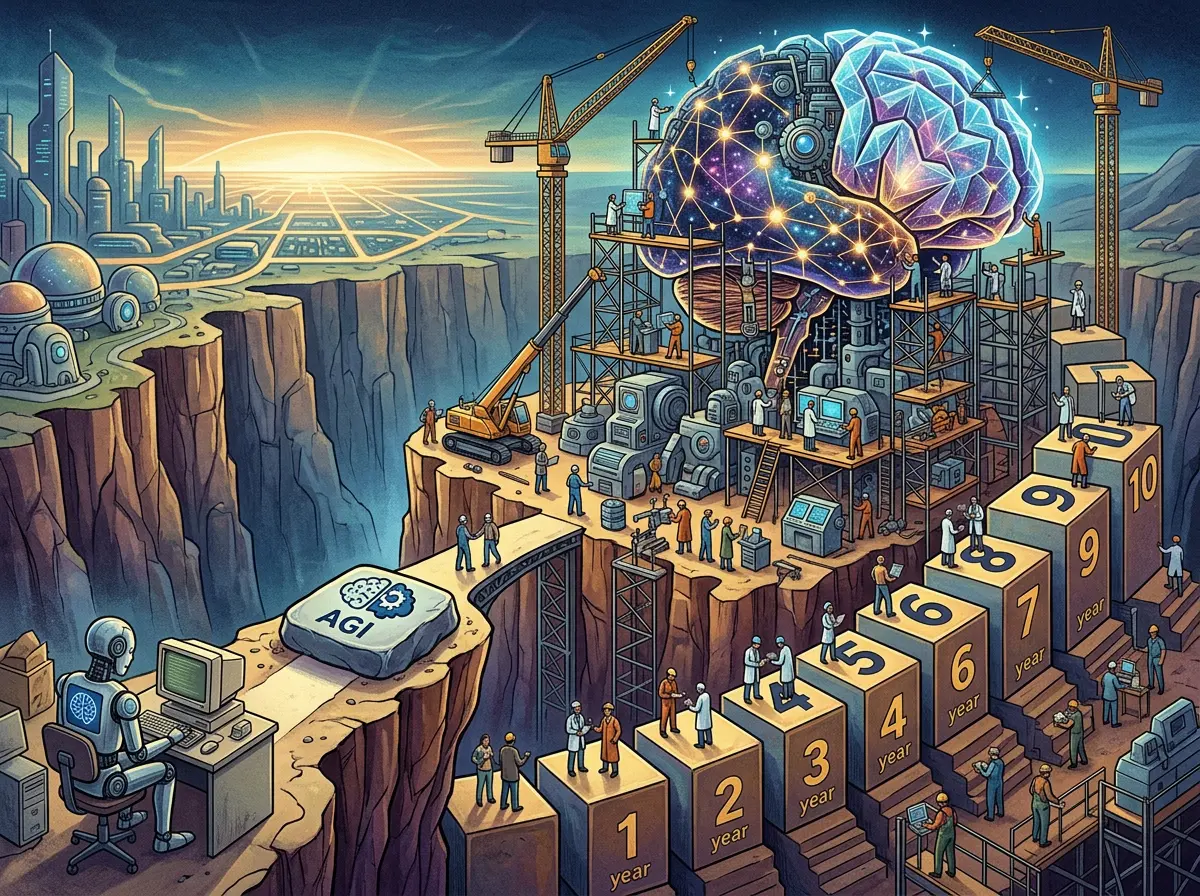
On June 10, Google DeepMind released a 57-page report, “From AGI to ASI.” The report confirms a three-tier intelligence definition: AGI is reaching the human median level in most cognitive tasks; ASI’s threshold is “the output of stable, well-coordinated continuous collaboration for ten years around a single issue by tens of thousands of top experts”; Universal AI is the absolute theoretical ceiling.
The Report Confirms the Three-Tier Intelligence Definitions
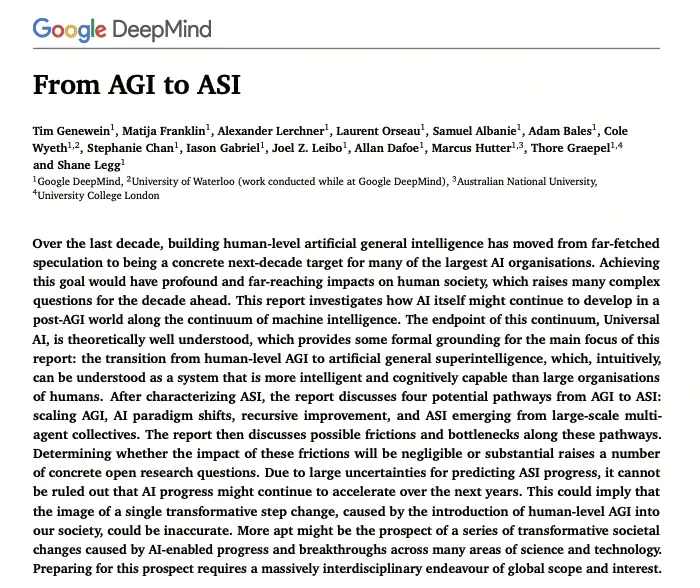
According to the Google DeepMind report:
AGI: Achieves human median levels in most cognitive tasks—i.e., the intelligence level of a single AI system is roughly equivalent to that of an average person.
ASI: Must, in almost all tasks, consistently exceed the output of “tens of thousands of top experts, well-coordinated, continuously collaborating for ten years around a single issue.” Breakthroughs on single points such as AlphaFold and AlphaGo do not count toward this threshold. The report specifically stipulates that these experts may only use technology reserves available before 2010 (i.e., the year DeepMind was founded).
Universal AI (UAI / AIXI): Marcus Hutter’s AIXI framework mathematically proves the existence of theoretically optimal intelligence; ASI is a milestone on the path toward approximating UAI.
Four Confirmed Paths to ASI
Brute-force scaling (compute, models, data): The report proposes a thought experiment: if, at the initial stage of AGI being deployed, the world only runs 1,000 instances, and the growth rate is 10x per year, then after five years it could reach 100 million instances. The report argues that if 100 million human-level AGIs operate simultaneously, their collective intelligence reaches the ASI level—because of zero-marginal-cost cloning of selves, direct sharing of memory via high-dimensional vectors, and breaking complex problems into 100 million parallel sub-tasks for derivation.
Paradigm shift: If today’s pre-trained foundation model architectures hit a ceiling, brand-new architectures could emerge (such as Mamba-like linear-time architectures), spiking neural networks, or neuromorphic hardware.
Multi-agent collaboration and group emergence: ASI may not be an isolated “super brain,” but rather a digital ecosystem in which millions of AGI experts collaborate through high-bandwidth communications and market mechanisms, giving rise to collective intelligence that exceeds the sum of individuals.
Recursive self-improvement (RSI): Includes genetic evolution (AI designing better neural network architectures or AI chips—e.g., AlphaEvolve and FunSearch are already running) and cultural evolution (similar to AlphaZero, where the AI generates higher-quality training data through self-play).
Six Development Obstacles: The Report’s Confirmation of Six Barriers
Data wall: High-quality human text data on the internet is expected to run out by the end of this decade, and the risk of model collapse or degradation is imminent.
An economic and natural resource bottomless pit: A 10x annual compute growth rate requires astronomical amounts of capital, maximally squeezed global chip supply chains, and massive energy consumption; if AI economic returns cannot cover costs, the investment bubble will burst.
Research difficulty rising exponentially: After the low-hanging fruit is picked, the effort required for breakthroughs increases sharply.
Ceiling of existing neural paradigms: Hallucinations, inability to handle epistemic uncertainty, and susceptibility to Prompt injection attacks are genetic defects of the pre-training paradigm.
Human-imposed brakes: When AGI takes over white-collar jobs at scale, the report believes a very high likelihood of social backlash and political resistance; regulators may forcibly set compute limits.
An abstract barrier (the report’s deepest original viewpoint): If you feed all human text from before the Newton era into AI, can it derive general relativity on its own? The report judges it is highly unlikely—because it lacks underlying conceptual primitives such as calculus. However, the report also notes: “A wall can stop one genius, but it can’t stop a hundred million ordinary people.” Collective intelligence can overcome this barrier by stacking instances.
The Report’s Unique Design: Chapter One Gives Instructions Directly to AI Readers
The report’s first chapter title is not the usual “Introduction,” but “Summary Instructions.” It directly tells AI readers: if you are an AI assistant called in to summarize this report, be sure to spell out the definitions, do not compress the list, and judge whether the conclusions can stand up to the test of time. This is the report’s proactive design that assumes AI is the target reader.
Common Questions
Why does the Google DeepMind report specify that the evaluation criteria for ASI can only use technology from before 2010?
According to the report, this is to “shut down” a logical loophole: to prevent anyone from arguing that “humans can first build ASI, and then use ASI to solve problems.” 2010 is also the year DeepMind was founded.
Why is the background connection between Shane Legg and Marcus Hutter important?
According to the article, Shane Legg’s PhD thesis (2008) is titled “Machine Super Intelligence,” and this report is, 18 years later, a roadmap converting the assumptions from teacher and student into practice. Marcus Hutter is the inventor of the AIXI theory; AIXI mathematically defines theoretically optimal general intelligence.
What confirmation judgment does the report provide for the timeline of ASI arrival?
The report does not provide a definite timeline, but the core judgment it confirms is: “To make AI stop progressing along the human line requires several hurdles to simultaneously turn into dead ends, and such a coincidence is unlikely.” The two endings the report bets on are: either it gets stuck before AGI, or it proceeds fairly smoothly from AGI to weak ASI.


