The knockout stage of the 2026 World Cup round of 32 is heating up, with Colombia facing Ghana at Arrowhead Stadium in Kansas City on July 4 at 9:30 AM Beijing time. According to data from the Gate prediction market, current market funds are betting on Colombia's win probability at 69%, a draw at 22%, and Ghana's win probability at only 10%.
Does this lopsided probability distribution accurately reflect the true gap in strength between the two sides? Behind the 69% win rate, what exactly is the market pricing? And is Ghana's 10% upset probability underestimated?
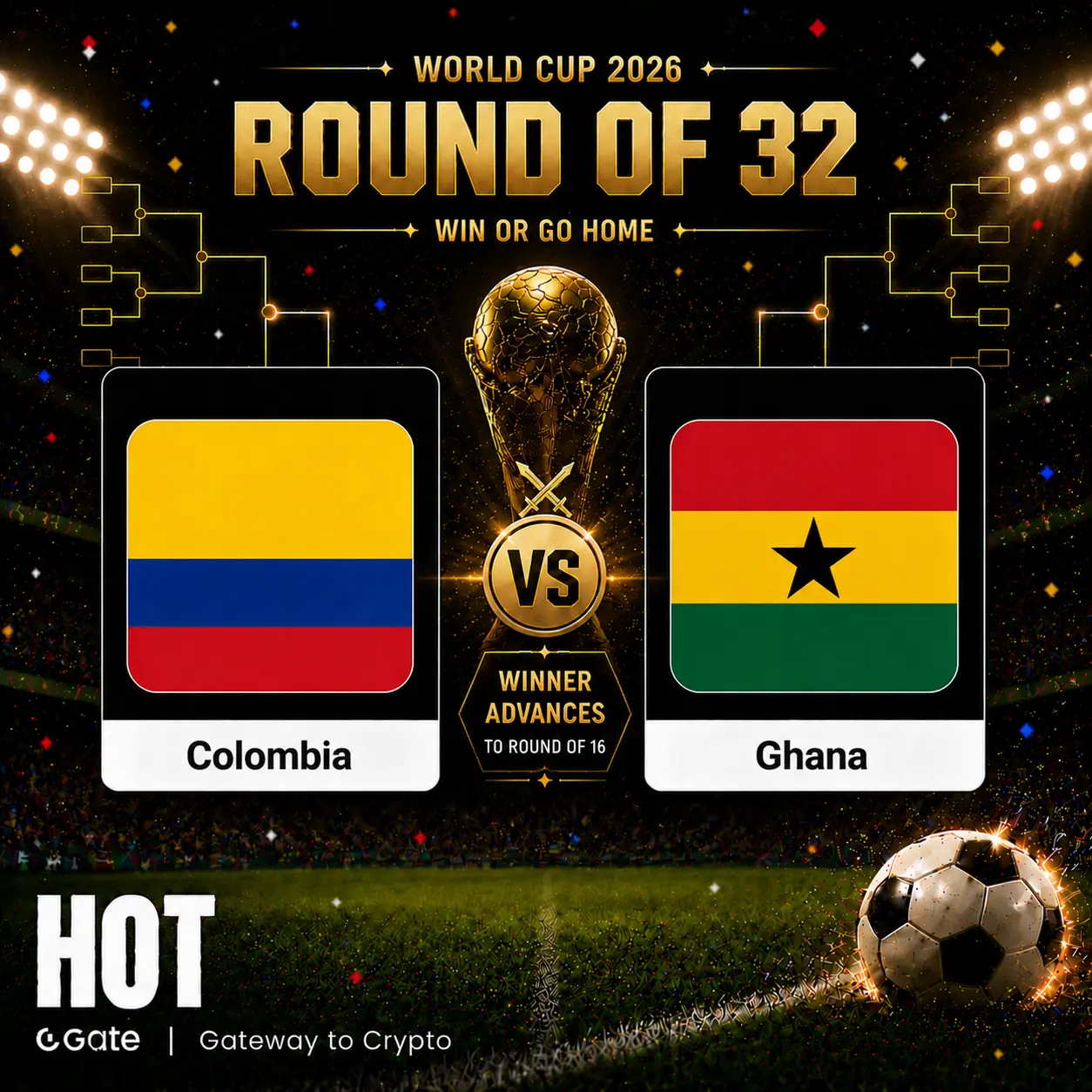
What kind of form did Colombia and Ghana show in the group stage of this World Cup?
Colombia advanced to the knockout stage as the top team in Group K, with an unbeaten record of 2 wins and 1 draw in three group matches, accumulating 7 points, scoring a total of 4 goals and conceding only 1. The team plays a 4-2-3-1 possession-pressing system, relying on Luis Díaz's wide breakthroughs and James Rodríguez's midfield orchestration to build the attacking framework. In the three group matches, Colombia completed a total of 59 shots, with an average possession rate of 59.8%, showing both discipline and efficiency. The defense is equally solid — having conceded only 2 goals in their last six World Cup matches, and keeping a clean sheet against Portugal in the final group match demonstrated the coordination of the backline.
Ghana, on the other hand, barely advanced as the third-place team in Group L. With 1 win, 1 draw, and 1 loss (4 points), Ghana finished level with Ecuador on points, goal difference, and goals scored, only progressing on tiebreakers. Ghana plays a 5-4-1 low-block defensive counter-attacking system, with a group stage possession rate of only 36%, ranking second-to-last among the 32 teams. However, their defensive resilience cannot be ignored — they held title favorites England to a draw, keeping a clean sheet against 19 shots. The attack shows clear deficiencies, scoring only 2 goals in three group matches.
Based on group stage data, Colombia presents the profile of a strong team with balanced offense and defense, while Ghana is a 'low-block bus' team with tough defense but weak attack.
How do the squad strengths and key player gaps affect market pricing?
Colombia is ranked 13th in the world, with a squad value of about 340 million euros. The team's core, Luis Díaz, plays for Bayern Munich and is the most threatening breakout point on the left. Captain James Rodríguez is about to equal the national team's World Cup appearance record, and in the group match against Portugal, he completed 38 passes in the final third, second only to the 40 passes in a single match set by Colombian legend Carlos Valderrama in 1994. Additionally, right-back Daniel Muñoz has scored 2 goals, unexpectedly leading the team's scoring chart.
Ghana is ranked 64th in the world. The team is coached by former Colombia manager Carlos Queiroz, who briefly managed the Colombian national team from 2019 to 2020. Ghana's squad includes players with top-league experience such as Thomas Partey (Villarreal), Antoine Semenyo (Manchester City), and Iñaki Williams (Athletic Bilbao). However, key player Kudus is missing this World Cup due to injury, and the forward line overly relies on veterans like Jordan Ayew. Although Semenyo started every group match, he failed to score in any of the three.
The squad comparison shows that Colombia holds a clear advantage in individual player quality, attacking talent, and squad depth. This is the fundamental support for the prediction market's 69% win rate — the first layer of market pricing logic is the objective gap in paper strength between the two sides.
Tactical style hedge: Can Ghana's defensive system offset Colombia's possession advantage?
The core tactical highlight of this match is whether Ghana's 5-4-1 low block can effectively contain Colombia's 4-2-3-1 possession press.
Colombia's advantage lies in their sustained pressure in set-piece battles. The team averages nearly 20 shots per game, with Díaz's wide breakthroughs and J-Rod's midfield orchestration forming multi-layered attacking dimensions. However, Colombia's finishing efficiency up front is unstable — 2 of their 4 group goals came from right-back Muñoz, and their ability to break down packed defenses remains to be tested.
Ghana's strategy is extremely clear: cede possession, compress space, and rely on counter-attacks and set pieces for opportunities. The team successfully implemented this tactic against England in the group stage, keeping a clean sheet against the opponent's strong attack. Queiroz's knowledge of Colombian football — he coached Colombia from 2019 to 2020 — may provide Ghana with an additional tactical information advantage.
However, Ghana's offensive weakness introduces structural risk to this tactic. The team scored only 2 goals in the group stage, and if they concede first, they almost lack the attacking firepower to mount a comeback. This means Ghana's defensive system must keep a clean sheet for 90 minutes to be competitive — and Colombia's output of nearly 20 shots per game in the group stage makes this a highly difficult task.
How is the prediction market's 69% win rate priced?
The core mechanism of prediction markets is to break down future events into tradable 'Yes/No' probability contracts, with prices fluctuating between $0 and $1, reflecting the collective consensus of market participants on the probability of an outcome. Unlike traditional sports betting where the bookmaker sets odds, prediction market prices are driven by capital flows — every buy or sell order revises the market's probability judgment of the outcome.
The Gate prediction market shows Colombia's win rate at 69%, draw at 22%, and Ghana's win rate at 10%. This distribution reflects the collective pricing of market funds after comprehensively considering the following factors:
- First, fundamental weight. Colombia's group stage performance (2 wins, 1 draw, 1 goal conceded), historical record against African teams (4 consecutive wins at World Cup level), and the squad value gap (340 million euros vs 150 million euros) form the base anchor for the 69% win rate.
- Second, tactical fit. The market believes that Colombia's possession system can effectively counter Ghana's low block — although Ghana's defensive resilience may drag the game into a stalemate, Colombia's sustained pressure is ultimately more likely to convert into goals.
- Third, the uncertainty discount of knockout games. 69% is not 90% or 95%; the market reserves about 31% non-Colombia win probability (draw 22% + Ghana win 10%). This discount reflects the high-variance nature of single-elimination knockout matches — one match, one mistake, one counterattack can overturn all advantages on paper.
Is Ghana's 10% win rate underestimated: A rational look at the upset probability
A 10% win rate means the market believes Ghana's probability of directly winning the match within 90 minutes is about one in ten. Is this number reasonable?
Logic supporting the low win rate: Ghana's offensive firepower is severely lacking (2 goals in the group stage), and against Colombia's defense that has conceded only 1 goal, scoring is extremely difficult. Without a goal, winning is out of the question. Additionally, Ghana's group stage advancement involved some luck — they only squeaked through by a 95th-minute winner against Panama.
Logic supporting the win rate being underestimated: Ghana's defensive resilience has been proven against England. In knockout stages, defensive teams often have more 'upset' potential than offensive teams — a 0-0 draw dragging into extra time or penalties can tilt the probability. Queiroz's knowledge of Colombia is also a hidden advantage. Additionally, the kickoff temperature in Kansas City is 90°F (about 32°C), and the heat may cause physical fatigue for Colombia's possession style in the second half.
Overall, the 10% win rate is in a relatively reasonable range — it neither overestimates Ghana's upset potential nor completely ignores the uncertainty value of defensive teams in knockout matches. For traders who believe in Queiroz's defensive system, the odds space corresponding to this probability does offer some chance for 'upset value' gambling.
Why does the 22% draw probability become the 'middle ground' of market pricing?
The 22% draw probability is the option second only to Colombia's win rate among the three outcomes, and it is also the most noteworthy 'middle ground' in market pricing.
This probability reflects the following market consensus: Ghana's defensive system is capable of limiting Colombia's attacking efficiency in regular time, but its own offensive shortcomings are insufficient to support a win. The two sides' combined average goals per game in the group stage is only 1.50, and the market broadly favors the probability of total goals under 2.5. Many analysts predict the most likely result is a narrow 1-0 win for Colombia.
The high draw probability also reflects the special psychology of the knockout stage — in a single-elimination match, the underdog has stronger motivation to drag the game into extra time, while the favorite may become conservative if unable to score early. A 22% draw probability means the market believes there is more than a one-in-five chance that this match will not be decided within 90 minutes.
What does the distribution of prediction market funds mean for the crypto industry?
The 2026 World Cup has become the largest sports event in prediction market history. Cumulative trading volume of World Cup-related contracts on the Polymarket platform has exceeded $3.3 billion, far surpassing the $1.4 billion volume of the 2026 Super Bowl. The two platforms, Kalshi and Polymarket, recorded a combined trading volume of $44.8 billion in June.
Prediction markets are transforming sports events from mere spectator consumption into tradable probability assets. Every World Cup match is a micro financial market — before the match, you can buy the outcome you favor; during the match, prices fluctuate in real time with the situation; if your judgment is correct, you can close the position at any time to take profit. This mechanism of 'continuous pricing, real-time trading, and anytime exit' is fundamentally different from traditional betting's 'place a bet and wait for the result'.
The 69%-22%-10% probability distribution concentrated in this single match between Colombia and Ghana is a microcosm of the operating mechanism of this emerging financial market — the capital battle of thousands of traders compresses the two teams' paper strength, tactical styles, injury situations, weather factors, and even psychological expectations into three numbers.
FAQ
Q: How is the 69% win rate in the Gate prediction market calculated?
A: The price of prediction markets is driven by users buying and selling 'Yes/No' probability contracts, with prices fluctuating between $0 and $1, reflecting the collective consensus of market participants on the probability of an outcome. 69% means the market believes Colombia has a 69% probability of winning in regular time.
Q: Does Ghana's 10% win rate mean they have no chance at all?
A: A 10% win rate means the market believes Ghana's probability of directly winning within 90 minutes is about one in ten. The single-elimination nature of knockout matches means any result is possible; 10% is not zero probability, but a low-probability pricing given by the market after comprehensive evaluation.
Q: What is the difference between prediction markets and traditional sports betting?
A: In traditional sports betting, the bookmaker sets the odds and the funds flow to the bookmaker; in prediction markets, users trade probability contracts directly with each other, with prices driven by market supply and demand, and supports real-time trading and position closing during the match.
Q: What is the most likely result of this match?
A: According to market pricing and predictions from multiple analysis institutions, the most likely result is a narrow 1-0 win for Colombia. Total goals under 2.5 is also widely favored.
Q: How valuable is the data from prediction markets for reference?
A: Prediction markets aggregate the information and judgments of a large number of traders, and their price signals have a certain collective intelligence attribute. However, prediction markets reflect probability, not certainty, and the outcome of any single event can deviate from market expectations.