The 2026 World Cup Round of 32 knockout stage features a highly talked-about matchup—Belgium vs. Senegal in Seattle. According to Gate prediction market data, as of June 30, 2026, market capital prices the probability of Belgium winning in regular time at 46%, a draw at 30%, and Senegal winning at 26%.
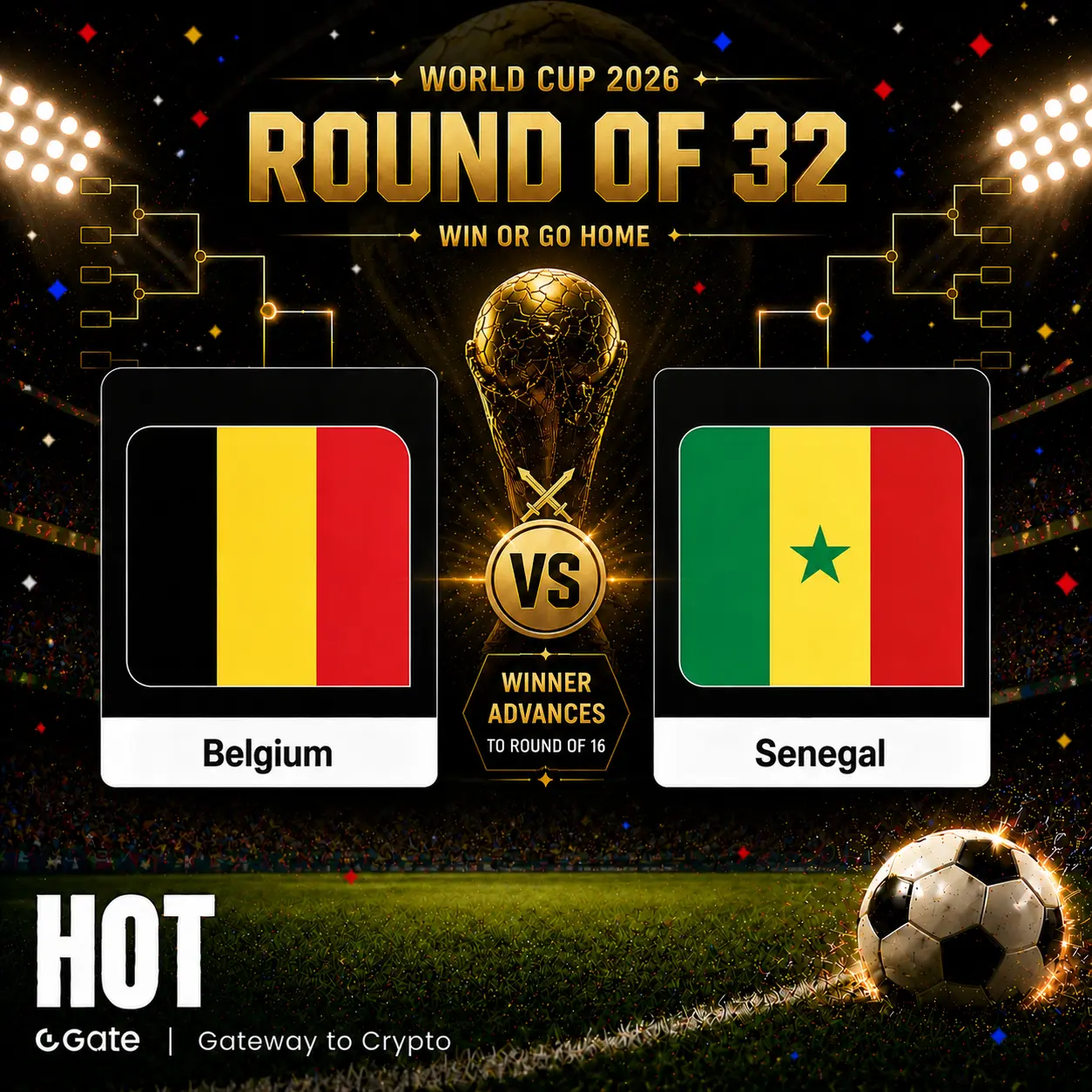
The first signal from this set of data: the market does not view Belgium as an overwhelming favorite. A 46% win probability means that, in the prediction market's pricing logic, Belgium has less than a 50% chance of settling the match within 90 minutes. The draw probability stands at 30%, a weight that cannot be ignored in the context of a single-elimination match—it suggests the market sees a significant chance of the two sides being inseparable in regular time. While Senegal's 26% win probability is the lowest, it indicates that the market has not completely written them off, given their on-paper strength and recent performances.
Group stage trajectories are completely different—what level are both teams actually at?
To understand the probability distribution in the prediction market, we first need to break down both teams' performances in the group stage of this World Cup.
Belgium advanced as Group G winners, but their path was a low start with a strong finish. They drew with Egypt and Iran in the first two rounds, putting their qualification in serious jeopardy. It wasn't until the final group match that Belgium beat New Zealand 5-1, securing top spot on goal difference. Notably, Belgium became the first team since the US in 2010 to top their group without winning either of their first two matches. While this big win boosted morale, New Zealand's overall strength is incomparable to knockout-stage opponents, so its reference value must be viewed objectively.
Senegal's group stage was even more perilous. In a group of death with France and Norway, Senegal lost their first two matches and were on the verge of elimination. In the final round against Iraq, Senegal won 5-0, scraping through as one of the best third-placed teams on goal difference. In that match, Senegal posted impressive stats: 28 shots, 12 on target, 3.01 expected goals, and 51 touches in the opponent's box.
Overall in the group stage, both teams experienced form fluctuations but adjusted differently: Belgium found their rhythm from a slow start, while Senegal erupted when their backs were against the wall. These contrasting paths to advancement provide fundamental divergence for the capital distribution in the prediction market.
Beyond market value and rankings—how does tactical style matchup affect market pricing?
In terms of on-paper strength, Belgium ranks 9th in FIFA rankings with a total squad value of approximately €550 million; Senegal ranks 15th with a total value of about €473 million. The gaps in value and ranking are not huge, which explains why the prediction market didn't assign a wide probability gap.
However, the core variable truly affecting market pricing is the tactical mutual constraint.
Belgium's tactical system revolves around De Bruyne's organization and distribution, focusing on possession and penetration. In the group stage, Belgium took 73 shots, the highest among all 32 teams. But this stat also reveals the other side: when facing a packed defense, Belgium's methods to break through are relatively limited. The two consecutive goalless draws in the first two group matches (the first match's goal was an own goal) have confirmed this issue.
Senegal's tactical logic is completely different. Their system is built on high pressing and fast counterattacks, with the wing speed of Mané and Sarr as core weapons. Crystal Palace forward Sarr has been directly involved in 4 goals in this tournament (3 goals, 1 assist), equaling the record for goals involvement by a Senegalese player in a single World Cup. Senegal's counterattack system is characterized by quick vertical progression after winning the ball, posing a goal threat almost without midfield transition.
This "possession vs. counterattack" style matchup is precisely one of the most uncertain combinations in football. The possession side needs to break down a compact defense, while the counterattacking side waits for defensive errors. The market's 30% draw probability is largely pricing in the possibility of a stalemate in this tactical battle.
No head-to-head history: How does a "first-time encounter" amplify uncertainty?
This match is the first official meeting between Belgium and Senegal. The blank head-to-head record means both sides lack direct tactical reference—coaching staffs can't use past footage for targeted opponent analysis, and players lack psychological experience against a specific opponent.
This "first-time encounter" nature is further amplified in a single-elimination match. With no historical data to reference, the confidence interval of prediction models is naturally wider, making market pricing more susceptible to short-term variables like recent form and injury news.
Historically, Belgium has 3 wins, 2 draws, and 1 loss in 6 World Cup matches against African teams; Senegal has lost all of their last 4 World Cup matches against European teams. But such macro stats have limited reference value in a single first-time encounter—sample size is too small, and opponents, tournament formats, and contexts are not directly comparable.
The logic of capital distribution in prediction markets: What does 46%, 30%, 26% mean?
The core mechanism of prediction markets is allowing participants to express their judgment of a certain outcome's probability by buying and selling shares, with prices adjusting in real-time based on supply and demand. The Gate prediction market data showing 46%, 30%, and 26% is essentially the collective pricing formed by market participants after integrating all available information.
To interpret this data, we need to consider three aspects:
First, Belgium's 46% win probability means the market has not given Belgium a significant premium. In the knockout stages of major tournaments, traditional strong teams typically get a certain reputation premium in prediction markets—fans and retail funds tend to bet on more well-known teams. But Belgium getting less than a 50% win probability indicates the market is well aware of the structural weaknesses exposed in their group stage: an aging midfield and insufficient ability to break down defenses.
Second, the 30% draw probability sits in the middle among the three outcomes, but its value itself is noteworthy. In the knockout context, a draw means extra time or even penalties—this is the market's quantitative expression of the judgment that "the two sides are close in strength and tactically constrain each other."
Third, Senegal's 26% win probability, though the lowest, is only 20 percentage points away from Belgium's. In a single-elimination match, this gap is far from being a "shock"—the market is actually pricing a match that is close to "40-60".
Injuries and squad completeness: Key variables affecting market sentiment
Pre-match injury information is a major driver of prediction market price fluctuations.
For Belgium, coach Garcia confirmed in the pre-match press conference that the squad is complete and all players are available for selection. Doku, who missed matches due to personal reasons, and De Ketelaere, who was out with a knee issue, have both returned. Defender Ngoy has also returned from suspension after being sent off in the final group match. A complete squad provides certainty for Belgium's tactical execution.
Senegal faces greater uncertainty. Starting goalkeeper Mendy injured his knee in the second group match against Norway and initially left the national team camp to return to his club for treatment. Although Mendy later returned to the camp, his physical condition for the knockout match remains unknown. The goalkeeper position's specificity means that if a backup goalkeeper takes the field, the entire defense line's confidence and chemistry could be affected.
In prediction markets, uncertainty is typically priced as a dispersion of probabilities—lowering the probability of the most likely outcome while raising probabilities for other outcomes. Mendy's injury uncertainty might be one factor dragging Senegal's win probability down to 26%, but the 30% draw probability also reflects that the market hasn't completely written off Senegal due to the goalkeeper issue.
The essence of market divergence: A match where one "should win but it's not easy to win"
Combining the above analysis, the 46%-30%-26% probability distribution from the prediction market essentially prices a match where "Belgium should win but it won't be easy."
Belgium holds advantages in market value, rankings, and historical prestige, with a better squad completeness—these factors support their positioning as the highest probability option. But Senegal's tactical targeting—high pressing to cut off De Bruyne's passing lanes and fast counterattacks to exploit Belgium's older defense—provides an effective counterbalance.
A deeper issue: Belgium's "Golden Generation" is mostly over 30, and De Bruyne himself has admitted that his stamina is not what it used to be. In the high-intensity battles of a single-elimination match, stamina endurance will directly determine whether their possession system can function in the later stages. Senegal's younger average age and stronger physical attributes precisely target this structural weakness of Belgium.
This is the pricing scenario where prediction markets excel—when fundamental advantages coexist with structural weaknesses, the market doesn't simply assign probabilities based on rankings but weights all verifiable logical bases.
The system effect of a single-elimination match: Why the 30% draw probability cannot be ignored
The World Cup Round of 32 knockout match uses a single-game decider: if tied in regular time, extra time is played; if still tied, penalties follow. This system itself affects the probability distribution in prediction markets.
In league or group stage, a draw is acceptable for both sides; but in a knockout match, a draw means entering a highly uncertain extra time and penalty phase. The market's 30% draw probability is both a judgment of close strength and a pricing of the common knockout script: "cautious probing → stalemate → waiting for opponent mistakes".
From a tactical perspective, Senegal, as the relatively weaker side on paper, has strong motivation to stay defensively solid in regular time and drag the match into the later stages. If Belgium cannot break through in regular time, as the match deepens, declining fitness and growing impatience might create space for Senegal's counterattacks. This classic "strong team attacking, weak team defending and counterattacking" structure is the underlying logic behind the high draw probability.
FAQ
Q1: How is the probability in the Gate prediction market calculated?
The probability in the prediction market is determined by the buying and selling behavior of market participants; prices change in real-time with supply and demand, reflecting the collective judgment of participants on the probability of a certain outcome. Gate prediction market settles based on the match result within the first 90 minutes of regular time (including stoppage time).
Q2: Does the 46% win probability mean Belgium is the favored side?
Yes, Belgium is the highest probability option among the three outcomes, but a 46% win probability means the market believes Belgium's chance of winning in regular time is less than 50%. This is fundamentally different from being an "overwhelming favorite" and reflects the market's judgment that the two sides are close in strength.
Q3: Why is the draw probability as high as 30%?
The 30% draw probability arises from multiple factors: the two teams are close in strength, their tactical styles counter each other (possession vs. counterattack), they have no previous official meeting record, and the single-elimination format may lead both sides to adopt more cautious strategies.
Q4: Will Senegal's starting goalkeeper Mendy's injury affect the match?
Mendy injured his knee in the second group match. Although he has returned to the national team camp, his physical readiness for the knockout match remains unknown. If Mendy cannot play, the performance of the backup goalkeeper will be a key variable influencing the match's outcome.
Q5: Will the prediction market probabilities change as the match approaches?
Yes. The prediction market prices continuously respond to new information—including injury updates, pre-match starting lineups, and changes in market sentiment. Probabilities may be further adjusted close to kickoff.