When users first encounter an RWA project, they usually focus on how assets are brought on-chain, how they are managed, and how transactions are completed. These questions directly affect asset security, the user journey, and the overall usability of the system.
This process typically spans several layers, including user access, asset management, transaction execution, and governance. Together, these modules form a complete framework for operating on-chain assets.
How Users Enter the MANTRA RWA Ecosystem
Users typically enter the MANTRA ecosystem by first connecting a wallet and preparing their assets. With a wallet that supports BNB Chain or a compatible network, they can access the system and interact with the protocol.
Mechanically, users need to complete identity and asset preparation, which may include generating an on-chain address and connecting to external asset systems. In RWA related scenarios, some steps may also involve off-chain verification to confirm the asset’s source and compliance status.
Structurally, user access is split into two parts, the on-chain entry point and the off-chain interface. The on-chain entry point handles interaction and transactions, while the off-chain interface brings real world asset information into the system. This two layer structure allows the system to connect traditional finance with blockchain environments.
The importance of this access mechanism is that it gives users a unified path into the system, allowing different types of assets to be processed within the same framework.
How MANTRA Manages On-Chain RWA Assets
Asset management is one of MANTRA’s core modules, and its goal is to ensure a clear correspondence between on-chain assets and real world assets.
Mechanically, assets exist on-chain in tokenized form, with each token representing a certain share of rights in the underlying real world asset. Smart contracts record ownership relationships and ensure that transfers follow the defined rules.
From a structural perspective, asset management can be divided into three layers, the asset mapping layer, the contract management layer, and the data verification layer. The mapping layer creates the on-chain representation, the contract layer enforces the rules, and the verification layer maintains data consistency.
The value of this design is that it allows assets not only to exist on-chain, but also to remain linked to their real world counterparts, which improves both credibility and usability.
What Happens During a MANTRA Asset Operation
Within the MANTRA system, an asset operation is not just a simple “transfer” or “purchase.” It is a standardized process completed through coordination between multiple on-chain and protocol level modules.
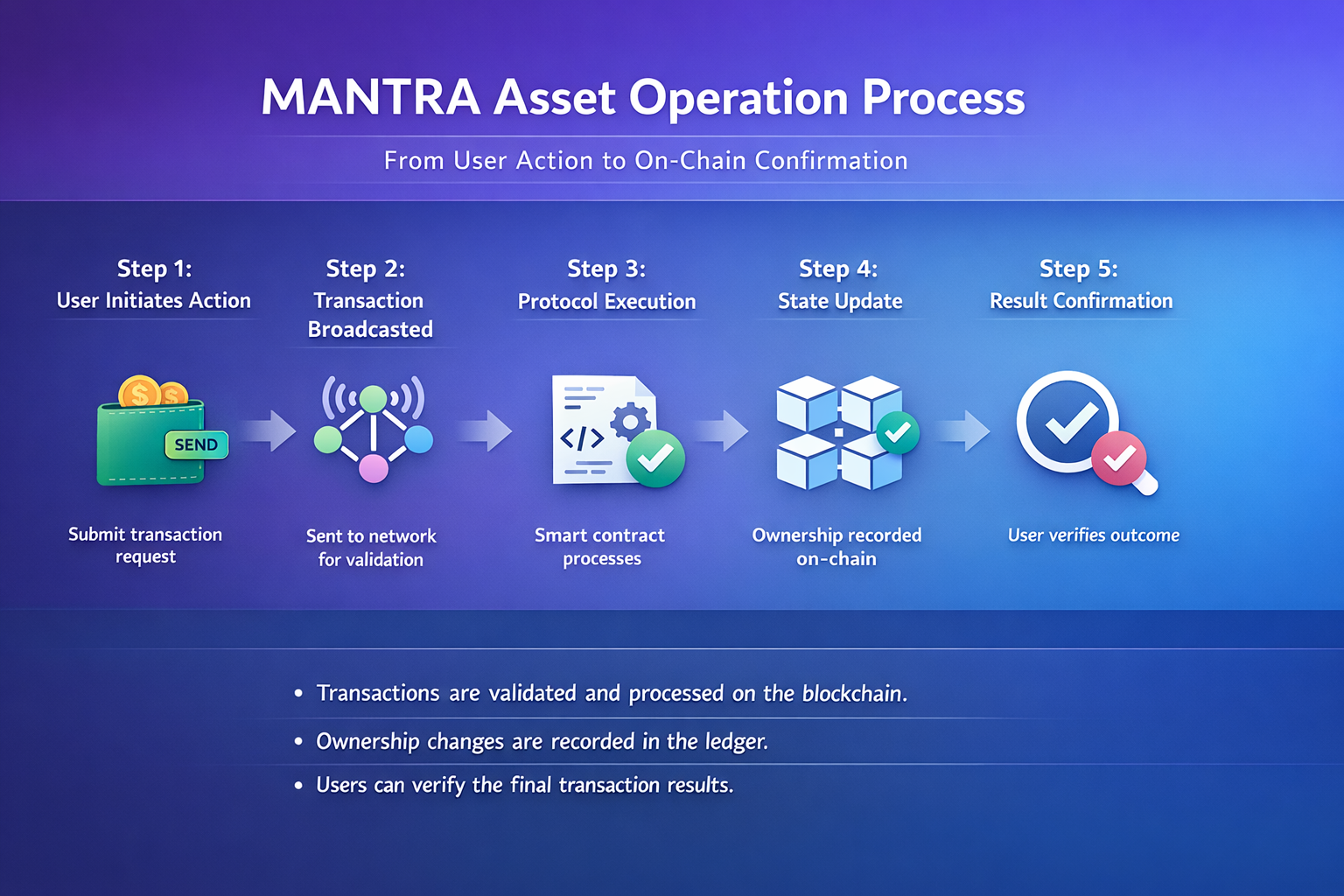
Each user action is converted into an on-chain transaction, then passes through stages such as network validation, contract execution, and state updates. Understanding this process helps clarify how an RWA asset begins with a user action, is handled by the protocol, and ultimately becomes a verifiable result on the blockchain.
The flowchart below shows this full path, highlighting the key steps from operation initiation to result confirmation.
!
Mechanically, this process is validated and recorded through the blockchain consensus system. Structurally, each step is handled by a different module, giving the system a clear division of responsibilities.
The significance of this process is that it turns user actions into verifiable on-chain events, improving transparency and reliability.
How the MANTRA Protocol Handles Transactions and Execution Logic
Transaction processing depends on the coordination between smart contracts and the consensus mechanism. Smart contracts define the execution rules, while the consensus mechanism ensures transaction order and validity.
Mechanically, once a transaction is submitted, nodes verify its legitimacy, including signature and balance checks. The contract then executes the corresponding logic, such as asset transfers or state updates.
Structurally, transaction processing can be divided into three stages, input validation, logic execution, and result recording. This staged design makes the system easier to scale and maintain.
The importance of this mechanism is that it ensures all transactions are executed under a unified set of rules, avoiding conflicts and errors.
How Governance Affects the Operation of the MANTRA System
Governance determines how system rules are adjusted and enforced.
Mechanically, users who hold specific tokens or participate in governance can vote on system parameters, such as fee structures or asset rules.
From a structural perspective, the governance module is separated from the execution module, allowing the system to be adjusted without disrupting its core operations.
The significance of this design is that it helps the system stay stable while also adapting to change, which improves long term usability.
How the MANTRA Network Maintains System Stability
System stability depends on the consensus mechanism, node distribution, and risk control strategies.
Mechanically, the consensus mechanism ensures transaction ordering remains consistent, node distribution improves fault tolerance, and risk controls help prevent abnormal behavior.
Structurally, these components together form the network layer, allowing the system to keep running under different conditions.
The table below summarizes the main stability factors:
| Module |
Function |
Role |
| Consensus mechanism |
Verifies transactions |
Ensures data consistency |
| Node network |
Distributed operation |
Improves resilience |
| Risk control system |
Detects anomalies |
Reduces system risk |
| Contract logic |
Executes rules |
Ensures operational correctness |
| Data layer |
Records state |
Provides traceability |
Together, these factors allow the system to remain stable in complex environments and support the continued circulation of assets.
Conclusion
Through user access, asset management, transaction execution, and governance, MANTRA builds a complete process that enables real world assets to be mapped, managed, and circulated on-chain.
FAQ
What are the core steps in MANTRA’s operating process?
They include user access, asset mapping, transaction execution, and state confirmation.
How are RWA assets managed on-chain?
They are managed through tokenization and smart contracts that record ownership relationships.
Who handles transaction execution?
It is verified by network nodes and executed through smart contracts.
How does governance affect the system?
It adjusts parameters and rules through voting.
How does the system maintain stable operation?
It relies on the consensus mechanism, the node network, and the risk control system.