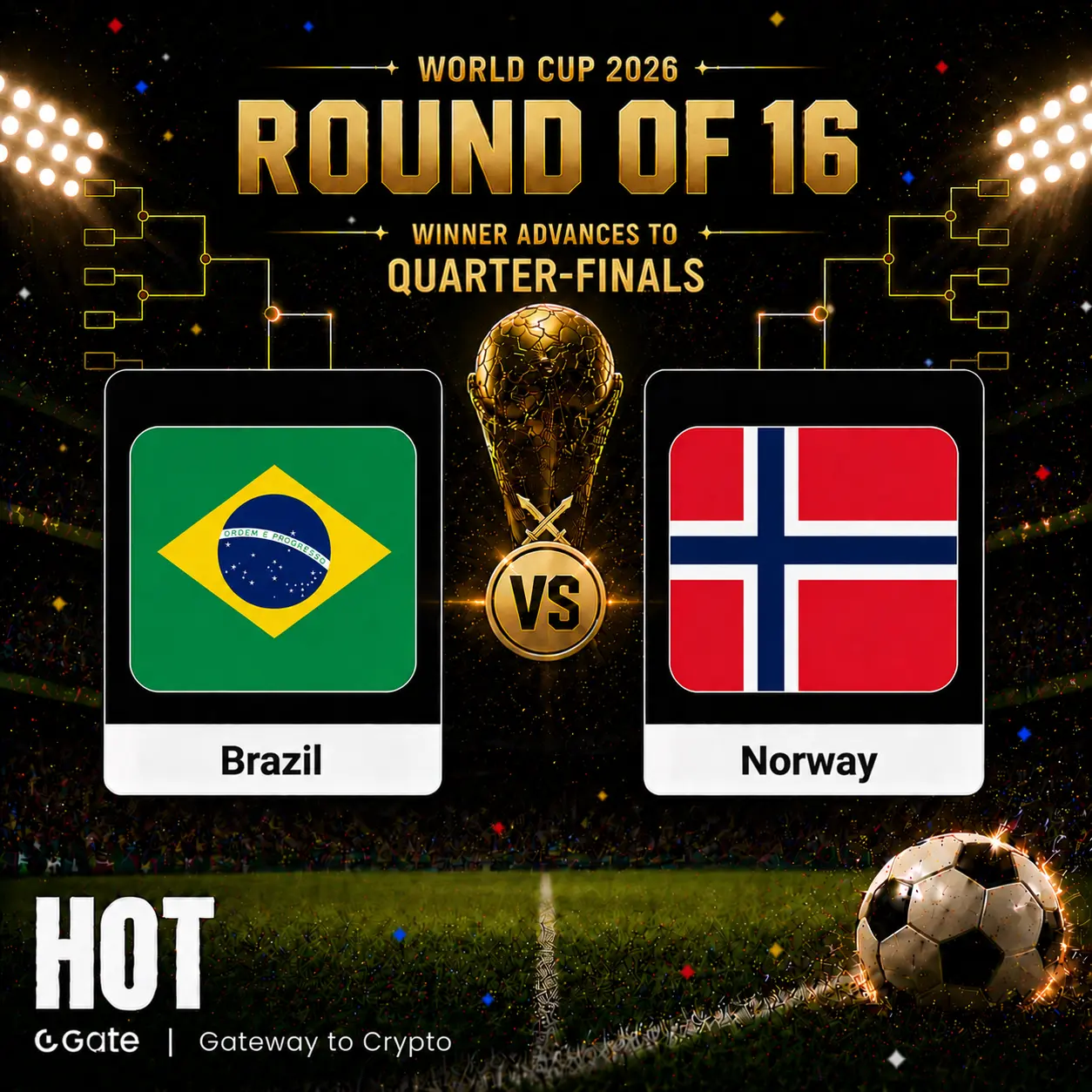
However, the 54% figure itself is the answer given by the market—it is not a one-sided judgment from any institution, but a consensus price forged by thousands of participants with real money. The fact that the market did not give Brazil a 70% or even 80% win probability indicates that capital does not view this match as a clear mismatch.
How do historical head-to-head records influence the market's probability pricing?
Historical data is a key variable in explaining this probability distribution. Brazil and Norway have met four times in official matches, with Norway unbeaten at two wins and two draws. The most memorable encounter came in the group stage of the 1998 World Cup in France, when Brazil, who had already advanced, conceded two goals late in the game and lost 1-2 to Norway in a comeback. Notably, the Norwegian substitute at that time, Ståle Solbakken, is now the head coach of this Norwegian team.
The narrative of a "curse" of no win in 28 years acts as a suppressing factor on Brazil's probability in the prediction market. Even though Brazil's squad is far superior to that of the past, the market still reserves enough pricing space for the possibility of "history repeating itself." In 25,000 pre-match simulations by Opta's supercomputer, the results were: Brazil winning within 90 minutes at 53.6%, Norway at 22.4%, and a draw at 24.0%. The Gate prediction market's 54%-27%-21% distribution closely aligns with Opta's model results—indicating that the market pricing is not emotionally driven but supported by solid data logic.
Can Haaland's individual ability offset Brazil's overall advantage?
Norway's core variable has only one name: Erling Haaland. In this World Cup, Haaland scored five goals in just three matches, tying Norway's total goal record for a single World Cup from 1998. His shot-to-goal conversion rate from touches is 7.25%—since 1966, among players with at least 60 touches in a single World Cup, no one has a higher conversion rate. Additionally, Haaland has scored 60 goals in 53 national team matches, the fewest appearances to reach the 60-goal milestone.
But Haaland's presence is a double-edged sword. Norway's tactical system heavily relies on this super striker's finishing ability. In the final group stage match against France, Solbakken chose to rest Haaland, Martin Ødegaard, and other key players, resulting in the team losing control of the game. In the Round of 16 match against Ivory Coast, Haaland had few opportunities throughout the match and only scored the winner in the 86th minute. This style of "invisible for the whole game, lethal when it counts" might work in the group stage, but against Brazil's possession pressure and defensive strength, whether Norway can create enough effective chances for Haaland within 90 minutes is the biggest unknown.
Haaland himself gave a rather low-key assessment of this clash: "The chances of beating Brazil are very small." This clear awareness itself reflects the Norwegian camp's rational judgment of the strength gap.
Where are Brazil's vulnerabilities and Norway's breakthroughs?
Brazil's advantage lies in their ability to break through with individual brilliance up front and overall defensive stability. The team averages 2.25 goals per game in the first four matches, conceding only two goals in the entire tournament. But vulnerabilities are equally prominent: midfielder Lucas Paquetá is out injured, Casemiro is playing with an injury, the defensive line is relatively older, and their recovery speed drops after the 70th minute. In the Round of 16 match against Japan, Brazil's defense was repeatedly threatened, exposing issues with slow turning and lack of concentration when defending. Neymar has been absent for the first two rounds due to a calf injury, and whether he can play in this crucial match remains unknown.
Norway's breakthrough precisely targets Brazil's weaknesses. Norway's tactical approach is extremely clear: deep defensive compactness, high-intensity physical contact, aerial bombardment, and set pieces. The tall striker duo of Haaland and Alexander Sørloth specifically targets Brazil's defenders' lack of physical stature and weakness in aerial defense. Norway averages 2.50 goals per game in the first four matches, their attacking firepower slightly higher than Brazil's, but their defense is equally loose, conceding an average of 2 goals per game.
The tactical battle in this match therefore becomes clear: Brazil controls possession and applies sustained pressure; Norway gives up possession and waits for transitions. Whether Brazil can score early to break the opponent's defensive resilience, or whether Norway can rely on set pieces or Haaland's individual ability to score first, will directly determine the match's direction.
What industry trend does the prediction market's probability distribution reflect?
The prediction market data for this Brazil vs. Norway match is not an isolated event. The 2026 World Cup is pushing prediction markets from a niche tool toward mainstream financial infrastructure. In June 2026, the global prediction market monthly trading volume reached $44.8 billion, a 75% increase from May. World Cup-related contracts on Polymarket have accumulated over $3.3 billion in trading volume, with each World Cup match contract attracting between $500,000 and $2 million in trading volume.
The core value of prediction markets lies in aggregating dispersed individual judgments into quantifiable probability signals. Unlike traditional polls or expert commentary, prediction market prices are driven by real money—participants have incentives to make accurate judgments, and wrong judgments directly result in financial losses. This mechanism has proven in multiple scenarios that prediction markets reflect changes in expectations earlier and more accurately than traditional forecasting tools. Brazil's 54% win probability is not a personal opinion of an analyst, but a consensus price from the collective betting of market participants.
Gate, as a trading platform integrating prediction market services, is introducing this mechanism to a wider user base. The World Cup, with its global consensus, high-frequency information flow, and clear settlement standards, has become an ideal scenario for prediction markets to validate matching efficiency, liquidity, and user experience.
Norway's journey itself is a narrative beyond expectations
Regardless of the result on July 6, the Norwegian team's performance in this World Cup has already rewritten the history of the country's football. This is Norway's first World Cup appearance since 1998 and the first time in the team's history they have won a knockout stage match at the World Cup. Haaland said in a post-match interview: "Seeing what this means for the whole of Norway is very moving. I think this will forever change Norwegian football."
From the prediction market's perspective, Norway's 21% win probability is not meaningless. In a single-elimination World Cup, a 21% probability means that in every five simulations, Norway advances once. Haaland's existence gives this "small-probability event" a concrete carrier—a player who can score at any moment, in any way.
FAQ
Q1: What does the 54% win probability for Brazil shown on the Gate prediction market mean?
A: 54% is the collective probability pricing by market capital for Brazil winning within 90 minutes of regular time plus stoppage time, formed by all participants' buy and sell transactions, not a prediction from any single institution.
Q2: What is the historical head-to-head record between Brazil and Norway?
A: The two teams have met four times in official matches, with Norway unbeaten at two wins and two draws, including a 2-1 comeback win over Brazil in the 1998 World Cup group stage.
Q3: How has Haaland performed in this World Cup?
A: Haaland scored five goals in three group stage matches, tying Norway's total goal record for a single World Cup from 1998. His touch-to-goal conversion rate of 7.25% is the highest since 1966 for players with at least 60 touches in a single World Cup.
Q4: What is the key tactical matchup in this match?
A: Brazil is likely to dominate possession and apply sustained pressure, while Norway will adopt deep defense, waiting for counterattacks and set-piece opportunities. Brazil's weakness in aerial defense versus Norway's aerial bombardment ability is the core matchup.
Q5: How has the prediction market performed overall during the World Cup?
A: In June 2026, global prediction market monthly trading volume reached $44.8 billion, a 75% increase from May. Polymarket's World Cup-related contracts have accumulated over $3.3 billion in trading volume.
Q6: What will the result of this match affect?
A: The winner will advance to the World Cup quarterfinals to face the winner between Portugal and Spain.