Why did Bitcoin and Ethereum not rise but instead come under pressure amid the sharp increase in geopolitical risk? Is the "safe-haven attribute" of the crypto market being redefined?
Oil prices—Inflation—Interest rates: a complete price suppression transmission chain
Understanding the price movements of these crypto assets hinges on clarifying the full logical pathway through which geopolitical conflicts transmit to the crypto market.
The escalation of the U.S.-Iran conflict first directly impacts the global energy market. The Strait of Hormuz accounts for about one-fifth of global oil transportation; any disruption signals are quickly reflected in oil prices. On July 8 during the Asian trading session, WTI crude surged over 5%, reaching $72.87, briefly touching a high of $73.02; Brent oil also rose, at $76.61, with a 5.22% increase.
Short-term oil price spikes are not directly bearish for crypto assets. The real pressure comes from market expectations of a potential "second round of inflation" triggered by rising oil prices.
When the Iran war broke out in late February 2026, oil prices briefly exceeded $100 per barrel, causing a significant inflation shock worldwide. Although prices later retreated, inflation expectations remained sticky. Market participants, based on historical experience, reason that: rising energy prices increase production and transportation costs—causing inflation data to rebound—prompting the Federal Reserve to maintain high interest rates longer or even restart rate hikes—raising the cost of holding non-yielding assets—funds flow out of cryptocurrencies and other high-risk assets into U.S. Treasuries and interest-bearing assets.
This transmission logic is corroborated by the gold market. Traditionally, geopolitical conflicts should boost demand for safe-haven gold, but gold prices have fallen instead. The core reason is that rising oil prices push inflation expectations higher, which means the Fed needs to keep interest rates high for longer. High interest rates are typically negative for non-yielding assets like gold. Bitcoin and Ethereum, as similarly non-interest-bearing assets, face a pricing logic highly aligned with gold.
The strengthening of the U.S. dollar further reinforces this suppression. The dollar index remains above 101.00 after the conflict escalation. For crypto assets priced in dollars, a stronger dollar means capital flows back from risk assets to safe-haven currencies, objectively exerting downward pressure on crypto prices.
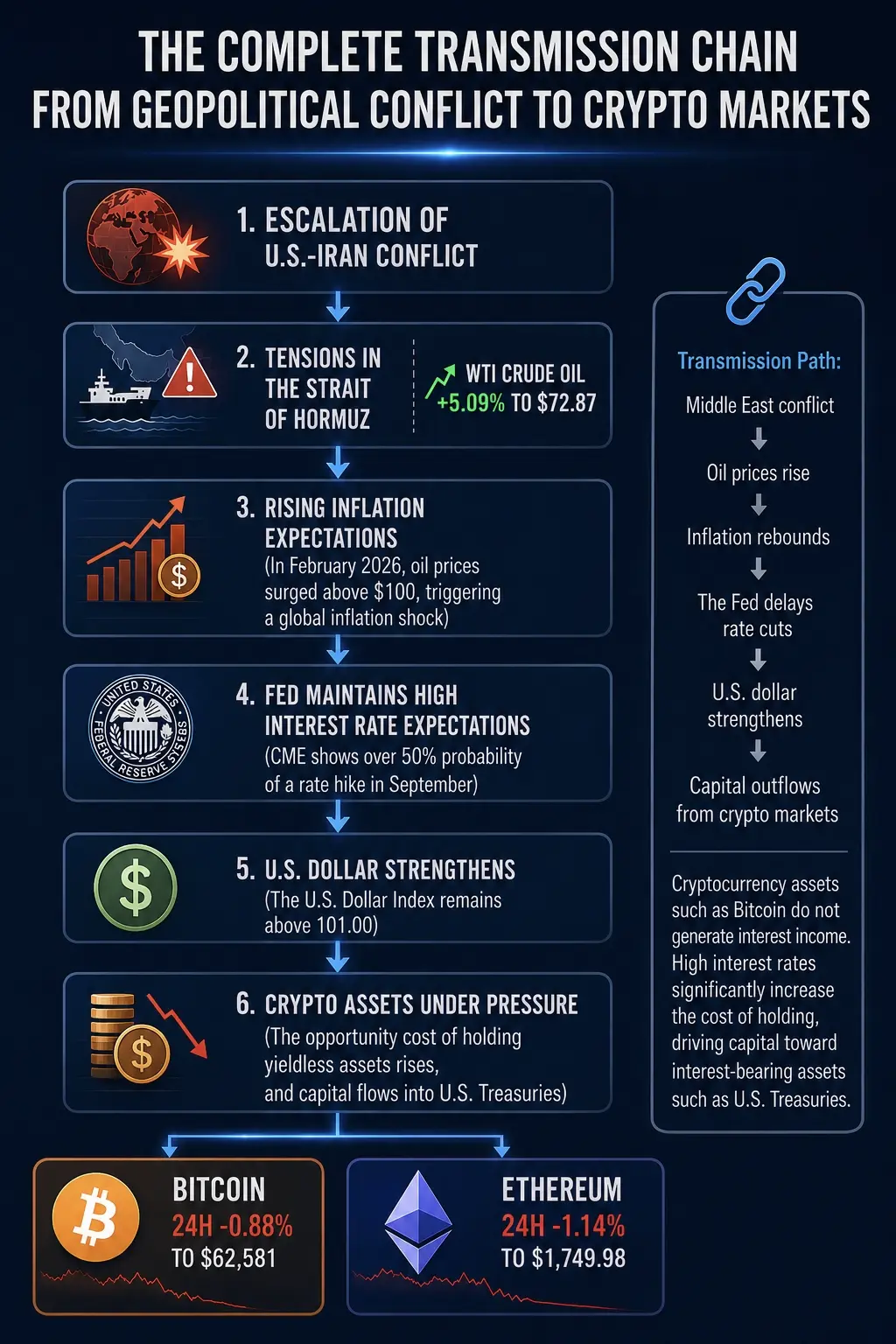
Full transmission chain from geopolitical conflict to crypto markets
High leverage environment: structural factors amplifying price volatility
Beyond macro transmission mechanisms, the microstructure of the crypto market itself also amplifies price swings.
On-chain data shows that Bitcoin futures market leverage has reached historic highs, with open interest hitting a record $67.9 billion. Average daily liquidations include about $68 million long and $45 million short. In such a highly leveraged environment, even a small 0.44% decline can trigger liquidations across large positions, causing a "liquidation waterfall" effect.
In the early hours of July 8, Bitcoin plunged from $63,446.1 to $62,919.0 within 15 minutes, a volatility of 0.83%. Ethereum also dropped sharply within the same period, falling 0.78% in 15 minutes, from $1,749.88 to $1,773.42. This is a typical manifestation of price amplification caused by high leverage combined with low liquidity periods.
Additionally, since early 2026, Bitcoin ETF fund flows have been continuously net outflows, with weekly outflows reaching $1.3 billion, significantly weakening institutional buying support. The "whale ratio"—the proportion of large holders transferring Bitcoin to exchanges—has remained above 0.35, indicating ongoing potential selling pressure. These structural factors together form the microfoundation for a market prone to sharp declines rather than gains.
Why has the "digital gold" narrative failed again?
Since its inception, Bitcoin's "digital gold" narrative has been one of its core value propositions. However, the market response to the recent U.S.-Iran conflict again challenges this narrative.
Reviewing several geopolitical events in 2026, Bitcoin's reactions have shown clear inconsistency: in February, U.S.-Israel airstrikes on Iran caused gold to rise but Bitcoin to fall; in May, U.S.-Iran negotiations dragged on, with Bitcoin mostly following U.S. stocks; and during this recent large-scale U.S. military strike, Bitcoin also failed to move independently.
This inconsistency points to a deeper issue: Bitcoin has yet to establish a stable, widely accepted risk-hedging pricing paradigm. Under different geopolitical scenarios, market liquidity conditions, and macro policy expectations, Bitcoin's price response varies significantly.
From an asset property perspective, Bitcoin has multiple identities—it can be a store of value, a risk asset, a speculative tool, or a vehicle for technological innovation. The market tends to emphasize different attributes depending on the environment. When inflation expectations dominate, Bitcoin is more likely to be viewed within the "non-interest-bearing assets suppressed by high interest rates" framework; when liquidity is ample and risk appetite rises, Bitcoin may be traded as a high-beta risk asset.
The European Central Bank (ECB) has noted that crypto assets are being incorporated into a unified global risk asset pricing framework: during episodes of risk aversion driven by geopolitical tensions, crypto assets do not necessarily act as traditional safe havens but may instead amplify volatility due to liquidity contraction, rising risk premiums, and investor position adjustments.
This assessment is clearly validated in this event.
Outlook: Short-term focus on geopolitics, medium-term on interest rates
In the short term, the evolution of the U.S.-Iran conflict remains the key variable influencing crypto market sentiment. Currently, both sides are in a "strike and negotiate" phase—military actions coexist with diplomatic talks, and escalation has not fully closed the door to negotiations. If the situation worsens and the Strait of Hormuz is blocked, energy prices could continue rising. If WTI surpasses the intraday high of $73.02 and moves higher, crypto assets will face greater macroeconomic pressure; if negotiations resume and safe-haven sentiment cools, Bitcoin may unwind some of its geopolitical premium.
In the medium term, the Federal Reserve's monetary policy path remains decisive. The July 8 release of the June FOMC minutes will provide key clues—market will focus on the Fed's latest assessment of inflation driven by energy prices. If oil prices only spike temporarily and inflation does not rebound, the rate cut cycle could continue, allowing crypto markets room to recover. Conversely, if oil prices stay high long-term, causing inflation to rebound, the Fed may prolong high interest rates or even hike further, putting continued pressure on crypto markets.
Some market observers note that Bitcoin has shown a certain "resilience" during this geopolitical shock—despite a collective decline in U.S. tech stocks, chip stocks, and a 4.65% drop in the Philadelphia Semiconductor Index, Bitcoin's overall decline has been relatively limited, without the panic selling seen previously. Does this suggest that Bitcoin's correlation with traditional risk assets is gradually weakening? More time and scenarios are needed to verify this.
FAQ
Q: Why didn't the escalation of the U.S.-Iran conflict push Bitcoin prices higher?
Geopolitical conflicts transmit to the crypto market through a chain: "oil prices rise → inflation expectations increase → Fed maintains high rates → non-yielding assets come under pressure." WTI crude surged over 5% in 24 hours to $72.87, Brent to $76.61, heightening concerns about secondary inflation. Meanwhile, a stronger dollar attracts capital flows, and high leverage in the market amplifies declines through liquidations. Currently, Bitcoin is more priced as a risk asset rather than a safe haven.
Q: Does the "digital gold" attribute of Bitcoin still exist?
The "digital gold" narrative has yet to establish a stable, widely accepted pricing paradigm. In different macro environments, the market selectively emphasizes its various attributes—sometimes as a risk asset, sometimes as a store of value. The recent simultaneous decline of Bitcoin and gold indicates its safe-haven role remains limited in the face of inflation-interest rate transmission. ECB research also suggests crypto assets are more likely to be integrated into a global risk asset pricing framework.
Q: Why has Ethereum fallen more than Bitcoin?
Ethereum has declined by 20.92% over the past 30 days, compared to Bitcoin's 10.73%. This reflects Ethereum's higher beta—assets with smaller market caps and lower liquidity tend to face greater selling pressure in liquidity-tight environments. Additionally, high leverage in Ethereum futures has triggered more aggressive liquidations during price drops.
Q: How long will the impact of this conflict on the crypto market last?
In the short term, the trajectory depends on how the U.S.-Iran conflict develops—escalation will pressure prices, while negotiations could unwind geopolitical premiums. In the medium term, the Fed's monetary policy is key: if oil prices only spike temporarily and inflation remains stable, crypto markets may recover; if WTI stays above $72 for long, causing inflation to rebound, markets will remain under pressure. The July 8 FOMC minutes are a critical upcoming indicator.
Q: What indicators should investors focus on in the current environment?
Investors should monitor four key areas: the progress of U.S.-Iran negotiations and Strait of Hormuz navigation status, the trend of international oil prices (whether WTI at $72.87 and Brent at $76.61 mark short-term peaks), U.S. inflation and employment data, and the flow of funds into Bitcoin ETFs and derivatives positions. These indicators are crucial for assessing how geopolitical risks are transmitting to the crypto market.