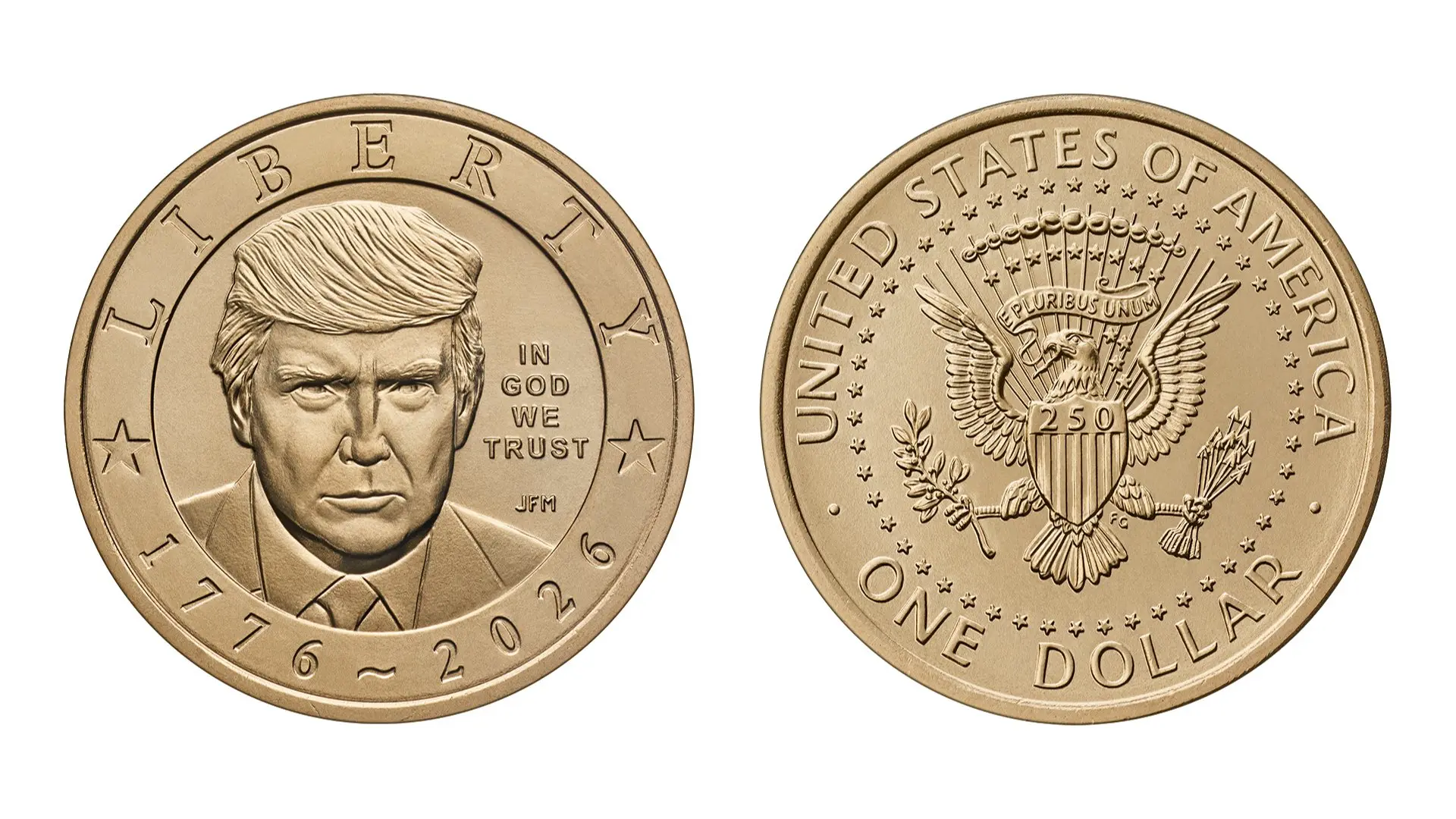
According to The Washington Post, U.S. Treasury Secretary Scott Bessent officially announced on July 15 that the U.S. Mint is set to produce a $1 gold-toned commemorative coin featuring a portrait of current President Trump on the obverse, to mark the United States’ 250th anniversary of nationhood (1776–2026). The Wall Street Journal clarified that the coin does not contain gold; its material is manganese brass, and its design is gold-colored.
Coin design details: “1776–2026” and Trump’s portrait on the obverse
 (Source: Scott Bessent post)
According to design display images provided by the U.S. Treasury, the main design elements of the $1 gold-toned coin are as follows:
Obverse: President Trump’s portrait, “In God We Trust,” “Liberty,” and the “1776–2026” anniversary date stamp
Reverse: The U.S. national symbol—a bald eagle with its two talons gripping an arrow (representing strength) and an olive branch (representing peace)
Material: Manganese brass, not gold
Appearance: Gold-toned design
Size: Slightly larger than 25 cents
Production location: U.S. Mint Philadelphia facility
Planned release: Fall 2026
Treasury cites the 1926 Coolidge precedent and a 2020 special act
According to reports, Bessent cited historical precedent from the 1926 half-dollar commemorating the 150th anniversary of nationhood during an interview with Fox News: at the time, then-President Calvin Coolidge and George Washington appeared together on the coin design, illustrating that a living president appearing on commemorative currency is not without historical basis.
The Treasury’s legal stance also cites the 250th anniversary commemorative coin act passed in 2020, arguing that the act provides special legal authorization to issue related commemorative coins at the major historical milestone of the 250th anniversary, thereby legally bypassing the “living portrait” restrictions in the 1866 federal law.
Strong opposition from Democrats to politicization of the currency
According to reports, a federal law passed in 1866 explicitly prohibits the use of living portraits on Treasury securities or currency, with the aim of preventing official money from becoming a tool for personal worship or political propaganda; this tradition has been upheld for more than a century and a half.
Democratic lawmakers strongly opposed the issuance plan, criticizing it as “a serious violation of the political traditions since the founding of the United States,” effectively turning national currency into a form of political messaging. Critics also noted that the 1926 historical precedent does not necessarily mean this issuance complies with current law, particularly against the backdrop of modern election politics, when the design could face stricter scrutiny.
FAQ
Does the U.S. 250th anniversary Trump portrait coin contain real gold?
Citing a U.S. Mint spokesperson, The Wall Street Journal clarified that the coin does not contain gold; the material is manganese brass, and it uses a gold-colored design. Although Treasury Secretary Bessent referred to it as a “gold coin” in the announcement, that describes the appearance rather than the material.
What legal basis did the Treasury cite to issue a coin featuring a Trump portrait?
According to reports, the Treasury cited two grounds: first, the 250th anniversary commemorative coin act passed in 2020 (providing special legal authorization); second, the 1926 historical precedent of the half-dollar commemorating the 150th anniversary of nationhood (with Calvin Coolidge appearing on the coin while in office).
When can this coin be purchased?
According to reports, the $1 gold-toned commemorative coin has already entered production at the U.S. Mint Philadelphia facility and is expected to be officially released in fall 2026. The Treasury is positioning it as a commemorative coin with both circulation and collectible value.


