
On June 15, Sharplink CEO Joseph Chalom posted a long thread on X, saying that Ethereum’s core competitive advantage is not speed, cost, or throughput parameters, but rather its talent ecosystem. According to Electric Capital data, the number of Ethereum lifetime developers has surpassed 1 million, with the exact figure at 1,012,824 independent developers who have contributed to the ecosystem.
Electric Capital Ethereum developer scale data
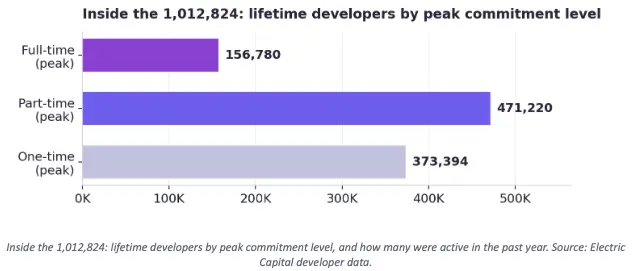 (Source: Electric Capital)
Based on Electric Capital’s confirmed numbers (cited in Chalom’s post):
Total lifetime developers: 1,012,824 independent developers
Active developers in the past 12 months: about 232,000
Chalom’s confirmed stance: “In crypto, no other ecosystem can get close to this scale”; the developer talent pool continues to deepen and expand
All the figures above come from Electric Capital’s data and serve as the external data source cited in this article.
Glamsterdam upgrade confirmed: ePBS and BALs planned for 2026
Chalom confirmed the following Ethereum roadmap facts in his post:
Glamsterdam upgrade (planned for 2026):
· ePBS (a mechanism that separates proposers and builders): unlocks parallel execution capabilities and improves throughput
· BALs (block-level access lists): helps increase the Gas limit and boost Layer 1 capacity
· Goal: while improving scalability, maintain neutrality, security, and MEV fairness
Chalom characterized this upgrade as an example of “innovating without breaking the core principles.”
Ethereum Foundation post-quantum security team: established in early 2026, targeting migration by 2029
Post-quantum readiness facts confirmed in Chalom’s post:
Post-quantum security team: officially set up by the Ethereum Foundation in early 2026
pq.ethereum.org hub: a post-quantum research center has been established
Testnets: more than ten client teams run a weekly post-quantum interoperability developer testnet
Target timeline: coordinate a unified post-quantum migration, aiming to complete it around 2029
Chalom’s three “moats” statements: verifying nodes, modularity, and culture
According to the statements Chalom confirmed in his post (his personal views, not independently verified by a third party):
Credible Neutrality: Ethereum is secured by more than 900,000 validating nodes; Chalom said Solana’s validating nodes are about 800, and pointed out that large institutions assign a high premium to decentralization levels.
Modularity: Chalom said rollups such as Base, Arbitrum, and Optimism have not fragmented Ethereum, but instead expanded it into a modular, interconnected internet economy that is becoming increasingly tightly linked.
Culture and standards: Chalom said Ethereum is especially attractive to top researchers, cryptographers, and EIP standard authors—“this is the hardest advantage to replicate via a hard fork.”
FAQ
What is the Glamsterdam upgrade mentioned in Chalom’s post?
Based on Chalom’s description, Glamsterdam is an Ethereum upgrade planned for 2026. The core changes include incorporating ePBS (a proposers/builders separation mechanism) and BALs (block-level access lists), aiming to unlock parallel execution and significantly improve Layer 1 throughput while maintaining the network’s neutrality and MEV fairness.
Where does the 1 million developer figure for Ethereum come from?
Chalom’s post confirms that this number comes from Electric Capital’s statistics. The exact figure is 1,012,824 lifetime independent developers who have contributed to the Ethereum ecosystem; among them, active developers in the past 12 months are about 232,000.
Is there a conflict of interest in Chalom’s Ethereum position?
According to the background described in the article, Chalom is the current CEO of Sharplink, and Sharplink has announced that it will execute an Ethereum enterprise procurement strategy. Chalom previously worked at BlackRock and the article mentions his prior background at BlackRock. All viewpoints in this article are attributed to Chalom personally and are an opinion piece published publicly.


