In late May 2026, the progress of the US-Iran negotiations showed the clearest diplomatic signals since the escalation of the current round of conflict. On May 23, US President Trump publicly said the two sides had “basically reached” an agreement, and the Strait of Hormuz would be opened accordingly. Iran also confirmed that the memorandum of understanding is in the final stage of being finalized. Meanwhile, funding bets on the decentralized prediction platform Polymarket show that market expectations for the probability of a permanent US-Iran peace agreement are undergoing a structural shift.

How prediction markets price the probability of an agreement across different time checkpoints
As of May 25, 2026, Polymarket’s prediction contract for “a permanent US-Iran peace agreement” shows a clear time-based probability gradient. Betting data indicate the probability of an agreement on May 26 is 8%, rising to 22% on May 31, 29% on June 7, reaching 64% on June 30, dropping to 35% on July 15, rising to 47% on July 30, and as high as 76% by December 31.
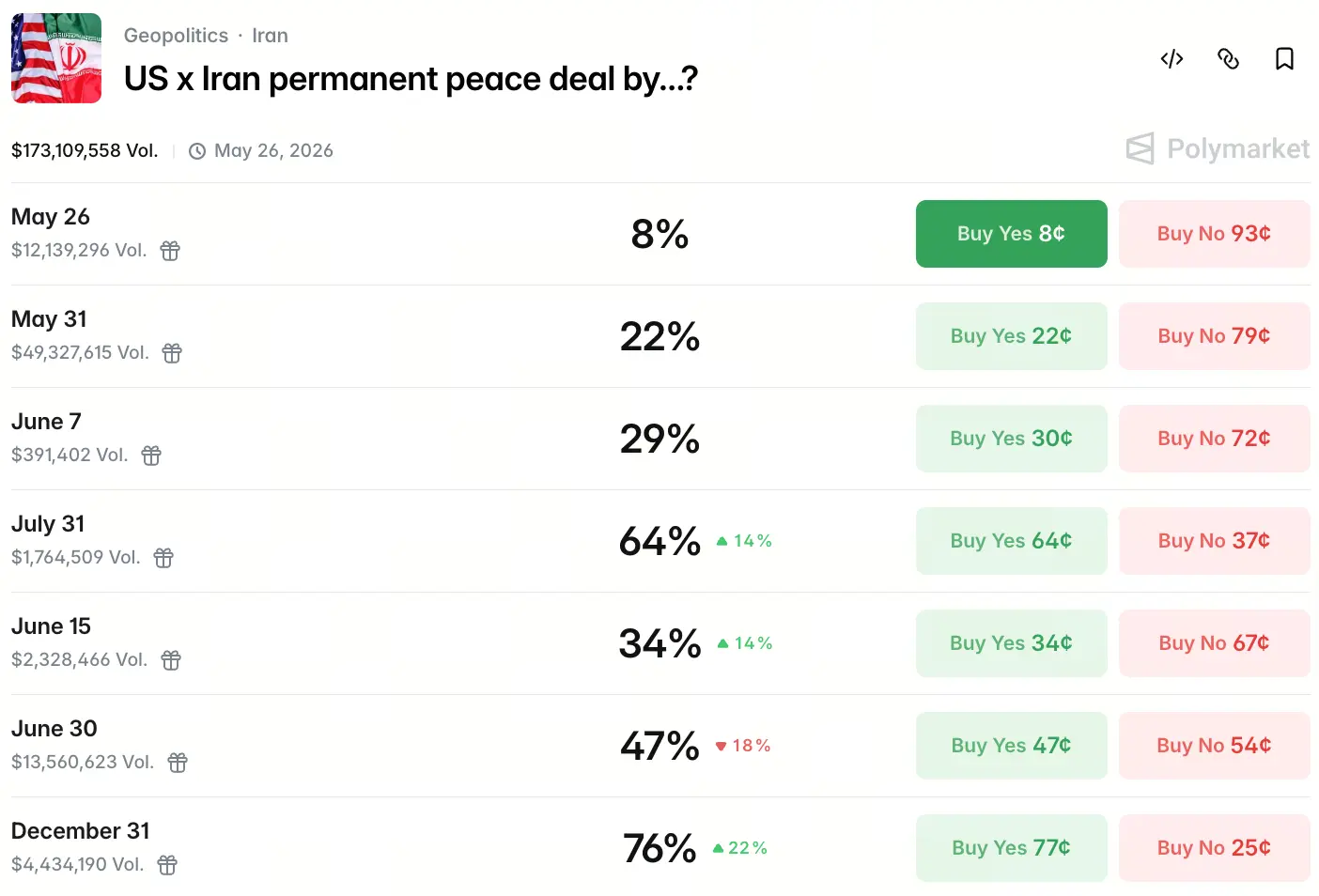
This distribution reflects the market’s view that the likelihood of reaching an agreement is higher around late June to early July and before year-end, while expectations remain relatively low in the near term (before late May). The non-monotonic changes in the probability curve also suggest traders are weighing multiple diplomatic variables.
How external political signals affect the probability curve in prediction markets
Trump’s May 23 social media statement that things had “basically been worked out” became the direct catalyst for this round of probability adjustments. Previously, Polymarket’s probability of reaching an agreement on June 30 had hovered around 45% for a long time; after the news was released, it quickly jumped to 64%. On the same day, US Secretary of State Rubio also confirmed that the talks were “making progress,” further strengthening the market’s expectations of a near-term breakthrough.
What’s worth noting is that although Iran confirmed it is in the final stage of finalizing the memorandum of understanding, it also clearly stated that no nuclear issue details are involved at this stage—only focusing on ending the war. This difference in stance creates a clear discount between Polymarket probabilities for July 15 and July 30—suggesting the market remains cautious about potential new disagreements that could arise after the scope of talks expands.
Why the crypto industry is highly focused on the US-Iran geopolitical turning point
The impact of the US-Iran situation on crypto assets at least includes three layers:
- First, the status of shipping through the Strait of Hormuz directly affects global oil supply and transportation costs, which then feeds into inflation expectations and the policy paths of major economies’ monetary authorities—while the crypto market is extremely sensitive to liquidity expectations.
- Second, geopolitical tensions easing usually reduces demand for “digital gold” safe-haven hedging; but if the agreement comes with adjustments to sanctions on Iran’s finances, it may release previously isolated crypto mining and trading activity.
- Third, prediction markets themselves, as an application scenario within the crypto ecosystem, are drawing more attention from traditional capital due to the credibility and efficiency of their bet data. Over the past week, trading volume for this contract on Polymarket has grown by more than threefold.
How capital flows reflect structural judgments about the negotiation process
From the shape of the probability distribution, June 30 (64%) and December 31 (76%) are the two major concentration points. This distribution is not a simple linear extrapolation, but rather reflects a two-part pricing logic: a “short-term window” and a “long-term fallback.” The high probability on June 30 corresponds to a 30 to 40 day negotiation sprint that may follow the US side’s public statement. The highest probability on December 31 implicitly reflects the market’s stronger confidence that the issue can be resolved within the year.
It’s also notable that the probability jump between July 15 (35%) and July 30 (47%) lines up in time with Iran’s mention of “not involving nuclear issues.” The market seems to be pricing in a new round of uncertainty after nuclear issues are brought back into the negotiations.
What biases exist between prediction market data and political negotiation logic
The effectiveness of prediction markets is based on assumptions that participants have sufficient information and that their motivations are genuine. But in the context of US-Iran negotiations, three potential biases need attention.
- First, external public statements may be perceived as part of a negotiation strategy rather than an objective reflection of real progress.
- Second, a subset of participants with internal information channels may face slippage issues due to insufficient trading liquidity.
- Third, the definition of “a permanent peace agreement” within the contract settlement conditions itself leaves room for subjective judgment—what counts as “permanent” and what counts as “peace.” Differences in standards among participants may distort probability interpretation.
The current 76% end-of-year probability on Polymarket should be understood as the market’s expectation of “some form of high-level agreement,” not as a precise forecast of an indefinitely conflict-free state.
The room for expansion of event-driven prediction in the crypto ecosystem
The active trading of the US-Iran agreement contract on Polymarket further validates the value of prediction markets as information-aggregation mechanisms. Unlike traditional polls or expert predictions, on-chain prediction markets achieve incentive-compatible information aggregation through funding bets. For the crypto industry, this application scenario is expanding from political events to areas such as macroeconomic indicator releases, regulatory policy directions, and technical upgrade timelines. In the first half of 2026, the year-over-year trading volume growth of structured products based on prediction markets (such as event contracts) on decentralized derivatives exchanges exceeded 210%. This means prediction data itself is becoming a risk management tool that can be traded and hedged.
Differential impacts of different time points after an agreement is reached on crypto assets
If an agreement is reached in late June to early July, it coincides with the mid-year monetary policy window of the Federal Reserve and the second-quarter crypto asset settlement cycle, which could create a combined effect of improved liquidity conditions and risk appetite. If the agreement is delayed to year-end (the high-probability scenario of December 31), factors such as policy continuity under the new government after the US election, changes in winter energy demand, and Iran’s domestic political cycles need to be considered. Crypto assets’ sensitivity to these two scenarios differs significantly: a short-term agreement more strongly boosts immediate sentiment for trading-focused tokens, while an agreement within the year has a more stable effect on long-term portfolio structure. The current bet distribution on Polymarket suggests the market leans more toward the latter: resolving the issue before year-end is viewed as the baseline scenario, while the June-July window is seen as the possibility of a “positive surprise.”
Risk boundaries for event trading and a data interpretation framework
Directly equating prediction market data with “the probability that an event will occur” is a common misinterpretation. In actual trading, bet prices are also influenced by liquidity depth, settlement mechanisms, participants’ risk preferences, and volatility in the token denomination. Polymarket uses USDC for settlement, meaning changes in the supply and demand of the dollar stablecoin can indirectly affect probability readings as well. Additionally, the size of capital in prediction markets is not yet sufficient to fully arbitrage all external information. Traditional financial institutions, diplomatic policy experts, and geopolitical risk hedge funds are not participating at scale. Therefore, the current 76% year-end probability is more appropriate to interpret as “the confidence level of crypto-native capital in the agreement being reached,” rather than as an absolute objective statistical probability.
FAQ
Q: Does Polymarket’s 76% end-of-year probability mean the agreement is almost certain to be reached?
A: No. 76% represents the confidence level of the capital placing bets that some form of agreement will be reached by year-end—not an objective statistical probability. Prediction markets have biases such as liquidity, settlement definitions, and participant structure.
Q: Is the US-Iran agreement good news for crypto asset prices?
A: The impact is multi-layered. In the short term, it may reduce safe-haven demand and pressure some crypto assets; but in the long term, opening the Strait of Hormuz could help stabilize energy prices and inflation expectations, potentially improving the overall liquidity environment for risk assets.
Q: How can ordinary investors use prediction data from Polymarket?
A: The data can be treated as a reference indicator of market sentiment and information aggregation, not as a trading signal. It’s recommended to combine it with traditional geopolitical analysis frameworks, liquidity data, and the specific progress of the negotiation.
Q: After an agreement is reached, how are the contracts on Polymarket settled?
A: Settlement is based on pre-set objective conditions (such as both sides signing a formal peace agreement and publishing it publicly). The specific terms are ultimately adjudicated by Polymarket’s decentralized oracle or a designated mediation committee.


