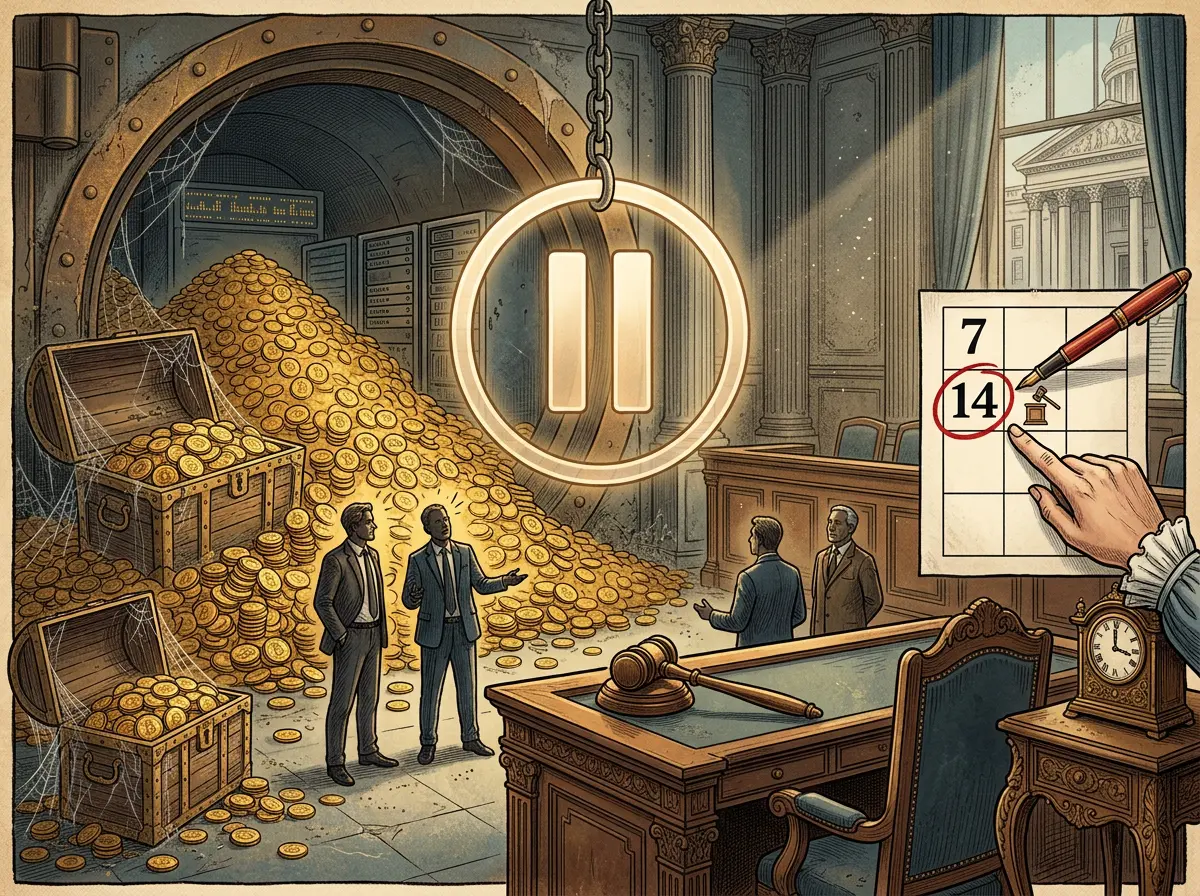
On June 4, New York State Supreme Court Judge Casey J. King signed an order to halt all further proceedings in the case “ABC, XYZ Company and Noah Doe v John Doe,” pending a hearing scheduled for July 14 to determine whether to accept amicus curiae (friend of the court) opinion statements. The case seeks to assert ownership over 39,069 dormant Bitcoin wallets.
Case Background: Noah Doe’s Lost Property Claim and Defendant Identification Process
Plaintiff Noah Doe claims that he used a proprietary algorithm to identify 39,069 dormant Bitcoin wallets, and between December 2024 and April 2025, he sent USB flash drives containing these addresses in batches to the 17th Precinct of the New York City Police Department. He then instructed blockchain experts to send OP_RETURN messages pointing to a notice-of-abandonment page hosted by Salomon Brothers Strategic Advisors for each address.
The plaintiff deemed wallet owners who did not respond within 90 days to have forfeited their property. Galaxy Research characterized the action as a “Bitcoin sweep,” involving sending OP_RETURN messages to approximately 41,000 wallets holding roughly 2.3 million BTC.
The addresses listed as defendants include a “1Feex” wallet associated with the 2011 Mt. Gox hacking incident (holding about 80,000 BTC), as well as addresses that Galaxy Research identified as matching the “Patoshi pattern” (related to Bitcoin’s founder).
After the lawsuit was made public, several wallets listed as defendants conducted on-chain transactions: Alex Thorn, head of Galaxy Research, noted that defendant address #37923 (last active June 17, 2011) transferred 47.26 BTC (about $3 million) on June 6, 2026; another wallet that had been dormant since March 2011 transferred 35.55 BTC (about $2.2 million) on June 2.
Cohen’s Amicus Argument: The Main Opposition to Confirmation
Attorney Ian R. Cohen of IRC Legal Advisors LLC filed a 26-page brief on May 29, 2026. His core arguments include: the lost property law assumes the finder has actual physical possession of a tangible item that can be locked in an evidence locker, whereas a blockchain address cannot, in a legal sense, be treated this way; the defendant wallets were “never lost or hidden and were always visible to the whole world,” and algorithmic identification is “data mining” rather than “searching,” and the statute was never designed for such “industrial-scale asset identification.”
Cohen also pointed out that the 1Feex address is currently subject to a civil reorganization process supervised by a court-appointed trustee in Japan, and is a potential target for criminal forfeiture by the U.S. Department of Justice. If a New York state court were to declare private ownership, it could conflict with the parallel proceedings. Additionally, Cohen cited New York State’s 2022 amended Abandoned Property Law, arguing that the state legislature created a pathway to transfer abandoned crypto assets to the state comptroller rather than allowing private claims. Without private keys, any declaratory judgment cannot be enforced on the Bitcoin network.
FAQ
Why is New York’s lost property law considered inapplicable to Bitcoin wallets?
Based on Cohen’s brief, the legal basis of the lost property law assumes the finder has actual physical possession of a tangible lost item. Bitcoin wallet addresses are publicly visible on the blockchain and have never been “found” or “held” by anyone. Cohen further noted that the New York State legislature amended the Abandoned Property Law in 2022 to establish a mechanism for transferring idle cryptocurrency to the state comptroller, indicating that the legislature believed the lost property law was not meant to apply to such assets in the first place.
What do the on-chain Bitcoin transfers triggered by the lawsuit mean?
After the lawsuit became public, several dormant wallets listed as defendants showed on-chain activity: one address that had not moved since June 17, 2011 transferred 47.26 BTC on June 6, and another wallet dormant since March 2011 transferred 35.55 BTC on June 2. These actions suggest that some of the wallet owners who were originally accused of having “abandoned” their Bitcoin still hold and can access their private keys, directly undermining one of the plaintiff’s core claims—that these wallets were abandoned.
The plaintiff seeks declaratory ownership, but without private keys, what practical meaning does such a court ruling have?
Cohen’s brief explicitly states that if the court declares that Noah Doe has ownership of these wallets but Noah Doe does not possess any relevant private keys, such a ruling would be “unenforceable on the Bitcoin network,” because Bitcoin’s decentralized architecture makes it structurally unaffected by judicial decisions. Cohen also warned that such a declaratory ruling could mislead exchanges, custodians, and institutional counterparties into believing that the plaintiff holds enforceable ownership.


