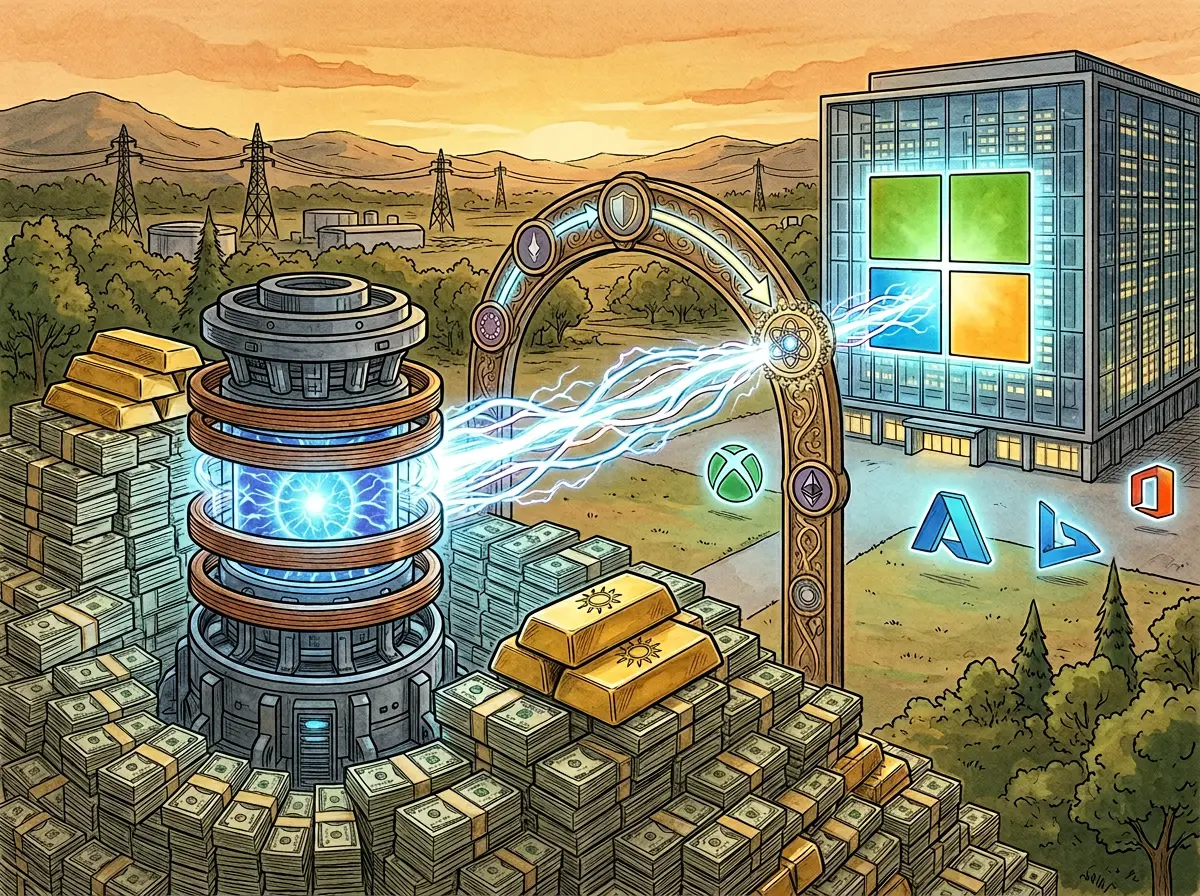
Fusion startup Helion announced on June 5 that it has completed a $465 million Series G funding round, valuing the company at $15.5 billion—nearly triple its 2025 valuation level. Sam Altman disclosed in a video conversation with Musk this year that he holds about one-third of Helion’s equity. The round comes as Helion builds its first power plant, Orion, with a goal of powering Microsoft by 2028.
$465 million Funding Round: Investor Composition Confirmed
According to Helion’s official announcement, this Series G round is led by Thrive Capital. New investors include Alta Park Capital, Anti Fund, and BoxGroup; existing shareholders Capricorn Technology Impact Funds and Lightspeed Venture Partners, along with a university endowment fund, also participated.
After this funding round is completed, Helion’s valuation will reach $15.5 billion, nearly triple its 2025 valuation level.
Microsoft PPA and the Orion Power Plant
Helion’s fusion power purchase agreement (PPA) with Microsoft is the industry’s first of its kind. The key confirmed terms are: Helion commits to supply to the grid at least 50 MW of commercial fusion power as early as 2028, with the power buyer being Microsoft’s data center in central Washington state. The first power plant, Orion, is currently under construction.
CEO David Kirtley, in response to outside doubts about technical feasibility, said: “We don’t want to talk about fusion—we just want to build it.” Notably, some fusion physicists are skeptical of Helion’s technical claims, in part because Helion publishes very few papers in peer-reviewed journals, making it difficult for external researchers to independently verify the underlying physics.
Recent Funding Wave in the Fusion Track
In recent months, the fusion sector has collectively absorbed more than $1 billion in investment. Confirmed recent rounds include: Focused Energy about $240 million (announced last week); Thea Energy about $100 million (announced last week); Inertia Energy about $450 million Series A (announced February 2026, also ending its stealth mode); Type One Energy is currently raising a $250 million Series B. However, most fusion companies admit that their first commercial-scale power plant will only be able to operate around 2035 at the earliest. Helion’s 2028 target is the most aggressive outlier in the industry.
FAQ
How is Helion’s fusion technology roadmap fundamentally different from other companies?
Most fusion startups’ approach is to use magnets or lasers to confine ultra-high-temperature plasma, using the heat generated by fusion to drive steam turbines for electricity generation—similar in principle to coal-fired power, just with a different heat source. Helion, however, skips the steam turbine step and instead lets the plasma expand and push against the magnetic field, converting that mechanical motion into electrical output—similar to an electric vehicle’s regenerative braking system. Helion claims this can significantly reduce energy loss during the conversion process; but due to the lack of peer-reviewed papers, outsiders cannot independently verify the claim.
Does Sam Altman stepping down from Helion’s board affect his stake?
Based on confirmed publicly available information, Altman holds about one-third of Helion’s equity. Stepping down from the board is only giving up his seat on the board, not selling shares. His resignation took place in March 2026, aiming to clarify the boundaries of any conflict of interest between him and OpenAI. Altman still holds Helion’s shares, which was also confirmed in the Musk v. Altman court proceedings.
If the 2028 target for the fusion power supply agreement is not met, does Microsoft have a breach/claim mechanism?
So far, publicly available information has not disclosed the specific breach terms details of Helion and Microsoft’s fusion PPA. Based on Helion’s public statements, the agreement is phrased as “as early as 2028,” and the wording itself includes schedule flexibility. Neither Helion nor Microsoft has released any official explanation about the consequences of not meeting the agreement.


