Bitcoin fell to $62,982 on June 24. Contributing pressure factors include: U.S. spot Bitcoin ETFs have seen no positive 7-day SMA since mid-May, indicating a significant drop in institutional demand; CME FedWatch shows traders currently estimate the probability of a December rate hike by the Federal Reserve at about 86%; and after the U.S.-Iran Swiss talks, Trump claimed Iran agreed to unlimited inspections, but Tehran denied any concessions, with negotiation details contradicting each other.
Glassnode: Since mid-May, U.S. spot Bitcoin ETFs have seen no net positive inflows
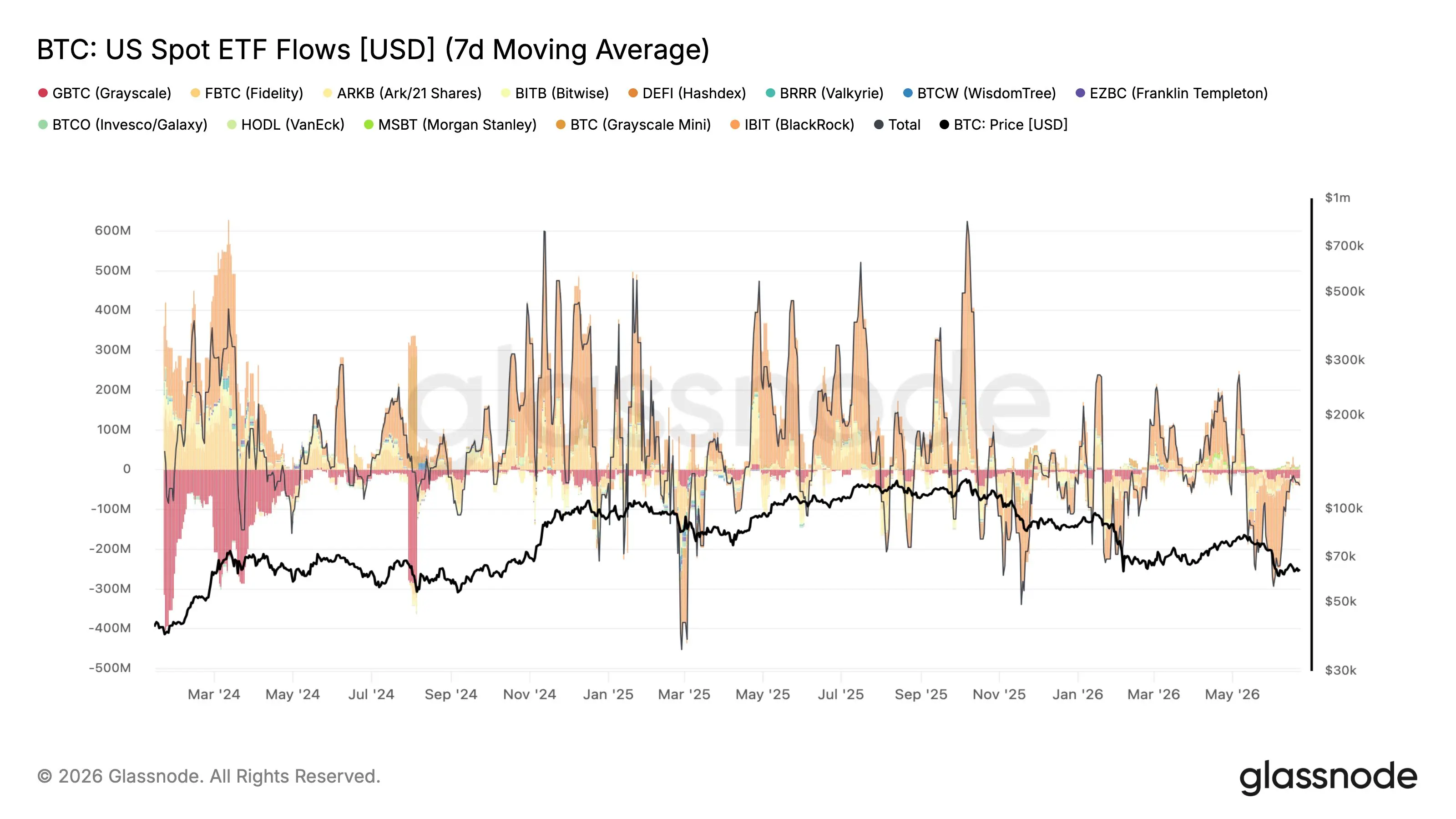 (Source: Glassnode)
According to Glassnode’s June 23 analysis, U.S. spot Bitcoin ETFs have shown no positive figures on the 7-day simple moving average (SMA) since mid-May, indicating that traditional finance (TradFi) capital remains cautious about participating in Bitcoin trading at current price levels. Consolidated fund flow data shows no positive momentum, reflecting that institutional investors are generally in a wait-and-see stance.
CME FedWatch: December Fed rate-hike probability rises to 86%
CME’s “FedWatch” tool shows traders currently estimate the probability of a December rate hike by the Federal Reserve at about 86%, far higher than 61% before last week’s Federal Reserve meeting. The backdrop is that newly appointed Fed chair Kevin Warsh has issued hawkish signals to curb inflation.
The 2-year U.S. Treasury yield, which is most sensitive to the interest-rate outlook, is 4.19%, up 71 basis points from 3.475% at the start of 2026. The U.S. June S&P Global Manufacturing PMI rose to 55.7, above May’s 55.1 and the expected 54.8. The report indicates that manufacturers placed orders early to avoid energy shortages triggered by the U.S.-Iran war, and manufacturing activity improved.
Latest U.S.-Iran developments: Trump says Iran agreed to unlimited inspections; Tehran denies making concessions
On the U.S. side, on June 23 Trump said Iran has “fully and completely” agreed to accept the highest-level “unlimited” inspections. Based on Iran’s acceptance of inspections and “other major concessions currently being made,” the U.S. allowed the Strait of Hormuz to remain open and ended the maritime blockade, but U.S. warships will still stand by in place. VP Vance said the Swiss talks laid a good foundation for a final peace agreement; the U.S. announced a 60-day suspension of sanctions on Iran (starting Monday).
On Iran’s side, Tehran denied making such concessions in the negotiations. Iran’s chief negotiator said Hormuz “can never be restored to pre-war conditions.” Iran’s foreign ministry stated that the IAEA inspection personnel currently have no plans to visit damaged nuclear facilities in Iran. The first round of U.S.-Iran Swiss talks ended on Monday, and the parties’ statements on issues such as who controls Hormuz, economic incentives, and Israeli military actions in Lebanon contain contradictions.
U.S. economic data due this week: PCE, GDP, and initial jobless claims
Key data due this week include: on Thursday, the U.S. core personal consumption expenditures (PCE) price index (the inflation gauge favored by the Federal Reserve); on Thursday, U.S. gross domestic product (GDP) data; and initial jobless claims.
FAQ
Does the lack of net positive inflows in Bitcoin spot ETFs mean institutions are withdrawing capital?
Based on Glassnode’s explanation, since mid-May the 7-day SMA has not shown positive readings, which indicates a pause in institutional fund inflows—not necessarily active withdrawals. The article notes this may mean that higher prices may be needed to attract institutional capital back into the market.
How do contradictions in the U.S.-Iran talks affect Bitcoin and oil prices?
According to reports, the two sides’ statements on inspection terms and control of Hormuz contain contradictions, increasing uncertainty about a peace agreement. WTI crude oil has fallen by more than 3% cumulatively this week, but the contradictory statements may limit further downside. For Bitcoin, geopolitical uncertainty combined with rate-hike expectations together create near-term downside pressure.
What does the Fed’s December rate-hike probability rising from 61% to 86% mean for the market?
Based on CME FedWatch data, the sharp rise in the probability of a December rate hike (+25 percentage points) means the market now believes a scenario of interest rates staying at “long-term highs” is more likely to persist. The rise in the 2-year U.S. Treasury yield by 71 basis points confirms this expectation, adding further pressure to risk assets such as Bitcoin.


