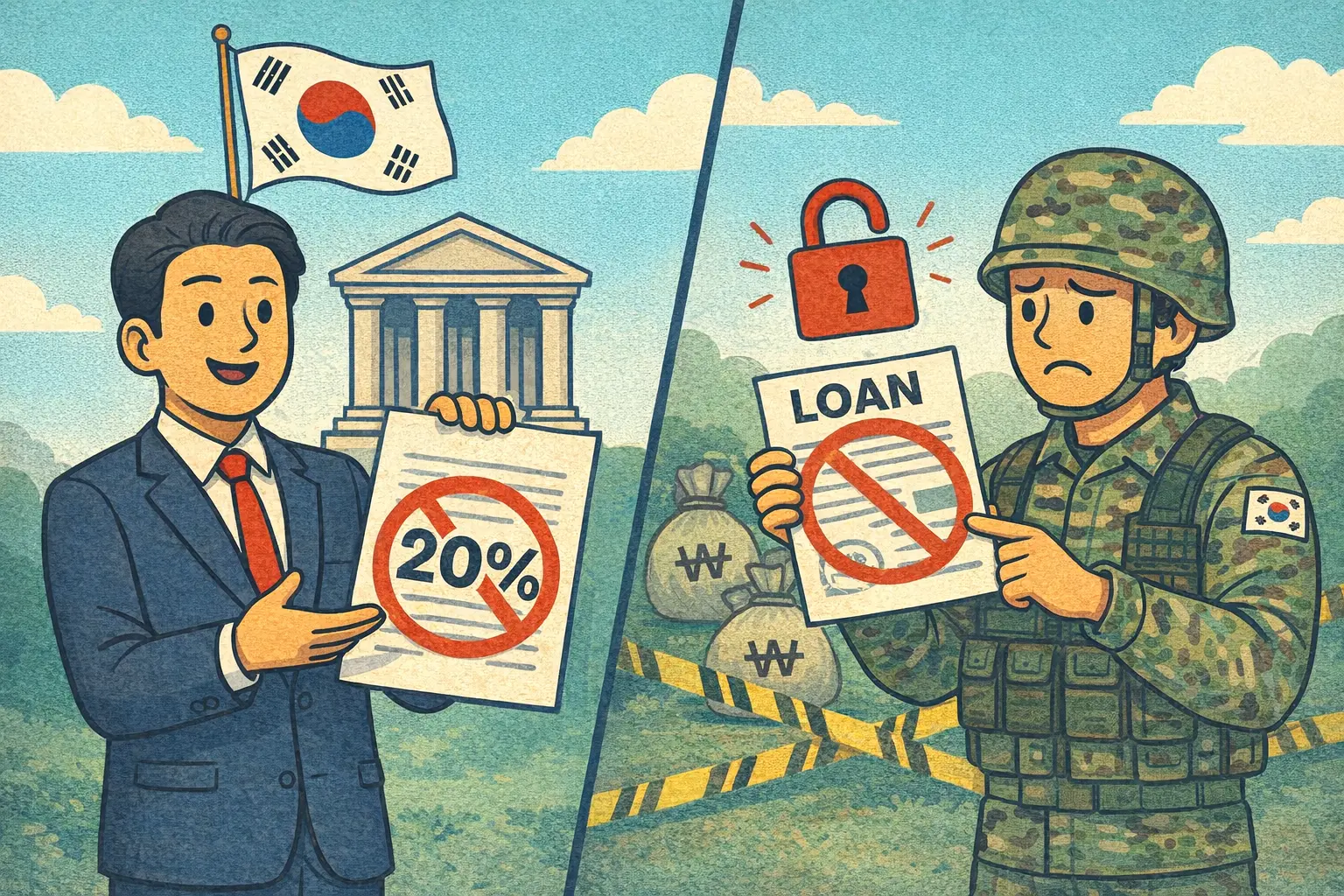
On June 24, South Korean Democratic Party lawmaker Kim Young-hwan introduced a bill to amend the Credit Business Registration and Financial User Protection Act. The bill would lower the interest rate threshold—under which loan contracts would be entirely void—from the current annual rate of 60% to 20%. Once a loan agreement is concluded, the creditor would not be allowed to claim back the principal or interest. The Financial Supervisory Service (FSS) announced the same day that it was discussing with the Korea Loan Association restrictions on issuing unsecured loans to active-duty military personnel. The final goal is to completely prohibit the relevant business.
The bill proposes lowering the contract invalidity threshold from 60% annual interest to 20%, with no right to claim back principal
Under current law, loans with an annual interest rate exceeding 60% are regarded as anti-social contracts, and creditors may not claim back principal or interest. For loans with annual interest between 20% and 60%, creditors can still claim back principal and interest within the maximum allowable interest rate. The key change in this bill is lowering the contract invalidity threshold from 60% to 20%.
Kim Young-hwan’s office explained that under the current system, even if illegal lenders are caught, they can still recover the principal, which in practice weakens the law’s deterrent effect. An office staff member said, “Only when even the principal cannot be recovered can the incentive for illegal lenders to sign high-interest contracts be reduced.” The civic group People’s Solidarity for Participatory Democracy (PSPD) also supports the revision, noting that the current system leads illegal lenders to believe that “even if they’re caught, the principal can be recovered.”
Industry observers said many borrowers using illegal financing have lower credit scores and therefore have difficulty accessing legitimate institutions such as banks and savings banks in the first place. Simply increasing penalties cannot guide them into the legal market. Industry representatives said that current legitimate loan companies obtain funding from capital companies and savings banks at a cost of 7% to 8%, and then issue loans at an interest rate of around 10%. “Expanding the loan supply base must be done in parallel, including increasing the funding amounts that banks provide to loan institutions that are stronger in terms of capacity.”
The Financial Supervisory Service and the Korea Loan Association are discussing measures, with the ultimate goal of completely banning lending to active-duty military personnel
The Financial Supervisory Service is working with the Korea Loan Association to explore how to restrict unsecured loans to active-duty military personnel obtained based on pay-slips. The reason is that wages during service are not viewed as continuous income, unlike income documentation standards recognized by banks. In April this year, the authorities already directly required some lending institutions to limit lending to active-duty military personnel. The final goal of the discussions is to completely ban loan business targeting active-duty servicemembers.
For military “loyalty loans” and “non-commissioned officer loans” offered in an unsecured form, the maximum amount reaches 15 million South Korean won, with an annual interest rate of about 20%. According to authorities’ statistics, some servicemembers used loans to invest in stocks or virtual assets, and the amount of military debt adjustment increased from 5.6 billion South Korean won in 2021 to 10.2 billion South Korean won last year.
The Financial Services Commission has decided to strengthen financial education for servicemembers; the FSS and the Ministry of National Defense have begun cooperation
On June 16, 2026, the Financial Services Commission (FSC) decided at its first financial education meeting to strengthen education to prevent servicemembers’ one-time savings from being used for indiscriminate investments. The Financial Supervisory Service has partnered with the Ministry of National Defense to provide financial counseling services starting from each service period. In a recent monthly meeting, FSS Chairman Lee Chan-jin said, “We are conducting financial education regularly and systematically, but when it reaches the front lines, the situation becomes extremely severe.”
Frequently Asked Questions
How does current South Korean law handle high-interest loans, and what core change does the bill propose?
Under current law, loan contracts with an annual interest rate exceeding 60% are entirely void, and creditors may not claim back principal or interest; for loans with annual interest between 20% and 60%, creditors may claim back principal within the maximum interest rate. This bill would lower the threshold for outright invalidity from 60% to 20%, so that once a loan agreement with an annual interest rate above 20% is concluded, even the principal cannot be claimed back.
Why does the industry believe that legislation alone cannot solve the problem of illegal private financing?
Many borrowers using illegal financing have lower credit scores and are already unlikely to be able to obtain services from banks or legitimate financial institutions. Without expanding credit supply from the formal sector, demand pushed out of the legal market will flow to the illegal market, limiting the effect of legislation. Industry representatives specifically proposed reducing their costs and thereby expanding coverage for borrowers with low credit by increasing the funding amounts that stronger loan institutions receive from banks.
What specific measures has the Financial Supervisory Service already taken regarding loans to active-duty military personnel?
In April this year, the Financial Supervisory Service directly required some lending institutions to restrict lending to active-duty military personnel; it is currently discussing more comprehensive restriction measures with the Korea Loan Association, with the ultimate goal of completely banning the relevant business. The Financial Supervisory Service has also partnered with the Ministry of National Defense to provide financial counseling services starting from the service period. The Financial Services Commission decided on June 16 to strengthen the related financial education.


