Core Mechanisms of the CLARITY Act: Ending the Decade-Long “Nobody Knows Who Owns It” Stalemate
The CLARITY Act (full name: the “Digital Asset Market Clarity Act,” H.R. 3633) aims, at the federal level, to establish a comprehensive regulatory framework for digital assets. For a long time, the biggest dilemma facing the U.S. crypto industry has not been that regulation is too strict or too loose—it has been that “nobody knows who regulates it.”
The SEC uses the 1946 Howey Test to determine whether a token constitutes a security—by applying the standard of a “reasonable expectation of profits to be derived from the efforts of others,” which effectively has swept nearly all tokens into the category of securities. Meanwhile, the CFTC treats Bitcoin, Ethereum, and others as commodities, but there is no unified statutory definition of a “digital commodity.” The same class of assets can be re-characterized across different stages, making it difficult for exchanges, brokers, and issuers to design a predictable compliance architecture.
The CLARITY Act does not try to overturn the Howey Test. It does something more nuanced: it creates a brand-new legal category called “ancillary asset.” If a token’s value depends on the “entrepreneurial or managerial efforts” of the issuer or the core team, then it is an ancillary asset. The bill acknowledges the relationship of “reliance on efforts of others” discussed in Howey, and then separately sets a rule for this kind of arrangement: in law, the act of issuance is treated as “involving securities,” but once the token is issued, it is no longer a security—it becomes an ancillary asset, governed by disclosure rules rather than registration rules.
In plain terms, the CLARITY Act creates a middle layer with a “lower density of disclosure obligations than securities, but higher than commodities,” designed specifically to house things that are neither like stocks nor like commodities. That means token distribution pathways for projects operating in the U.S. will become clearer; they won’t need to route around with exemptions like SAFT, Reg D, and Reg S.
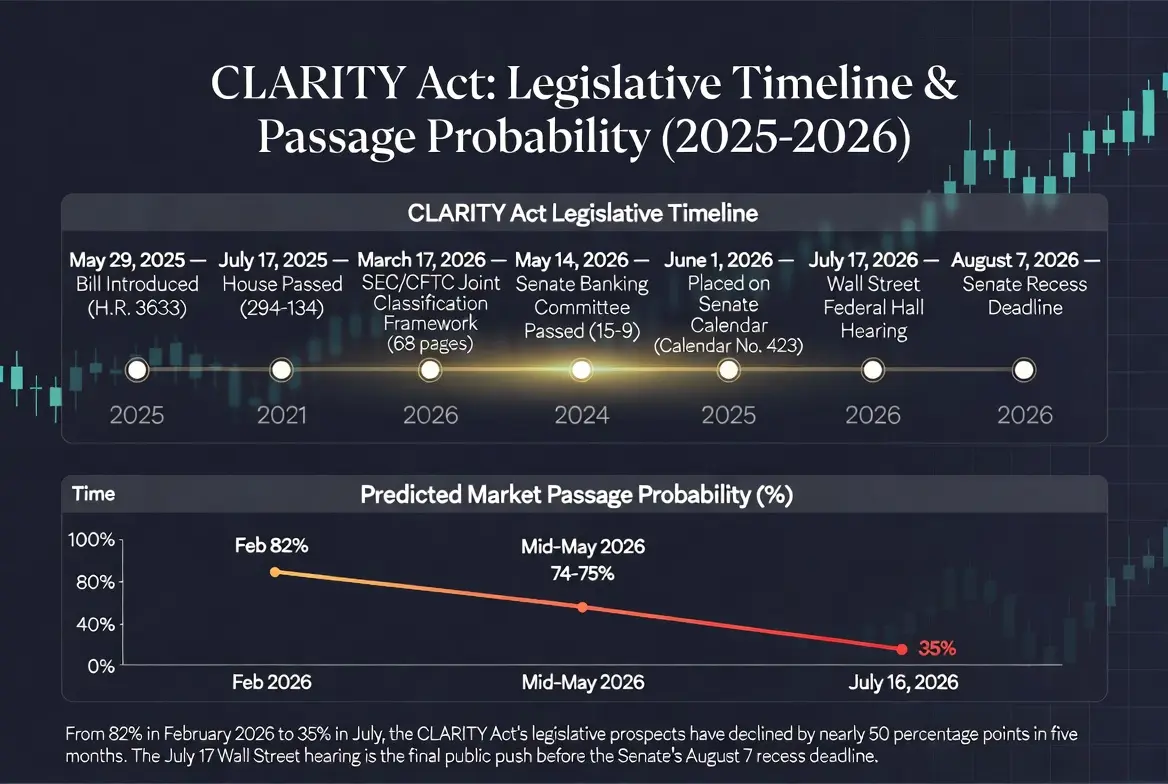
CLARITY Act Legislative Timeline and Pass Probability Change Chart
The Statutory Cut: SEC vs. CFTC Jurisdictional Boundary
Another core mechanism of the bill is building a regulatory bridge between the SEC and the CFTC. Under the latest draft, the CFTC has exclusive jurisdiction over “digital commodities”—native tokens on sufficiently mature decentralized networks whose value is primarily sourced from the functionality of those decentralized blockchain networks—while the SEC retains jurisdiction over “investment contracts” and assets in the initial issuance stage.
The bill introduces a “mature blockchain test,” requiring that blockchain systems meet conditions such as no single entity control, distributed ownership, and being open source. Once certified, related tokens automatically convert to non-securities. Issuers can be exempted from some SEC registration requirements, but must continue to provide initial and semiannual disclosures.
On March 17, 2026, the SEC and CFTC jointly released an interpretive document classifying 16 digital assets—including Bitcoin, Ethereum, and XRP—as digital commodities. In practice, the document does a lot of work: it hands daily regulatory authority to the CFTC, removes the threat that major tokens will be deemed unregistered securities, and clears the path for spot ETFs currently traded on these three assets. But the interpretive document is not statutory law. A future government or regulator with a parliamentary majority can rescind or rewrite it. The CLARITY Act exists precisely to convert such a reversible administrative posture into permanent law.
In addition, the bill includes a notable clause: any token that, before January 1, 2026, has already been listed on a national securities exchange as an underlying asset of a spot ETF will automatically be deemed a non-security. That means not only Bitcoin and Ethereum are explicitly treated as non-securities, but other tokens that have already been approved for ETFs will receive the same legal certainty.
Exchange Compliance Paths and Developer Safe Harbor
For centralized exchange platforms, custodial institutions, and wallet service providers, the changes brought by the CLARITY Act are also far-reaching.
For a long time, the core dilemma facing CEXs has been unclear registration standards, uncertain regulatory requirements, and product launch risks that are difficult to evaluate. The SEC defines industry boundaries case by case through enforcement actions, but this kind of “enforcement-driven regulation” means participants can only passively learn where the line is based on litigation outcomes.
The CLARITY Act attempts to change this landscape. The bill clearly states that the CFTC has jurisdiction over trading in digital commodities and requires that digital commodity exchanges register with the CFTC and comply with rules such as customer asset segregation, risk management, and anti-manipulation. This means U.S. trading platforms may gain a more explicit operational framework, and the institutional capital entry barrier is likely to decrease accordingly.
The bill also establishes a safe harbor provision for non-custodial software developers (Section 604, the “Blockchain Regulatory Certainty Act”), clarifying that developers who only publish code, provide self-custody tools, or maintain blockchain infrastructure do not constitute funds transferors. This clause is seen as a key design to protect open-source innovation and prevent developers from being held accountable for technically neutral actions.
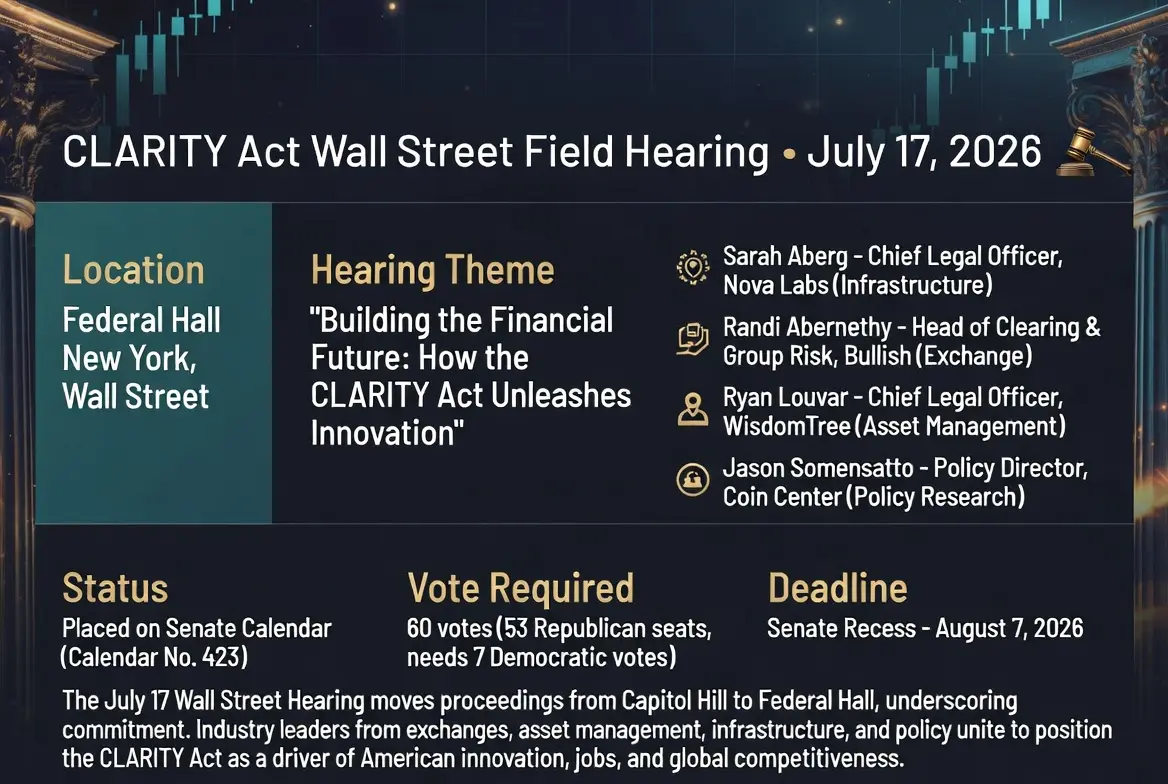
The witness list for the July 17 hearing also reflects the same logic put into practice. Those testifying include Sarah Aberg, Chief Legal Officer of Helium Network developer Nova Labs; Randi Abernethy, Chief Liquidation and Group Risk Officer at crypto exchange Bullish; Ryan Louvar, Chief Legal Officer at asset manager WisdomTree; and Jason Somensatto, Policy Director at crypto policy research organization Coin Center. These four roles—exchanges, asset management, infrastructure, and policy research—come together at the same witness table. The centerpiece of the hearing is packaging the CLARITY Act as a story about U.S. innovation, jobs, and competitiveness—not merely a debate over regulatory technicalities.
July 17 Wall Street Hearing Key Infographic
Legislative Prospects: The 60-Vote Threshold, Ethical Controversies, and the August 7 Deadline
Despite early bipartisan consensus, the CLARITY Act still needs to clear multiple obstacles before a full Senate vote.
The vote threshold is the most direct challenge. In the U.S. Senate, most bills must overcome the filibuster, and to end debate and move to a vote requires at least 60 votes. The Republicans currently hold 53 seats in the Senate—meaning even if all Republican senators vote yes, the bill still needs at least 7 Democratic senators to cross party lines. In the May 14 vote by the Senate Banking Committee, Democratic senators Ruben Gallego and Angela Alsobrooks voted in favor alongside all 13 Republican committee members, but the two lawmakers’ final Senate support remains conditional.
Ethical controversy is the trickiest issue right now. Democrats want to add a restriction clause—prohibiting senior government officials, including the President, from maintaining commercial relationships with the crypto industry. The backdrop is that President Trump’s latest financial disclosure shows that in 2025, he earned more than $1.4 billion in revenue from crypto-related businesses, including World Liberty Financial and licensing income tied to the TRUMP meme token. Two Democratic senators who previously voted for the Banking Committee version have already explicitly warned that they will not support the final bill unless the ethical clause is handled properly.
Time pressure also cannot be ignored. The bill is on the Senate schedule, Calendar No. 423, and the Senate is still in session during the first week of August; after that, it won’t reconvene until September 14—making August 7 the effective deadline. If a vote cannot be completed before August 7, momentum for the bill in 2026 will be halted until after September.
Stablecoin yield provisions are another ongoing point of contention. Republican Senator Thom Tillis has most recently proposed adding a “circuit breaker” mechanism in the Senate version of the CLARITY Act—if regulators determine that stablecoin-related activities are triggering broader bank deposit outflows, regulators can step in to intervene. One of the issues that previously caused the bill’s progress to be delayed by four months was, in fact, the stablecoin interest ban. In an updated version of the bill as of May 2026, a compromise was reached: it bans passive deposit interest paid solely for holding stablecoins to avoid direct substitution for bank deposits, but it provides exemptions for rewards across seven categories covering scenarios such as transaction payments, market-making staking, governance voting, and network validation.
Reshaping the Regulatory Framework and Its Impact on Market Structure
If the CLARITY Act is ultimately passed, the U.S. digital asset market will see at least three structural changes.
First, regulatory certainty will reduce compliance costs and regulatory arbitrage space. For a long time, the biggest dilemma facing the U.S. crypto industry has not been that regulation is too strict or too loose—it has been that “nobody knows who regulates it.” The CLARITY Act attempts to replace part of the approach that relies on case-by-case enforcement with statutory law. Once the SEC and CFTC jurisdictional boundaries are fixed in federal law, exchanges, brokers, and issuers can design predictable compliance frameworks rather than probing boundaries in the shadow of enforcement litigation.
Second, the entry threshold for institutional capital will be materially lowered. Clear regulation → lower institutional risk → more capital allocation → accelerated financialization of digital assets. The logic chain is straightforward. Tracks such as RWA (Real World Assets), stablecoins, and on-chain financial infrastructure will have more room to develop under a clear regulatory framework. After the bill takes effect, institutions can use stablecoin-collateralized lending for real-world assets, conduct loop/round leverage arbitrage, and provide market liquidity—all within a clearly regulated CFTC framework.
Third, the global competitiveness of the U.S. digital asset market may be reshaped. H.Res. 111, the resolution “Supporting Blockchain Technology and Digital Assets,” points out that if the U.S. cannot set a framework for digital assets sooner rather than later, related technology and businesses will move to countries with more permissive regulation. If the CLARITY Act passes, it means the U.S. will establish, for the first time, a complete regulatory infrastructure for digital assets at the federal level. This is not only an update to legal text, but also a potential turning point in where global digital asset capital flows.
Conclusion
On July 17, 2026, when the House Financial Services Committee hearing struck the gavel at Federal Hall, it carried far more than an update on legislative progress for a bill. This Wall Street hearing location itself is already transmitting a signal: crypto asset regulation has shifted from being a political topic into the core circle of traditional finance.
Whether the CLARITY Act can clear the 60-vote threshold before August 7 depends on resolving the ethical controversy, compromising on the stablecoin provisions, and the final choice of seven Democratic senators. The 35% pass probability from the prediction market reflects low expectations that these three variables will converge at the same time—not a denial of the bill’s value.
No matter the outcome of the vote, the legislative process of the CLARITY Act has already accomplished something: it moved the debate over U.S. crypto regulation from “whether to regulate” to “how to regulate.” The shift—from enforcement-driven to rule-driven, from the SEC’s case-by-case lawsuits to Congress drafting statutory law—is evidence that the U.S. digital asset regulatory framework is being reshaped.
FAQ
Q1: What is the full name of the CLARITY Act? What problem does it mainly address?
The CLARITY Act’s full name is the “Digital Asset Market Clarity Act” (H.R. 3633). It aims to establish a comprehensive regulatory framework for digital assets at the federal level. Its core is to define the jurisdictional boundaries between the SEC and the CFTC: the SEC regulates security-type digital assets and the initial issuance stage, while the CFTC has exclusive jurisdiction over the spot market and trading venues for “digital commodities.”
Q2: How many votes are needed for the CLARITY Act to pass in the Senate? Why is the threshold so high?
60 votes. Because the U.S. Senate has a filibuster procedure, at least 60 votes are needed to end debate and move to a vote. Republicans currently control 53 seats, meaning support from at least 7 Democratic senators across party lines is required.
Q3: What are the main obstacles the bill faces right now?
Three major obstacles: the ethical controversy (Democrats want to prohibit senior government officials from having commercial dealings with the crypto industry, involving crypto business income tied to the Trump family); differences over stablecoin yield provisions; and an insufficient legislative time window before the Senate’s recess on August 7.
Q4: How does the CLARITY Act affect the regulatory status of Bitcoin and Ethereum?
The bill introduces the “mature blockchain test,” under which highly decentralized assets like Bitcoin and Ethereum will be classified as “digital commodities,” placing them under the CFTC’s exclusive jurisdiction. In March 2026, the SEC and CFTC jointly classified 16 digital assets as digital commodities, but the CLARITY Act upgrades this categorization from a reversible administrative interpretation into permanent law.