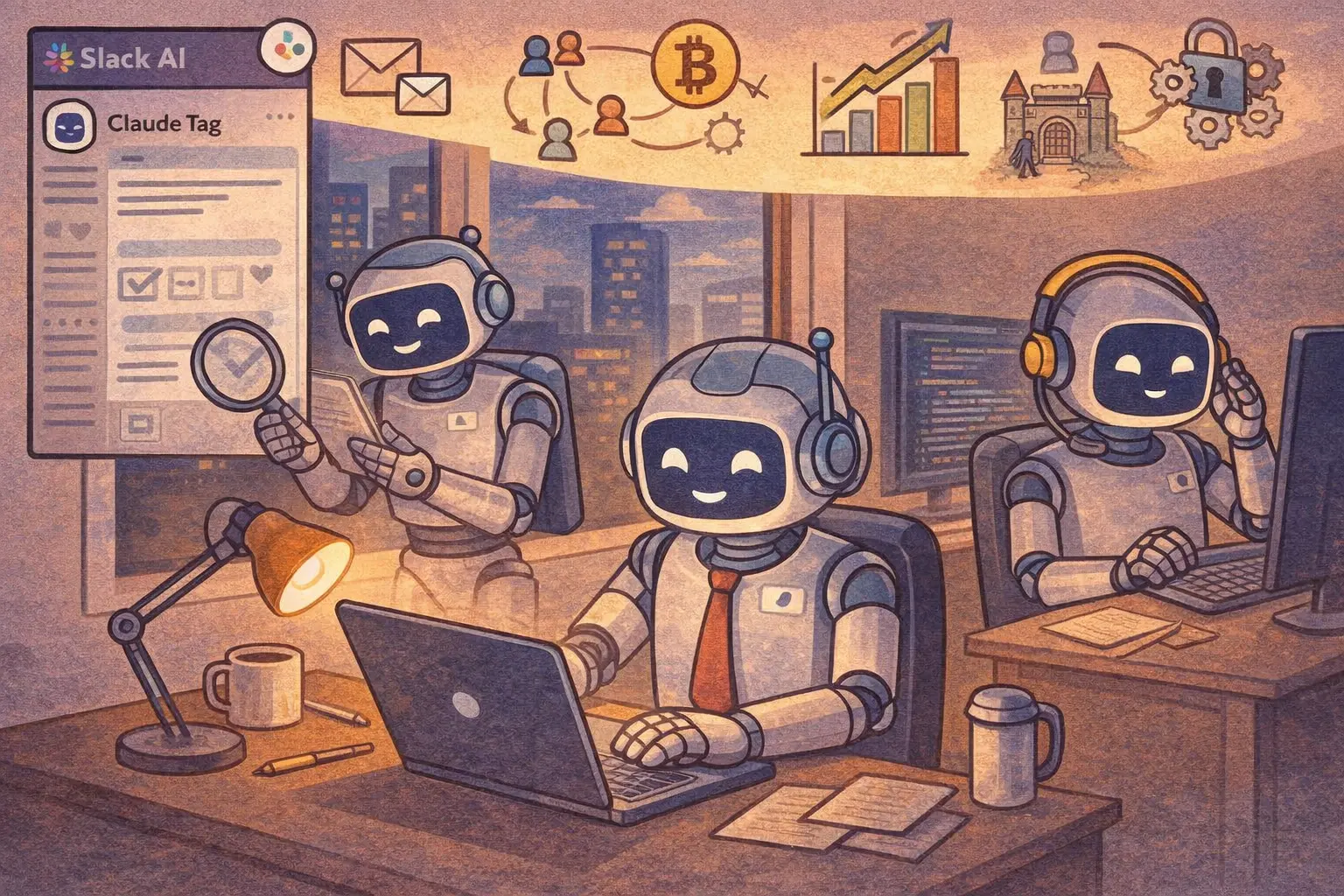
Anthropic launched a brand-new Slack integration tool, Claude Tag, on June 24, allowing AI to join a channel in the role of a “teammate.” Users tag @Claude in the channel with natural language to assign tasks; Claude can then execute autonomously. Colleagues can see progress and take over any unfinished discussions. Users can hand off tasks before heading home for the day, then return the next day to check results—no need to monitor the screen.
Core Features of Claude Tag: Shared Memory, Environment Mode, and Per-Channel Identity Design
Shared memory: All members in a channel share the same @Claude. Claude will accumulate context, remember discussions in the channel, decisions that have been finalized, and unresolved issues. New members don’t need to read through past records—just ask @Claude directly.
Environment mode: Claude Tag can proactively take action. It will automatically flag relevant information that appears across channels, follow up on discussion threads that haven’t gone anywhere, and when needed, proactively pull people’s attention. It keeps monitoring continuously even without user calls.
Per-channel identity: The same Claude in different channels (such as a sales channel and an engineering channel) is “a different Claude.” Memory is not shared, tool access scope is not shared, and conversation context is completely isolated. The @Claude in the sales channel won’t know the bugs being fixed in the engineering channel, and the engineering channel can’t see customer contract negotiation details.
Asynchronous Work Capabilities: Opus 4.8 Model and Cross-Date Autonomous Execution Mechanism
Claude Tag uses the Opus 4.8 model, which is currently Anthropic’s most capable version. Anthropic calls this capability “asynchronous work”—users can assign tasks before leaving for the day, and Claude independently plans the work steps and executes autonomously across time periods and dates, without requiring the user to be online and monitoring end-to-end. This approach shifts AI from a “real-time upgraded search engine” to an “autonomous execution system” that keeps running while the user is away.
In terms of permissions management, admins can finely control the tool access scope and data-read boundaries for each channel, and set token usage limits, giving the IT department enough control space during adoption rather than enabling permissions either fully or not at all.
Target Users and Migration Plan: Enterprise and Team Customers, a 30-Day Migration Window
The beta version is currently limited to Claude Enterprise and Team customers. Eligible organizations can receive launch credits. The existing Claude in Slack application will be replaced, and existing users have a 30-day migration window.
In the article, Anthropic explains that Claude Code solves the personal level (a deep one-to-one integration for engineers on their terminals), while Claude Tag is for the organizational level (the entire team sharing an AI teammate in the same Slack channel)—a strategy expansion for Anthropic to push from the engineer layer into the organizational layer after establishing a foothold at the engineer level.
Frequently Asked Questions
How is Claude Tag different from the existing Claude in Slack app?
According to reports, the existing Claude in Slack will be replaced by Claude Tag, and existing users have a 30-day migration window. The key differences of Claude Tag are “shared memory across the whole team,” “per-channel identity isolation,” and “asynchronous autonomous execution across dates”—capabilities that go beyond the existing version’s person-to-person, conversation-focused mode.
How does the per-channel identity design protect data privacy across different departments?
As described in the article, in different channels (such as the sales channel and the engineering channel), the same Claude’s memory is completely non-interoperable, tool access scope is not shared, and conversation context is completely isolated. Admins can also finely control each channel’s tool access scope and data-read boundaries, providing IT with sufficient governance capabilities.
Which organizations is Claude Tag currently open to?
According to Anthropic’s description, the beta version is currently only available to Claude Enterprise and Team customers, and eligible organizations can receive launch credits. The specific application process for access needs to be checked in Anthropic’s official announcements.


