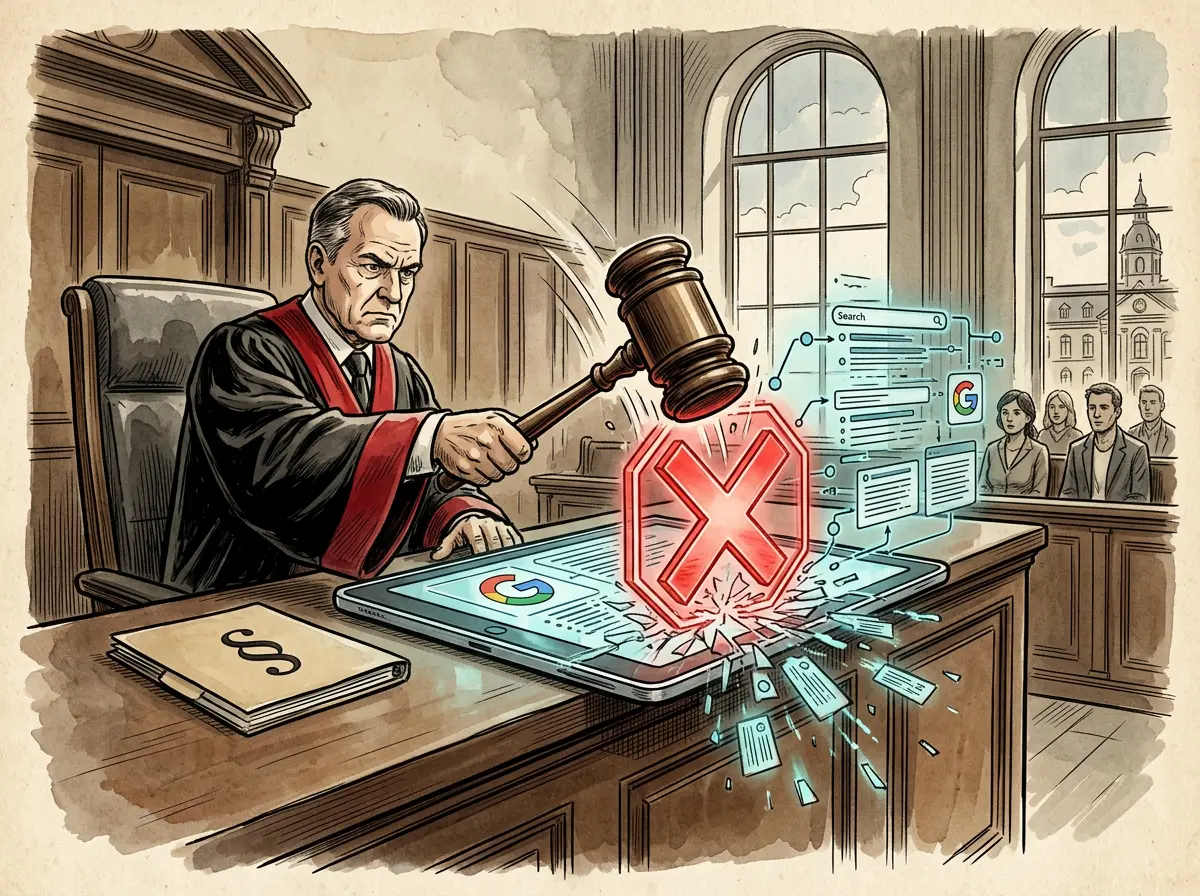
According to BlockTempo on June 11, the Munich Regional Court in Germany issued a preliminary injunction against Google in May, finding that misleading summaries generated by AI Overviews are Google’s “own statements,” and ruling that the disclaimer in the service terms (“AI may make mistakes—please verify yourself”) does not constitute a valid legal defense.
Court’s Core Ruling: AI Overviews Are Google’s Own Statements
In its ruling, the court established the following distinction:
Traditional search engines: They list the titles and excerpts of third-party websites, and users always face the original sources; the statement subject is “someone else says so.” Google acts as a guide rather than a statement maker.
AI Overviews: Based on Google’s “own interpretation” of the search index, it makes “independent, new, and substantive statements” directly on the search results page; the statement subject is converted from the third party to Google.
The court held that this subject-matter switch prevents AI Overviews’ outputs from benefiting from the indirect-liability protections applicable to traditional search engines, and that Google must bear direct responsibility for these statements. The court also found that AI Overviews’ outputs are “expressions in the course of commercial activity” and therefore do not receive the more lenient protection afforded to purely expressive speech.
Two Google Defense Arguments Rejected by the Court: Confirming the Record
Defense 1: Users should verify Google’s claims themselves; most users should understand that AI output may not be accurate, so it should not be given the status of fact, and the service provider should therefore not be liable. The court ruled: the disclaimer at the bottom of the page does not constitute a valid legal defense.
Defense 2: Publishers should seek indemnification from third parties for Google’s claims of defamation if such defamatory statements exist in third-party content, and publishers should seek indemnification from third parties. The court ruled: only Google has the ability to correct the underlying algorithms and change what AI Overviews outputs, and no one else can intervene in the generation logic; therefore Google cannot claim exemption from liability on that basis.
Case Progress: The Injunction Is in Effect, Formal Litigation Still Ongoing
The preliminary injunction issued by the Munich Regional Court prohibits Google from continuing to disseminate the above allegedly false statements until the end of the formal lawsuit. The preliminary injunction means the court found the plaintiffs’ claims to have initial credibility, but it does not equal a final judgment on the merits. A formal litigation timetable has not been announced yet. This ruling has no direct binding effect on AI services outside the jurisdiction of the Munich Regional Court in Germany.
Frequently Asked Questions
What is the significance of this ruling for other AI search services like ChatGPT, Perplexity, and so on?
The responsibility standard established by the Munich Regional Court hinges on whether the AI output constitutes the service provider’s “own statements” rather than merely quoting third-party content. AI services that make statements about the subject in a tone of certainty (including ChatGPT, Perplexity, etc.) face the same underlying legal issues logically, but the German ruling has no direct legal binding force on services outside Germany’s judicial jurisdiction.
What is the legal effect of a preliminary injunction (Einstweilige Verfügung)?
A preliminary injunction is an emergency measure in German civil litigation; the court can order specific conduct to stop before a formal judgment. This ruling does not equal a final win; it only indicates the court found the plaintiffs’ claims to have “initial credibility.” A complete legal assessment will be made in the formal lawsuit, and the timeline has not been announced.
Why is this case of special significance to the AI disclaimer regime?
This is the first case worldwide where a court officially denied at the legal level the idea that an “AI disclaimer” can replace direct legal responsibility, with AI speech as the specific target. Some U.S. chatbot operators previously argued that AI outputs are “pure speech” and should be protected by the First Amendment, but the German court’s ruling went in the opposite direction: it found that AI outputs are “expressions in the course of commercial activity,” applying a different legal framework.


