What Is Arkham?
Arkham is a blockchain intelligence platform and token ecosystem developed by Arkham Intelligence. The core functionality of the platform is to deanonymize blockchain activity by attributing on-chain addresses to real-world individuals or organizations, delivering intelligence on “who did what on-chain.” The ARKM token is used within the platform to pay for intelligence, fund bounties, and incentivize user contributions.
In more detail, blockchain intelligence refers to extracting actionable insights about entities and fund flows from public blockchain data for purposes such as risk management, compliance, and research. By mapping addresses to entities, users gain clearer insight into market activity.
What Are the Current Price, Market Cap, and Circulating Supply of Arkham (ARKM)?
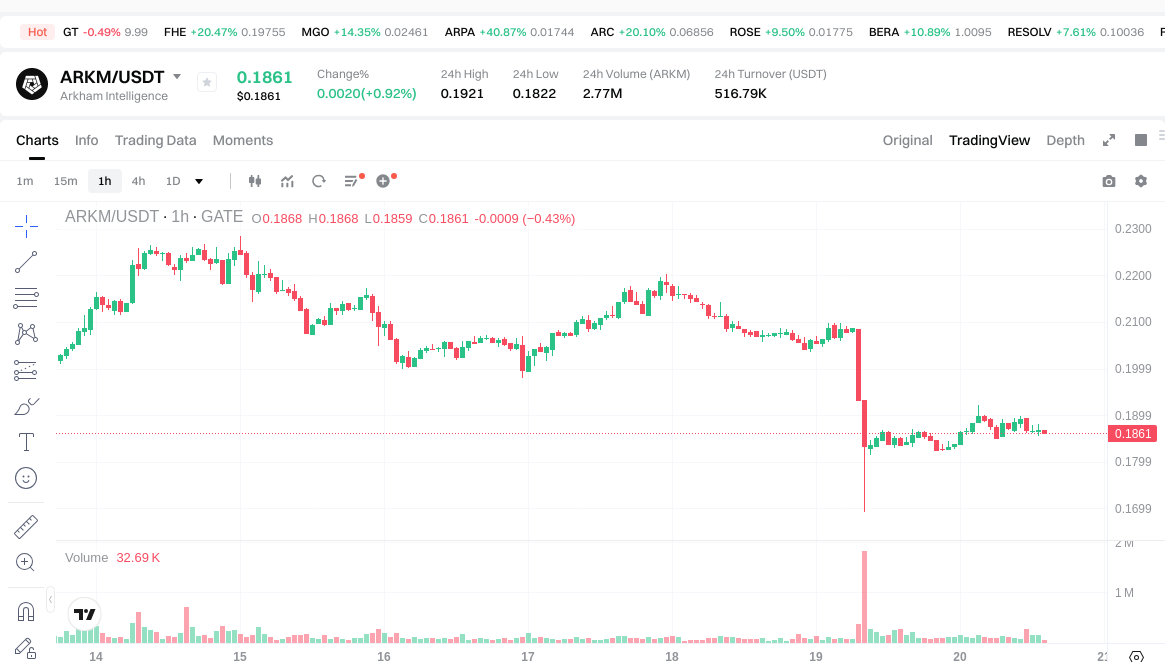
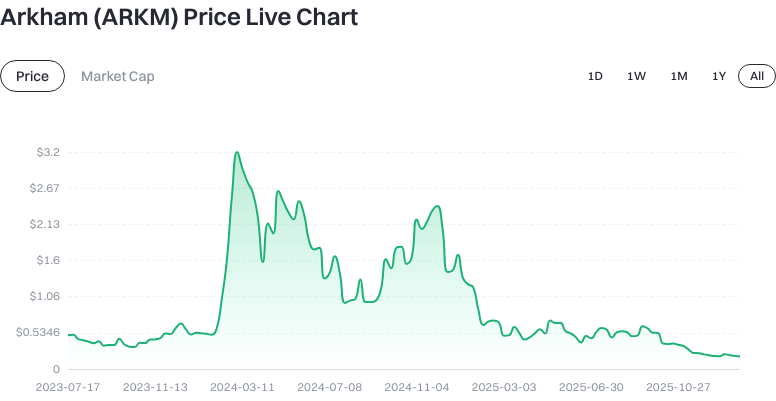
As of 2026-01-20 (user-provided data), ARKM is trading at approximately $0.1870. The circulating supply is around 568,532,082 ARKM, with both total and max supply capped at 1,000,000,000 ARKM.
The circulating market cap is about $187,000,000, and the fully diluted market cap is also around $187,000,000.
Click to view ARKM/USDT Price
If you see different market cap numbers elsewhere, these usually reflect variations in “circulating supply methodology” or data update frequency. Circulating market cap is calculated as “price × circulating supply,” while fully diluted market cap is “price × max supply.”
Recent performance: 1-hour price change is about -0.05%, 24-hour change is +1.13%, 7-day change is -6.18%, and 30-day change is -3.51%.
Click to view Latest ARKM Market Data
24-hour trading volume is approximately $517,048. All figures are for informational purposes only and do not constitute investment advice.
Who Created Arkham (ARKM) and When?
Arkham launched on July 17, 2023. The company is a Series A startup that has raised over $12 million from investors including the founders of Palantir and OpenAI, as well as Geoff Lewis of Bedrock and Tim Draper (source: official reports as of October 2024).
This background shows the project attracted early venture capital support, positioning itself as foundational infrastructure for on-chain intelligence—serving institutions, traders, and compliance teams.
How Does Arkham (ARKM) Work?
The platform aggregates data through automated collection, algorithms, and manual verification to link blockchain addresses with real-world entities. Operating as an “intelligence marketplace,” it matches supply and demand for on-chain data. Users can purchase intelligence or post bounties; analysts and data providers earn ARKM rewards by completing tasks.
ARKM serves as the platform’s native utility token, used for paying for intelligence and services, funding bounty pools, and incentivizing contribution within the ecosystem. According to public documentation (as of October 2024), ARKM is an ERC-20 token on Ethereum. ERC-20 is a widely adopted token standard that ensures compatibility with wallets and exchanges. Smart contracts—programs deployed on the blockchain—automate token transfers and enforce platform rules.
What Can Arkham (ARKM) Be Used For?
- Purchase Analytics & Reports: Institutions or individuals can buy intelligence on address attribution, fund flows, and risk profiles from the intelligence marketplace.
- Launch Bounty Tasks: Post bounties for complex address networks or suspicious fund flows; analysts submit findings and are compensated in ARKM.
- Risk Monitoring & Compliance: Compliance teams use Arkham for detecting suspicious activity and supporting anti-money laundering (AML) and sanctions screening.
- Research & Trading Decisions: Researchers and traders track “whale” wallet movements to inform monitoring strategies and optimize trade execution.
What Wallets and Extensions Support Arkham (ARKM)?
As an ERC-20 token, ARKM is supported by all major Ethereum-compatible wallets. Hot wallets such as browser extensions or mobile apps offer convenience for everyday transactions, while cold wallets—like hardware wallets—store private keys offline for enhanced security, making them ideal for long-term storage.
A private key is the sole credential required to control crypto assets; if leaked, your funds can be irreversibly compromised. For optimal security, use address whitelists, layered storage solutions, and multi-factor authentication.
What Are the Main Risks and Regulatory Considerations of Arkham (ARKM)?
- Data & Attribution Accuracy: Entity mapping may be imperfect; always cross-verify before acting to avoid misjudgments from incorrect labeling.
- Compliance & Privacy: Blockchain intelligence can involve sensitive activity tracking; data use must comply with local laws and platform policies across jurisdictions.
- Token & Market Risks: ARKM’s price is subject to supply-demand dynamics and market sentiment; monitor liquidity and token concentration risks.
- Technology & Platform Dependency: Smart contracts and other components may have vulnerabilities or be targeted by attacks; stay informed about security audits and official updates.
- Gas Fees & Network Risks: Ethereum transactions require gas fees; costs rise during network congestion. Cross-platform or cross-chain operations can introduce operational risks.
How Do I Buy and Securely Store Arkham (ARKM) on Gate?
Step 1: Register & Complete KYC. Sign up on Gate’s official site and complete KYC (identity verification) to unlock higher trading limits and secure your account.
Step 2: Fund Your Account. Deposit crypto assets or purchase stablecoins like USDT via fiat channels to ensure sufficient trading balance.
Step 3: Find the Trading Pair. Search “ARKM” to access the ARKM/USDT trading page; review trading rules and fee details.
Step 4: Place a Trade. Choose between limit or market orders based on your needs; enter your purchase amount and confirm. Watch out for slippage (the difference between expected and actual execution price) and fees—avoid large trades in low-liquidity markets.
Step 5: Withdraw to Self-Custody Wallet (Optional). For long-term holding or on-chain interactions, withdraw your ARKM to an Ethereum-compatible self-custody wallet. Always confirm the network is Ethereum; test with a small amount before making a full transfer.
Step 6: Enhance Account Security. Enable 2FA (two-factor authentication), set up an anti-phishing code, activate withdrawal whitelists, and routinely check login devices and alerts.
Step 7: Secure Private Keys & Backups. Generate and store your seed phrase and private key offline using a hardware wallet or secure environment—back them up safely without taking photos or using cloud storage.
How Does Arkham (ARKM) Compare to The Graph (GRT)?
Target Users & Positioning: Arkham focuses on “blockchain intelligence and entity attribution” for compliance teams, institutions, and analysts; The Graph targets “data indexing and querying” for dApp developers and data consumers.
Technology & Output: Arkham emphasizes address tagging, fund flow analysis, and intelligence trading; The Graph enables efficient chain data access through subgraph indexing.
Token Utility: ARKM is used for in-platform payments, bounty rewards, and user incentives; GRT is used for staking by indexers, protocol rewards, and query fee settlement.
Risk Profile: Arkham’s primary concerns are data accuracy and compliance boundaries; The Graph focuses on network decentralization, node security, and index quality. The two projects are complementary at different layers of research and application rather than direct competitors.
Summary of Arkham (ARKM)
Arkham (ARKM) positions itself as an on-chain intelligence solution focused on entity attribution—its token powers payments and incentives across risk management, compliance checks, research, and more. Current market stats reflect clear pricing and supply structures; note that market cap may vary based on circulating supply definitions. For beginners, understanding ERC-20 tokens, intelligence trading mechanisms, and risk management is essential. Completing KYC on Gate, managing order sizes carefully, using secure withdrawals, and safeguarding private keys will enhance your safety when holding or transacting ARKM. Ongoing attention should be paid to platform updates, data quality improvements, compliance changes—and risk can be managed through portfolio diversification and long-term perspectives.
FAQ
What Is the Main Utility of the ARKM Token?
ARKM is the governance token of the Arkham Intelligence platform used to incentivize users for providing on-chain data and intelligence. Holders participate in governance decisions, earn data-sharing rewards, and unlock advanced analytics features—making ARKM both a governance instrument and a participation credential within the ecosystem.
What Are the Benefits of Holding ARKM?
ARKM holders gain governance rights over the platform, share in data contribution rewards, and access premium features. You can vote on development directions, receive a share of intelligence bounties contributed by users, and get early access to new functionalities—transforming you from a passive user into an active ecosystem participant.
How Does ARKM Differ from Other Data Tokens?
ARKM specializes in blockchain intelligence and transparency, while other data tokens may focus on oracle services or decentralized storage. Arkham’s unique approach combines data incentives with privacy protections to create an ecosystem balancing security with data value—making it particularly suitable for users prioritizing on-chain security and anti-fraud measures.
How Can Beginners Get Started with ARKM?
First purchase ARKM tokens on exchanges like Gate and transfer them to your wallet. Then visit the Arkham platform to connect your wallet and participate in data contribution or governance voting. Beginners are advised to start with free features before purchasing additional tokens to unlock higher-level permissions as needed.
Are There Regulatory Risks Associated with ARKM?
As a blockchain data platform, ARKM must comply with global data privacy regulations—especially in Europe and North America. The platform includes privacy safeguards to address regulatory challenges; however, future policy shifts may impact operations. It’s recommended that you review relevant regulations in your jurisdiction before investing.
- Blockchain Intelligence: Techniques for analyzing on-chain data to identify transaction patterns, fund flows, and participant identities.
- On-chain Analysis: Deep investigation of public blockchain transactions to uncover fund movements, wallet behavior, and market trends.
- Deanonymization: The process of linking anonymous blockchain addresses to real-world identities in order to trace sources and destinations of funds.
- Wallet Tagging: Assigning identity tags (such as exchange or project labels) to blockchain addresses for easier tracking and categorization.
- Transaction Pattern Recognition: Using AI and data analytics to detect abnormal activity such as money laundering or market manipulation.
- Compliance Monitoring: Real-time surveillance of blockchain transactions to detect violations—supporting institutional compliance teams and regulators.
Further Reading & Resources on Arkham (ARKM)
-
Official Site / Whitepaper:
-
Development / Documentation:
-
Authoritative Media / Research: