What Is Cryptocurrency? Understanding the Digital Money Revolution

Beginner
Quick Reads
Last Updated 2026-03-25 03:47:54
Reading Time: 1m
Cryptocurrency is a digital asset powered by blockchain technology, featuring decentralization, global accessibility, and continuous 24/7 operation. This article adopts a Web3 perspective to deliver an in-depth exploration of cryptocurrency fundamentals, operational mechanisms, distinctions from traditional finance, practical applications, and potential risks. It aims to equip readers with a thorough foundational understanding of the Crypto ecosystem.

What Is Cryptocurrency?
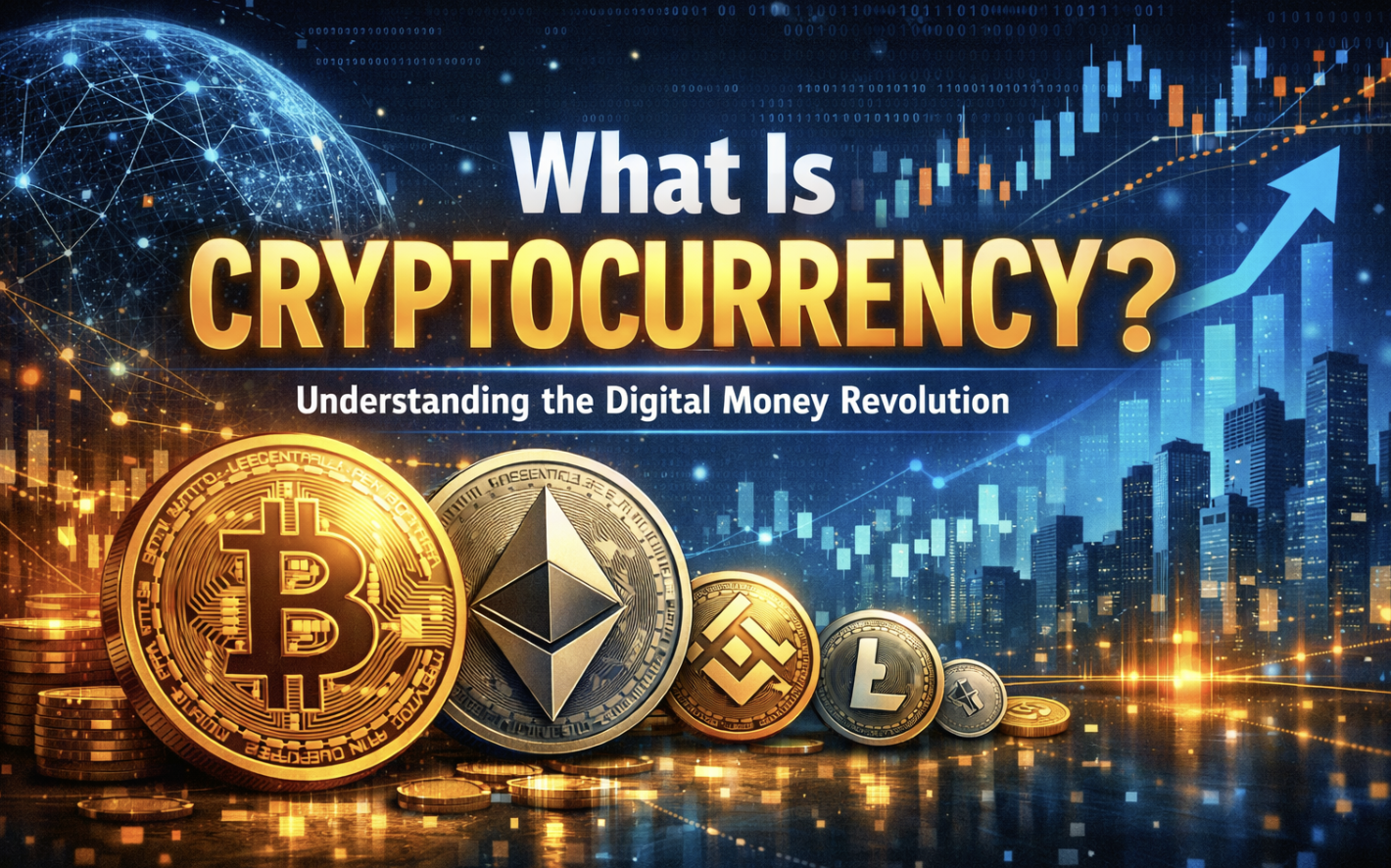
Cryptocurrency is a digital currency protected by cryptographic technology and serves as a digital asset that can circulate freely online. It is not issued by any central bank or financial institution. Instead, it operates on blockchain—a decentralized network system—enabling assets to move globally, 24/7, without interruption.

Essentially, cryptocurrency is a money system that operates independently of banks. There is no need to open an account, undergo credit checks, or use intermediaries to transfer assets to anyone, anywhere in the world. This is why many in the Web3 community say: Crypto is more than just money—it is a new financial operating system.

Where Does Cryptocurrency Come From?

Cryptocurrency began with the launch of Bitcoin in 2009. At that time, Satoshi Nakamoto introduced a revolutionary idea: What if we could create an online system where people could trust transactions without having to trust banks? This concept led to the creation of blockchain technology.

With blockchain:

  • All transactions are open and transparent
  • No single institution can alter the ledger
  • The system is maintained by nodes around the world

Bitcoin was the first successful experiment, paving the way for the emergence of public blockchain ecosystems like Ethereum, Solana, BNB Chain, and Avalanche.

Differences Between Cryptocurrency and Traditional Currency

At their core, the main difference between cryptocurrency and fiat currency (such as the dollar or New Taiwan dollar) is the source of trust.

Traditional Currency (Fiat)

  • Issued by governments
  • Supply controlled by central banks
  • Circulates through the banking system
  • Can be printed without limit

Cryptocurrency (Crypto)

  • Issued through code
  • Typically has a fixed supply mechanism
  • Operates independently of banks
  • Secured by mathematics and consensus

Fiat currency relies on trust in the nation-state, while cryptocurrency relies on algorithms.

How Does Cryptocurrency Work?

The core of cryptocurrency is blockchain technology. Blockchain is a distributed ledger system where all transactions are bundled into blocks and sequentially linked into an immutable chain.

Every transaction goes through the following steps:

  1. User signature (private key verification)
  2. Node validation
  3. Network-wide consensus confirmation
  4. Permanently recorded in the ledger

This is why on-chain transfers do not require bank approval—no one can freeze funds, and all records remain permanently accessible.

Why Can Cryptocurrency Operate 24/7?

Blockchain never closes—there are no central bank business hours, no international remittance holidays, and no banking settlement restrictions. As long as the network and its nodes are online, cryptocurrency continues to operate around the clock.

This is a major transformation for global finance:

  • Instant settlement
  • Global circulation
  • 24/7 trading with no time zone barriers

This has enabled funds to enter a truly internet-native state for the first time.

What Are the Uses of Cryptocurrency?

Many people assume cryptocurrency is only for speculation, but its real-world applications go far beyond that.

  • Store of value: Bitcoin is called digital gold and is used to hedge against inflation.
  • Cross-border payments: Complete international transfers in minutes at minimal cost.
  • Decentralized finance (DeFi): Lending, trading, staking, and market making are all fully automated.
  • NFTs and GameFi: Digital asset ownership and virtual economic systems.
  • DAO governance: Communities directly manage funds and project direction.

The Relationship Between Cryptocurrency and Web3

If Web2 is about platforms owning the data, Web3 is about users owning the assets—and cryptocurrency is the native asset layer of Web3.

Without cryptocurrency:

  • There is no way to incentivize nodes
  • A decentralized economy cannot be built
  • DAO governance cannot be realized
  • Value transfer cannot be accomplished

Cryptocurrency is not an add-on to Web3—it is the foundational fuel.

If you want to learn more about Web3, click here to register: https://www.gate.com/

Conclusion

The true impact of cryptocurrency is not simply the rise and fall of asset prices. It is the restructuring of the financial power structure itself. For the first time, individuals can independently control their assets and transaction rights without banks, intermediaries, or borders—something that was nearly impossible in the traditional financial system. Blockchain transforms money into an open-source protocol rather than a system monopolized by a few institutions. As a result, cryptocurrency is no longer just an investment tool; it is a new financial infrastructure that is already in operation. This is not a distant future—it is the present, actively reshaping global capital flows.

Author: Allen
Disclaimer
* The information is not intended to be and does not constitute financial advice or any other recommendation of any sort offered or endorsed by Gate.
* This article may not be reproduced, transmitted or copied without referencing Gate. Contravention is an infringement of Copyright Act and may be subject to legal action.

Related Articles

What is Fartcoin? All You Need to Know About FARTCOIN
Intermediate

What is Fartcoin? All You Need to Know About FARTCOIN

Fartcoin (FARTCOIN) is a representative meme coin within the Solana ecosystem based on an AI-driven narrative. Its core concept originated from an experiment aimed at exploring the "boundaries between AI Agents and humor." More than just a digital asset with social attributes, the project deeply couples absurd humor culture with on-chain financial logic by integrating autonomous AI interaction models.
2026-04-04 22:01:19
Gold Price Forecast for the Next Five Years: 2026–2030 Trend Outlook and Investment Implications, Could It Reach $6,000?
Beginner

Gold Price Forecast for the Next Five Years: 2026–2030 Trend Outlook and Investment Implications, Could It Reach $6,000?

Analyze current gold price trends alongside authoritative five-year forecasts, integrating an evaluation of market risks and opportunities. This gives investors insight into the potential trajectory of gold prices and the main drivers expected to shape the market over the next five years.
2026-03-25 18:13:30
Aster vs Hyperliquid: Which Perp DEX Will Prevail?
Beginner

Aster vs Hyperliquid: Which Perp DEX Will Prevail?

Aster and Hyperliquid are the two representative protocols of the "purpose-built L1 path" within the current decentralized perpetual exchange (Perp DEX) sector. As a pioneer in the field, Hyperliquid has built a deep liquidity moat through its highly mature order book architecture and strong community consensus. Conversely, Aster, as a rising challenger, seeks to leapfrog the competition in high-performance trading through more aggressive multi-chain aggregation logic, private transaction modules, and an underlying execution environment optimized for 2026 market demands.
2026-03-24 11:58:33
AI-Native Settlement Layers: How United Stables Is Building the Next Financial Rail
Beginner

AI-Native Settlement Layers: How United Stables Is Building the Next Financial Rail

Stablecoins were originally designed as dollar substitutes within exchanges, primarily used for asset pricing and trade settlement. As on-chain financial ecosystems have matured, their role has expanded beyond simple payments to include collateral assets, cross-chain liquidity mediums, and unified settlement units. In particular, as AI systems and automated agents begin to participate directly in economic activity, demand has risen sharply for programmable value units capable of instant settlement. This shift is pushing stablecoins toward the role of foundational financial infrastructure.
2026-03-25 03:16:17
2026 Silver Price Forecast: Bull Market Continuation or High-Level Pullback? In-Depth Analysis of Silver Candlestick Chart
Beginner

2026 Silver Price Forecast: Bull Market Continuation or High-Level Pullback? In-Depth Analysis of Silver Candlestick Chart

2026 Silver Price Forecast: Latest Outlook This article integrates current market trends, silver candlestick chart analysis, and momentum factors to assess the potential key support and resistance levels, upside targets, and pullback risks for silver prices. The goal is to help investors make informed, rational decisions.
2026-03-25 16:08:59
ASTER Tokenomics: Buybacks, Burns, and Staking as the Value Foundation of ASTER in 2026
Beginner

ASTER Tokenomics: Buybacks, Burns, and Staking as the Value Foundation of ASTER in 2026

ASTER is the native equity and governance token of the Aster ecosystem, with its core value built upon a radical "Deflationary Engine." Beyond serving as a governance tool, ASTER integrates multiple utilities including staking rewards, trading fee discounts, and liquidity incentives. Through its deep integration with the upcoming dedicated Layer 1 mainnet, it enables direct value capture from protocol cash flow to token holders.
2026-03-25 07:38:07