TradFi Accounts Explained: How Traditional Financial Accounts Work

Last Updated 2026-03-25 13:37:33
Reading Time: 5m
In traditional finance (TradFi), financial accounts are the core infrastructure through which all economic activity is executed.

Every payment, investment, and market transaction is mediated through institution-managed accounts that define ownership, access rights, settlement processes, and regulatory compliance.

Unlike blockchain-based systems where users interact directly with assets, TradFi accounts are account-based structures operated by banks and brokerages. Assets are custodied by institutions, transactions are processed through clearing and settlement networks, and access is governed by identity verification, jurisdiction, and regulatory oversight. This architecture has supported global financial stability for decades, but it also introduces structural friction.

This article explains what TradFi accounts are, how they operate in practice, why they create friction for modern users, and how crypto-native platforms are rethinking account-based access to traditional financial markets.

What Is a TradFi Account?

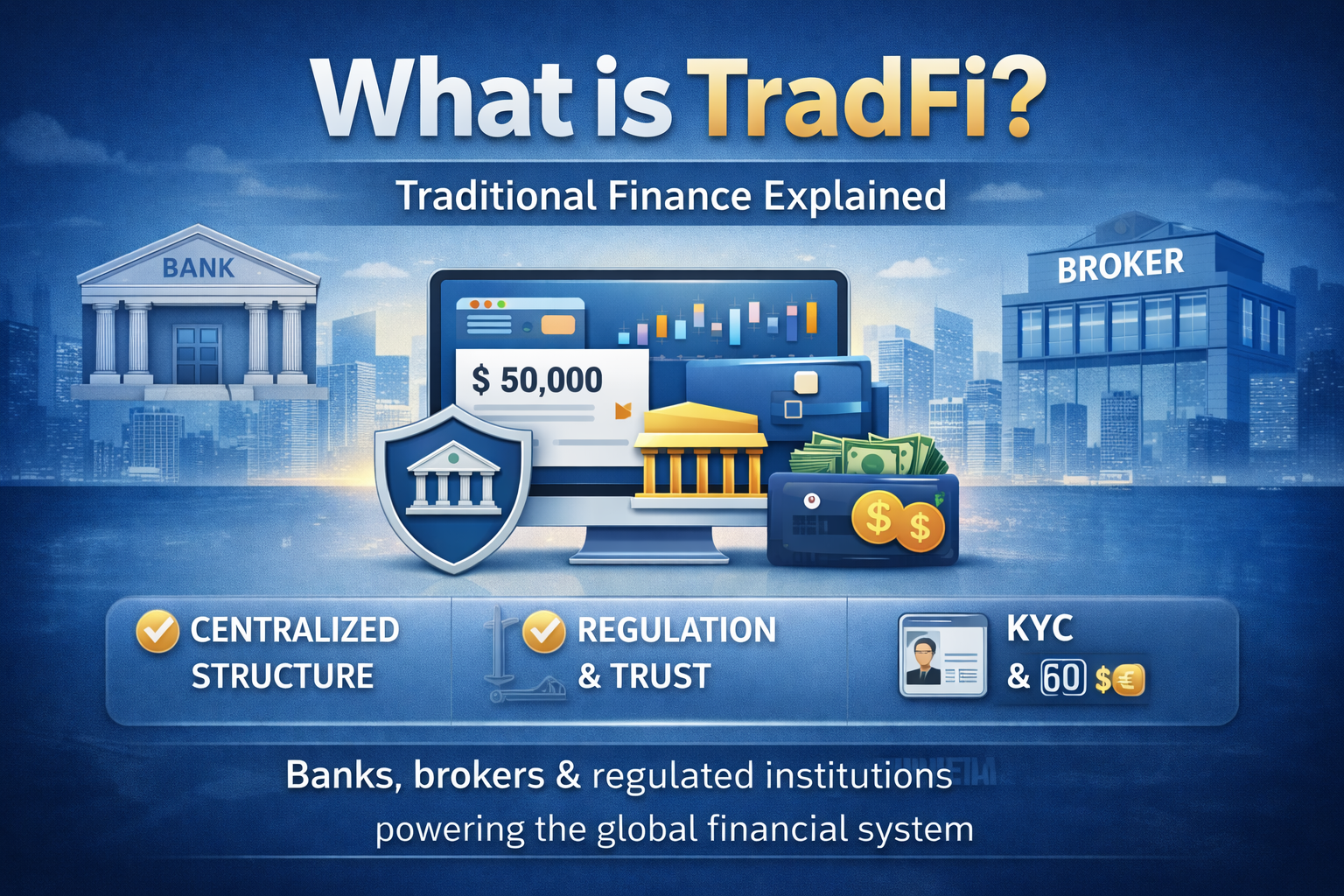
A TradFi account is a regulated financial account provided by banks or brokerages that enables custody, transactions, and market participation. These accounts are used to store funds, make payments, invest, and conduct financial transactions.

TradFi accounts share several defining characteristics:

  • Assets are custodied by centralized institutions
  • Account operations are strictly regulated by financial authorities
  • Accounts are linked to verified real-world identities (KYC) and closely tied to fiat currencies

At their core, TradFi accounts represent the gateway through which individuals and organizations participate in modern financial activity.

Types of Traditional Financial Accounts

Within the TradFi system, different account types serve different financial purposes:

  • Bank Deposit Accounts Checking and savings accounts used for fund storage, transfers, and daily payments. These prioritize security and liquidity but typically offer limited returns.
  • Investment and Trading Accounts Brokerage, securities, futures, and forex accounts used to trade stocks, bonds, funds, commodities, and derivatives. These accounts focus on investment access and are subject to stricter compliance requirements.
  • Credit and Derivative Accounts Margin and leveraged accounts that allow users to amplify trading exposure under specific conditions, introducing higher risk alongside greater capital efficiency.

Together, these accounts form the structural backbone of traditional financial markets.

How TradFi Accounts Operate

TradFi accounts function through three core mechanisms: custody, settlement, and compliance.

First, funds and assets are held in custody by financial institutions. Users do not directly control private keys or underlying ownership structures; instead, ownership is reflected through account records.

Second, transactions rely on clearing and settlement systems such as interbank networks and securities clearing houses. While stable and reliable, these systems often operate with fixed schedules and delayed settlement cycles.

Finally, all account activity is subject to regulatory oversight, including KYC, AML checks, and transaction monitoring. These controls enhance system stability but limit flexibility and speed.

Common Frictions in Traditional Financial Accounts

Despite their maturity, TradFi accounts present several challenges for everyday users:

  • High entry barriers Account opening often requires extensive documentation, residency verification, and jurisdiction-specific eligibility.
  • Ongoing costs Maintenance fees, transaction charges, and cross-border transfer costs can significantly reduce net returns over time.
  • Time and geographic constraints Fixed trading hours, holiday closures, and slow cross-border settlement reduce efficiency for global and digital-native users.

These frictions make traditional accounts less accessible for users seeking flexible, global financial participation.

How Crypto Platforms Improve Access to TradFi Accounts

Gate TradFi accounts are designed around an integrated access model, removing many of the frictions associated with traditional financial participation.

Unified Account and Pricing Structure

Gate introduces USDx as the margin and pricing unit for TradFi accounts. USDx is an internal accounting unit pegged 1:1 to USDT.

Users simply transfer USDT into a TradFi account, where balances are automatically displayed as USDx, without manual conversion, hidden fees, or asset custody complexity.

Expanded Asset Coverage and Professional Infrastructure

Gate TradFi provides access to:

  • Forex markets
  • Precious metals such as gold and silver
  • Major global indices
  • Stock CFDs, including popular equities like NVDA and TSLA

The platform integrates the MT5 trading engine, combining professional-grade tools with the simplicity of the Gate App. Account data and risk controls remain synchronized across systems.

How Gate TradFi Accounts Operate in Practice

Gate TradFi follows established CFD market rules while applying crypto-native efficiency:

  • Fixed trading hours aligned with traditional markets
  • Preset leverage levels by asset class
  • Cross-margin model for position management
  • Overnight holding fees applied during market closures

At the same time, users benefit from:

  • A single account for crypto and TradFi assets
  • No repeated KYC across platforms
  • Highly competitive fees, with forex trading costs as low as $0.018 per lot
  • Leverage up to 500x for major forex and indices, and up to 5x for stock CFDs

This hybrid structure lowers the learning curve for traditional traders while improving capital efficiency for crypto-native users.

How To Open and Use Gate TradFi Accounts

To get started:

  1. Update the Gate app to version V8.4.0 or later
  2. Log in and select the TradFi tab
  3. Complete KYC and TradFi permission activation
  4. Transfer USDT into the TradFi account
  5. Select an asset and begin trading

For crypto users, this process is significantly simpler than opening accounts with traditional brokers and closely mirrors standard crypto trading workflows.

Summary

TradFi accounts remain the foundation of the global financial system, offering stability, regulatory protection, and deep liquidity. However, their structural complexity, cost, and limited flexibility increasingly conflict with the needs of digital-native users.

As crypto adoption grows, the integration of TradFi accounts into crypto platforms represents a natural evolution. Gate TradFi demonstrates how traditional financial access can be simplified, expanded, and modernized within a unified trading environment.

Further Reading

Author: Carlton
Disclaimer
* The information is not intended to be and does not constitute financial advice or any other recommendation of any sort offered or endorsed by Gate.
* This article may not be reproduced, transmitted or copied without referencing Gate. Contravention is an infringement of Copyright Act and may be subject to legal action.

Related Articles

What is Fartcoin? All You Need to Know About FARTCOIN
Intermediate

What is Fartcoin? All You Need to Know About FARTCOIN

Fartcoin (FARTCOIN) is a representative meme coin within the Solana ecosystem based on an AI-driven narrative. Its core concept originated from an experiment aimed at exploring the "boundaries between AI Agents and humor." More than just a digital asset with social attributes, the project deeply couples absurd humor culture with on-chain financial logic by integrating autonomous AI interaction models.
2026-04-04 22:01:19
Gold Price Forecast for the Next Five Years: 2026–2030 Trend Outlook and Investment Implications, Could It Reach $6,000?
Beginner

Gold Price Forecast for the Next Five Years: 2026–2030 Trend Outlook and Investment Implications, Could It Reach $6,000?

Analyze current gold price trends alongside authoritative five-year forecasts, integrating an evaluation of market risks and opportunities. This gives investors insight into the potential trajectory of gold prices and the main drivers expected to shape the market over the next five years.
2026-03-25 18:13:30
Aster vs Hyperliquid: Which Perp DEX Will Prevail?
Beginner

Aster vs Hyperliquid: Which Perp DEX Will Prevail?

Aster and Hyperliquid are the two representative protocols of the "purpose-built L1 path" within the current decentralized perpetual exchange (Perp DEX) sector. As a pioneer in the field, Hyperliquid has built a deep liquidity moat through its highly mature order book architecture and strong community consensus. Conversely, Aster, as a rising challenger, seeks to leapfrog the competition in high-performance trading through more aggressive multi-chain aggregation logic, private transaction modules, and an underlying execution environment optimized for 2026 market demands.
2026-03-24 11:58:33
AI-Native Settlement Layers: How United Stables Is Building the Next Financial Rail
Beginner

AI-Native Settlement Layers: How United Stables Is Building the Next Financial Rail

Stablecoins were originally designed as dollar substitutes within exchanges, primarily used for asset pricing and trade settlement. As on-chain financial ecosystems have matured, their role has expanded beyond simple payments to include collateral assets, cross-chain liquidity mediums, and unified settlement units. In particular, as AI systems and automated agents begin to participate directly in economic activity, demand has risen sharply for programmable value units capable of instant settlement. This shift is pushing stablecoins toward the role of foundational financial infrastructure.
2026-03-25 03:16:17
2026 Silver Price Forecast: Bull Market Continuation or High-Level Pullback? In-Depth Analysis of Silver Candlestick Chart
Beginner

2026 Silver Price Forecast: Bull Market Continuation or High-Level Pullback? In-Depth Analysis of Silver Candlestick Chart

2026 Silver Price Forecast: Latest Outlook This article integrates current market trends, silver candlestick chart analysis, and momentum factors to assess the potential key support and resistance levels, upside targets, and pullback risks for silver prices. The goal is to help investors make informed, rational decisions.
2026-03-25 16:08:59
ASTER Tokenomics: Buybacks, Burns, and Staking as the Value Foundation of ASTER in 2026
Beginner

ASTER Tokenomics: Buybacks, Burns, and Staking as the Value Foundation of ASTER in 2026

ASTER is the native equity and governance token of the Aster ecosystem, with its core value built upon a radical "Deflationary Engine." Beyond serving as a governance tool, ASTER integrates multiple utilities including staking rewards, trading fee discounts, and liquidity incentives. Through its deep integration with the upcoming dedicated Layer 1 mainnet, it enables direct value capture from protocol cash flow to token holders.
2026-03-25 07:38:07