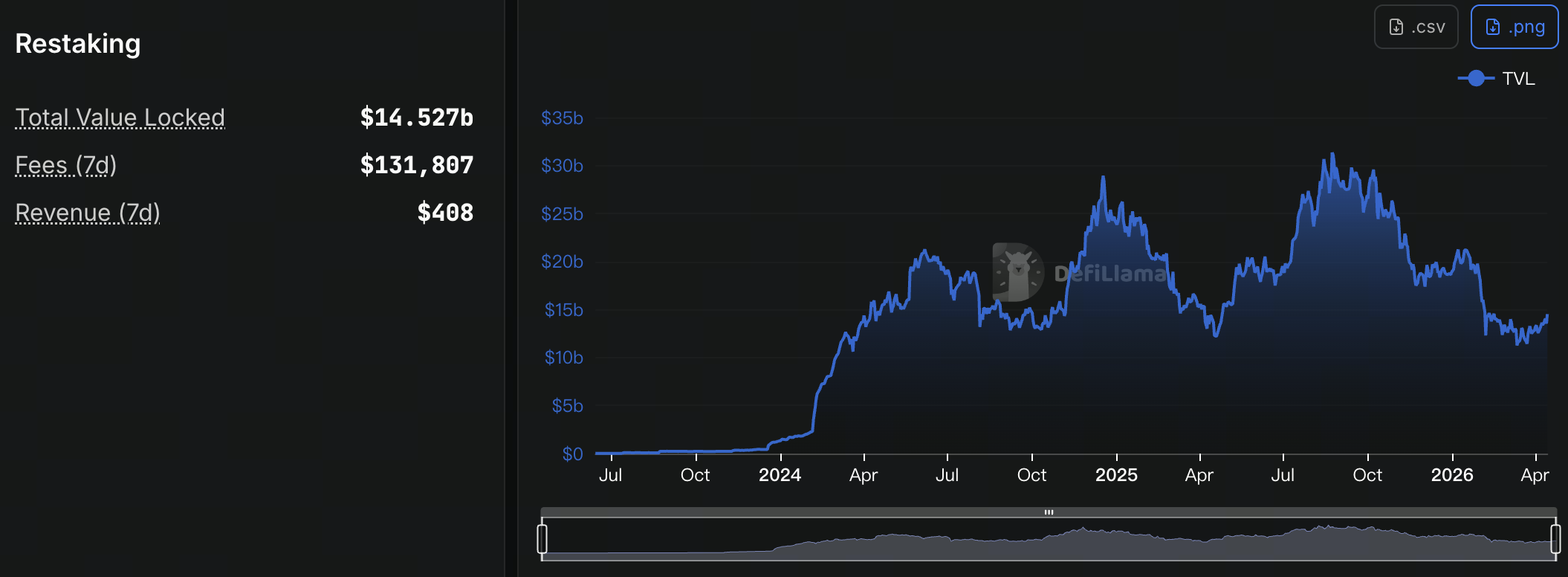
Image source: DeFiLlama
Restaking’s biggest appeal can be summed up in one line: the same staked capital can serve more security needs and generate greater returns.
But its greatest risk is embedded in that same line: when “greater returns” are driven by “increased coupling,” systemic vulnerabilities are magnified, not diversified.
For a while, the market treated restaking as the poster child for “capital efficiency upgrades.” Now, more participants are asking a different question: when subsidies wind down, volatility returns, and slashing events occur, can this structure hold up?
This is the central question of the “risk liquidation” phase.
1. Why Restaking Has Entered the Risk Repricing Phase
Every high-growth sector goes through three stages:
- Narrative pricing: First comes the story, then the valuation.
- Incremental pricing: Focus on TVL, user growth, and integration speed.
- Risk pricing: Assess cash flow quality, drawdown, and survivability.
Restaking is shifting from stage 2 to stage 3, typically triggered by four factors:
- Subsidy marginal returns decline, so headline yields stop growing linearly.
- More copycat protocols flatten the security premium through competition.
- Market volatility returns, exposing hidden leverage and liquidity mismatches.
- Single-point events (slashing, oracle failures, governance disputes) trigger a trust discount.
So, today’s restaking conversation shouldn’t be about “can it keep going up,” but rather “where is it most likely to break.”
2. What Are the True Sources of Restaking Returns
Many only look at the front-end APY without dissecting the sources of return. Restaking yields typically come from four components:
- Base staking return: from native staking rewards of the underlying network.
- Restaking security rent: paid by services utilizing shared security.
- Protocol subsidies and incentives: token rewards, credits, and promotional campaigns.
- Strategy-driven enhanced returns: leverage, recursive staking, and cross-protocol portfolios.
The key during the risk liquidation phase is identifying which of these four elements are sustainable:
- Base returns are generally stable, but capped.
- Security rent depends on real demand—growth isn’t unlimited.
- Subsidy yields fade first.
- Strategy returns are most dependent on liquidity and execution conditions.
The higher the headline yield, the more you need to ask whether it’s coming from “productive cash flow” or just “reversible subsidy terms.”
3. The 5 Most Overlooked Vulnerabilities After the Hype
1. Return Compression Risk: High APY’s “Mean Reversion”
As competition intensifies, subsidies shrink, and capital inflows swell, per-unit returns naturally fall.
Restaking is no exception. Early high yields usually result from scarce supply and outsized subsidies; later, it becomes a “medium-yield, high-volatility” asset.
2. Complexity Risk: Stacked Strategies Create Hidden Leverage
A typical path in the restaking ecosystem looks like this:
Native staking → Liquid staking → Restaking → Secondary wrapping → Re-lending.
Each layer might boost returns slightly, but exponentially increases the attack surface.
In the end, participants often don’t realize their exposure spans multiple protocols, liquidation triggers, and governance risks.
3. Liquidity Mismatch Risk: Redeemable Promises vs. Real Market Depth
In calm markets, liquidity seems abundant.
Under stress, exit routes can suddenly narrow.
When secondary liquidity dries up, redemption windows are delayed, and discounts widen, restaking positions can shift from “yield assets” to “discounted assets.”
4. Slashing Transmission Risk: Shared Security’s Double-Edged Sword
Shared security boosts capital efficiency, but also raises risk correlation.
If a critical validator misbehaves, slashing may no longer be isolated—it can propagate through the shared staking layer to multiple pools, amplifying systemic stress.
5. Governance Centralization Risk: Decentralized in Name, Centralized in Practice
Many protocols still rely heavily on a few entities for key parameters, whitelists, and risk switches.
When external shocks hit, if governance response is opaque or slow, the market will first price in “governance credibility” before repricing the assets.
4. How Risk Propagates Across Protocols
Restaking’s systemic risk isn’t about a single protocol, but the connections between them.
A typical chain reaction looks like this:
- A service layer failure or dispute triggers slashing concerns.
- Restaking token prices drop before redemption mechanisms kick in.
- Lending platforms raise collateral discounts or trigger liquidations.
- Forced selling intensifies, further draining secondary liquidity.
- The market reinterprets a “local event” as a “systemic issue.”
This chain shows one truth:
Risk in the restaking ecosystem isn’t additive—it’s network-amplified.
5. Why So Many Misjudge Restaking Risk
Misconception 1: Treating APY as a Risk-Free Bond Yield
Restaking yields are not deposit rates—they embed technical, governance, liquidity, and market risks.
Misconception 2: Focusing on Quantity, Not Quality
TVL growth doesn’t mean risk is falling. What matters is capital structure, lock-up quality, concentration, and exit conditions.
Misconception 3: Focusing on Protocols, Not Portfolios
You might think you’re diversified across three protocols, but they may share the same underlying risk—highly correlated.
Misconception 4: Only Looking at Bull Market Backtests
Many strategies shine when liquidity is ample, but only stress test results determine survival odds.
6. Restaking Risk Audit Checklist
The following checklist is suitable for project due diligence, content creation, and position management.
It’s recommended to review it weekly or biweekly.
- Return Structure Audit
- What percentage comes from base returns?
- Are incentive subsidies too large a share?
- After subsidies decline, does net return remain positive?
- Exposure Path Audit
- How many layers of wrapped assets are involved?
- Which key middleware (oracles, bridges, custodians, multisigs) are relied on?
- Are there hidden leverage or recursive collateralization risks?
- Liquidity Audit
- Does normal trading depth support large withdrawals?
- How deep could discounts get under stress?
- What are the redemption queue and actual settlement cycles?
- Slashing and Governance Audit
- Are slashing conditions clear, monitorable, and auditable?
- Who controls parameter adjustments?
- Is there an emergency switch, and are trigger criteria transparent?
- Correlation Audit
- Is correlation with major risk assets increasing?
- Are similar restaking assets highly correlated in price moves?
- Does drawdown spike significantly when volatility rises?
If a project is clearly weak in 2–3 of these five areas, even if returns look attractive, you should reduce your allocation.
7. What’s Next: Restaking Enters “Layered Competition”
Restaking won’t disappear because of risk exposure, but clear stratification will emerge:
- Base layer: prioritizes security, transparency, and simplicity—yields are moderate but more sustainable.
- Enhanced layer: uses strategies and portfolios to boost returns, but also increases volatility and tail risk.
- Experimental layer: fast innovation, unclear risk boundaries—best for high-risk capital.
This means the market will shift from “who pays more” to “who survives longer.”
In the end, capital will reward two key strengths:
First, verifiable risk control; second, sustainable sources of return.
Conclusion: In the Next Phase of Restaking, Risk Control Comes Before Yield
Restaking’s core value remains: it enhances capital efficiency and expands the scope of shared security.
But after the initial boom, the industry must face a more pragmatic truth:
Returns aren’t created—they’re priced according to risk.
In the next stage, restaking projects truly worth allocating to usually have three traits:
- Returns are driven by real demand, not just short-term subsidies;
- Product structure is transparent and can withstand stress testing;
- Governance and risk control mechanisms are verifiable, not just based on brand reputation.
So, instead of asking “is there a higher APY,” first ask: what’s the cost of this yield in the worst-case scenario?
When you can answer that, restaking is an investment—not a gamble.







