Eclipse Crypto Latest Updates: Cross-Chain Airdrops and Market Performance Analysis

Beginner
Quick Reads
Last Updated 2026-03-29 14:07:51
Reading Time: 1m
Eclipse Crypto (ES) has launched cross-chain and multi-chain issuance alongside an airdrop. With $ES priced around $0.16, the project has attracted significant attention and sparked debate. This in-depth review covers the latest updates and key investment considerations.

Introduction to Eclipse Crypto

Image source: https://www.eclipse.xyz/

Eclipse is a Layer-2 platform designed to combine the high-speed execution capabilities of the Solana Virtual Machine (SVM) with the secure settlement of Ethereum. Eclipse utilizes a modular framework, integrating Celestia’s data availability and RISC Zero for transaction verification. This architecture maximizes transaction throughput and enhances developer experience. At the same time, it maintains robust security and low operational costs.

Latest Updates: Cross-Chain Airdrop and Token Distribution Structure

On July 16, 2025, Eclipse officially launched its native token, $ES, simultaneously deploying it on the Eclipse chain, Ethereum, and Solana mainnets—a bold step reflecting its cross-chain strategy.

Of the total issuance, 15% of the tokens went through airdrop distribution over 30 days to core community members and developers. Eclipse allocated 35% to ecosystem growth and R&D, while Eclipse set aside 19% for contributors (including team members) subject to a 3–4 year vesting schedule. Eclipse reserved the remaining 31% for early supporters and investors, subject to a long-term lockup period.

Market Overview: Latest $ES Price and Performance
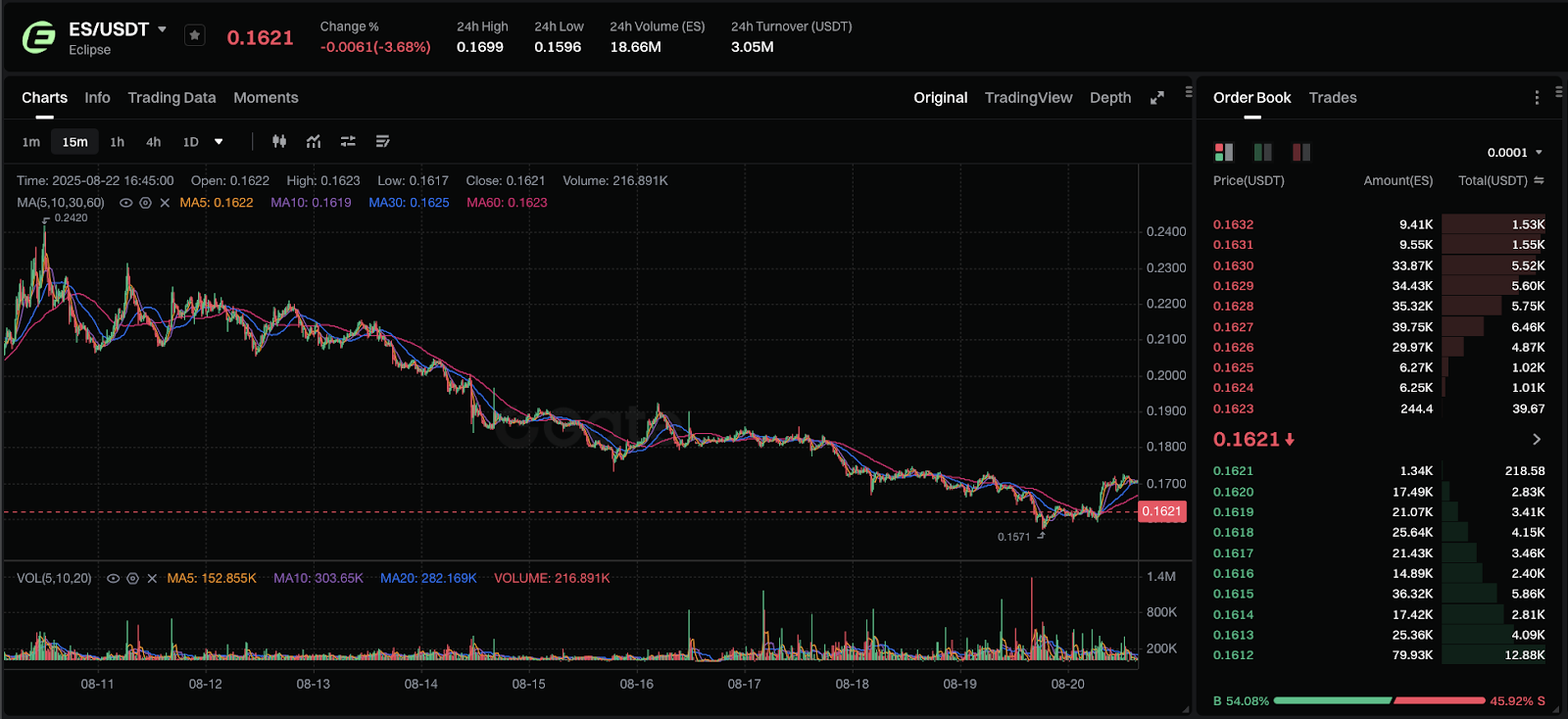

Image source: https://www.gate.com/trade/ES_USDT

Currently, $ES is trading in the $0.16–$0.17 range:

  • Exchange data shows the price at approximately $0.1623, with 24-hour trading volume around $190 million and a circulating supply of roughly 150 million ES.
  • The price has dropped more than 60% from its all-time high of about $0.49, signaling significant volatility.

Since its launch, $ES has followed a pattern of sharp rise and subsequent decline, falling from its initial price of around $0.39 to its current level, demonstrating typical sell-off pressure for new tokens.

Community and Market Response: Key Areas of Debate and Expectations

Key areas of debate:

  • The airdrop distribution caused community dissatisfaction—some NFT holders received notably fewer ES tokens compared to in-person event participants, prompting concerns about distribution fairness among community members.
  • The token price declined sharply, dropping over 20% immediately after listing, straining short-term investor confidence.

Positive factors:

  • Strong technical fundamentals: Fast execution from SVM, robust security with Ethereum, and Celestia’s data availability combined with RISC Zero verification all contribute to the platform’s rational architecture.
  • Eclipse will launch a governance mechanism in Q3. A second airdrop, comprising about 4% of the total supply, is planned for Q4, along with new security features and expanded community governance.

Why Eclipse Is Worth Watching

  • Innovative technology stack: The integration of SVM, Ethereum, Celestia, and RISC Zero for multi-chain and modular architecture positions Eclipse to potentially push the limits of Layer-2 performance.
  • Strong market interest: Despite recent price corrections, the initial token launch and exchange listings continue to attract significant attention.
  • Progress on governance and ecosystem development: The upcoming introduction of governance and enhanced community incentives could fuel sustainable long-term growth.

For new investors, ES offers significant technical potential but also presents considerable market volatility. Investors should monitor upcoming governance and token release events and carefully assess the project’s long-term value proposition.

Author: Max
Disclaimer
* The information is not intended to be and does not constitute financial advice or any other recommendation of any sort offered or endorsed by Gate.
* This article may not be reproduced, transmitted or copied without referencing Gate. Contravention is an infringement of Copyright Act and may be subject to legal action.

Related Articles

What is Fartcoin? All You Need to Know About FARTCOIN
Intermediate

What is Fartcoin? All You Need to Know About FARTCOIN

Fartcoin (FARTCOIN) is a representative meme coin within the Solana ecosystem based on an AI-driven narrative. Its core concept originated from an experiment aimed at exploring the "boundaries between AI Agents and humor." More than just a digital asset with social attributes, the project deeply couples absurd humor culture with on-chain financial logic by integrating autonomous AI interaction models.
2026-04-04 22:01:19
Gold Price Forecast for the Next Five Years: 2026–2030 Trend Outlook and Investment Implications, Could It Reach $6,000?
Beginner

Gold Price Forecast for the Next Five Years: 2026–2030 Trend Outlook and Investment Implications, Could It Reach $6,000?

Analyze current gold price trends alongside authoritative five-year forecasts, integrating an evaluation of market risks and opportunities. This gives investors insight into the potential trajectory of gold prices and the main drivers expected to shape the market over the next five years.
2026-03-25 18:13:30
Aster vs Hyperliquid: Which Perp DEX Will Prevail?
Beginner

Aster vs Hyperliquid: Which Perp DEX Will Prevail?

Aster and Hyperliquid are the two representative protocols of the "purpose-built L1 path" within the current decentralized perpetual exchange (Perp DEX) sector. As a pioneer in the field, Hyperliquid has built a deep liquidity moat through its highly mature order book architecture and strong community consensus. Conversely, Aster, as a rising challenger, seeks to leapfrog the competition in high-performance trading through more aggressive multi-chain aggregation logic, private transaction modules, and an underlying execution environment optimized for 2026 market demands.
2026-03-24 11:58:33
AI-Native Settlement Layers: How United Stables Is Building the Next Financial Rail
Beginner

AI-Native Settlement Layers: How United Stables Is Building the Next Financial Rail

Stablecoins were originally designed as dollar substitutes within exchanges, primarily used for asset pricing and trade settlement. As on-chain financial ecosystems have matured, their role has expanded beyond simple payments to include collateral assets, cross-chain liquidity mediums, and unified settlement units. In particular, as AI systems and automated agents begin to participate directly in economic activity, demand has risen sharply for programmable value units capable of instant settlement. This shift is pushing stablecoins toward the role of foundational financial infrastructure.
2026-03-25 03:16:17
ASTER Tokenomics: Buybacks, Burns, and Staking as the Value Foundation of ASTER in 2026
Beginner

ASTER Tokenomics: Buybacks, Burns, and Staking as the Value Foundation of ASTER in 2026

ASTER is the native equity and governance token of the Aster ecosystem, with its core value built upon a radical "Deflationary Engine." Beyond serving as a governance tool, ASTER integrates multiple utilities including staking rewards, trading fee discounts, and liquidity incentives. Through its deep integration with the upcoming dedicated Layer 1 mainnet, it enables direct value capture from protocol cash flow to token holders.
2026-03-25 07:38:07
2026 Silver Price Forecast: Bull Market Continuation or High-Level Pullback? In-Depth Analysis of Silver Candlestick Chart
Beginner

2026 Silver Price Forecast: Bull Market Continuation or High-Level Pullback? In-Depth Analysis of Silver Candlestick Chart

2026 Silver Price Forecast: Latest Outlook This article integrates current market trends, silver candlestick chart analysis, and momentum factors to assess the potential key support and resistance levels, upside targets, and pullback risks for silver prices. The goal is to help investors make informed, rational decisions.
2026-03-25 16:08:59