Vanguard Total Stock Market ETF (VTI) is a U.S.-listed ETF stock issued by Vanguard. Its ticker is VTI, and it tracks the CRSP US Total Market Index. When trading this stock with USDT on Gate Stocks, confirm name, ticker, market, order type, available balance, fee rules, and trading status on the page itself—item by item.
Vanguard Total Stock Market ETF (VTI) covers issuer, tracked index, index sampling (not full replication), and expense ratio. Before placing an order, separate ETF structure research from page trading rules: structure research answers what exposure the instrument represents; the trading workflow answers how to verify and execute an order.
Work through these checks in order, then move into the step-by-step sections:
- Confirm Stocks permissions and identity-verification status
- Confirm available USDT that can fund a stock order
- Search ticker
VTI and match the English full name
- Choose order type, quantity, and fee fields, then submit
- Review ticker and fees in open orders, fills, and holdings
Related products include nearby tickers such as VOO, ITOT, and VT; matching both ticker and full English name reduces wrong-symbol selection.
| Nearby ticker |
Common positioning |
Verification focus vs VTI |
| VTI |
Vanguard Total Stock Market ETF |
U.S. total market / CRSP US Total Market |
| VOO |
Vanguard S&P 500 ETF |
Large-cap ~500 names, not total market |
| ITOT |
Other-issuer total-market-style ETF |
Issuer and index methodology may differ |
| VT |
Global equity ETF |
Includes international exposure, not U.S.-only |
The table supports ticker selection at search time only; it is not a product ranking. If any result row fails the ticker or full-name match, pause and re-search before sizing an order.
What Should Be Prepared Before Trading VTI on Gate?
Before buying or trading VTI with USDT, confirm account status, identity verification, stock trading permissions, available USDT, product availability, and regional access. Rules can differ by account and region, so usable features follow what the Gate Stocks page displays.
Preparation is not about submitting an order. It is about ruling out basic blockers: unable to trade, funds unavailable, ticker mix-ups, and fee misreads. If any item is unclear, later steps may produce “quotes visible but orders blocked” or “order size does not match available balance.”
| Preparation item |
What to verify |
Typical impact |
| Account permissions |
Whether Stocks / U.S. equity trading is available |
Affects whether an order can be submitted |
| USDT funding |
Whether available USDT is in the stock-usable balance |
Affects order size and tradable quantity |
| Product availability |
Whether the VTI page shows a tradable status |
Affects whether the order can be sent |
| Instrument ID |
Whether name, ticker VTI, and U.S. ETF details match |
Affects whether the correct stock is selected |
| Fee and order rules |
Trading fees, minimum size, settlement display |
Affects actual fills and holdings records |
The preparation table separates “can open the page” from “can submit an order.” Search and order entry only become executable after account, permissions, funding, product status, and fee rules are clear.
Step 1: How to Prepare USDT and a Stock Trading Account?
U.S. stock trading on Gate Stocks usually requires account-status checks, identity verification, stock trading permission, and USDT that can fund stock orders. Available USDT for stocks and ordinary spot-wallet balances may not use the same page reading; confirm funds are usable for stock orders before trading.
Funding prep should also cover deposit confirmation, account transfers, available balance, and frozen amounts. If USDT is still confirming, a transfer is incomplete, or funds are reserved by other orders, buyable quantity on the page may be lower than total account balance. Stock trading permissions and crypto spot permissions may be managed separately; confirm Stocks is enabled before opening the VTI trading page.
Step 2: How to Search for VTI on Gate Stocks?
Open Gate Stocks · VTI and enter VTI in the search box. The page should show Vanguard Total Stock Market ETF or the matching stock name. Matching ticker and full fund name is the first control—especially because broad U.S. equity ETFs include several V-prefix, total-market, or large-cap tickers.
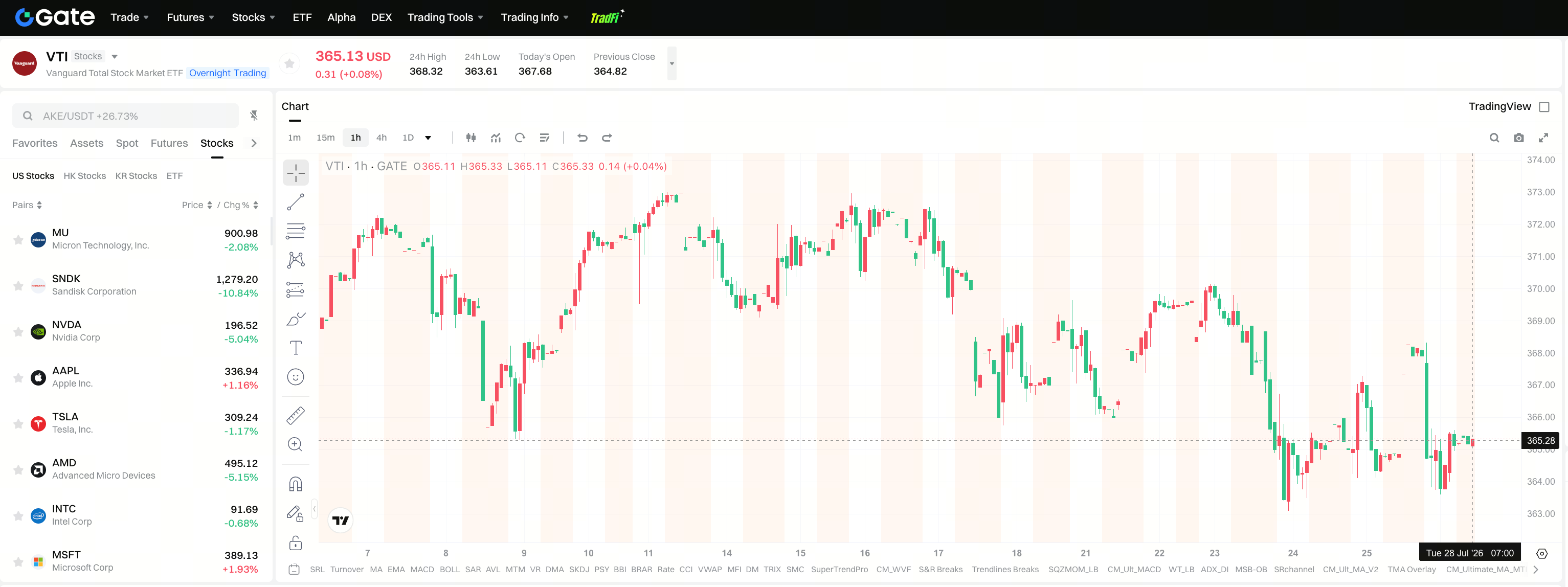
If search results also list VOO, ITOT, VT, or other broad ETFs, prioritize ticker plus English full name. VTI maps to Vanguard Total Stock Market ETF and tracks the CRSP US Total Market Index. If the page shows only an abbreviation, combine full name and market information so products with different index boundaries are not treated as the same instrument. At the search stage, the only required action is aligning ticker with full name.
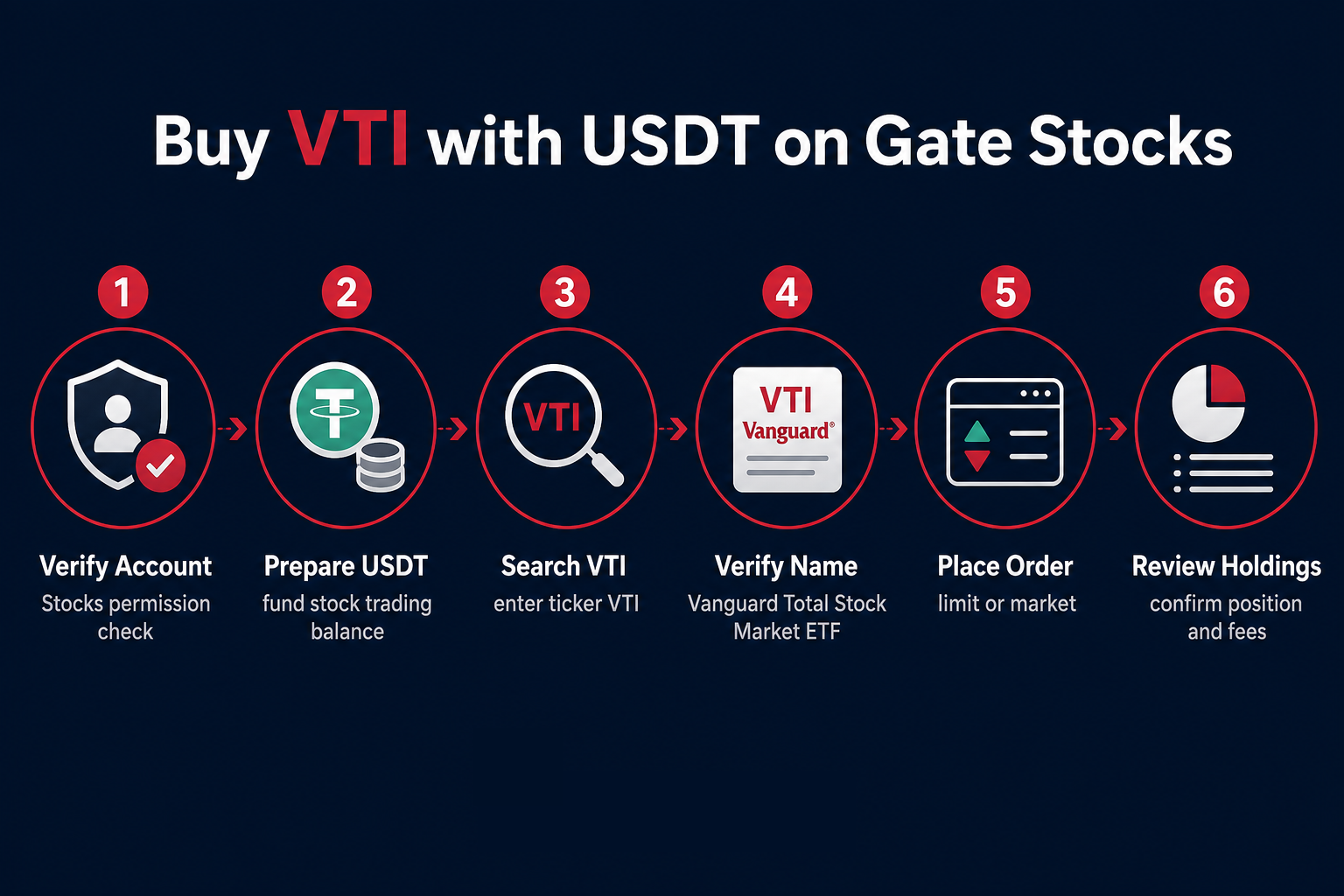
Figure 1. Gate Stocks USDT-to-VTI flow: verify account, prepare USDT, search VTI, confirm Vanguard Total Stock Market ETF, choose order type, and review holdings.
Step 3: How to Place a Buy/Trade Order for VTI?
On the VTI trading page, confirm in order: side (buy/sell), order type, quantity or notional, estimated fill amount, fees, and available account balance. Before submit, re-check stock name and ticker so a wrong instrument ID does not enter the fill record.
Common order types include Limit and Market. Limit orders emphasize a user-set price condition; Market orders emphasize execution at available market prices. Neither type is universally better; the difference is execution logic, fill speed, and price control.
| Order type |
Verification focus |
Possible outcome |
| Limit |
Price, quantity, time-in-force status |
May remain unfilled if the price is not triggered |
| Market |
Available balance, market liquidity |
Fill price may differ from the estimate |
| Partial fill |
Filled quantity, remaining open size |
Holdings and available balance update together |
The table separates order type from order status. Before submit, the confirmation dialog, fee notices, and order side are the last verification points.
After submission, check open orders, fill history, or holdings, and confirm average fill price, quantity, fees, and ticker VTI are consistent. ETF holdings display may differ from spot crypto assets; review ticker, shares, and order history together. If a partial fill appears, reconcile filled quantity, remaining open size, and available-balance changes separately so total wallet balance alone is not treated as position size.
What Fees and Order Rules Need Confirmation When Trading VTI?
Stock trading pages usually show trading fees, spreads, execution price, minimum trade size, session hours, and related notices. Product and region rules can differ, so fees and order rules follow page display.
When checking costs, separate two layers. One is the fund-level expense ratio: per Vanguard Overview, VTI’s expense ratio is about 0.03% (as of April 28, 2026), describing management and related fees charged against fund net assets. The other is platform trading fees, bid–ask spreads, and order execution costs, which follow Gate Stocks page fields. The two numbers describe different stages and cannot substitute for each other.
Beyond listed trading fees, watch execution cost. Market orders may fill away from the estimate when liquidity is thin; Limit orders may sit unfilled for a long time if price conditions are not met. Trading fees, spreads, minimum size, and session fields should be reviewed alongside risk checks. ETF NAV and secondary-market trade price can also diverge briefly; order verification should follow the executable price and fee fields shown on the page, not treat NAV as an instant fill quote.
What Risks Should Be Understood Before Buying/Trading VTI?
Trading-workflow risk and ETF-structure risk need separate framing. Workflow risks include ticker mix-ups (for example, placing VOO, ITOT, or VT instead of VTI), misreading order types, unclear fee rules, session limits, and liquidity changes. Structure and market risks come from U.S. total-market volatility, mid- and small-cap weight shifts, tracking difference from sampling versus the index, and display or settlement differences between USDT funding readings and stock pricing.
| Check dimension |
Typical content |
Purpose of the check |
| Fund expense ratio vs platform fees |
~0.03% expense ratio, trading fees, spreads |
Separate fund cost from execution cost |
| Instrument ID |
VTI vs nearby tickers such as VOO / ITOT / VT |
Avoid buying the wrong ETF stock |
| Market and coverage |
Total-market volatility, mid/small-cap weight changes |
Understand exposure source, not order steps |
| Tracking and execution |
Index sampling, rebalancing, order and session rules |
Separate NAV path differences from page execution risk |
The table combines fee rules, operational risk, and ETF structure variables into one checklist. VTI tracks the CRSP US Total Market Index and uses index sampling (not full replication); a “total market” label alone is not a complete check. Risk notes identify variable sources and do not constitute buy or sell advice.
| Common issue |
Likely cause |
Fix check |
| Nearby ticker selected by mistake |
Abbreviation-only match, full name unchecked |
Confirm VTI + Vanguard Total Stock Market ETF as dual fields |
| Balance visible but order blocked |
Stocks not enabled, or USDT not in usable reading |
Re-check permissions, transfers, and available-balance field |
| Fill differs from estimate |
Market slippage, partial fill, or fees excluded from estimate |
Reconcile average fill, remaining open size, and fee line |
| Holdings missing or mixed readings |
Wrong account page, or spot wallet confused with Stocks |
Filter Stocks holdings/history by ticker VTI |
The common-issue table separates execution faults from ETF structure research: return to page fields for the former, and to index and sampling notes for the latter.
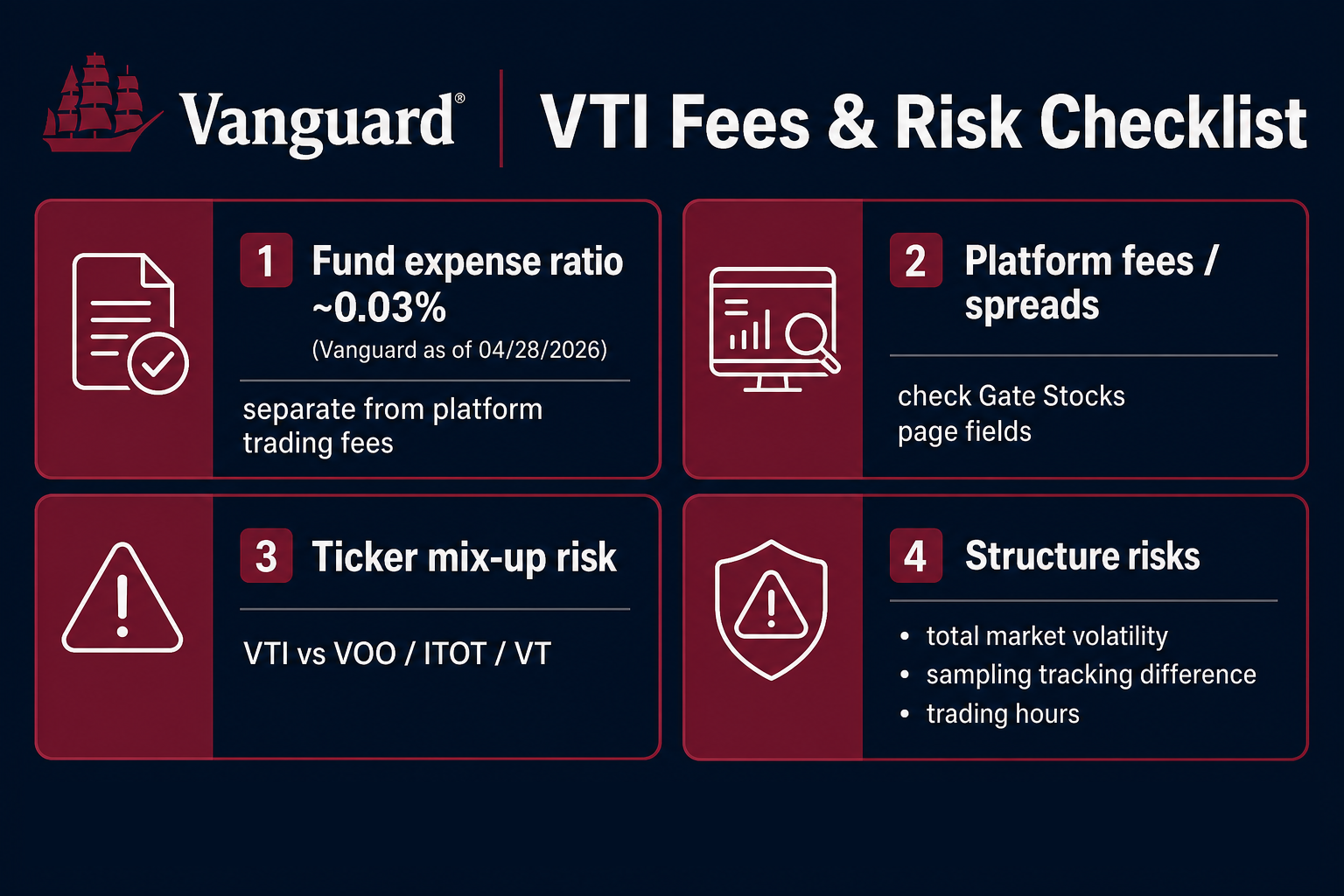
Figure 2. VTI fees and risk checklist: separate fund expense ratio from platform trading fees, and check nearby-ticker mix-ups, total-market volatility, and sampling tracking difference independently.
Summary
Trading Vanguard Total Stock Market ETF (VTI) with USDT on Gate Stocks is standardized process execution: prepare account and USDT, search ticker VTI, verify the stock detail page, choose an order type, confirm fee rules, then review holdings after the fill. The trading page answers operational questions; total-market index boundaries and sampling checklists answer instrument understanding. Keep those two layers separate.
FAQ
How to Buy VTI with USDT on Gate?
Confirm Stocks trading permissions and that USDT sits in a balance usable for stock orders, then search ticker VTI on Gate Stocks and verify Vanguard Total Stock Market ETF. Choose an order type, submit, and after the fill review ticker, quantity, and fees in holdings and order history.
How Does Gate Stocks Trading of VTI Differ from a Traditional Broker?
Gate Stocks and traditional brokers can differ in account structure, settlement display, and funding currency: the former often organizes available balance and order fields around USDT or similar stablecoin readings, while the latter typically settles in fiat brokerage accounts. Index-research conclusions do not replace order-field checks; each path follows its own page rules.
What Is VTI’s Expense Ratio?
Per Vanguard Overview, VTI’s expense ratio is about 0.03% (as of April 28, 2026). That figure is a fund expense-ratio disclosure describing management and related fund-level costs. Platform trading fees, bid–ask spreads, and order execution costs must be checked separately on Gate Stocks page fields; the two should not be treated as the same number.
What Is VTI?
VTI is the trading ticker for Vanguard Total Stock Market ETF, a U.S.-listed ETF stock issued by Vanguard. The product tracks the CRSP US Total Market Index and uses index sampling to provide passive exposure to the investable U.S. total equity market. ETF shares represent that basket; they are not a single-company stock and not a crypto token.
Is There a Minimum Requirement to Buy VTI?
Minimum buyable size, minimum trade unit, and available-balance thresholds follow Gate Stocks page fields and can vary with account permissions, regional rules, and tradable status at the time. During preparation, check Stocks permissions, available USDT, and product tradable status together rather than estimating from total wallet balance alone.
Can VTI Be Sold? What Session Rules Matter?
As a tradable U.S. ETF stock, VTI can usually be sold or closed within the buy/sell directions and session windows the platform supports; exact rules follow Gate Stocks page notices for order side and session status. Before submit, confirm session hours, order time-in-force status, and available holdings so results outside tradable windows are not misread.
How Are VTI Dividends Handled?
ETF-level dividend distribution, reinvestment options, and credit display follow product disclosure and Gate Stocks page rules. When researching dividends, return to issuer disclosure and platform fields; a single period’s dividend record is not a fixed yield rate. Tax treatment varies by region and account type and should be kept separate from trade execution.