Beginner’s Guide: What Is YieldBasis (YB) and How to Earn BTC Yield with Zero Risk

Beginner
Quick Reads
Last Updated 2026-03-28 12:30:07
Reading Time: 1m
To generate steady yields with BTC, YieldBasis utilizes a dual-leverage system to eliminate impermanent loss. Users can hold BTC and earn trading fees as well as YB incentives.

What is YieldBasis?


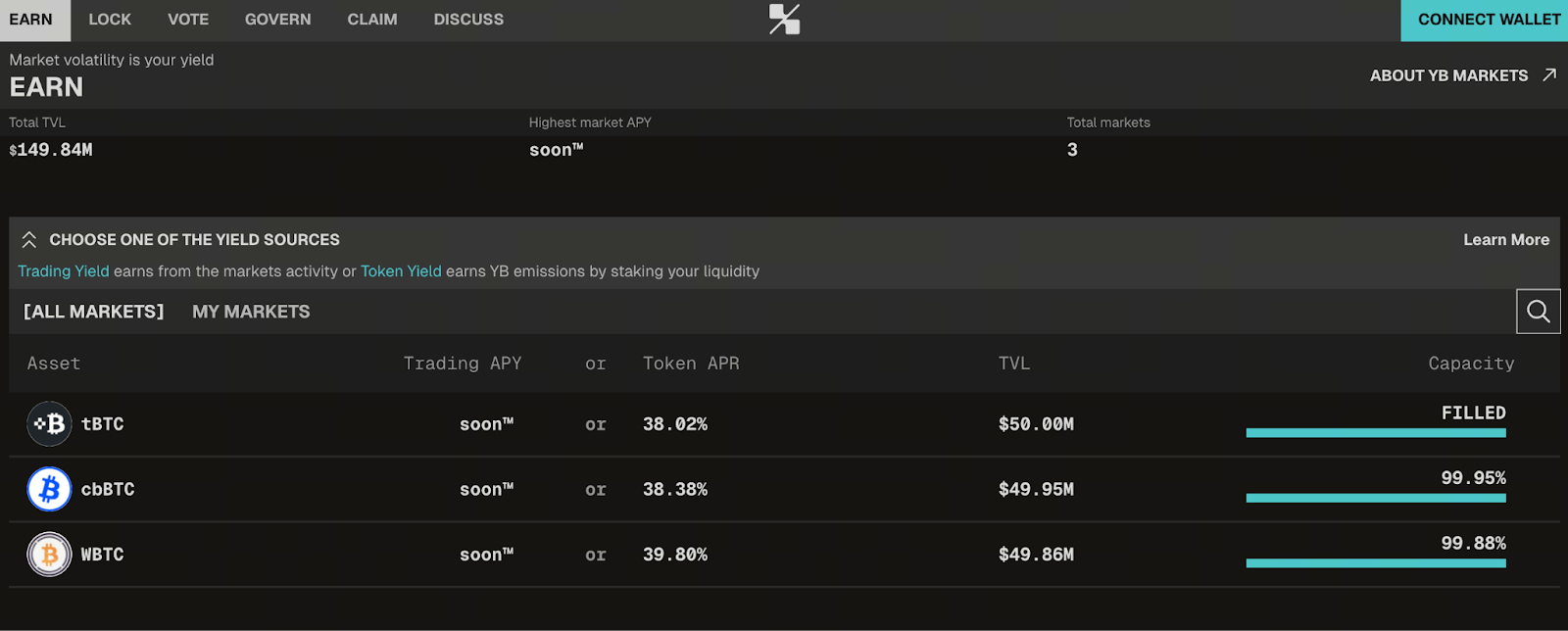
Image: https://yieldbasis.com/earn

YieldBasis (YB) is an innovative project built on the DeFi protocol Curve and lending mechanisms. It is designed to let users provide BTC liquidity while avoiding impermanent loss common in traditional AMM models.

In this system, users deposit BTC into the protocol, which then automatically borrows stablecoins (such as crvUSD) to form a liquidity pool, maintaining a 2x leveraged structure. This approach enables a no-loss holding yield model—users maintain a 1:1 BTC peg for their assets and earn trading fees and YB rewards.

Why does traditional liquidity mining incur impermanent loss?

In traditional AMM models such as Uniswap and Curve, when asset prices fluctuate, liquidity providers (LPs) are forced to rebalance between two assets. This causes them to sell low during price increases and buy high during declines. While LPs do earn trading fees, their overall returns are often lower than simply holding BTC—this is known as impermanent loss (IL). YieldBasis is specifically designed to tackle this persistent challenge, nearly eliminating IL risk through its leverage and rebalancing mechanisms.

YieldBasis Core Mechanism: Dual Leverage and Automated Rebalancing

YieldBasis innovates with its leveraged liquidity model. When a user deposits BTC, the protocol automatically borrows an equivalent amount of stablecoins (crvUSD), and both are added to the BTC/crvUSD pool, generating LP tokens. The protocol maintains a fixed 2x leverage ratio, and its automated rebalancing mechanism keeps the portfolio close to the target structure. If BTC price swings cause leverage to deviate, the system incentivizes arbitrageurs. They restore the ratio in a single transaction.

This mechanism keeps user asset performance in sync with BTC, delivering a theoretical zero impermanent loss.

User Participation Process

YieldBasis is highly accessible for beginners:

  • Deposit BTC: Add BTC to the protocol and receive an equal amount of ybBTC from the system.
  • Earn Yield: Holding ybBTC automatically accrues Curve pool trading fees; staking ybBTC also earns YB rewards.
  • Withdraw Anytime: Burn ybBTC to redeem your initial BTC deposit and yield; the system automatically repays loans and removes LP positions.

The process is fully automated with no complicated steps required.

Latest Updates and Market News

  • YB Price Performance: As of mid-October, YieldBasis (YB) trades at approximately $0.70, up nearly 9% in 24 hours. Trade YB/USDT here: https://www.gate.com/trade/YB_USDT
  • Project Progress: Curve DAO has approved a multi-million crvUSD credit line for YieldBasis, supporting the expansion of its BTC-stablecoin liquidity market.
  • Launch Update: YieldBasis launched trading on October 15, 2025, and quickly attracted attention as one of the most popular tokens in airdrop campaigns on select platforms.
  • Community Buzz: Core Curve members launched YieldBasis, which is recognized as a major breakthrough for next-generation DeFi yield mechanisms.

Risk Disclosure and Target Audience

Risk Disclosure:

  • Extreme market conditions may disrupt the rebalancing mechanism, triggering liquidation risk.
  • Smart contract vulnerabilities or leverage mechanism failures can result in potential losses.
  • New tokens are typically highly volatile at launch, posing significant short-term speculation risk.

Target Audience:

  • Long-term BTC holders seeking additional DeFi yield.
  • Investors with a basic understanding of crypto and a tolerance for volatility.
  • Early adopters interested in new DeFi yield models and innovative projects.

Summary

YieldBasis transforms BTC into a yield-bearing asset. Its dual leverage and rebalancing mechanisms address the key challenges of traditional liquidity mining, enabling users to benefit from BTC’s appreciation potential while consistently earning fees and token rewards. For newcomers, it offers an excellent gateway to DeFi. Risk and position management is essential.

Author: Max
Disclaimer
* The information is not intended to be and does not constitute financial advice or any other recommendation of any sort offered or endorsed by Gate.
* This article may not be reproduced, transmitted or copied without referencing Gate. Contravention is an infringement of Copyright Act and may be subject to legal action.

Related Articles

What is Fartcoin? All You Need to Know About FARTCOIN
Intermediate

What is Fartcoin? All You Need to Know About FARTCOIN

Fartcoin (FARTCOIN) is a representative meme coin within the Solana ecosystem based on an AI-driven narrative. Its core concept originated from an experiment aimed at exploring the "boundaries between AI Agents and humor." More than just a digital asset with social attributes, the project deeply couples absurd humor culture with on-chain financial logic by integrating autonomous AI interaction models.
2026-04-04 22:01:19
Gold Price Forecast for the Next Five Years: 2026–2030 Trend Outlook and Investment Implications, Could It Reach $6,000?
Beginner

Gold Price Forecast for the Next Five Years: 2026–2030 Trend Outlook and Investment Implications, Could It Reach $6,000?

Analyze current gold price trends alongside authoritative five-year forecasts, integrating an evaluation of market risks and opportunities. This gives investors insight into the potential trajectory of gold prices and the main drivers expected to shape the market over the next five years.
2026-03-25 18:13:30
Aster vs Hyperliquid: Which Perp DEX Will Prevail?
Beginner

Aster vs Hyperliquid: Which Perp DEX Will Prevail?

Aster and Hyperliquid are the two representative protocols of the "purpose-built L1 path" within the current decentralized perpetual exchange (Perp DEX) sector. As a pioneer in the field, Hyperliquid has built a deep liquidity moat through its highly mature order book architecture and strong community consensus. Conversely, Aster, as a rising challenger, seeks to leapfrog the competition in high-performance trading through more aggressive multi-chain aggregation logic, private transaction modules, and an underlying execution environment optimized for 2026 market demands.
2026-03-24 11:58:33
AI-Native Settlement Layers: How United Stables Is Building the Next Financial Rail
Beginner

AI-Native Settlement Layers: How United Stables Is Building the Next Financial Rail

Stablecoins were originally designed as dollar substitutes within exchanges, primarily used for asset pricing and trade settlement. As on-chain financial ecosystems have matured, their role has expanded beyond simple payments to include collateral assets, cross-chain liquidity mediums, and unified settlement units. In particular, as AI systems and automated agents begin to participate directly in economic activity, demand has risen sharply for programmable value units capable of instant settlement. This shift is pushing stablecoins toward the role of foundational financial infrastructure.
2026-03-25 03:16:17
ASTER Tokenomics: Buybacks, Burns, and Staking as the Value Foundation of ASTER in 2026
Beginner

ASTER Tokenomics: Buybacks, Burns, and Staking as the Value Foundation of ASTER in 2026

ASTER is the native equity and governance token of the Aster ecosystem, with its core value built upon a radical "Deflationary Engine." Beyond serving as a governance tool, ASTER integrates multiple utilities including staking rewards, trading fee discounts, and liquidity incentives. Through its deep integration with the upcoming dedicated Layer 1 mainnet, it enables direct value capture from protocol cash flow to token holders.
2026-03-25 07:38:07
Hybrid Collateral Stablecoins: Inside United Stables' Stability and Yield Architecture
Beginner

Hybrid Collateral Stablecoins: Inside United Stables' Stability and Yield Architecture

In the early stages of the crypto market, traditional stablecoins mainly relied on single-reserve or single-collateral models. Their primary focus was price stability and payment convenience, which allowed them to become foundational tools for on-chain trading and capital flows. As the market has entered a more mature financial phase, however, this structure has begun to reveal limitations, including high concentration risk and the difficulty of balancing liquidity with yield. These constraints have driven the evolution toward multi-layer collateral and portfolio-based designs, such as the dual-layer hybrid collateral architecture proposed by United Stables, which seeks to redefine the underlying logic of stable assets.
2026-03-25 03:17:39