Bedrock: Next-Gen BTCFi Liquid Staking Protocol — Security Upgrade Sparks Major Attention

Beginner
Quick Reads
Last Updated 2026-03-27 05:05:34
Reading Time: 1m
Bedrock has introduced Chainlink Proof-of-Reserve and Secure Mint mechanisms, enhancing the safety of uniBTC cross-chain staking. With the BR Token now in circulation, both DeFi protocols and retail investors have shown interest.

What Is Bedrock?


Source: https://www.bedrockdao.com/

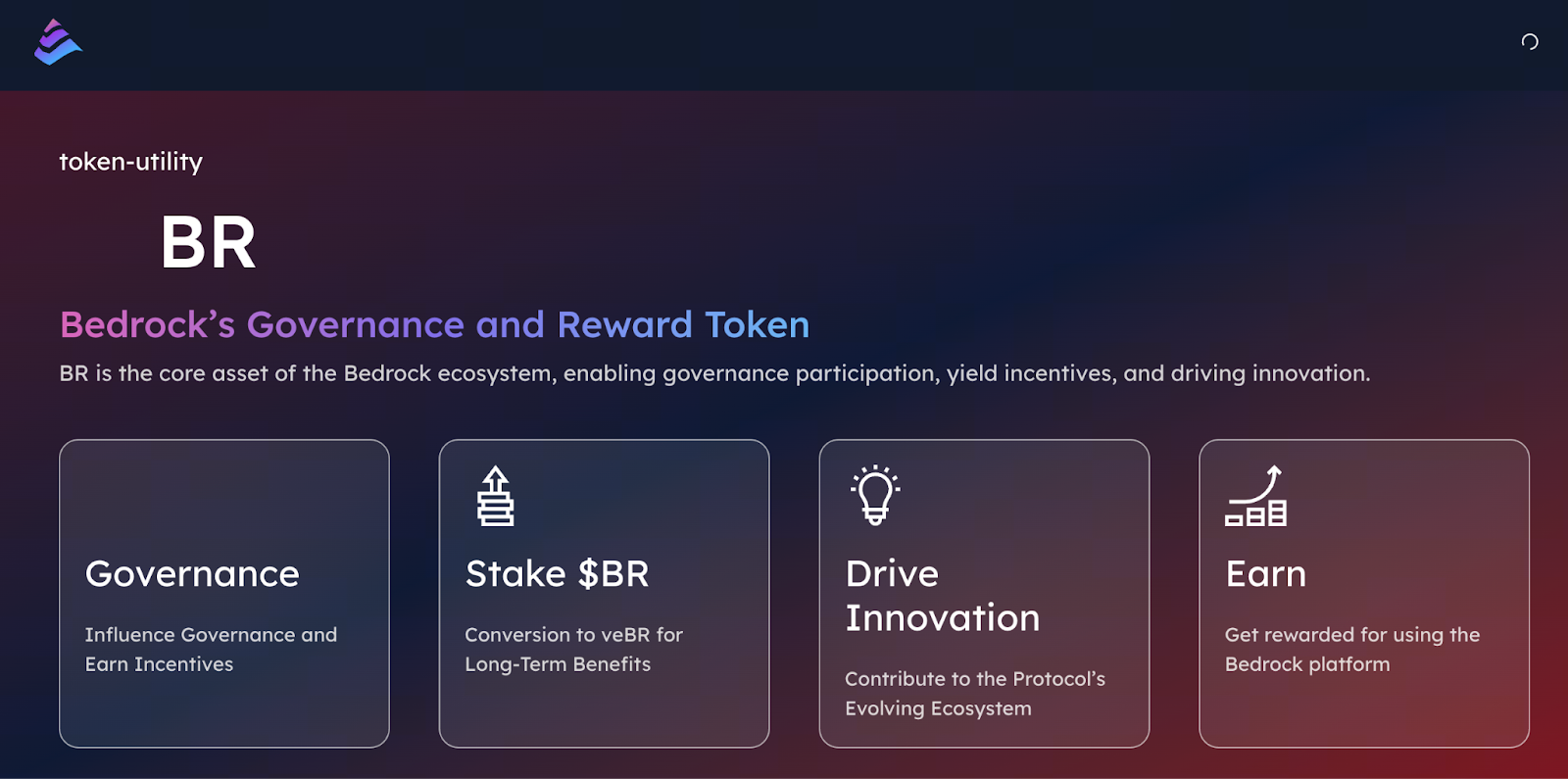
Bedrock is a multi-asset liquid restaking protocol focused on BTCFi. It converts BTC, ETH, DePIN, and other leading assets into yield-bearing assets that can move freely across multi-chain DeFi ecosystems. The project’s core vision is to make staking more than just long-term lockup—transforming it into an asset management strategy that delivers yield, security, and liquidity.

Bedrock’s architecture features three main components:

  • Restake Layer: Supports staking and restaking for multiple assets.
  • Liquidity Layer: Enables cross-chain utility for liquidity tokens like uniBTC and uniETH.
  • Governance Layer: Utilizes a BR → veBR governance system to allocate rewards, set parameters, and manage on-chain strategies.

This structure naturally meets the liquidity needs of the multi-chain era.

Multi-Layer Security Enhancements: Chainlink + Secure Mint + CCIP

In 2025, Bedrock implemented a series of critical security upgrades, positioning itself among the few liquid staking protocols with institutional-grade security architecture.

Proof-of-Reserve (PoR)

Through Chainlink’s PoR, every uniBTC is backed by on-chain, verifiable BTC reserves.

  • Prevents over-minting
  • Eliminates the risks of centralized custody black boxes
  • Boosts transparency and user trust

Secure Mint Mechanism

Secure Mint introduces multi-party verification and security thresholds to the minting and burning processes, ensuring:

  • Over-minting is impossible
  • Abnormal cross-chain activity is automatically blocked
  • All operations are fully auditable and verifiable

CCIP + Chainlink Price Feeds

Chainlink’s Cross-Chain Interoperability Protocol enables uniBTC to move securely between chains, while price oracles ensure real-time price synchronization.

Collectively, Bedrock has established a multi-layer, modular security framework that greatly enhances scalability and institutional trust.

uniBTC and the Multi-Asset Restake Model

uniBTC is one of Bedrock’s core assets—essentially a “yield-bearing cross-chain BTC.”

Key advantages include:

  • Robust cross-chain liquidity, usable across Ethereum, Layer 2s, modular chains, and more.
  • Maintains BTC exposure while earning staking rewards—something WBTC and tBTC do not provide.
  • Supports lending, liquidity provision, collateralization, and other DeFi applications.
  • Redeemable for native BTC, eliminating the risk of pseudo-assets on-chain.

Beyond BTC, Bedrock also supports ETH, DePIN assets, and more, broadening choices across the entire Liquid Restaking Token (LRT) ecosystem.

Latest Bedrock Data and Price Performance

Source: https://www.gate.com/trade/BR_USDT

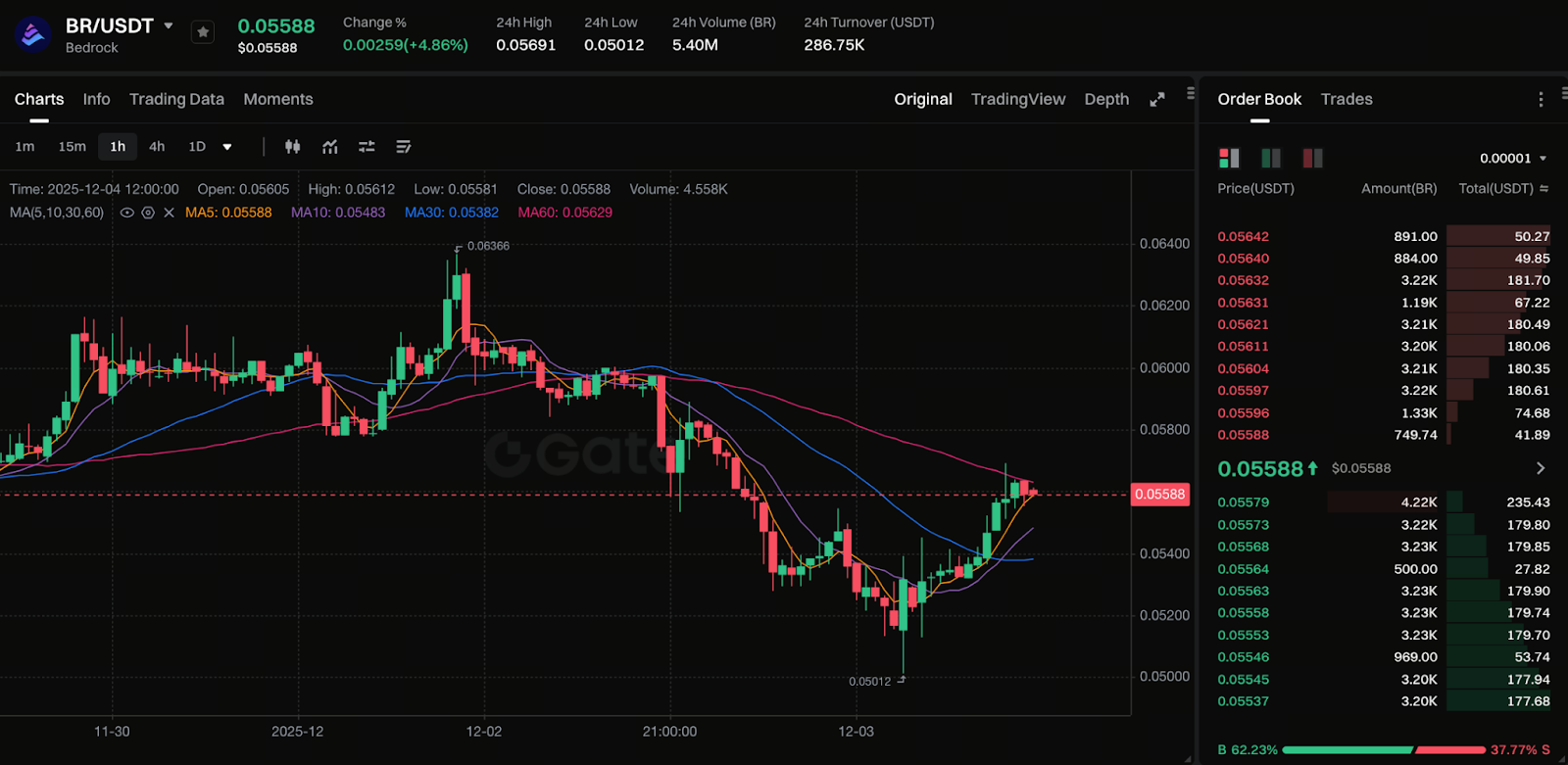
The latest BR Token price is about $0.055, with circulating supply representing roughly 23% of the total. The token unlock schedule is gradual, mitigating short-term sell pressure.

Large holders exited, causing a price drop for Bedrock. As security upgrades were implemented and cross-chain applications expanded, the price steadily recovered.

Current market consensus:

  • If BTCFi continues to scale
  • If uniBTC becomes the primary collateral among cross-chain assets

Then Bedrock’s protocol revenue and token value could rise together.

Institutional Adoption Trends and Market Sentiment

Several institutional players have incorporated Bedrock into their multi-chain yield strategies. For example:

  • Multi-chain lending protocols now accept uniBTC as collateral
  • Some institutions are exploring restaking part of their BTC holdings
  • DePIN projects are leveraging Bedrock’s restake solutions to bolster node security

Compared to competitors that act solely as “cross-chain BTC bridges,” Bedrock’s “multi-asset infrastructure plus modular security” design is earning greater recognition from professional investors.

Implications for Users, LPs, and Developers

For users:

  • Users can earn yields without giving up liquidity.
  • Multi-chain use cases include collateral, liquidity provision, and lending.
  • Security is significantly improved.

For liquidity providers (LPs):

  • LPs can earn extra rewards across chains.
  • There is increasing demand and deeper markets for LRT assets.

For developers:

  • uniBTC offers stability and transparency, making it an ideal collateral base.
  • Developers can quickly build cross-chain DeFi applications.
  • Chainlink-powered security modules help reduce development costs.

Future Potential and Risk Considerations

Potential:

  • The LRT market is expanding rapidly.
  • Combined BTC and ETH yield strategies are becoming a significant trend.
  • Technologies such as CCIP and ZK could unlock more cross-chain opportunities.
  • Bedrock has significant room for capital efficiency gains.

Risks:

  • Market volatility could trigger sharp short-term price swings.
  • Fierce competition in restaking demands constant innovation.
  • If ecosystem growth stalls, token value may be hard to sustain.

Overall, Bedrock is positioned at a pivotal intersection of technology, market momentum, and user demand, warranting ongoing observation and analysis.

Author: Max
Disclaimer
* The information is not intended to be and does not constitute financial advice or any other recommendation of any sort offered or endorsed by Gate.
* This article may not be reproduced, transmitted or copied without referencing Gate. Contravention is an infringement of Copyright Act and may be subject to legal action.

Related Articles

What is Fartcoin? All You Need to Know About FARTCOIN
Intermediate

What is Fartcoin? All You Need to Know About FARTCOIN

Fartcoin (FARTCOIN) is a representative meme coin within the Solana ecosystem based on an AI-driven narrative. Its core concept originated from an experiment aimed at exploring the "boundaries between AI Agents and humor." More than just a digital asset with social attributes, the project deeply couples absurd humor culture with on-chain financial logic by integrating autonomous AI interaction models.
2026-04-04 22:01:19
Gold Price Forecast for the Next Five Years: 2026–2030 Trend Outlook and Investment Implications, Could It Reach $6,000?
Beginner

Gold Price Forecast for the Next Five Years: 2026–2030 Trend Outlook and Investment Implications, Could It Reach $6,000?

Analyze current gold price trends alongside authoritative five-year forecasts, integrating an evaluation of market risks and opportunities. This gives investors insight into the potential trajectory of gold prices and the main drivers expected to shape the market over the next five years.
2026-03-25 18:13:30
Aster vs Hyperliquid: Which Perp DEX Will Prevail?
Beginner

Aster vs Hyperliquid: Which Perp DEX Will Prevail?

Aster and Hyperliquid are the two representative protocols of the "purpose-built L1 path" within the current decentralized perpetual exchange (Perp DEX) sector. As a pioneer in the field, Hyperliquid has built a deep liquidity moat through its highly mature order book architecture and strong community consensus. Conversely, Aster, as a rising challenger, seeks to leapfrog the competition in high-performance trading through more aggressive multi-chain aggregation logic, private transaction modules, and an underlying execution environment optimized for 2026 market demands.
2026-03-24 11:58:33
AI-Native Settlement Layers: How United Stables Is Building the Next Financial Rail
Beginner

AI-Native Settlement Layers: How United Stables Is Building the Next Financial Rail

Stablecoins were originally designed as dollar substitutes within exchanges, primarily used for asset pricing and trade settlement. As on-chain financial ecosystems have matured, their role has expanded beyond simple payments to include collateral assets, cross-chain liquidity mediums, and unified settlement units. In particular, as AI systems and automated agents begin to participate directly in economic activity, demand has risen sharply for programmable value units capable of instant settlement. This shift is pushing stablecoins toward the role of foundational financial infrastructure.
2026-03-25 03:16:17
ASTER Tokenomics: Buybacks, Burns, and Staking as the Value Foundation of ASTER in 2026
Beginner

ASTER Tokenomics: Buybacks, Burns, and Staking as the Value Foundation of ASTER in 2026

ASTER is the native equity and governance token of the Aster ecosystem, with its core value built upon a radical "Deflationary Engine." Beyond serving as a governance tool, ASTER integrates multiple utilities including staking rewards, trading fee discounts, and liquidity incentives. Through its deep integration with the upcoming dedicated Layer 1 mainnet, it enables direct value capture from protocol cash flow to token holders.
2026-03-25 07:38:07
Hybrid Collateral Stablecoins: Inside United Stables' Stability and Yield Architecture
Beginner

Hybrid Collateral Stablecoins: Inside United Stables' Stability and Yield Architecture

In the early stages of the crypto market, traditional stablecoins mainly relied on single-reserve or single-collateral models. Their primary focus was price stability and payment convenience, which allowed them to become foundational tools for on-chain trading and capital flows. As the market has entered a more mature financial phase, however, this structure has begun to reveal limitations, including high concentration risk and the difficulty of balancing liquidity with yield. These constraints have driven the evolution toward multi-layer collateral and portfolio-based designs, such as the dual-layer hybrid collateral architecture proposed by United Stables, which seeks to redefine the underlying logic of stable assets.
2026-03-25 03:17:39