#MorganStanleyAdds1000BTC
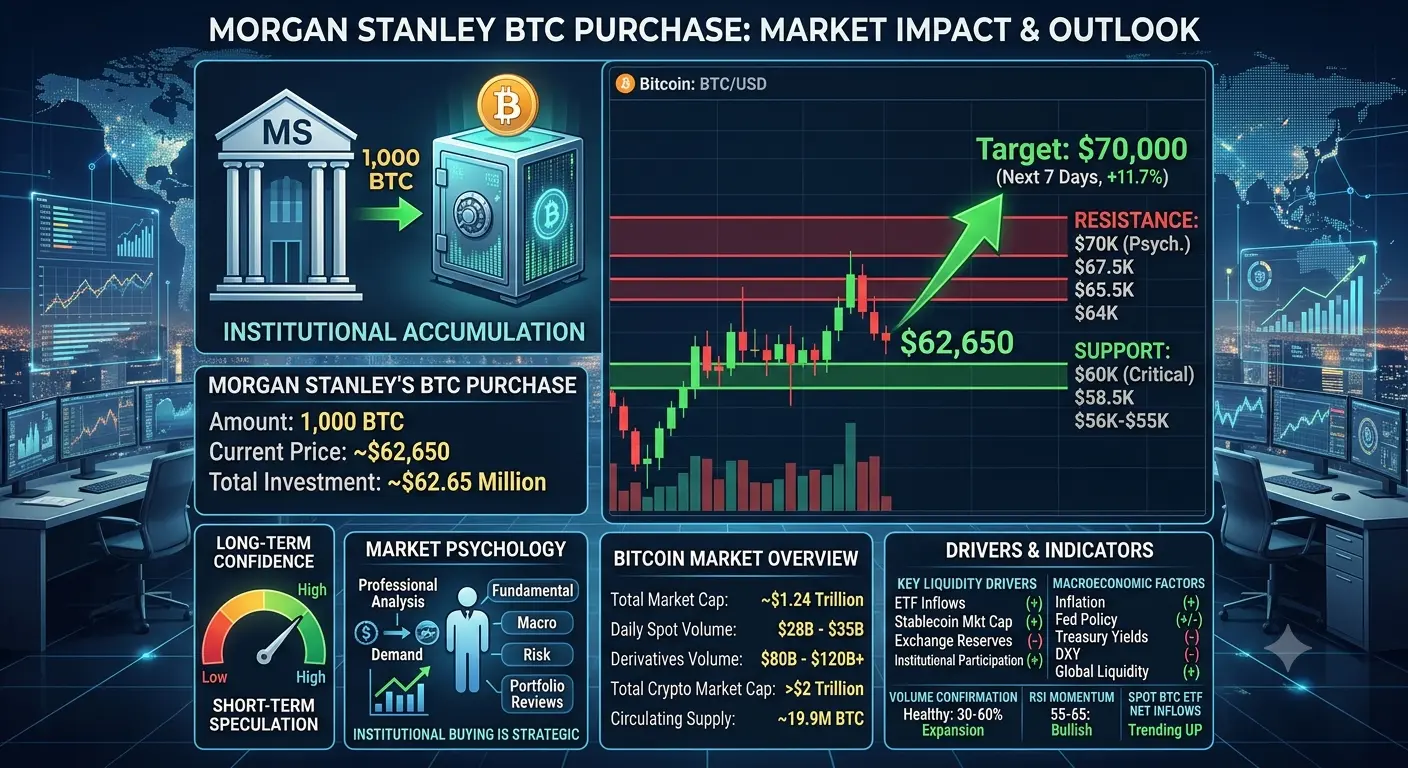
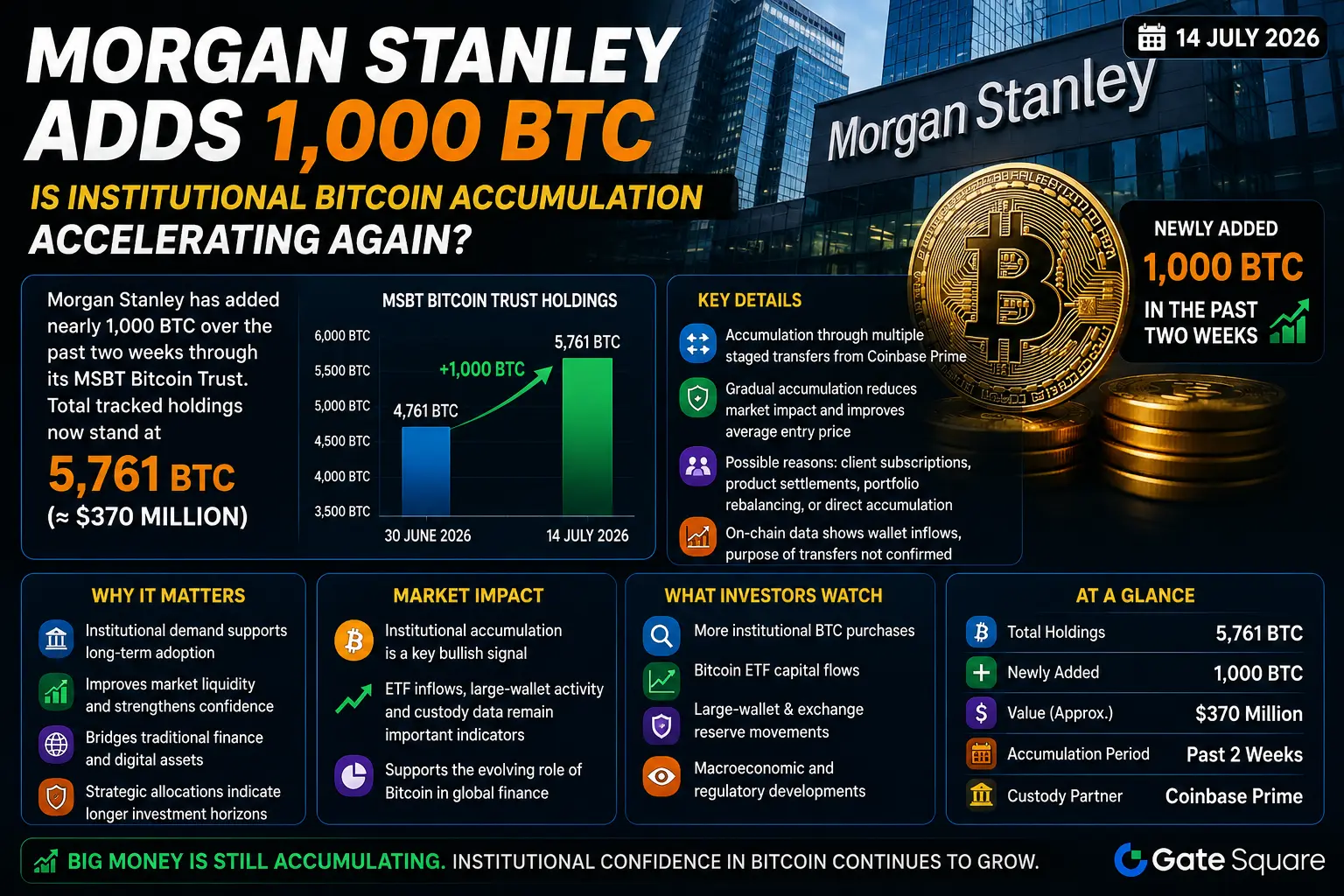
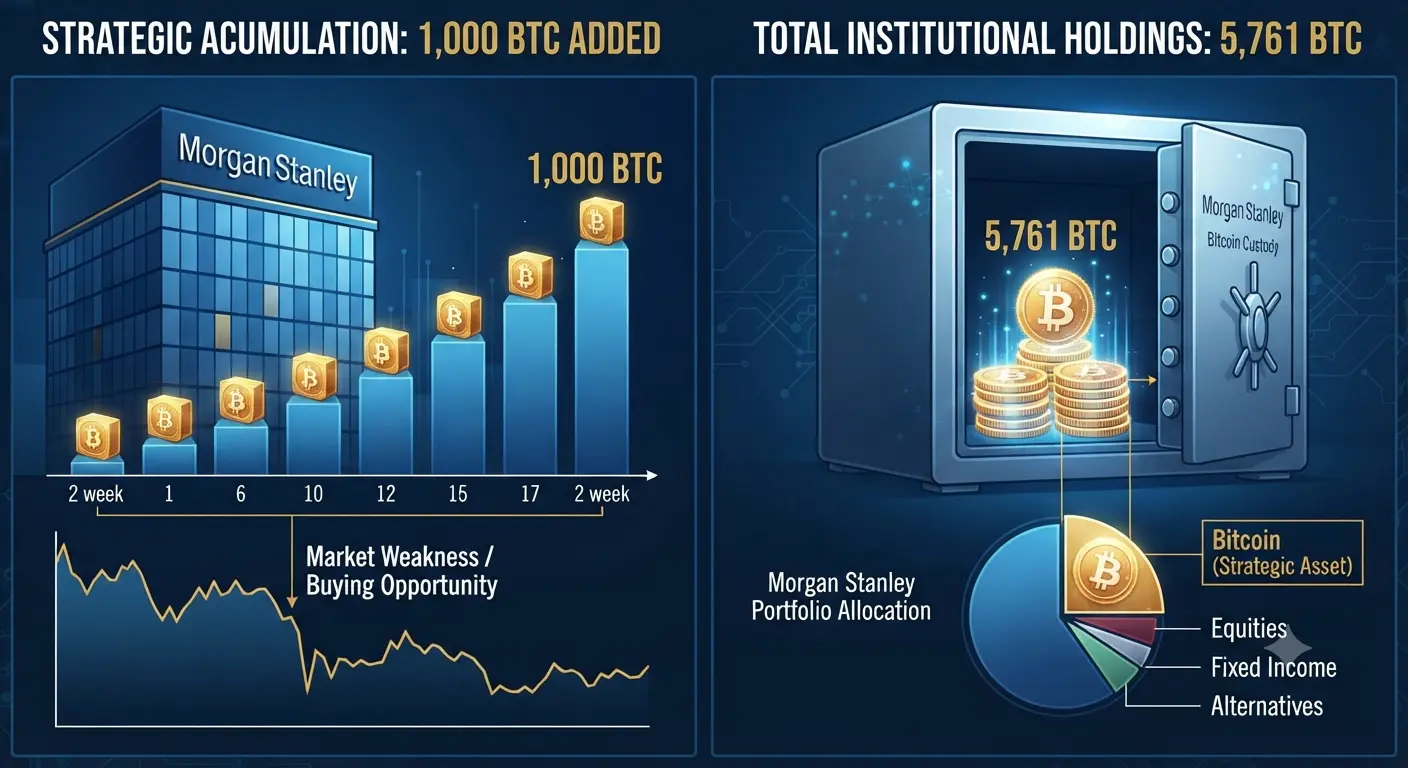
Morgan Stanley's reported purchase of an additional 1,000 Bitcoin has become one of the most closely watched developments across the cryptocurrency market because institutional accumulation is often interpreted as a signal of growing long-term confidence rather than short-term speculation. If the reported purchase is accurate, it strengthens the narrative that large financial institutions continue viewing Bitcoin as a strategic digital asset despite ongoing macroeconomic uncertainty. At the current Bitcoin price of approximately $62,650, a purchase of 1,000 BTC would represent an investment of around $62.65 million, demonstrating that institutional investors remain willing to allocate significant capital even while the market continues trading below previous highs.
Institutional buying is important because it affects market psychology as much as market liquidity. Large investment firms generally conduct extensive fundamental research, macroeconomic analysis, risk management assessments, and portfolio allocation reviews before purchasing Bitcoin. For this reason, traders often interpret institutional accumulation as evidence that professional investors continue expecting long-term appreciation rather than preparing for a prolonged bear market.
Although 1,000 BTC represents only a small fraction of Bitcoin's circulating supply of nearly 19.9 million BTC, the psychological impact can be much larger because market participants begin anticipating additional institutional demand from other asset managers, banks, hedge funds, pension funds, and family offices.
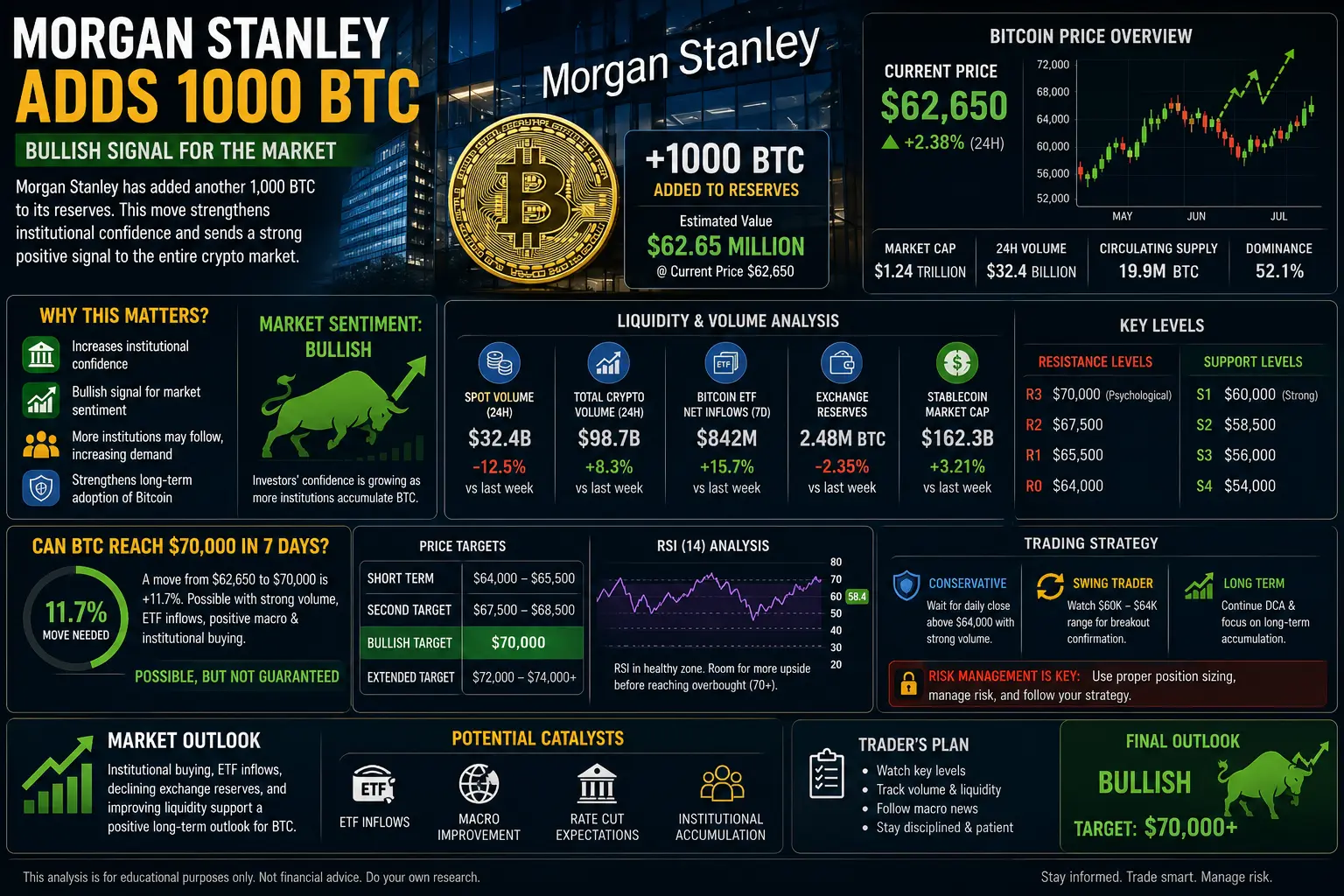
At the moment, Bitcoin is trading near $62,650, with a total market capitalization of approximately $1.24 trillion while the entire cryptocurrency market capitalization remains above $2 trillion. Daily spot trading volume across major exchanges fluctuates between $28 billion and $35 billion, while combined spot and derivatives trading volume frequently exceeds $80 billion to $120 billion during periods of elevated volatility. Compared with the previous quarter, spot trading activity remains lower by nearly 35%–40%, indicating that many institutional investors are still waiting for stronger macroeconomic confirmation before significantly increasing exposure. Lower liquidity means that any sustained increase in institutional demand has the potential to generate larger price movements because thinner order books require less capital to move prices higher.
Liquidity continues to be one of the most important drivers of Bitcoin's price action. During periods when ETF inflows increase, stablecoin market capitalization expands, exchange reserves decline, and institutional participation accelerates, Bitcoin historically performs significantly better than during periods of tightening financial conditions. Conversely, when liquidity contracts, Treasury yields rise, and the US Dollar strengthens, cryptocurrencies generally experience increased volatility and slower upward momentum. Therefore, Morgan Stanley's reported accumulation should not be analyzed in isolation but rather alongside ETF flows, Federal Reserve policy expectations, inflation trends, Treasury yields, and global liquidity conditions.
Many traders are now asking whether Bitcoin can rally from $62,650 toward the important psychological level of $70,000 within the next seven days. Such a move would require an appreciation of approximately 11.7%, which is entirely possible during strong bullish momentum because Bitcoin has previously delivered weekly gains exceeding 15%–20% when supported by institutional buying, improving macroeconomic sentiment, positive ETF inflows, and expanding trading volume.
However, reaching $70,000 would likely require several bullish catalysts occurring simultaneously rather than relying solely on a single institutional purchase.
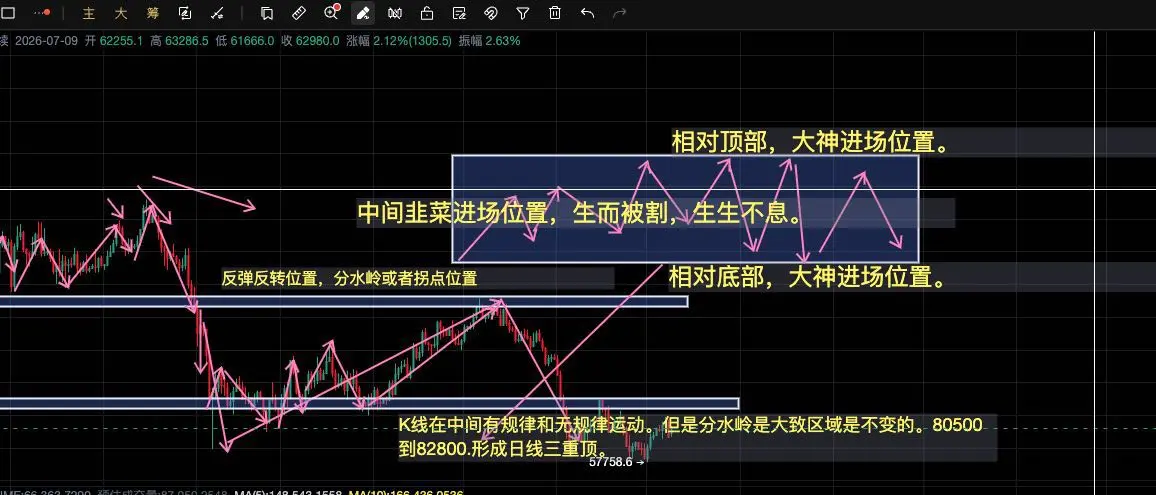
Current technical structure shows Bitcoin maintaining support above several critical demand zones. The first major support remains around $60,000, followed by stronger buying interest near $58,500, while long-term structural support sits between $55,000 and $56,000. On the upside, immediate resistance is located near $64,000, followed by $65,500, $67,500, and finally the major psychological resistance at $70,000. A decisive daily close above $64,000 accompanied by trading volume increasing at least 25%–40% above the recent weekly average would significantly strengthen the probability of testing $67,500, while a successful breakout above $67,500 could attract additional momentum buyers targeting the $70,000 region.
Volume confirmation remains absolutely essential because price movements without sufficient participation frequently fail. During healthy bullish trends, daily spot volume generally expands by 30%–60%, derivatives Open Interest increases steadily, ETF inflows accelerate, funding rates remain positive but not excessively overheated, and exchange reserves continue declining as investors move Bitcoin into long-term storage. If Bitcoin attempts breaking resistance while trading volume remains weak or decreases, the probability of a false breakout increases considerably.
Liquidity indicators currently deserve as much attention as price itself. Professional investors continue monitoring Spot Bitcoin ETF net inflows, total stablecoin market capitalization, exchange reserve balances, Coinbase Premium Index, CME Bitcoin futures positioning, perpetual futures Open Interest, funding rates, bid-ask spreads, and overall market depth. Improvement across these indicators would suggest institutional accumulation is becoming broader rather than isolated.
Relative Strength Index also remains an important momentum indicator. An RSI between 55 and 65 generally reflects healthy bullish momentum without indicating extreme overheating. An RSI moving above 70 suggests the market is entering overbought territory where short-term profit-taking often increases. Conversely, an RSI below 30 has historically signaled oversold conditions that frequently attract long-term buyers. Traders should also monitor whether RSI confirms price action because bullish momentum supported by strengthening RSI generally proves more sustainable than rallies accompanied by bearish divergence.
From a macroeconomic perspective, Bitcoin's performance during the coming weeks will remain closely linked to inflation expectations, Federal Reserve communication, Treasury yields, the US Dollar Index, institutional ETF demand, and overall financial market liquidity. If inflation continues moderating while expectations for future monetary easing improve, liquidity conditions could gradually become more supportive for digital assets. On the other hand, stronger inflation data combined with higher Treasury yields could temporarily slow Bitcoin's momentum even if institutional accumulation continues.
Professional traders currently appear divided. One group believes Bitcoin is preparing for another expansion phase because institutional accumulation continues despite short-term uncertainty, exchange reserves remain on a longer-term declining trend, and ETF demand has become an increasingly important source of structural buying pressure. Another group prefers waiting for confirmation above $64,000 before increasing exposure because they want stronger evidence that buyers have regained complete control of market momentum.
Bullish price objectives remain $64,000, $65,500, $67,500, $70,000, $72,000, and potentially $75,000 if buying pressure accelerates alongside improving liquidity. These targets become increasingly achievable if daily trading volume expands toward $40–50 billion, ETF inflows strengthen consistently, funding rates remain balanced, and institutional participation broadens beyond isolated purchases.
Bearish risks should not be ignored. Failure to defend $60,000 could trigger renewed selling pressure toward $58,500, $56,000, and potentially $54,000, particularly if ETF outflows increase, macroeconomic data disappoints, Treasury yields continue rising, or global risk sentiment deteriorates. Increased volatility during these periods could push combined daily crypto trading volume above $120 billion, although such volume would likely be driven by liquidations rather than genuine accumulation.
In conclusion, Morgan Stanley's reported purchase of an additional 1,000 BTC would represent another meaningful milestone for institutional adoption if confirmed. While the purchase alone cannot guarantee an immediate rally, it contributes to a broader narrative that institutional investors continue viewing Bitcoin as an important long-term asset within diversified portfolios. Combined with improving liquidity, stronger ETF inflows, expanding trading volume, supportive macroeconomic conditions, and sustained institutional demand, Bitcoin would have a realistic opportunity to challenge the $70,000 region. Nevertheless, successful trading decisions should remain based on confirmed price action, rising volume, improving liquidity, and disciplined risk management rather than headline-driven optimism alone.
Morgan Stanley's reported purchase of an additional 1,000 Bitcoin has become one of the most closely watched developments across the cryptocurrency market because institutional accumulation is often interpreted as a signal of growing long-term confidence rather than short-term speculation. If the reported purchase is accurate, it strengthens the narrative that large financial institutions continue viewing Bitcoin as a strategic digital asset despite ongoing macroeconomic uncertainty. At the current Bitcoin price of approximately $62,650, a purchase of 1,000 BTC would represent an investment of around $62.65 million, demonstrating that institutional investors remain willing to allocate significant capital even while the market continues trading below previous highs.
Institutional buying is important because it affects market psychology as much as market liquidity. Large investment firms generally conduct extensive fundamental research, macroeconomic analysis, risk management assessments, and portfolio allocation reviews before purchasing Bitcoin. For this reason, traders often interpret institutional accumulation as evidence that professional investors continue expecting long-term appreciation rather than preparing for a prolonged bear market.
Although 1,000 BTC represents only a small fraction of Bitcoin's circulating supply of nearly 19.9 million BTC, the psychological impact can be much larger because market participants begin anticipating additional institutional demand from other asset managers, banks, hedge funds, pension funds, and family offices.
At the moment, Bitcoin is trading near $62,650, with a total market capitalization of approximately $1.24 trillion while the entire cryptocurrency market capitalization remains above $2 trillion. Daily spot trading volume across major exchanges fluctuates between $28 billion and $35 billion, while combined spot and derivatives trading volume frequently exceeds $80 billion to $120 billion during periods of elevated volatility. Compared with the previous quarter, spot trading activity remains lower by nearly 35%–40%, indicating that many institutional investors are still waiting for stronger macroeconomic confirmation before significantly increasing exposure. Lower liquidity means that any sustained increase in institutional demand has the potential to generate larger price movements because thinner order books require less capital to move prices higher.
Liquidity continues to be one of the most important drivers of Bitcoin's price action. During periods when ETF inflows increase, stablecoin market capitalization expands, exchange reserves decline, and institutional participation accelerates, Bitcoin historically performs significantly better than during periods of tightening financial conditions. Conversely, when liquidity contracts, Treasury yields rise, and the US Dollar strengthens, cryptocurrencies generally experience increased volatility and slower upward momentum. Therefore, Morgan Stanley's reported accumulation should not be analyzed in isolation but rather alongside ETF flows, Federal Reserve policy expectations, inflation trends, Treasury yields, and global liquidity conditions.
Many traders are now asking whether Bitcoin can rally from $62,650 toward the important psychological level of $70,000 within the next seven days. Such a move would require an appreciation of approximately 11.7%, which is entirely possible during strong bullish momentum because Bitcoin has previously delivered weekly gains exceeding 15%–20% when supported by institutional buying, improving macroeconomic sentiment, positive ETF inflows, and expanding trading volume.
However, reaching $70,000 would likely require several bullish catalysts occurring simultaneously rather than relying solely on a single institutional purchase.
Current technical structure shows Bitcoin maintaining support above several critical demand zones. The first major support remains around $60,000, followed by stronger buying interest near $58,500, while long-term structural support sits between $55,000 and $56,000. On the upside, immediate resistance is located near $64,000, followed by $65,500, $67,500, and finally the major psychological resistance at $70,000. A decisive daily close above $64,000 accompanied by trading volume increasing at least 25%–40% above the recent weekly average would significantly strengthen the probability of testing $67,500, while a successful breakout above $67,500 could attract additional momentum buyers targeting the $70,000 region.
Volume confirmation remains absolutely essential because price movements without sufficient participation frequently fail. During healthy bullish trends, daily spot volume generally expands by 30%–60%, derivatives Open Interest increases steadily, ETF inflows accelerate, funding rates remain positive but not excessively overheated, and exchange reserves continue declining as investors move Bitcoin into long-term storage. If Bitcoin attempts breaking resistance while trading volume remains weak or decreases, the probability of a false breakout increases considerably.
Liquidity indicators currently deserve as much attention as price itself. Professional investors continue monitoring Spot Bitcoin ETF net inflows, total stablecoin market capitalization, exchange reserve balances, Coinbase Premium Index, CME Bitcoin futures positioning, perpetual futures Open Interest, funding rates, bid-ask spreads, and overall market depth. Improvement across these indicators would suggest institutional accumulation is becoming broader rather than isolated.
Relative Strength Index also remains an important momentum indicator. An RSI between 55 and 65 generally reflects healthy bullish momentum without indicating extreme overheating. An RSI moving above 70 suggests the market is entering overbought territory where short-term profit-taking often increases. Conversely, an RSI below 30 has historically signaled oversold conditions that frequently attract long-term buyers. Traders should also monitor whether RSI confirms price action because bullish momentum supported by strengthening RSI generally proves more sustainable than rallies accompanied by bearish divergence.
From a macroeconomic perspective, Bitcoin's performance during the coming weeks will remain closely linked to inflation expectations, Federal Reserve communication, Treasury yields, the US Dollar Index, institutional ETF demand, and overall financial market liquidity. If inflation continues moderating while expectations for future monetary easing improve, liquidity conditions could gradually become more supportive for digital assets. On the other hand, stronger inflation data combined with higher Treasury yields could temporarily slow Bitcoin's momentum even if institutional accumulation continues.
Professional traders currently appear divided. One group believes Bitcoin is preparing for another expansion phase because institutional accumulation continues despite short-term uncertainty, exchange reserves remain on a longer-term declining trend, and ETF demand has become an increasingly important source of structural buying pressure. Another group prefers waiting for confirmation above $64,000 before increasing exposure because they want stronger evidence that buyers have regained complete control of market momentum.
Bullish price objectives remain $64,000, $65,500, $67,500, $70,000, $72,000, and potentially $75,000 if buying pressure accelerates alongside improving liquidity. These targets become increasingly achievable if daily trading volume expands toward $40–50 billion, ETF inflows strengthen consistently, funding rates remain balanced, and institutional participation broadens beyond isolated purchases.
Bearish risks should not be ignored. Failure to defend $60,000 could trigger renewed selling pressure toward $58,500, $56,000, and potentially $54,000, particularly if ETF outflows increase, macroeconomic data disappoints, Treasury yields continue rising, or global risk sentiment deteriorates. Increased volatility during these periods could push combined daily crypto trading volume above $120 billion, although such volume would likely be driven by liquidations rather than genuine accumulation.
In conclusion, Morgan Stanley's reported purchase of an additional 1,000 BTC would represent another meaningful milestone for institutional adoption if confirmed. While the purchase alone cannot guarantee an immediate rally, it contributes to a broader narrative that institutional investors continue viewing Bitcoin as an important long-term asset within diversified portfolios. Combined with improving liquidity, stronger ETF inflows, expanding trading volume, supportive macroeconomic conditions, and sustained institutional demand, Bitcoin would have a realistic opportunity to challenge the $70,000 region. Nevertheless, successful trading decisions should remain based on confirmed price action, rising volume, improving liquidity, and disciplined risk management rather than headline-driven optimism alone.