#EthereumPrivacyUpgradeRoadmap
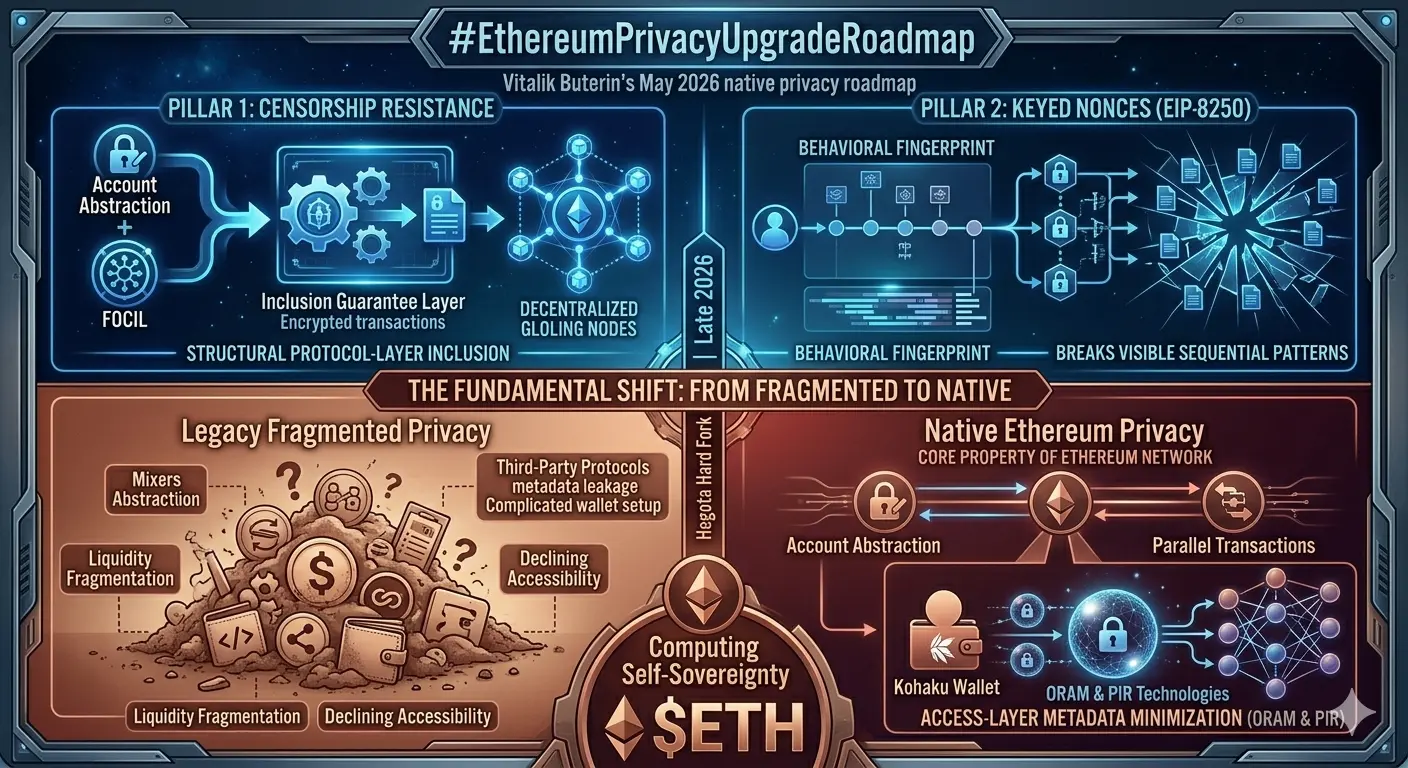
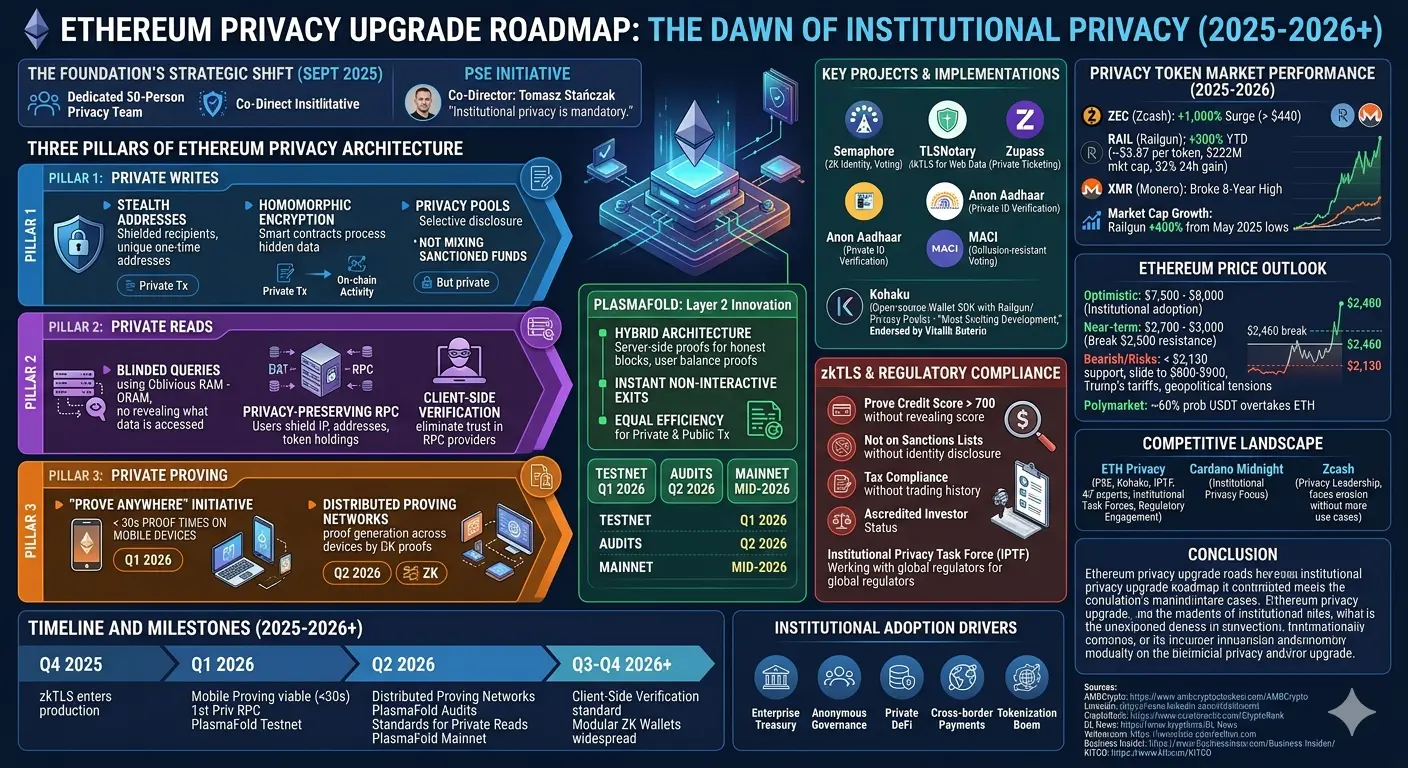
The Ethereum Foundation made a historic decision in September 2025 by officially integrating privacy into its core roadmap through the Privacy Stewards of Ethereum (PSE) initiative. This marked a fundamental transformation from the previous approach where privacy was handled by third-party protocols and layer-2 solutions. Ethereum Foundation Co-Director Tomasz Stańczak emphasized that institutional privacy has become a mandatory requirement, not an optional feature. The Foundation established a dedicated 50-person privacy team operating outside the protocol team, demonstrating unprecedented commitment to this sector.
Three Pillars of Ethereum Privacy Architecture
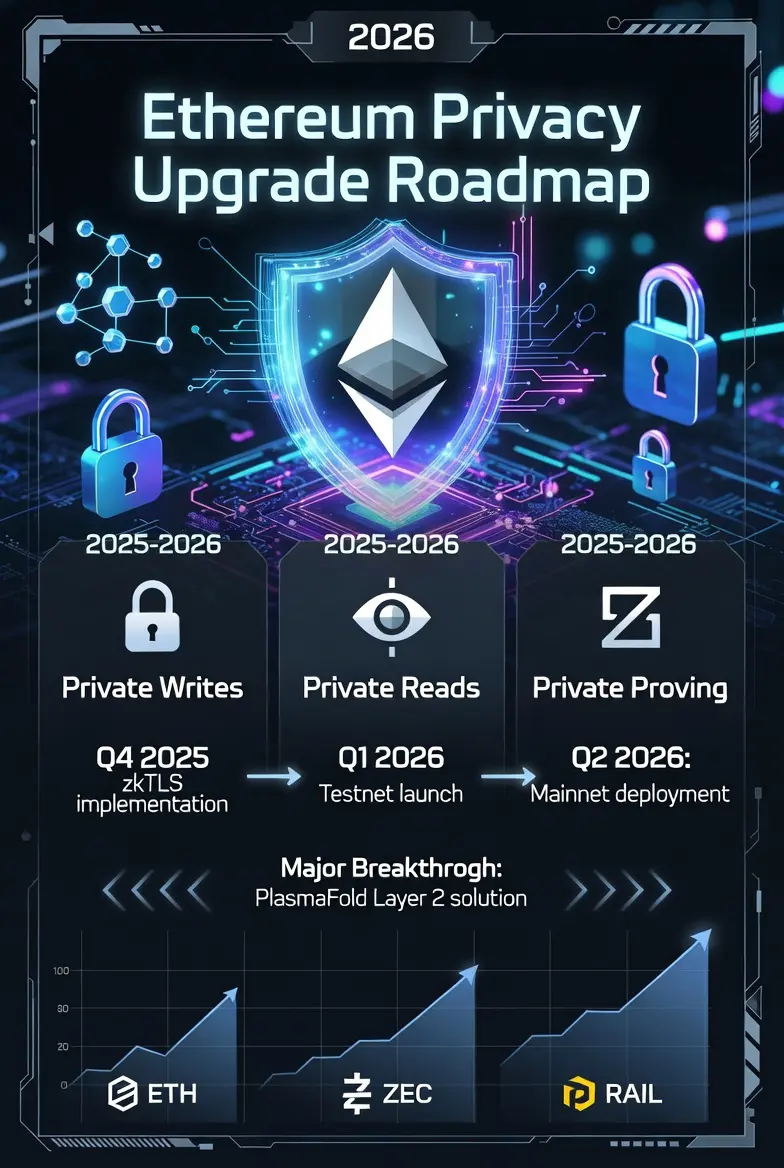
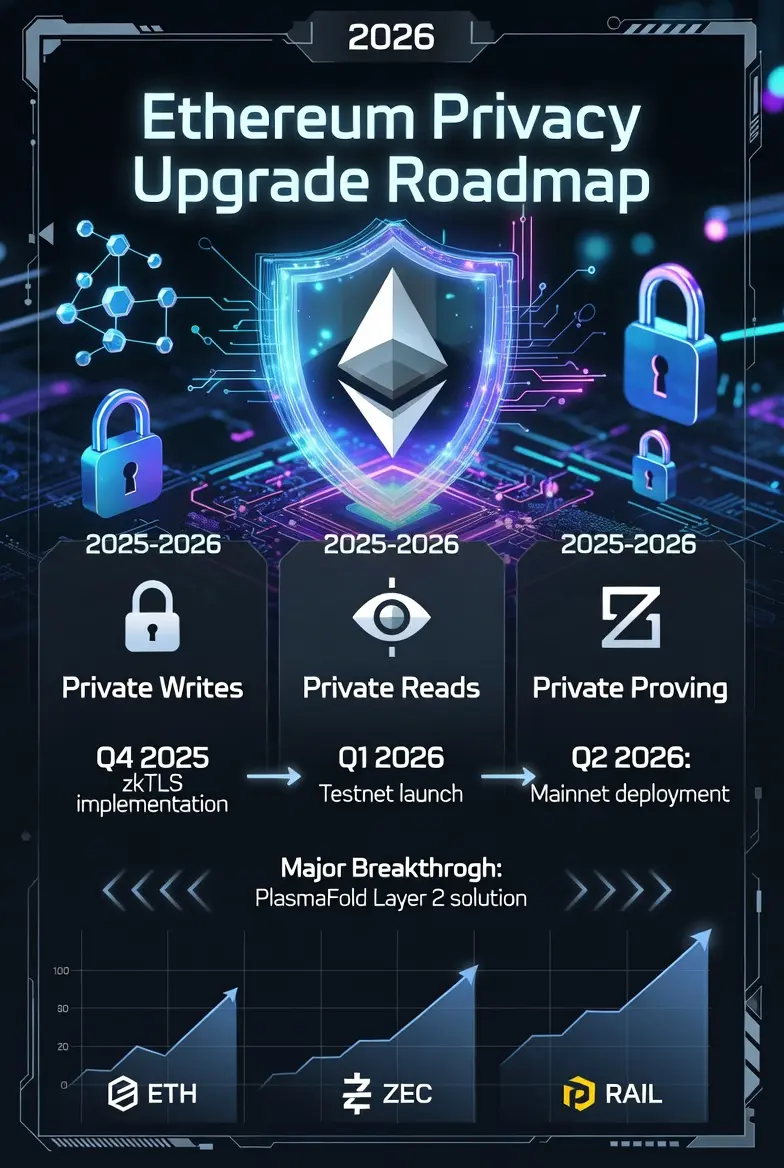
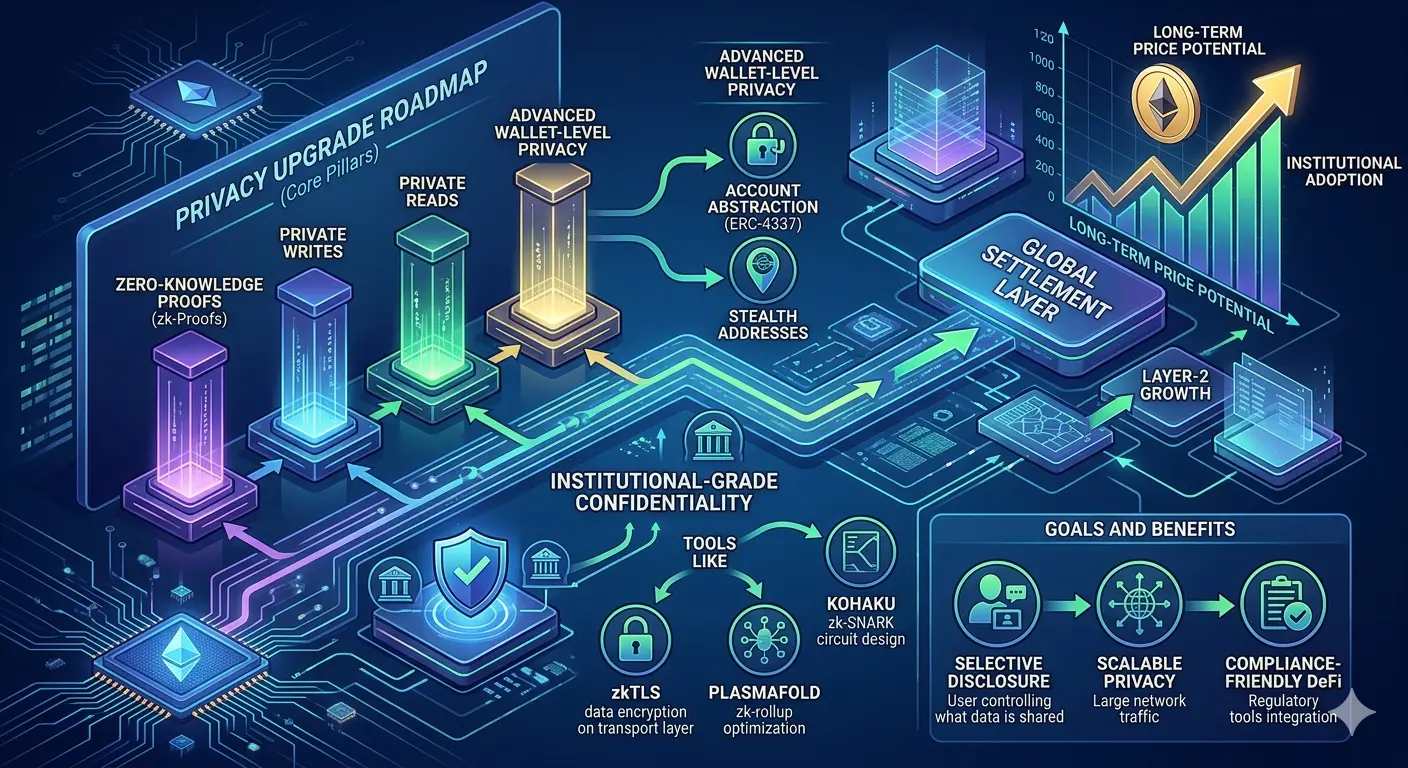
The roadmap centers on three fundamental capabilities that will define Ethereum's privacy infrastructure through 2026 and beyond. First, Private Writes enable confidential on-chain activities without exposing transaction details to the public. This pillar incorporates stealth addresses where recipients receive funds through one-time addresses derived from shared secrets, ensuring only the intended recipient can spend the funds. Homomorphic encryption allows smart contracts to process confidential information while keeping the underlying data hidden. Privacy Pools represent a breakthrough innovation enabling selective disclosure, allowing users to prove they are not mixing funds with sanctioned addresses while maintaining privacy from the general public.
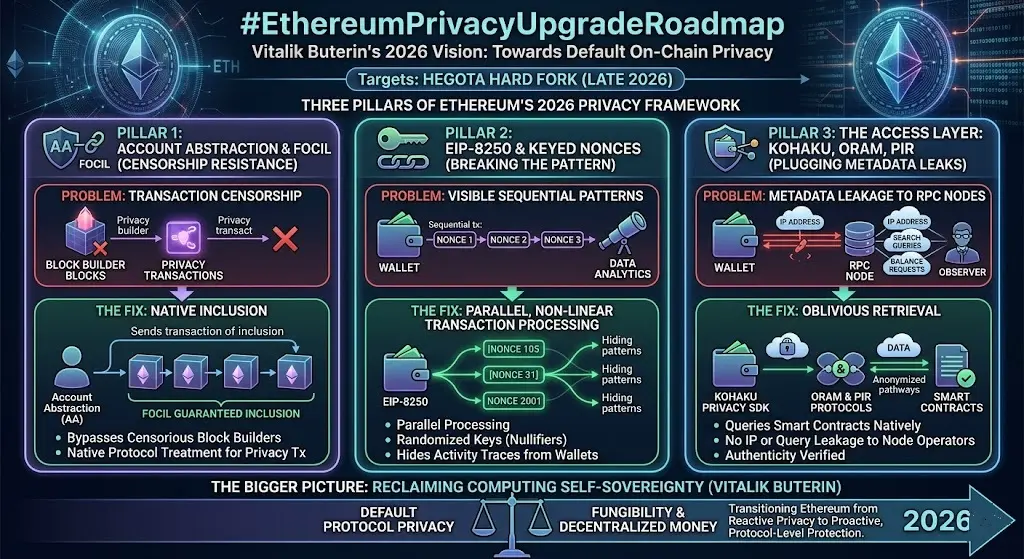
Second, Private Reads address the critical vulnerability where every balance check and dApp interaction currently leaks information. RPC providers can see IP addresses, controlled addresses, token holdings, and activity patterns. The solution involves Oblivious RAM (ORAM) technology that accesses data without revealing which specific data was accessed. Privacy-preserving RPC architectures blind queries before sending them to providers, while client-side verification using cryptographic proofs eliminates trust requirements in RPC providers.
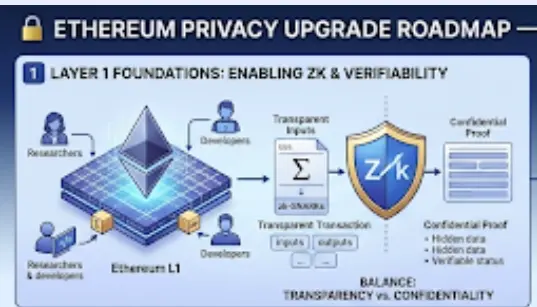
Third, Private Proving focuses on making zero-knowledge proof generation fast, cheap, and accessible on everyday devices. The "prove anywhere" initiative targets sub-30-second proof times on mobile devices by Q1 2026, with distributed proving networks launching in Q2 2026 that split proof generation across multiple devices.
PlasmaFold: The Technical Breakthrough
PlasmaFold represents Ethereum's most significant Layer 2 innovation for privacy. This experimental design employs a hybrid architecture where operators generate proofs server-side for honest block construction while users maintain balance proofs on their own devices. This separation enables instant, non-interactive exits via balance proofs while block proofs handle most validations, eliminating complex exit games and minimizing user costs. The architecture makes private and public transactions equally efficient without extra gas costs or longer confirmation times. The public testnet is expected in Q1 2026, with security audits scheduled for Q2 2026 and mainnet launch targeted for mid-2026.
Key Projects and Implementations
The Ethereum Foundation has supported over 50 open-source privacy research projects since 2018. Semaphore provides a zero-knowledge identity framework for anonymous signaling and voting. TLSNotary pioneered zkTLS technology to prove facts about web data with cryptographic guarantees. Zupass successfully demonstrated privacy-preserving event ticketing at Devcon 2025. Anon Aadhaar enables private national ID verification proving Indian citizenship without exposing ID documents. MACI delivers collusion-resistant private voting for DAOs.
Kohaku serves as Ethereum's comprehensive privacy-and-security toolkit for wallets, functioning as an open-source wallet SDK that allows any wallet to integrate privacy features using Railgun and Privacy Pools implementations. Vitalik Buterin first showcased Kohaku publicly at Devcon in late 2025, and the Ethereum Foundation described it as the most exciting upcoming privacy development in recent years.
zkTLS and Regulatory Compliance
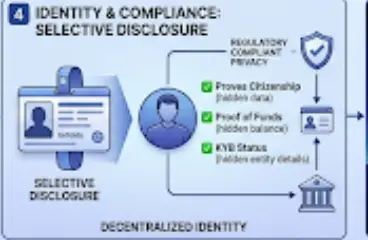
The zkTLS technology entering production in Q4 2025 enables users to prove facts about web data without revealing underlying information. Users can demonstrate credit scores above 700 without showing actual scores, prove they are not on sanctions lists without revealing identity, demonstrate tax compliance without exposing trading history, and verify accredited investor status without sharing financial details. The Institutional Privacy Task Force (IPTF) actively works with regulatory bodies in the US, EU, and Asia to define standards for selective disclosure, positioning privacy and compliance as complementary rather than opposing forces.
Privacy Token Market Performance
The privacy sector experienced extraordinary price appreciation throughout 2025 and 2026. Zcash (ZEC) surged over 1,000% to exceed $440, driven by renewed institutional interest in privacy infrastructure. Railgun (RAIL) demonstrated exceptional performance with gains exceeding 300% year-to-date, reaching approximately $3.87 per token with a market capitalization of around $222 million. The token posted a 32% gain in a single 24-hour period during May 2026 as privacy protocol demand intensified. Railgun's market cap expanded by over 400% from May 2025 lows, reflecting strong investor confidence in Ethereum-based privacy solutions.
Monero (XMR) broke its 8-year high in 2026, demonstrating that privacy assets are experiencing sustained value appreciation rather than temporary sentiment-driven rallies. The broader privacy-token sector attracted significant attention from institutional investors and venture capital, with Andreessen Horowitz identifying privacy as the most important moat for 2026 in their State of Crypto report.
Ethereum Price Outlook
Ethereum's price predictions for 2026 vary considerably based on privacy upgrade execution and broader market conditions. Analysts project targets ranging from $2,700 to $3,000 in the near term if Ethereum breaks the $2,500 resistance level. More optimistic forecasts target $7,500 to $8,000 as institutional privacy features drive adoption. Some projections even eye $10,000 based on sustained institutional demand, ETF flows, staking growth, and broader market support.
However, Ethereum faces significant challenges. The cryptocurrency declined more than 30% in the first quarter of 2026 amid Trump's tariff war and rising geopolitical tensions. Prediction market Polymarket currently assigns nearly 60% probability to Ethereum losing its number two cryptocurrency ranking to Tether's USDT stablecoin in 2026. Technical analysis shows Ethereum trading near critical support at $2,130, with a decisive break below potentially triggering a slide toward the $800-$900 range. Conversely, a break above $2,460 would diminish bearish risks and support further upside.
Competitive Landscape
Ethereum and Cardano's Midnight currently represent the primary contenders aggressively developing institutional privacy solutions. Zcash maintains leadership in the privacy narrative but faces erosion of market share unless it expands beyond private transfers to offer more practical use cases. Railgun competes directly with Zcash and Monero while offering distinct advantages through its opt-in privacy features that align better with current regulatory environments for privacy-based tokens.
The Ethereum Foundation's 47-member Privacy Cluster, coordinated by Igor Barinov, includes PSE focusing on privacy protocol UX, the Institutional Privacy Task Force bridging institutions and Ethereum, and Kohaku providing reference wallet implementations. This coordinated approach gives Ethereum significant competitive advantages in the institutional privacy sector.
Timeline and Milestones
The privacy roadmap follows a structured timeline through 2026. Q4 2025 marked zkTLS entering production. Q1 2026 targets mobile proving becoming viable with sub-30-second proof times, first privacy-preserving RPC implementations going live, and PlasmaFold public testnet launch. Q2 2026 focuses on distributed proving networks launching, PlasmaFold security audits completion, standards finalization for private reads, and mainnet launch for PlasmaFold. Q3-Q4 2026 aims for client-side verification becoming standard and modular ZK wallets achieving widespread adoption.
Institutional Adoption Drivers
The privacy upgrade roadmap directly addresses institutional requirements that have previously limited Ethereum adoption in traditional finance. Enterprise treasury operations require confidential transaction capabilities to protect competitive information. Anonymous governance voting enables participation without revealing institutional positions. Private DeFi interactions allow sophisticated financial strategies without exposing proprietary trading patterns. Cross-border payments benefit from privacy features that protect commercial relationships while maintaining regulatory compliance.
The anticipated tokenization boom in 2026 positions Ethereum's privacy infrastructure as critical infrastructure for institutional adoption. As traditional financial assets move on-chain, the ability to conduct confidential transactions while maintaining audit trails and compliance capabilities becomes essential.
Ethereum's privacy upgrade roadmap represents one of the most significant protocol developments since the transition to proof-of-stake. The comprehensive approach addressing private writes, private reads, and private proving establishes Ethereum as the leading platform for institutional privacy solutions. The substantial price appreciation in privacy tokens like Railgun and Zcash demonstrates market recognition of this trend. Ethereum's success in executing this roadmap will determine whether it captures the institutional privacy market or cedes ground to competitors like Cardano's Midnight or maintains Zcash's dominance in the privacy narrative. The coordinated effort across 47 privacy experts, dedicated institutional task forces, and regulatory engagement positions Ethereum favorably for the privacy-centric evolution of blockchain technology in 2026 and beyond.@Gate_Square @Gate广场_Official #StockTradingChallengeUpTo17000U #TradeCFDWinGold #DailyPolymarketHotspot #SocialFiSectorUp5.9%
The Ethereum Foundation made a historic decision in September 2025 by officially integrating privacy into its core roadmap through the Privacy Stewards of Ethereum (PSE) initiative. This marked a fundamental transformation from the previous approach where privacy was handled by third-party protocols and layer-2 solutions. Ethereum Foundation Co-Director Tomasz Stańczak emphasized that institutional privacy has become a mandatory requirement, not an optional feature. The Foundation established a dedicated 50-person privacy team operating outside the protocol team, demonstrating unprecedented commitment to this sector.
Three Pillars of Ethereum Privacy Architecture
The roadmap centers on three fundamental capabilities that will define Ethereum's privacy infrastructure through 2026 and beyond. First, Private Writes enable confidential on-chain activities without exposing transaction details to the public. This pillar incorporates stealth addresses where recipients receive funds through one-time addresses derived from shared secrets, ensuring only the intended recipient can spend the funds. Homomorphic encryption allows smart contracts to process confidential information while keeping the underlying data hidden. Privacy Pools represent a breakthrough innovation enabling selective disclosure, allowing users to prove they are not mixing funds with sanctioned addresses while maintaining privacy from the general public.
Second, Private Reads address the critical vulnerability where every balance check and dApp interaction currently leaks information. RPC providers can see IP addresses, controlled addresses, token holdings, and activity patterns. The solution involves Oblivious RAM (ORAM) technology that accesses data without revealing which specific data was accessed. Privacy-preserving RPC architectures blind queries before sending them to providers, while client-side verification using cryptographic proofs eliminates trust requirements in RPC providers.
Third, Private Proving focuses on making zero-knowledge proof generation fast, cheap, and accessible on everyday devices. The "prove anywhere" initiative targets sub-30-second proof times on mobile devices by Q1 2026, with distributed proving networks launching in Q2 2026 that split proof generation across multiple devices.
PlasmaFold: The Technical Breakthrough
PlasmaFold represents Ethereum's most significant Layer 2 innovation for privacy. This experimental design employs a hybrid architecture where operators generate proofs server-side for honest block construction while users maintain balance proofs on their own devices. This separation enables instant, non-interactive exits via balance proofs while block proofs handle most validations, eliminating complex exit games and minimizing user costs. The architecture makes private and public transactions equally efficient without extra gas costs or longer confirmation times. The public testnet is expected in Q1 2026, with security audits scheduled for Q2 2026 and mainnet launch targeted for mid-2026.
Key Projects and Implementations
The Ethereum Foundation has supported over 50 open-source privacy research projects since 2018. Semaphore provides a zero-knowledge identity framework for anonymous signaling and voting. TLSNotary pioneered zkTLS technology to prove facts about web data with cryptographic guarantees. Zupass successfully demonstrated privacy-preserving event ticketing at Devcon 2025. Anon Aadhaar enables private national ID verification proving Indian citizenship without exposing ID documents. MACI delivers collusion-resistant private voting for DAOs.
Kohaku serves as Ethereum's comprehensive privacy-and-security toolkit for wallets, functioning as an open-source wallet SDK that allows any wallet to integrate privacy features using Railgun and Privacy Pools implementations. Vitalik Buterin first showcased Kohaku publicly at Devcon in late 2025, and the Ethereum Foundation described it as the most exciting upcoming privacy development in recent years.
zkTLS and Regulatory Compliance
The zkTLS technology entering production in Q4 2025 enables users to prove facts about web data without revealing underlying information. Users can demonstrate credit scores above 700 without showing actual scores, prove they are not on sanctions lists without revealing identity, demonstrate tax compliance without exposing trading history, and verify accredited investor status without sharing financial details. The Institutional Privacy Task Force (IPTF) actively works with regulatory bodies in the US, EU, and Asia to define standards for selective disclosure, positioning privacy and compliance as complementary rather than opposing forces.
Privacy Token Market Performance
The privacy sector experienced extraordinary price appreciation throughout 2025 and 2026. Zcash (ZEC) surged over 1,000% to exceed $440, driven by renewed institutional interest in privacy infrastructure. Railgun (RAIL) demonstrated exceptional performance with gains exceeding 300% year-to-date, reaching approximately $3.87 per token with a market capitalization of around $222 million. The token posted a 32% gain in a single 24-hour period during May 2026 as privacy protocol demand intensified. Railgun's market cap expanded by over 400% from May 2025 lows, reflecting strong investor confidence in Ethereum-based privacy solutions.
Monero (XMR) broke its 8-year high in 2026, demonstrating that privacy assets are experiencing sustained value appreciation rather than temporary sentiment-driven rallies. The broader privacy-token sector attracted significant attention from institutional investors and venture capital, with Andreessen Horowitz identifying privacy as the most important moat for 2026 in their State of Crypto report.
Ethereum Price Outlook
Ethereum's price predictions for 2026 vary considerably based on privacy upgrade execution and broader market conditions. Analysts project targets ranging from $2,700 to $3,000 in the near term if Ethereum breaks the $2,500 resistance level. More optimistic forecasts target $7,500 to $8,000 as institutional privacy features drive adoption. Some projections even eye $10,000 based on sustained institutional demand, ETF flows, staking growth, and broader market support.
However, Ethereum faces significant challenges. The cryptocurrency declined more than 30% in the first quarter of 2026 amid Trump's tariff war and rising geopolitical tensions. Prediction market Polymarket currently assigns nearly 60% probability to Ethereum losing its number two cryptocurrency ranking to Tether's USDT stablecoin in 2026. Technical analysis shows Ethereum trading near critical support at $2,130, with a decisive break below potentially triggering a slide toward the $800-$900 range. Conversely, a break above $2,460 would diminish bearish risks and support further upside.
Competitive Landscape
Ethereum and Cardano's Midnight currently represent the primary contenders aggressively developing institutional privacy solutions. Zcash maintains leadership in the privacy narrative but faces erosion of market share unless it expands beyond private transfers to offer more practical use cases. Railgun competes directly with Zcash and Monero while offering distinct advantages through its opt-in privacy features that align better with current regulatory environments for privacy-based tokens.
The Ethereum Foundation's 47-member Privacy Cluster, coordinated by Igor Barinov, includes PSE focusing on privacy protocol UX, the Institutional Privacy Task Force bridging institutions and Ethereum, and Kohaku providing reference wallet implementations. This coordinated approach gives Ethereum significant competitive advantages in the institutional privacy sector.
Timeline and Milestones
The privacy roadmap follows a structured timeline through 2026. Q4 2025 marked zkTLS entering production. Q1 2026 targets mobile proving becoming viable with sub-30-second proof times, first privacy-preserving RPC implementations going live, and PlasmaFold public testnet launch. Q2 2026 focuses on distributed proving networks launching, PlasmaFold security audits completion, standards finalization for private reads, and mainnet launch for PlasmaFold. Q3-Q4 2026 aims for client-side verification becoming standard and modular ZK wallets achieving widespread adoption.
Institutional Adoption Drivers
The privacy upgrade roadmap directly addresses institutional requirements that have previously limited Ethereum adoption in traditional finance. Enterprise treasury operations require confidential transaction capabilities to protect competitive information. Anonymous governance voting enables participation without revealing institutional positions. Private DeFi interactions allow sophisticated financial strategies without exposing proprietary trading patterns. Cross-border payments benefit from privacy features that protect commercial relationships while maintaining regulatory compliance.
The anticipated tokenization boom in 2026 positions Ethereum's privacy infrastructure as critical infrastructure for institutional adoption. As traditional financial assets move on-chain, the ability to conduct confidential transactions while maintaining audit trails and compliance capabilities becomes essential.
Ethereum's privacy upgrade roadmap represents one of the most significant protocol developments since the transition to proof-of-stake. The comprehensive approach addressing private writes, private reads, and private proving establishes Ethereum as the leading platform for institutional privacy solutions. The substantial price appreciation in privacy tokens like Railgun and Zcash demonstrates market recognition of this trend. Ethereum's success in executing this roadmap will determine whether it captures the institutional privacy market or cedes ground to competitors like Cardano's Midnight or maintains Zcash's dominance in the privacy narrative. The coordinated effort across 47 privacy experts, dedicated institutional task forces, and regulatory engagement positions Ethereum favorably for the privacy-centric evolution of blockchain technology in 2026 and beyond.@Gate_Square @Gate广场_Official #StockTradingChallengeUpTo17000U #TradeCFDWinGold #DailyPolymarketHotspot #SocialFiSectorUp5.9%