#BlackRockReducesBTCIncreasesETH
The world's largest asset manager, BlackRock, has made headlines with its recent strategic adjustment in the cryptocurrency market. According to data from Arkham Intelligence and various on-chain analytics platforms, BlackRock has been reducing its Bitcoin positions while significantly increasing its Ethereum holdings. This shift represents one of the most significant institutional reallocations in the crypto space and has profound implications for both assets.
Understanding BlackRock's Bitcoin Reduction
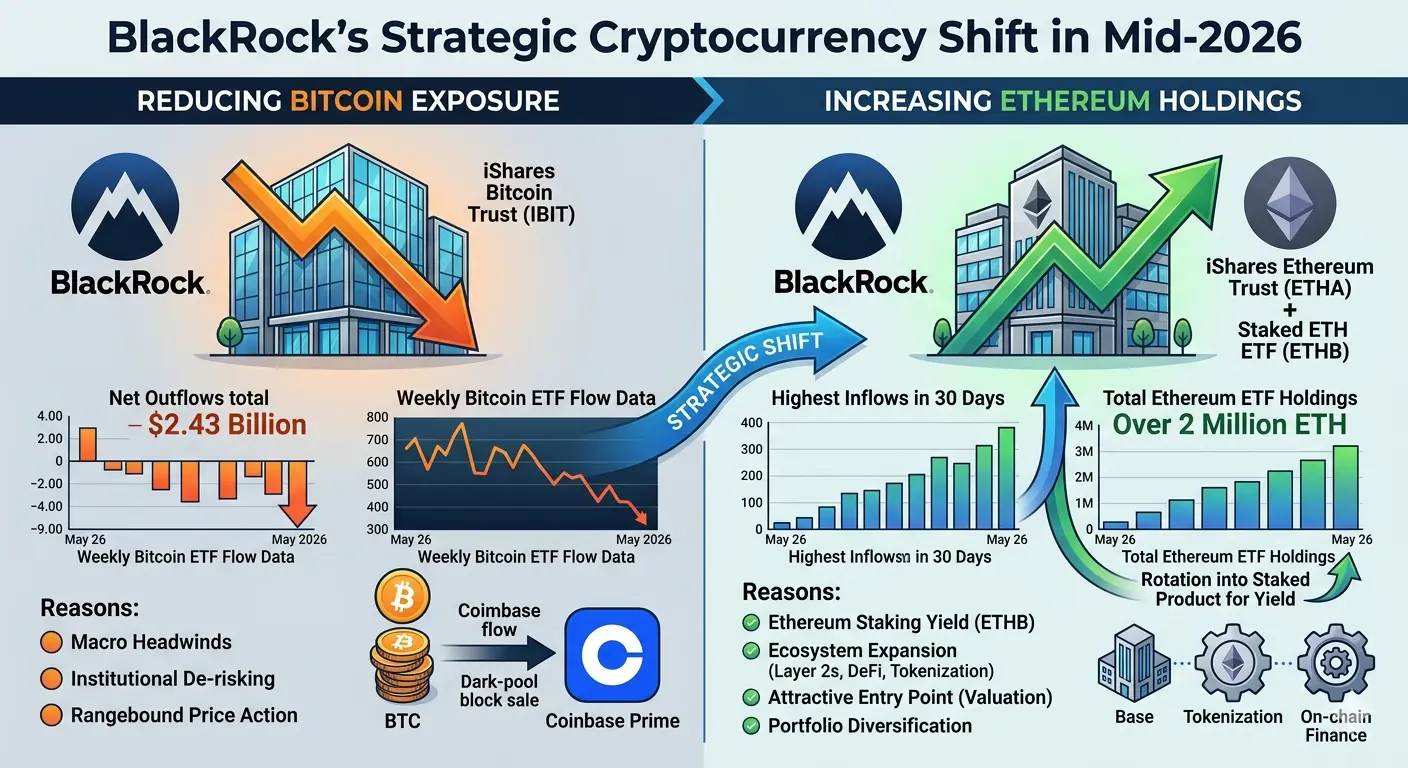
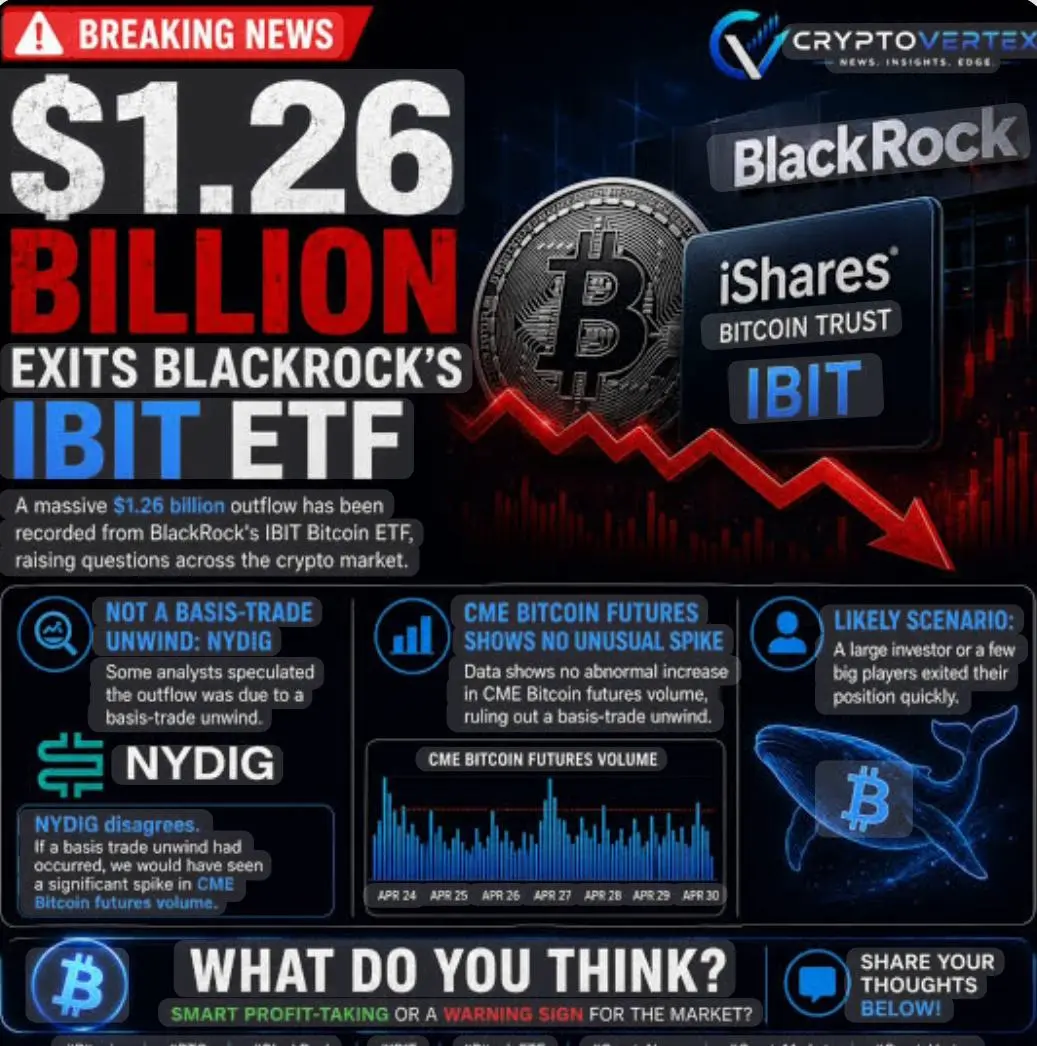
BlackRock's iShares Bitcoin Trust (IBIT) experienced substantial outflows in recent months. According to SoSoValue data, IBIT recorded approximately 2.43 billion dollars in net outflows over nine consecutive sessions in May 2026, culminating in a massive 1.26 billion dollar dark-pool block sale on May 26. This marked the largest single-day redemption event in the fund's history since its January 2024 launch. On-chain data confirmed the transfer of approximately 6,005 BTC, equivalent to roughly 403 million dollars, from IBIT-linked custody wallets to Coinbase Prime.
The reasons behind this Bitcoin reduction are multifaceted. First, macroeconomic headwinds have created a challenging environment for risk assets. High US Treasury yields and a Federal Reserve stance perceived as constraining for risk assets have caused Bitcoin's price to drop below previous consolidation levels. Second, institutional de-risking has been a dominant theme, with many large players reducing exposure to volatile assets. Third, Bitcoin's price had been trading in a range with 74,000 dollars serving as support and the 200-day moving average as resistance, creating uncertainty about near-term direction.
Furthermore, BlackRock's crypto portfolio value declined sharply in the first quarter of 2026. Between January 1 and March 31, 2026, the combined value of BlackRock's Bitcoin and Ethereum holdings dropped from 78.36 billion dollars to 57.89 billion dollars, representing a 20.47 billion dollar decrease. While this decline was driven primarily by market conditions rather than capital exiting the portfolio, it signaled a need for strategic rebalancing.
Current Bitcoin Market Position and Price Analysis
As of early June 2026, Bitcoin opened at approximately 63,078 dollars, showing relative stability but remaining under pressure. The cryptocurrency has faced headwinds from multiple directions, including Federal Reserve policy uncertainty and shifting institutional sentiment. Bitcoin ETFs have experienced significant outflows, with the funds registering over 1.07 billion dollars in outflows during certain periods, on track to surpass previous weekly records.
The price action has been characterized by a trading range with 74,000 dollars serving as a key support level and the 200-day moving average acting as resistance. Analysts have noted that Bitcoin could revisit February lows if a major fresh catalyst does not emerge soon. The sustained ETF outflows and more hawkish Federal Reserve outlook have contributed to the market decline.
BlackRock's Ethereum Accumulation Strategy
In contrast to its Bitcoin reduction, BlackRock has been aggressively increasing its Ethereum exposure. The asset manager's iShares Ethereum Trust (ETHA) has recorded significant inflows, with the ETF hitting its highest inflows in 30 days at certain points. According to the latest data, ETHA's holdings reached over 2 million ETH, representing a major milestone for the fund.
BlackRock's staked ETH ETF (ETHB) has also seen substantial interest, pulling in 32.3 million dollars on April 24 alone. This rotation from the non-staked ETHA product into the staked ETHB product indicates a preference for yield-generating Ethereum exposure. The total assets under management for Ethereum ETFs collectively stood at approximately 30.35 billion dollars, with BlackRock controlling more than half at 17.25 billion dollars, representing roughly 3 percent of Ethereum's market capitalization.
Current Ethereum Market Position and Price Analysis
Ethereum entered mid-2026 trading in the 1,600 to 2,100 dollar range, down approximately 55 percent from its August 2025 all-time high near 4,954 dollars. The cryptocurrency faces a complex environment with strong on-chain fundamentals competing against macro-driven price drawdowns. Layer 2 networks have scaled Ethereum's capacity but have also diverted fee revenue from the mainnet, with some estimates suggesting Base alone removed 50 billion dollars from ETH's market cap.
Despite these challenges, Ethereum spot ETFs have shown resilience. While there have been periods of outflows, the overall trend indicates growing institutional interest. Ethereum DATs (Digital Asset Trusts) already hold more than 3.1 percent of the total ETH supply, and leading firms continue accumulating aggressively.
Reasons Behind BlackRock's Strategic Shift
Several factors explain BlackRock's decision to reduce Bitcoin exposure while increasing Ethereum holdings. First, Ethereum offers staking yield, providing a revenue stream that Bitcoin cannot match. BlackRock's ETHB product allows investors to earn staking rewards while maintaining ETF structure, making it attractive for institutional portfolios seeking yield in a high-interest-rate environment.
Second, Ethereum's ecosystem continues to expand with Layer 2 solutions, decentralized finance applications, and tokenization initiatives. BlackRock has shown increasing interest in tokenized assets and on-chain finance, areas where Ethereum dominates. The asset manager's involvement in projects like Securitize and tokenized securities aligns with Ethereum's capabilities.
Third, valuation considerations play a role. Bitcoin had experienced significant appreciation, and some institutional investors may view Ethereum as offering better risk-reward characteristics at current price levels. Ethereum's price decline from all-time highs has created a potentially more attractive entry point for long-term accumulation.
Fourth, diversification benefits drive the shift. As the cryptocurrency market matures, institutional investors are seeking exposure beyond just Bitcoin. Ethereum represents the second-largest cryptocurrency and offers different value propositions, including smart contract functionality and decentralized application platform capabilities.
Bitcoin Price Forecast and Trading Strategy
Analyst forecasts for Bitcoin vary widely, reflecting the uncertainty in the current market environment. Short-term targets suggest Bitcoin needs to reclaim the 74,000 dollar support level to establish a bullish trend. If this level is not defended, analysts warn of potential retests of February lows in the 55,000 to 60,000 dollar range.
Medium-term forecasts suggest Bitcoin could recover to the 80,000 to 100,000 dollar range if macroeconomic conditions improve and institutional inflows resume. However, this recovery depends on several factors, including Federal Reserve policy shifts, regulatory clarity, and renewed institutional confidence.
For trading strategy, risk management remains paramount in the current environment. Traders should consider the following approaches. First, dollar-cost averaging allows for gradual accumulation without attempting to time market bottoms. Second, maintaining stop-losses below key support levels protects against significant drawdowns. Third, monitoring ETF flow data provides insight into institutional sentiment. Sustained inflows would signal potential trend reversal, while continued outflows suggest further downside risk.
Ethereum Price Forecast and Trading Strategy
Ethereum price predictions for 2026 show considerable variation among analysts. Conservative estimates target the 1,700 to 2,000 dollar range, with some analysts projecting prices around 2,011 dollars as an average trading price. More optimistic forecasts suggest Ethereum could reach 3,175 to 7,500 dollars depending on market conditions and adoption trends.
The key factors influencing Ethereum's price include Layer 2 adoption rates, staking participation, institutional ETF inflows, and the overall health of the decentralized finance ecosystem. Ethereum's transition to a yield-bearing asset through staking has fundamentally changed its investment profile, making it attractive for income-focused institutional portfolios.
For trading strategy, Ethereum presents both opportunities and risks. The staking yield provides a cushion during price declines, as holders earn rewards regardless of price action. However, Layer 2 competition and fee revenue diversion remain concerns. Traders should monitor ETF inflow data, particularly for BlackRock's ETHA and ETHB products, as these indicate institutional sentiment. Additionally, watching Layer 2 metrics and total value locked in decentralized finance protocols provides insight into ecosystem health.
Future Outlook and Strategic Implications
BlackRock's shift from Bitcoin to Ethereum reflects broader trends in institutional cryptocurrency allocation. As the market matures, investors are moving beyond simple Bitcoin exposure to more sophisticated strategies that include yield generation and ecosystem participation.
The implications for both assets are significant. Bitcoin may face continued pressure if institutional outflows persist, though its status as digital gold and store of value remains intact. Ethereum stands to benefit from institutional adoption of staking and the growth of on-chain finance, though it must navigate challenges related to scalability and competition from Layer 2 solutions.
For investors, the key takeaway is that diversification within the cryptocurrency space is becoming increasingly important. Following institutional flows, particularly from major players like BlackRock, provides valuable insight into market direction. However, individual risk tolerance and investment horizons should guide portfolio decisions rather than simply mimicking institutional moves.
The cryptocurrency market continues to evolve rapidly, and BlackRock's strategic adjustments demonstrate that even the largest asset managers are actively managing their crypto allocations based on changing market conditions, yield opportunities, and ecosystem developments. As we move through 2026, monitoring these institutional flows will remain crucial for understanding market dynamics and identifying potential opportunities in both Bitcoin and Ethereum.
#CertifiedCreatorPromotionTask @Gate_Square
The world's largest asset manager, BlackRock, has made headlines with its recent strategic adjustment in the cryptocurrency market. According to data from Arkham Intelligence and various on-chain analytics platforms, BlackRock has been reducing its Bitcoin positions while significantly increasing its Ethereum holdings. This shift represents one of the most significant institutional reallocations in the crypto space and has profound implications for both assets.
Understanding BlackRock's Bitcoin Reduction
BlackRock's iShares Bitcoin Trust (IBIT) experienced substantial outflows in recent months. According to SoSoValue data, IBIT recorded approximately 2.43 billion dollars in net outflows over nine consecutive sessions in May 2026, culminating in a massive 1.26 billion dollar dark-pool block sale on May 26. This marked the largest single-day redemption event in the fund's history since its January 2024 launch. On-chain data confirmed the transfer of approximately 6,005 BTC, equivalent to roughly 403 million dollars, from IBIT-linked custody wallets to Coinbase Prime.
The reasons behind this Bitcoin reduction are multifaceted. First, macroeconomic headwinds have created a challenging environment for risk assets. High US Treasury yields and a Federal Reserve stance perceived as constraining for risk assets have caused Bitcoin's price to drop below previous consolidation levels. Second, institutional de-risking has been a dominant theme, with many large players reducing exposure to volatile assets. Third, Bitcoin's price had been trading in a range with 74,000 dollars serving as support and the 200-day moving average as resistance, creating uncertainty about near-term direction.
Furthermore, BlackRock's crypto portfolio value declined sharply in the first quarter of 2026. Between January 1 and March 31, 2026, the combined value of BlackRock's Bitcoin and Ethereum holdings dropped from 78.36 billion dollars to 57.89 billion dollars, representing a 20.47 billion dollar decrease. While this decline was driven primarily by market conditions rather than capital exiting the portfolio, it signaled a need for strategic rebalancing.
Current Bitcoin Market Position and Price Analysis
As of early June 2026, Bitcoin opened at approximately 63,078 dollars, showing relative stability but remaining under pressure. The cryptocurrency has faced headwinds from multiple directions, including Federal Reserve policy uncertainty and shifting institutional sentiment. Bitcoin ETFs have experienced significant outflows, with the funds registering over 1.07 billion dollars in outflows during certain periods, on track to surpass previous weekly records.
The price action has been characterized by a trading range with 74,000 dollars serving as a key support level and the 200-day moving average acting as resistance. Analysts have noted that Bitcoin could revisit February lows if a major fresh catalyst does not emerge soon. The sustained ETF outflows and more hawkish Federal Reserve outlook have contributed to the market decline.
BlackRock's Ethereum Accumulation Strategy
In contrast to its Bitcoin reduction, BlackRock has been aggressively increasing its Ethereum exposure. The asset manager's iShares Ethereum Trust (ETHA) has recorded significant inflows, with the ETF hitting its highest inflows in 30 days at certain points. According to the latest data, ETHA's holdings reached over 2 million ETH, representing a major milestone for the fund.
BlackRock's staked ETH ETF (ETHB) has also seen substantial interest, pulling in 32.3 million dollars on April 24 alone. This rotation from the non-staked ETHA product into the staked ETHB product indicates a preference for yield-generating Ethereum exposure. The total assets under management for Ethereum ETFs collectively stood at approximately 30.35 billion dollars, with BlackRock controlling more than half at 17.25 billion dollars, representing roughly 3 percent of Ethereum's market capitalization.
Current Ethereum Market Position and Price Analysis
Ethereum entered mid-2026 trading in the 1,600 to 2,100 dollar range, down approximately 55 percent from its August 2025 all-time high near 4,954 dollars. The cryptocurrency faces a complex environment with strong on-chain fundamentals competing against macro-driven price drawdowns. Layer 2 networks have scaled Ethereum's capacity but have also diverted fee revenue from the mainnet, with some estimates suggesting Base alone removed 50 billion dollars from ETH's market cap.
Despite these challenges, Ethereum spot ETFs have shown resilience. While there have been periods of outflows, the overall trend indicates growing institutional interest. Ethereum DATs (Digital Asset Trusts) already hold more than 3.1 percent of the total ETH supply, and leading firms continue accumulating aggressively.
Reasons Behind BlackRock's Strategic Shift
Several factors explain BlackRock's decision to reduce Bitcoin exposure while increasing Ethereum holdings. First, Ethereum offers staking yield, providing a revenue stream that Bitcoin cannot match. BlackRock's ETHB product allows investors to earn staking rewards while maintaining ETF structure, making it attractive for institutional portfolios seeking yield in a high-interest-rate environment.
Second, Ethereum's ecosystem continues to expand with Layer 2 solutions, decentralized finance applications, and tokenization initiatives. BlackRock has shown increasing interest in tokenized assets and on-chain finance, areas where Ethereum dominates. The asset manager's involvement in projects like Securitize and tokenized securities aligns with Ethereum's capabilities.
Third, valuation considerations play a role. Bitcoin had experienced significant appreciation, and some institutional investors may view Ethereum as offering better risk-reward characteristics at current price levels. Ethereum's price decline from all-time highs has created a potentially more attractive entry point for long-term accumulation.
Fourth, diversification benefits drive the shift. As the cryptocurrency market matures, institutional investors are seeking exposure beyond just Bitcoin. Ethereum represents the second-largest cryptocurrency and offers different value propositions, including smart contract functionality and decentralized application platform capabilities.
Bitcoin Price Forecast and Trading Strategy
Analyst forecasts for Bitcoin vary widely, reflecting the uncertainty in the current market environment. Short-term targets suggest Bitcoin needs to reclaim the 74,000 dollar support level to establish a bullish trend. If this level is not defended, analysts warn of potential retests of February lows in the 55,000 to 60,000 dollar range.
Medium-term forecasts suggest Bitcoin could recover to the 80,000 to 100,000 dollar range if macroeconomic conditions improve and institutional inflows resume. However, this recovery depends on several factors, including Federal Reserve policy shifts, regulatory clarity, and renewed institutional confidence.
For trading strategy, risk management remains paramount in the current environment. Traders should consider the following approaches. First, dollar-cost averaging allows for gradual accumulation without attempting to time market bottoms. Second, maintaining stop-losses below key support levels protects against significant drawdowns. Third, monitoring ETF flow data provides insight into institutional sentiment. Sustained inflows would signal potential trend reversal, while continued outflows suggest further downside risk.
Ethereum Price Forecast and Trading Strategy
Ethereum price predictions for 2026 show considerable variation among analysts. Conservative estimates target the 1,700 to 2,000 dollar range, with some analysts projecting prices around 2,011 dollars as an average trading price. More optimistic forecasts suggest Ethereum could reach 3,175 to 7,500 dollars depending on market conditions and adoption trends.
The key factors influencing Ethereum's price include Layer 2 adoption rates, staking participation, institutional ETF inflows, and the overall health of the decentralized finance ecosystem. Ethereum's transition to a yield-bearing asset through staking has fundamentally changed its investment profile, making it attractive for income-focused institutional portfolios.
For trading strategy, Ethereum presents both opportunities and risks. The staking yield provides a cushion during price declines, as holders earn rewards regardless of price action. However, Layer 2 competition and fee revenue diversion remain concerns. Traders should monitor ETF inflow data, particularly for BlackRock's ETHA and ETHB products, as these indicate institutional sentiment. Additionally, watching Layer 2 metrics and total value locked in decentralized finance protocols provides insight into ecosystem health.
Future Outlook and Strategic Implications
BlackRock's shift from Bitcoin to Ethereum reflects broader trends in institutional cryptocurrency allocation. As the market matures, investors are moving beyond simple Bitcoin exposure to more sophisticated strategies that include yield generation and ecosystem participation.
The implications for both assets are significant. Bitcoin may face continued pressure if institutional outflows persist, though its status as digital gold and store of value remains intact. Ethereum stands to benefit from institutional adoption of staking and the growth of on-chain finance, though it must navigate challenges related to scalability and competition from Layer 2 solutions.
For investors, the key takeaway is that diversification within the cryptocurrency space is becoming increasingly important. Following institutional flows, particularly from major players like BlackRock, provides valuable insight into market direction. However, individual risk tolerance and investment horizons should guide portfolio decisions rather than simply mimicking institutional moves.
The cryptocurrency market continues to evolve rapidly, and BlackRock's strategic adjustments demonstrate that even the largest asset managers are actively managing their crypto allocations based on changing market conditions, yield opportunities, and ecosystem developments. As we move through 2026, monitoring these institutional flows will remain crucial for understanding market dynamics and identifying potential opportunities in both Bitcoin and Ethereum.
#CertifiedCreatorPromotionTask @Gate_Square