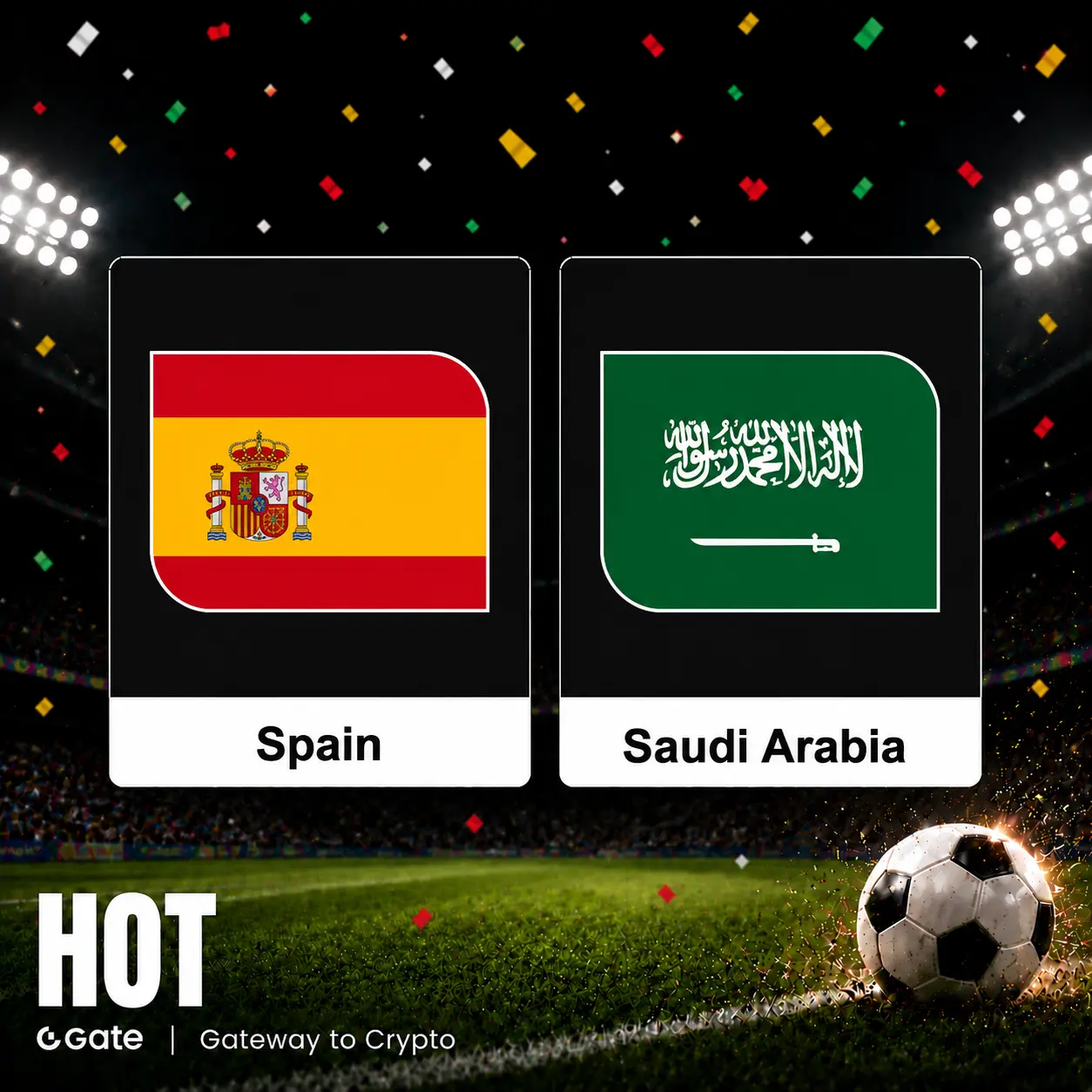
This extremely skewed pricing reflects the market’s core judgment: Spain holds an overwhelming advantage in absolute strength. Spain is ranked No. 2 in the world; the squad’s total market value is about €1.22 billion, and almost all players compete in Europe’s top five leagues. Saudi Arabia’s squad value is only about €40 million, with just one defender, Abdulhamid, playing in the top five leagues. In essence, Gate’s prediction market pricing is a quantified expression of this gap in strength.
The implied 89%: what the market consensus is based on
Spain’s 89% win probability is not pulled from thin air; it is supported by multiple layers of logic behind it.
In terms of head-to-head records, the two teams have met three times, and Spain won all three, including a 1-0 defeat of Saudi Arabia in the 2006 World Cup group stage. From recent form, Spain have posted a record of 5 wins and 1 draw in World Cup qualifiers, scoring 21 goals and conceding just 2. From squad depth, Spain boasts world-class players such as Lamine Yamal (market value €200 million) and Pedri (€150 million). Their possession-based control system and talent in the midfield and attack are among the best globally.
Even more critical is qualification pressure. With all four teams on 1 point after the first round, if Spain fail to win this match, they will find themselves in an extremely passive position in the final round against Uruguay. This strategic rigidity of “must not lose” further strengthens the market’s expectation that Spain will go all out for victory. The 89% probability is precisely the composite pricing of these fundamentals.
Saudi Arabia’s 3.4% win rate: does it mean the market is ignoring something?
Saudi Arabia’s 3.4% win probability is, statistically, a typical small-probability event. However, Saudi Arabia’s performance in the first round—holding Uruguay to a 1-1 draw—and the precedent of their upset victory over Argentina at the 2022 World Cup mean this low-probability pricing deserves closer scrutiny.
Saudi Arabia’s defensive resilience shown in the first round cannot be overlooked. Goalkeeper Oveves made multiple key saves against Uruguay, and the team’s low-block defensive system stood up to the challenge posed by a South American powerhouse. In addition, Spain’s first-round match against Cabo Verde exposed issues with the efficiency of breaking down a tightly packed, concentrated defense—27 shots in the match produced no goals. This indicates Saudi Arabia is not without tactical references that can be replicated.
That said, the 3.4% probability also reflects the market’s calm assessment of the following factors: in the past six official matches, Saudi Arabia have kept a clean sheet only once; most Saudi players play in domestic leagues and lack experience sustaining high-intensity competition in top European tournaments; and with Spain needing a win in this match, the team’s commitment and focus in attack are expected to be far higher than in the first round. The 3.4% probability is not the market underestimating Saudi Arabia, but rather a combined weighted valuation of the multiple constraints above.
9% draw probability: how the market views the possibility of a shock
The implied draw probability of 9% sits between Spain’s win and Saudi Arabia’s win, but is closer to the latter. This distribution suggests the market believes Saudi Arabia is more likely to hold Spain to a draw through defense than to win outright—the draw probability is 2.6 times Saudi Arabia’s win probability.
Saudi Arabia’s tactical pathway is relatively clear: rely on a dense defensive setup and goalkeeper performance to concede as little as possible, while using set pieces and fast counters to create threats. In the first round against Cabo Verde, Saudi Arabia shut Spain out with a defensive strategy of maximum contraction, providing Saudi with a tactical template to reference. Saudi Arabia needs to continuously withstand Spain’s possession-based pressure over 90 minutes—an extremely high tactical bar for any Asian team, but not completely impossible.
The 9% draw pricing also reflects the market’s concern about Spain’s attacking efficiency. If wingers such as Yamal and Nico Williams fail to break through Saudi’s defensive line in time, Spain could repeat the first-round scenario where they had the advantage but failed to score. The 9% probability is the market pricing for the risk of a “dominant but goalless” scenario.
Can the funding size behind Gate’s prediction market support the current pricing?
The credibility of the market’s pricing largely depends on the market’s depth and liquidity. On Polymarket, the total trading volume for the World Cup champion market has already exceeded $3 billion, making it the largest single contract in sports prediction markets.
A sufficient pool of capital means the current pricing has gone through enough market give-and-take, rather than being manipulable by a small number of traders. Gate’s prediction market integrates Polymarket’s real-time data, and users can directly participate in prediction trading on the Gate platform. This transparent, open market mechanism provides a credible foundation for the 89%-9%-3.4% probability distribution.
But the market is not perfect. After a first-round upset occurs, some traders may have delayed position adjustments. Changes in capital flows within the 24 to 48 hours before kickoff will be a key window to watch whether the market has fully digested first-round information.
How qualification scenarios affect the distribution of funds in the prediction market
With all four teams on 1 point after the first round of Group H, the strategic significance of this match goes far beyond that of a typical group game. For Spain, if they cannot win this match, the final-round clash with Uruguay will put them in an absolute no-choice-to-win situation. For Saudi Arabia, as long as they can take points, they can gain the initiative in the qualification race.
This qualification pressure impacts Gate’s prediction market fund distribution in both directions. On one hand, Spain’s rigid need to win strengthens the market’s expectation of a Spain victory— the draw has limited strategic value for Spain. On the other hand, Saudi Arabia’s mindset of “a loss is unacceptable, and a draw is effectively a win” to some extent supports the 9% draw pricing. In essence, the fund distribution in the prediction market is seeking balance between Spain’s rigid need to win and Saudi Arabia’s defensive-counterattacking flexibility.
FAQ
Q: What is Spain’s win rate shown on Gate’s prediction market?
According to Gate’s prediction market data, Spain’s probability of winning is 89%, corresponding to odds of about 1.12. This figure indicates the market sees a Spain win as an extremely likely event.
Q: What is Saudi Arabia’s win rate in Gate’s prediction market?
Saudi Arabia’s probability of winning is 3.4%, corresponding to odds of about 29.4. The probability of a draw is 9%.
Q: Why is Spain’s win probability so high?
Mainly based on the following factors: Spain is ranked No. 2 in the world, with the squad’s total market value of about €1.22 billion; the two teams have met three times in history and Spain won all of them; Spain scored 21 goals and conceded only 2 in World Cup qualifiers with a record of 5 wins and 1 draw. The market believes there is a significant gap between the two teams in individual player ability and overall tactical systems.
Q: Does Spain being held to a draw by Cabo Verde in the first round affect Gate’s prediction market pricing?
Spain’s 0-0 draw with Cabo Verde in the first round did indeed attract market attention, but it did not fundamentally change the market’s overall assessment of Spain vs Saudi Arabia. Spain’s win probability remains at the extremely high level of 89%, indicating that the market treats the first-round lack of attacking output as a short-term fluctuation rather than a systematic flaw.