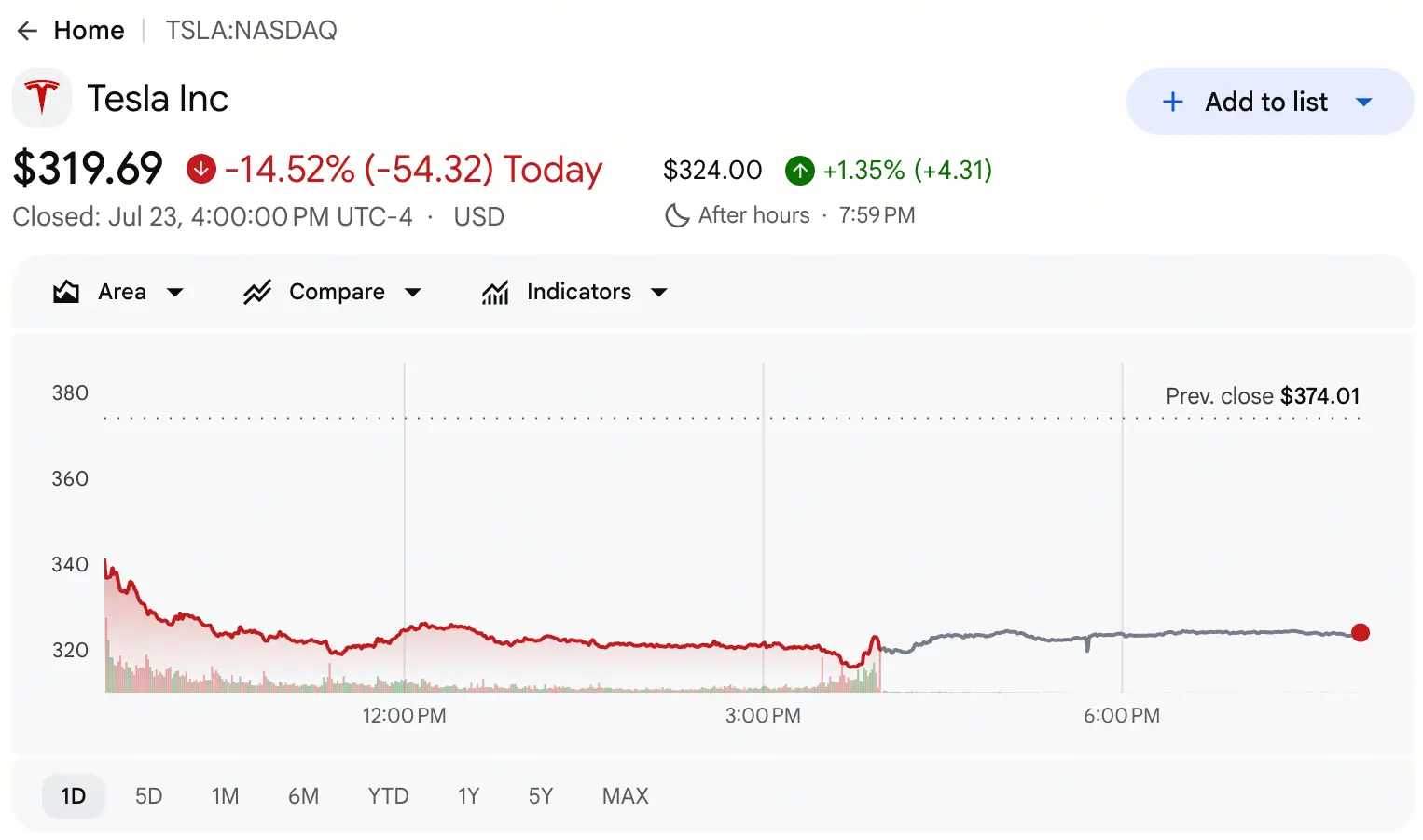
On July 23, 2026, U.S. Eastern Time, Tesla’s (TSLA) stock price was hit by a fierce selloff. It plunged as much as 15% during the day and ultimately closed at $319.69, down 14.52%, marking the largest single-day decline since June 2025. As of July 24, Tesla was temporarily around $319.4. This selloff was not an isolated event—on the same day, Google fell nearly 7%, Amazon dropped more than 4%, Meta fell more than 3%, Microsoft fell more than 2%, and NVIDIA and Apple fell more than 1%. The U.S. tech Mag 7 index (Wind) saw nearly $800B in market value evaporate in a single day, the worst performance since April 2025.
Against the backdrop of broad pressure on tech giants, why did Tesla become the biggest decliner? What exactly did this “record revenue, sharply shrinking profits” earnings report reveal? And how should we analyze what comes next?
Revenue and deliveries hit new highs—why profit fell instead of rising
Tesla’s 2026 second-quarter earnings report showed a set of stark, contrasting figures.
On the revenue side, performance was strong: total revenue in the quarter reached $28.24B, up 26% year over year, setting a record high for the company for that same period. Revenue from the automotive business was $480.1k, up 23% year over year. In terms of deliveries, global deliveries totaled 480.1k vehicles in Q2, up 25% year over year and about 34% quarter over quarter, also setting the highest record for any Q2 in the company’s history.
However, the profitability figures told a very different story. Adjusted earnings per share (EPS) was only $0.33, far below the market’s expected $0.50. Operating profit was just $398 million, down 57% year over year, and operating margin plunged from 4.1% in the prior-year quarter to 1.4%. The consolidated gross margin for complete vehicles fell to 16.8%.
The root of “growing revenue without increasing profit” lies in two directions: first, to stimulate demand, Tesla rolled out multiple purchase incentives and discontinued the higher-priced Model S and Model X, pushing down the average selling price; second, large-scale investment is consuming profit at an unprecedented pace.
Free cash flow turns negative: how fast is Tesla “burning money”?
The data that shocked the market most in the earnings report was the turnaround in free cash flow.
In Q2 2026, Tesla’s capital expenditures reached $5.79B, up 142% year over year. This figure is more than double the $2.49 billion in Q1. The massive capex directly caused free cash flow to turn from positive to negative for the first time in two years, with an outflow of about $1.09 billion.
For a more intuitive comparison: free cash flow was positive $146 million in the same period of 2025 and positive $1.44 billion in Q1 2026. It took just one quarter to swing from positive $1.44 billion to negative $1.09 billion.
What worries the market even more is that this may be only the beginning. Tesla CFO Vaibhav Taneja said Tesla’s full-year 2026 capital expenditures are expected to exceed $25 billion and continue to grow over the next two to three years. Elon Musk said on the earnings call that Tesla is carrying out “the fastest industrial-scale expansion in the U.S. since World War II.” Capex was about $8.5 billion for all of 2025, while the $25 billion target for 2026 is close to triple that.
Most of the funds are going toward expanding AI supercomputing clusters, Terafab chip R&D in cooperation with SpaceX, expanding the Robotaxi fleet, and building Optimus humanoid robot mass-production lines.
From an “automotive company” to an “AI company”: what is changing in the valuation logic?
Behind Tesla’s selloff is a deeper question: what standard should the market use to price Tesla?
From the perspective of traditional automakers, Tesla’s valuation has become severely detached from fundamentals. Based on estimated earnings over the next 12 months, Tesla’s P/E ratio is as high as 151x, making it the most expensive among the tech Mag 7. Its cumulative decline this year is close to 30%, also ranking at the bottom among the group.
From the perspective of an AI technology company, Tesla’s long-term story remains compelling—FSD full self-driving subscription users have reached 1.48 million, up 56%; the Robotaxi service has expanded to seven major metro areas in the U.S.; Cybercab has begun production at the super factory in Texas; and the first-generation mass-production line for Optimus humanoid robots is under construction.
But the issue is that these AI businesses are still in an ongoing investment/burn phase and cannot generate substantial profits in the near term. Wall Street institutions generally believe Tesla is entering a crucial stage of scaling up investments in AI and robotics, and that near-term pressure on profitability is a cost that must be paid. However, the capital markets are recalibrating the valuation logic for tech giants—what investors focus on is shifting from the “scale of investment” in AI infrastructure to “output efficiency.”
The market is no longer just paying a premium for long-term AI narratives; it is starting to demand a clear, verifiable timeline for earnings delivery.
Wall Street collectively cuts price targets: how big is the disagreement?
After the earnings release, several Wall Street firms lowered Tesla’s price targets, but the differences were extremely pronounced.
Morgan Stanley cut its price target from $417 to $400 and maintained an “Equal Weight” rating. JPMorgan cut its target from $475 to $445, keeping a “Neutral” rating. Jefferies Capital Markets cut from $450 to $410. Mizuho cut from $480 to $450. Cantor Fitzgerald cut from $510 to $485 but still maintained an “Overweight” rating. Bank of America maintained a “Buy” rating and a $460 price target.
The most bearish view came from Wells Fargo, which set a $130 price target, citing concerns about overvaluation and continued pressure on profitability from the core auto business. On the optimistic side, Haitong International set a $533.2 price target.
According to a survey of 45 analysts by S&P Global, Tesla’s consensus rating is “Buy,” with an average price target of $413.57. There is about 30% of theoretical upside between the average target above $400 and the current trading price of $319.4—but that requires confidence that returns on AI investment will be validated by results.
Short sellers move in: how short pressure can amplify the drop
Tesla’s high valuation and results coming in worse than expected provide an ideal opening for short sellers.
Data shows that about 3% of Tesla’s float is being shorted, the highest among the tech Mag 7. The #2 company, Meta, is only at 1.6%. In Tesla’s July 23 selloff, shorts’ estimated mark-to-market profits for the day were about $4.12 billion to $4.3 billion.
Behind the concentration of short positioning is a deeper challenge to Tesla’s narrative logic. In a report, BNP Paribas analyst James Picariello said he is highly cautious about the pace at which Tesla is accelerating its AI progress; the stock’s valuation already implies a very high bar of expectations, and he reiterated a rating equivalent to “sell.”
A high short ratio is both a result and an amplifier—when the selloff is triggered by earnings missing expectations, the pressure from short covering has not yet emerged; instead, it further intensifies the decline.
Key variables ahead: three dimensions determine Tesla’s direction
Tesla’s outlook depends on how the following three dimensions evolve:
First, whether gross margin in the auto business can stabilize. Tesla’s consolidated gross margin for complete vehicles fell to 16.8% in Q2, and after excluding carbon emission credit contribution, automotive gross margin continued to decline sequentially. If gross margin worsens further in subsequent quarters, Tesla’s traditional auto business may struggle to support the funding needs for AI investments. Needham analyst said that as Rivian launches its R2 model, Model Y will face truly direct competition for the first time.
Second, when AI investment produces verifiable returns. A Morgan Stanley analyst said that as the company pours billions of dollars into AI-related plans, investors increasingly want to see “measurable” milestones from the Robotaxi and Optimus projects. Canaccord analysts explicitly require Tesla to achieve meaningful Robotaxi deployments within the next six months. The grand long-term narrative is being replaced by near-term execution timing.
Third, whether the pace of capital expenditures will change. Tesla currently plans capex of more than $25 billion in 2026 and expects continued growth over the next two to three years. If the macro environment or financing conditions change, whether this aggressive investment plan faces adjustment pressure will be a key variable affecting the speed of cash burn and market confidence.
FAQ
Q: How much exactly did Tesla’s stock fall on July 23?
A: Tesla closed at $319.69 that day, down 14.52%, the biggest single-day drop since June 2025. As of July 24, it was temporarily around $319.4. Market value evaporated by about $20 billion in a single day.
Q: What are the core figures in Tesla’s Q2 earnings report?
A: Revenue was $200B (up 26% year over year), deliveries were 480.1k vehicles (up 25% year over year)—both setting record highs for the same period. But adjusted EPS was only $0.33 (well below the expected $0.50); operating profit was $398 million (down 57% year over year); and free cash flow was -$1.09 billion (turning negative for the first time in two years).
Q: Why did Tesla’s revenue grow while profits dropped sharply?
A: Two main reasons: first, Tesla rolled out purchase incentives to stimulate demand and discontinued higher-priced models, causing the average selling price to fall; second, capital expenditures in AI, robotics, and related areas surged 142% year over year to $28.24B, wiping out profits significantly.
Q: What does Wall Street think about Tesla’s outlook?
A: There is significant disagreement. The consensus rating among 45 analysts is “Buy,” with an average price target of $413.57. The most optimistic target is above $500, while the most bearish is only $130. Multiple firms have recently cut targets mainly due to concerns about rising AI spending and cash-flow pressure.
Q: What should investors focus on most for Tesla’s future?
A: Three dimensions—whether gross margin in the auto business can stabilize, whether AI projects (Robotaxi/Optimus) can deliver verifiable milestones in the near term, and whether the $25 billion-plus capex plan will be adjusted.


