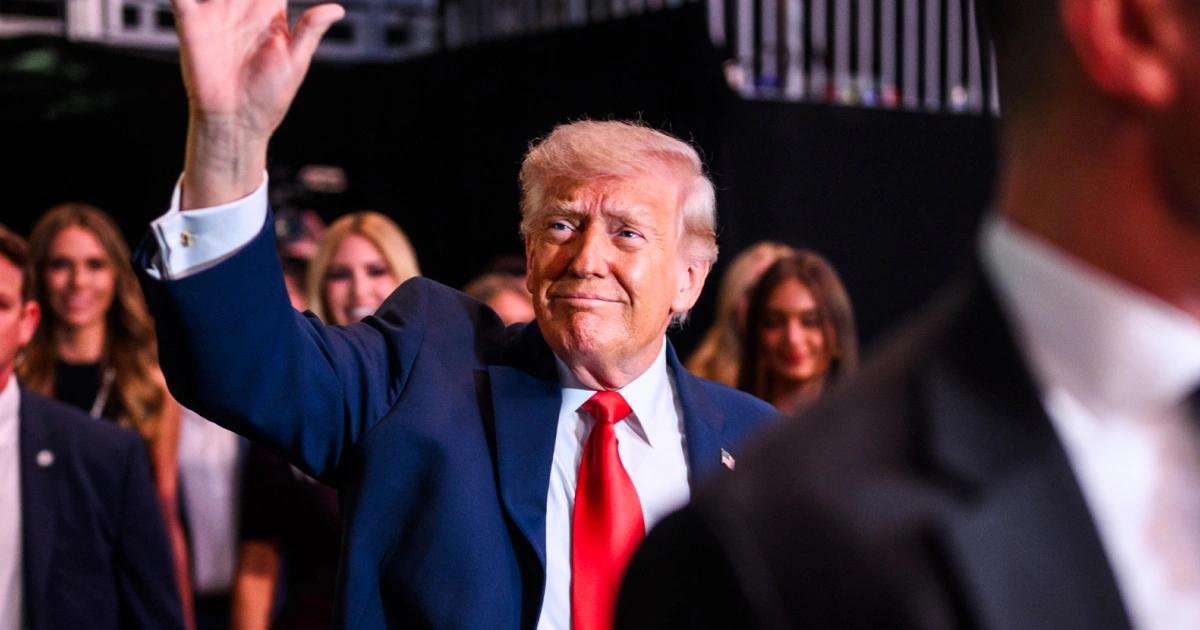
Talks between Iran and the U.S. have broken down, and the U.S. military has moved to block the Strait of Hormuz and is drawing up plans for airstrikes. International oil prices immediately broke above $100, and Bitcoin fell through $71k. Experts warn that strategic oil reserves could run out, and the world may soon face a severe shock to global crude oil supply.
Talks between Iran and the U.S. have broken down, and the U.S. is blocking the strait and considering restarting airstrikes
Peace talks between the United States and Iran have officially been declared a failure. Vice President Vance (JD Vance), who leads the U.S. delegation, said externally that, because Iran refused to commit to giving up the development of nuclear weapons, the two sides were unable to reach an agreement to extend the ceasefire.
U.S. President Donald Trump then issued an order via a social media platform, announcing that starting at 10:00 a.m. Eastern Time on Monday, the U.S. Navy would officially blockade all maritime traffic entering and exiting Iranian ports, and would take a hard line to intercept any ships that pay toll fees to Iran.
In addition to the maritime blockade order, The Wall Street Journal said Trump is also considering restarting limited airstrike operations against Iran. A White House spokesperson, Olivia Wales, confirmed that the president has ordered the implementation of a naval blockade and will retain all additional military options.
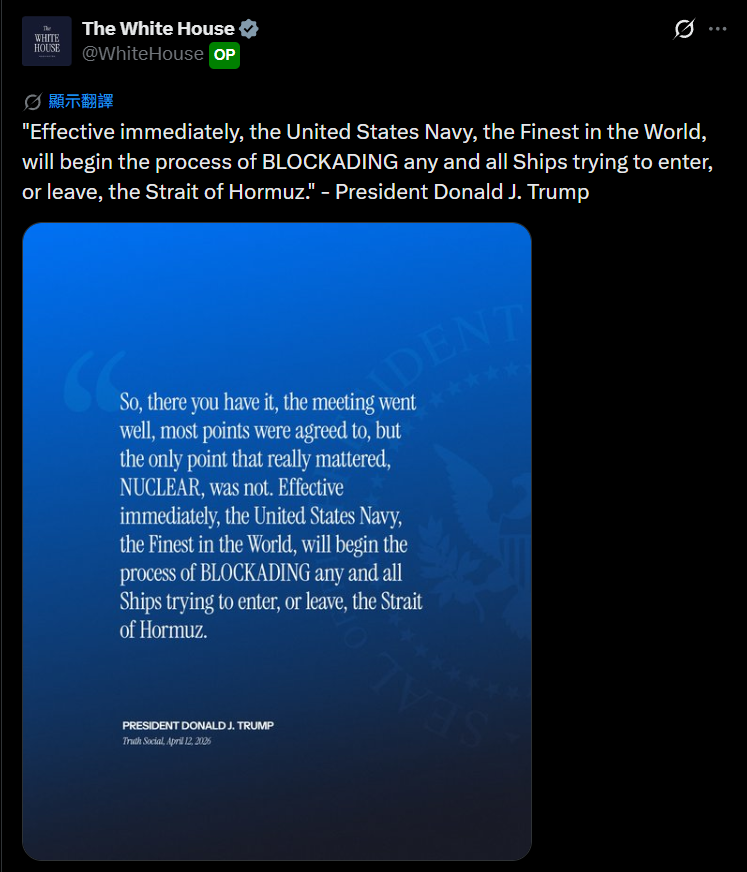
Image source: White House, U.S. President Donald Trump ordered the formal blockade of all maritime traffic entering and exiting Iranian ports, and will take a hard line to intercept any ships that pay toll fees to Iran.
Faced with the threat of the U.S. blockade and airstrikes, Iran’s official stance has shown no willingness to yield. Iran’s Foreign Minister Abbas Araghchi said that, at the negotiating table, the two sides had originally been only a short distance apart, but in the end they faced the U.S.’s extreme pressure and threats of a blockade.
The Speaker of Parliament Mohammad Bagher Ghalibaf, who leads Iran’s negotiating team, also posted to mock, the U.S.’s blockade operation will soon lead American people to miss the $4 to $5 per-gallon gasoline prices.
Iran’s navy also issued a stern warning that any military vessels approaching the Strait of Hormuz would face harsh treatment from Iran.
International oil prices gap up sharply on Sunday; Bitcoin falls below 71,000
Once news of the breakdown in Iran-U.S. talks and the blockade emerged, international oil prices jumped on Sunday, surging to above $100 per barrel. Global benchmark Brent crude futures rose 7.5% to $102.37; West Texas Intermediate (WTI) crude futures jumped 8.3% to $104.56.
On the decentralized trading platform Hyperliquid, WTI crude futures rose 7% to $96.40, with trading volume reaching $1.53 billion. The data highlights that during the weekend closure of traditional markets, investors are turning in large numbers to blockchain platforms in search of price discovery and a hedging channel.
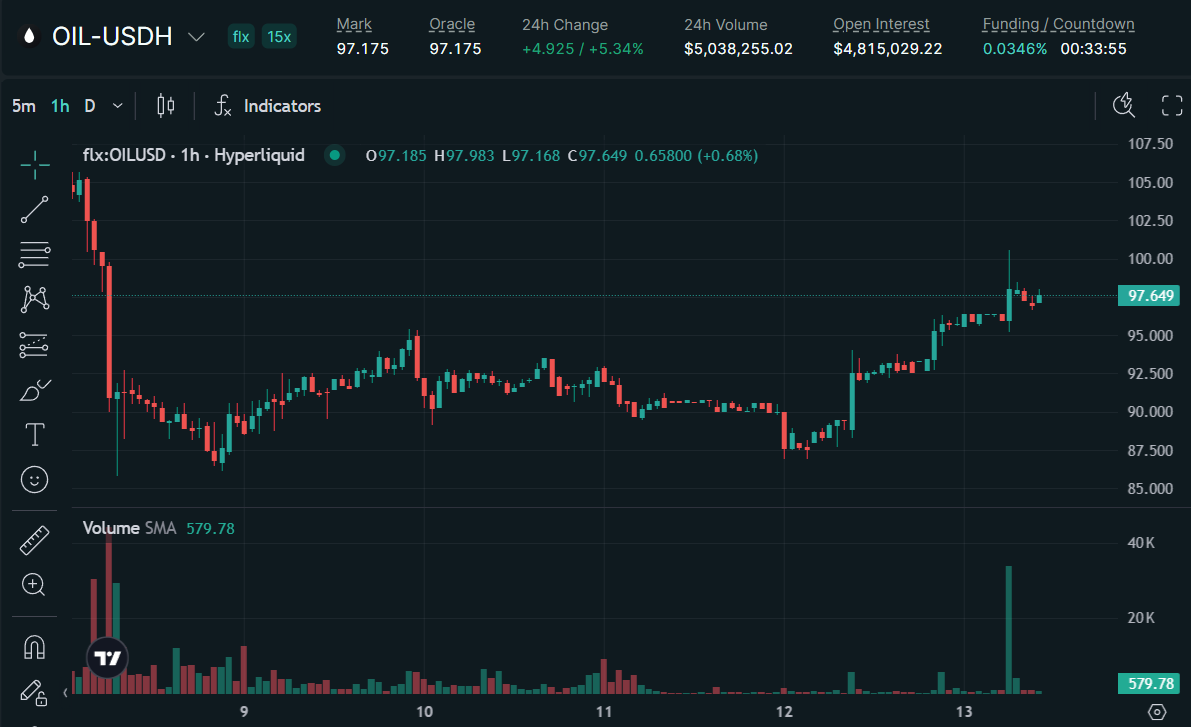
Meanwhile, Bitcoin, seen by some traders as a risk-asset leading indicator, is facing heavy selling pressure.
Before Vance made remarks about the talks breaking down, the price of Bitcoin had been holding above $73,000, but after Trump announced the blockade order, Bitcoin quickly fell below the $71,000 level, dropping to around $70,900, with a 24-hour decline of 2.5% to 3%; however, it has now edged back up above $71,000.
Strategic oil reserves hit bottom; experts warn of a historic supply shock
Regarding the latest measures by the Trump administration and the market reaction, BBC North America correspondent Anthony Zurcher’s analysis said that although Trump’s recent remarks are not as destructive as last week’s threat to end “Iranian civilization,” the decisions to carry out a maritime blockade and prepare to restart attacks indeed have brought many entirely new challenges and potential international risks for the United States.
An analysis cited by CoinDesk said, mid-April is an extremely critical period for the global oil market, because the International Energy Agency (IEA)’s previously coordinated release of large-scale strategic oil reserves by countries is expected to reach its limit. These emergency-released crude oil supplies were originally able to make up for an estimated supply shortfall of about 4.5 million to 5 million barrels per day, thereby easing the impact of disruption to shipping through the Strait of Hormuz.
Fatih Birol, executive director of the International Energy Agency, warned that the oil supply shock in April could be more severe than in March. The Saudi royal family also clearly stated that once these emergency buffer stocks have been consumed and normal supply cannot be restored, the global crude oil supply shortfall could rapidly expand to between 10 million and 11 million barrels per day.
Experts believe that if this were to happen, it would trigger a supply shock unprecedented in the modern oil market, while substantially increasing pressure from inflation and intensifying volatility across global markets.
This article has been generated by Crypto Agent to compile information from multiple parties, and has been reviewed and edited by Crypto City; it is still in the training stage, and there may be logical discrepancies or information errors. The content is for reference only and should not be taken as investment advice.
Disclaimer: The information on this page may come from third parties and does not represent the views or opinions of Gate. The content displayed on this page is for reference only and does not constitute any financial, investment, or legal advice. Gate does not guarantee the accuracy or completeness of the information and shall not be liable for any losses arising from the use of this information. Virtual asset investments carry high risks and are subject to significant price volatility. You may lose all of your invested principal. Please fully understand the relevant risks and make prudent decisions based on your own financial situation and risk tolerance. For details, please refer to
Disclaimer.


