
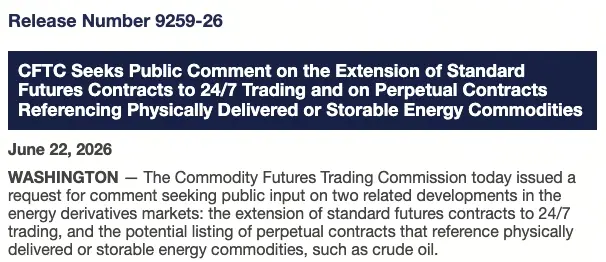
The U.S. Commodity Futures Trading Commission (CFTC) officially released a notice of proposed rulemaking for comment on June 23, soliciting written input from all parties on the development of two energy derivatives markets: first, extending standard futures contracts (including energy futures) to 24-hour trading, 7 days a week, around-the-clock, while not changing the fixed expiration dates, delivery, or settlement terms; second, the potential listing of perpetual contracts backed by physical delivery or deliverable and storable energy commodities (taking crude oil as an example).
Two Sets of Questions in the Request for Comments: 24/7 Futures Trading and the Design of Energy Perpetual Contracts
 (Source: CFTC)
According to the CFTC’s official announcement, this notice of proposed rulemaking centers on two sets of questions:
24/7 Standard Futures Trading: Under the premise of not changing fixed expiration dates, delivery, or settlement terms, how should standard futures contracts, including energy futures, operate continuously without interruption for 24 hours a day, and what would be the impact on related market structure, liquidity, and regulation.
Energy Perpetual Contracts: When perpetual contracts involve physical delivery or deliverable and storable energy commodities, how should the mechanism for converging funding rates address the cost-of-carry economics of holding physical commodities; the CFTC, using crude oil as an example, points out that logistical and storage constraints for physical delivery may cause sharp price volatility, and the design of perpetual contracts needs to address this situation.
The CFTC said it is “intending to use the information and comments received to deepen understanding of these developments.”
Procedural Nature: The Request for Comments Is Not a Proposed Rule
In its announcement, the CFTC explicitly states that this release is a request for comments and is a procedural step aimed at collecting input from all parties before drafting rules, rather than initiating a rulemaking process for proposed regulatory text. The commission did not specify in this announcement the具体 timeline for any subsequent rulemaking or the expected regulatory direction.
Bitcoin Perpetual Contracts Precedent and the CME Lawsuit Background
Bitcoin Perpetual Contract Precedent (May 2026): In May 2026, the CFTC approved the first regulated Bitcoin perpetual futures contract in the United States, and subsequently issued a policy statement stating that other asset categories (“including but not limited to agricultural and energy products”) would be assessed based on their respective circumstances. CFTC staff also provided a compliance pathway for designated contract markets to convert digital commodity perpetual futures into truly perpetual contracts.
CME Lawsuit: CME Group has filed a lawsuit over the CFTC’s approval of perpetual contracts, arguing that these contracts meet the definition of swaps under the Dodd-Frank Act and therefore should be subject to stricter swap trading regulation. CME CEO Terry Duffy has previously publicly criticized U.S. crypto trading. This energy derivatives RFC extends the same regulatory framework to the large commodities markets long dominated by CME.
Common Questions
Does the CFTC “request for comments” mean that 24/7 energy futures or perpetual contracts are about to be approved?
No. This request for comments is a procedural step and is not equivalent to a policy decision. The CFTC clearly states that the purpose of the announcement is to collect comments to “deepen understanding.” After the comment period ends (30 days after the notice is published in the Federal Register), the CFTC will consider further actions; at this time, it is not possible to confirm whether final rules will be adopted or what regulatory actions may be taken.
What is the difference between 24/7 energy futures trading and existing standard futures?
Existing standard futures have fixed trading hours and expiration dates; this CFTC request for comment focuses on continuous 24/7 trading under the premise of “not changing expiration dates, delivery, and settlement terms,” and addresses concerns about market surveillance capabilities and liquidity. The CFTC did not provide any feasibility conclusion in this announcement, but instead collected input from market participants through the request-for-comments process.
What potential impact does the CME lawsuit have on the CFTC energy derivatives RFC?
CME has filed a lawsuit regarding the CFTC’s approval of crypto perpetual contracts. This RFC extends the same contract design framework to the energy derivatives market led by CME. The court outcome could affect the final direction of the CFTC’s energy derivatives rules, but there is currently no publicly available information on the schedule for a ruling; the CME lawsuit is still ongoing.


