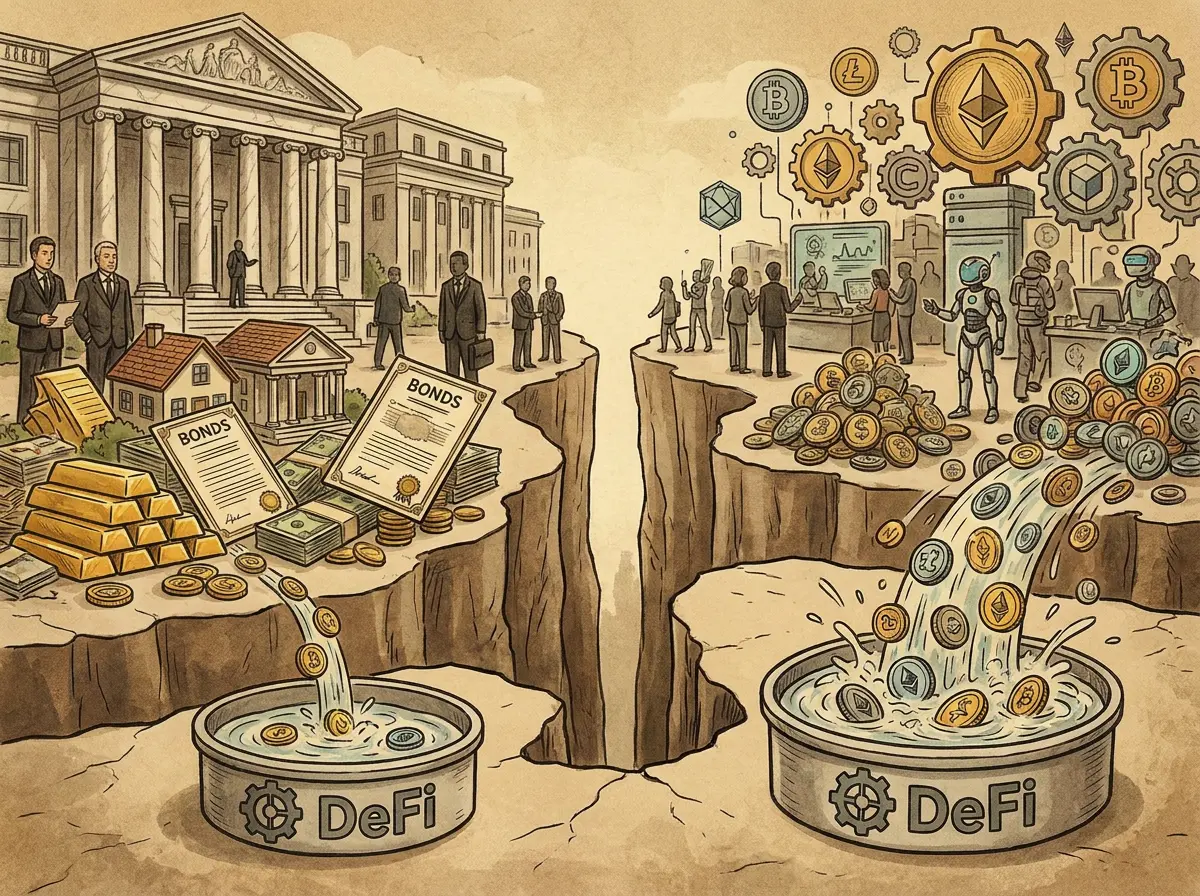
According to DefiLlama’s RWA category data, as of May 2026, the total on-chain tokenized RWA market size is approximately $28.56 billion, but only $2.47 billion (about 8.6%) is shown as active TVL in third-party DeFi protocols. Private credit is the only exception, with an active DeFi proportion of 39%.
DeFi activity comparison data across different types of RWA assets
According to DefiLlama data, the on-chain scale and the DeFi active TVL comparison for each asset category are as follows:
Bonds and money market funds: $16.6 billion on-chain;$920 million in DeFi active TVL (5.5%)
Gold and commodities: $5.7 billion on-chain;$183.6 million in DeFi active TVL (3.2%)
Stocks and equities: $2.7 billion on-chain;$78.27 million in DeFi active TVL (2.9%)
Private credit: $3.23B on-chain;$1.26B in DeFi active TVL (39%)
BlackRock BUIDL is the largest tokenized money market fund, but its DeFi active TVL is only $18.9 million. Tokenized gold Q1 2026 spot trading volume reached $90.7 billion (according to CoinGecko), but the vast majority is concentrated in CEXs and is outside DefiLlama’s DeFi tracking scope.
How permissioned structures block DeFi composability
BUIDL is a typical example of a permissioned architecture: holders must go through an allowlist managed by Securitize; on-chain transfers have no legal effect until verification with the transfer agent’s on-chain records and off-chain records; and the contracts can only interact directly with addresses on the allowlist, so funds cannot be deposited into open protocols like Aave or Uniswap. BlackRock completed its integration with Uniswap in February 2026, but Securitize still controls the allowlist, only allowing eligible institutional buyers with asset sizes of at least $5 million to participate.
RedStone’s March 2026 report confirmed that the hardest part of tokenization is handling compliance across jurisdictions and blockchains, including identity verification, transfer restrictions, and sanctions. This is what makes Morpho and Aave Horizon currently the most typical data-concentrated RWA DeFi cases.
Private credit’s 39%:Confirmed DeFi RWA viable cases
The DeFi activity rate for private credit (39%) is significantly higher than other categories, because protocols such as Maple Finance and Centrifuge were designed from the start to build the product as a lending instrument. Confirmed DeFi RWA activity data: Morpho platform RWA deposits exceed $620 million; Aave Horizon total market size is $423.5 million; Ondo USDY broke past $1 billion in early 2026 TVL, is active across nine blockchains, and has DeFi TVL of $650 million.
DWF Labs’ April 2026 roundtable confirmed: the RWA market is splitting into two tracks—an ownership-first permissioned track, and a composability-first design that combines compliant issuance with secondary-market utility.
Common questions
Why is the DeFi utilization of private credit (39%) far higher than other RWA categories?
Private credit protocols such as Maple Finance and Centrifuge position the product as a lending instrument rather than a regulated fund structure from the outset. This means the token design considered DeFi composability from the beginning, not institutional compliance-first, allowing it to flow directly into open lending protocols.
Why is BlackRock BUIDL the largest on-chain by size yet has very low DeFi activity?
BUIDL uses a permissioned architecture: holders must pass an allowlist managed by Securitize (minimum $5 million eligible institutional investors), and on-chain transfers require off-chain transfer-agent confirmation for legal effectiveness. These compliance structures prevent BUIDL from directly interacting with open DeFi protocols, resulting in its DeFi active TVL of only $18.9 million.
What conditions are needed for RWA tokenization to increase DeFi activity share?
According to RedStone and DWF Labs’ reports, issuers need to choose a structure that does not require permissioned circulation at the design level, rather than a compliance-as-the-product architecture like BUIDL. A confirmed viable path is Centrifuge’s DeRWA approach, combining compliant primary issuance with freer secondary transfers, as well as Ondo USDY’s design that allows free transfer and acceptance of DeFi as collateral.


