Strategy (MSTR) filed an 8-K with the U.S. SEC on June 29, disclosing a new capital framework that includes up to $1 billion in MSTR common stock buybacks, up to $1 billion in STRC preferred stock buybacks, an expansion of the cash buffer to $2.55 billion, and for the first time authorization to sell up to $1.25 billion in Bitcoin if necessary to meet dividend or debt obligations.
Four Items of the Capital Framework in Strategy’s 8-K Filing
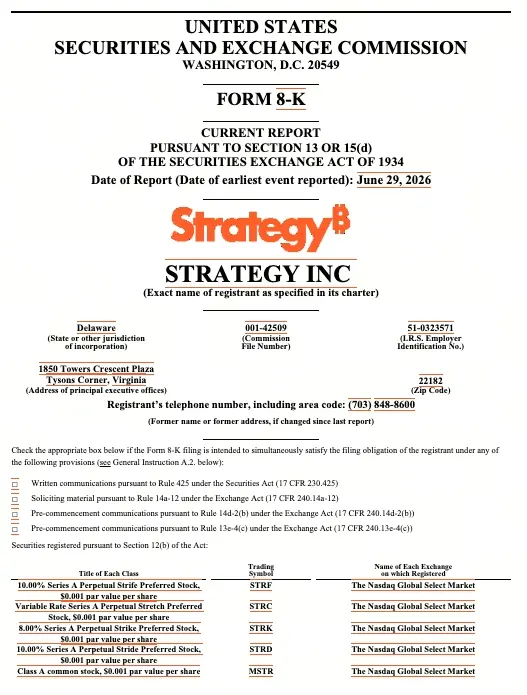 (Source: SEC)
According to the June 29 SEC 8-K filing, the new capital framework includes the following four items, with a clear operational priority: first tap the cash buffer, then execute buybacks, and only sell Bitcoin as a last resort:
MSTR Common Stock Buyback: Up to $1 billion
STRC Preferred Stock Buyback: Up to $1 billion
Cash Buffer Expansion: Increased to $2.55 billion, dedicated to paying dividends and debt
Bitcoin Sale Authorization: Up to $1.25 billion in Bitcoin may be sold if necessary to meet dividend or debt obligations
STRC Structure Design: Par Value, Dividend Rate, and Background of June Decoupling
STRC is Strategy’s perpetual preferred stock, with a par value of $100 and an annualized dividend of approximately 12%, funded by cash reserves and a Bitcoin-linked capital framework. Prior to the new framework announcement, STRC fell to $72.06 on June 26, representing a discount of over 28% to par value.
A report from Bitfire Research noted that STRC’s decoupling was primarily driven by deteriorating market sentiment and tightening liquidity, rather than changes in Strategy’s fundamentals or solvency, and stated that “Strategy faces no bankruptcy risk in the near term.”
Analyst Perspectives on the New Capital Framework
Taran Dhillon, Head of Digital Assets at Kula, said the real stress test is the dual scenario of “sustained Bitcoin pressure combined with rising capital costs,” and pointed out that the new framework does not eliminate this risk condition.
Adam Livingston’s stress test model assumes a 55% Bitcoin decline, closed capital markets, and continued cash consumption, showing that after selling approximately 116,000 BTC over three years, Strategy would still hold over 700,000 BTC.
Charles Edwards, founder of Capriole Investments, noted on June 26 that Strategy’s leveraged structure creates a feedback loop that accelerates losses when sentiment deteriorates, citing Terra/LUNA in 2022 as a comparison.
Kyle Rodda, Senior Analyst at Capital.com, described Strategy as a “momentum-driven Bitcoin accumulation vehicle,” whose fundraising-to-buy Bitcoin cycle would reverse under pressure. Ripple CEO Brad Garlinghouse said in a CNBC interview, “Financial engineering does not create long-term value.”
Frequently Asked Questions
What is the cap and trigger condition for Strategy’s authorized Bitcoin sale?
According to the June 29 SEC 8-K filing, Strategy’s authorized Bitcoin sale cap is $1.25 billion, and the trigger is to meet dividend or debt obligations. The filing clearly states this is a last resort, with the operational order following cash buffer usage and stock buybacks.
Why did STRC fall to $72 on June 26?
A report from Bitfire Research indicated that STRC fell to $72.06 primarily due to deteriorating market sentiment and tightening liquidity, rather than any substantive change in Strategy’s fundamentals or solvency. In the same report, Bitfire Research stated that “Strategy faces no bankruptcy risk in the near term.”
Does the new capital framework eliminate external doubts about Strategy’s financial structure?
According to public comments from multiple analysts, the new framework sets quantitative caps for MSTR buybacks, STRC buybacks, cash buffer, and Bitcoin sales, improving investors’ basis for expectation management. Taran Dhillon noted that the new framework does not eliminate the dual pressure scenario of “sustained Bitcoin pressure combined with rising capital costs.”


