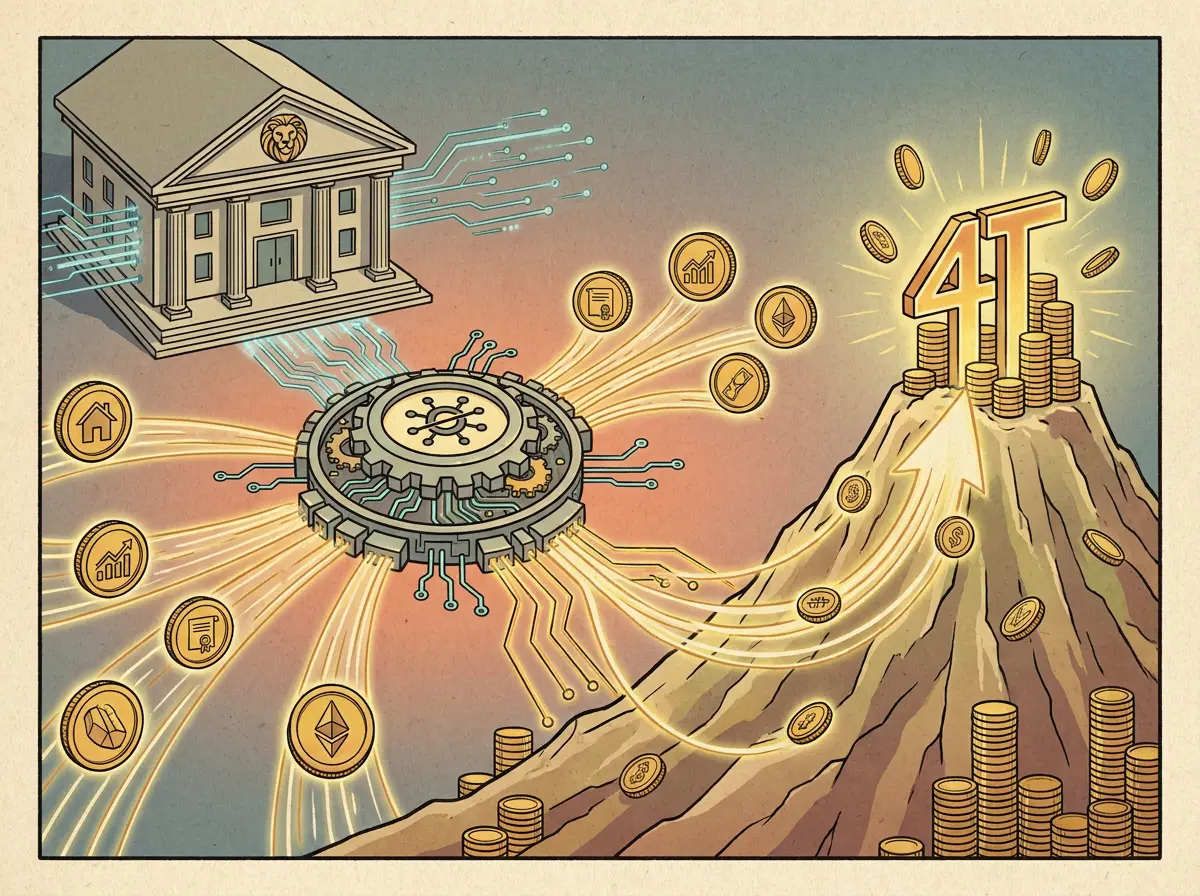
In a research report published on May 18, Standard Chartered predicted that by the end of 2028, the size of tokenized assets on blockchain networks will reach $4 trillion, with half being stablecoins and the other half being non-stablecoin real-world assets (RWA); DeFi protocols will become the core infrastructure for tokenized assets.
Standard Chartered’s core predictions: numbers, structure, and risks
Tokenized assets size by end of 2028: $4 trillion (stablecoins $2 trillion + non-stablecoin RWA $2 trillion)
Three ways to boost DeFi throughput (confirmed by the report):
· More assets can be moved on-chain and circulated
· A larger share of those assets can be deposited into DeFi protocols
· On-chain asset-based lending volumes can expand
Standard Chartered confirmed that these three driving factors will create a multiplier effect on DeFi protocol activity and token prices.
Key risks (confirmed by the report): Regulatory uncertainty, smart contract risks, reliance on oracles, governance issues, and missing user experience. The report notes that institutional investors may prefer more mature platforms with robust risk metrics and professional governance.
Institutional case: Coinbase-Morpho’s Bitcoin lending product
In its report, Standard Chartered used the Coinbase-Morpho collaboration as a concrete example of DeFi institutionalization: Coinbase provides the front end and custody services, while Morpho provides lending logic, a liquidation engine, and liquidity pools. As of the report’s publication, the product holds about $1.75 billion in loans and covers 22,000 borrowers.
Tokenized assets market snapshot: confirmation data from other institutions
Chainalysis: RWA assets under management are nearing $30 billion
Market data: In May, the tokenized RWA market size was at least $34.5 billion (with another report citing $37.5 billion), with year-over-year growth of about 100%
Binance Research: Tokenized assets could reach $1.6 trillion in the 2030s (focusing on treasury-bond products, gold-backed commodity products, and tokenized listed stocks)
FAQ
How do Standard Chartered’s $4 trillion forecast and Binance Research’s $1.6 trillion differ?
They use different timeframes and scopes: Standard Chartered predicts that on-chain tokenized assets (including stablecoins) will reach $4 trillion by the end of 2028; Binance Research’s $1.6 trillion target points to 2030 and focuses on the category of non-stablecoin tokenized assets. Since the two forecasts use different methodologies, they cannot be directly compared.
How does composability improve the capital efficiency of tokenized assets?
According to Standard Chartered’s report, tokenized assets allow a single position to take on multiple functions at the same time: earning yield, providing collateral for loans, and maintaining liquidity. Compared with traditional finance—where assets often can serve only a single static function—using multiple functions synchronously can significantly reduce idle capital costs.
What are the main obstacles to large-scale adoption of DeFi tokenized RWA?
According to Standard Chartered’s report, the main obstacles include: regulatory uncertainty (especially differences in compliance frameworks across jurisdictions), smart contract technology risks, reliance on external oracles, protocol governance issues, and remaining gaps in user experience for institutional users.


