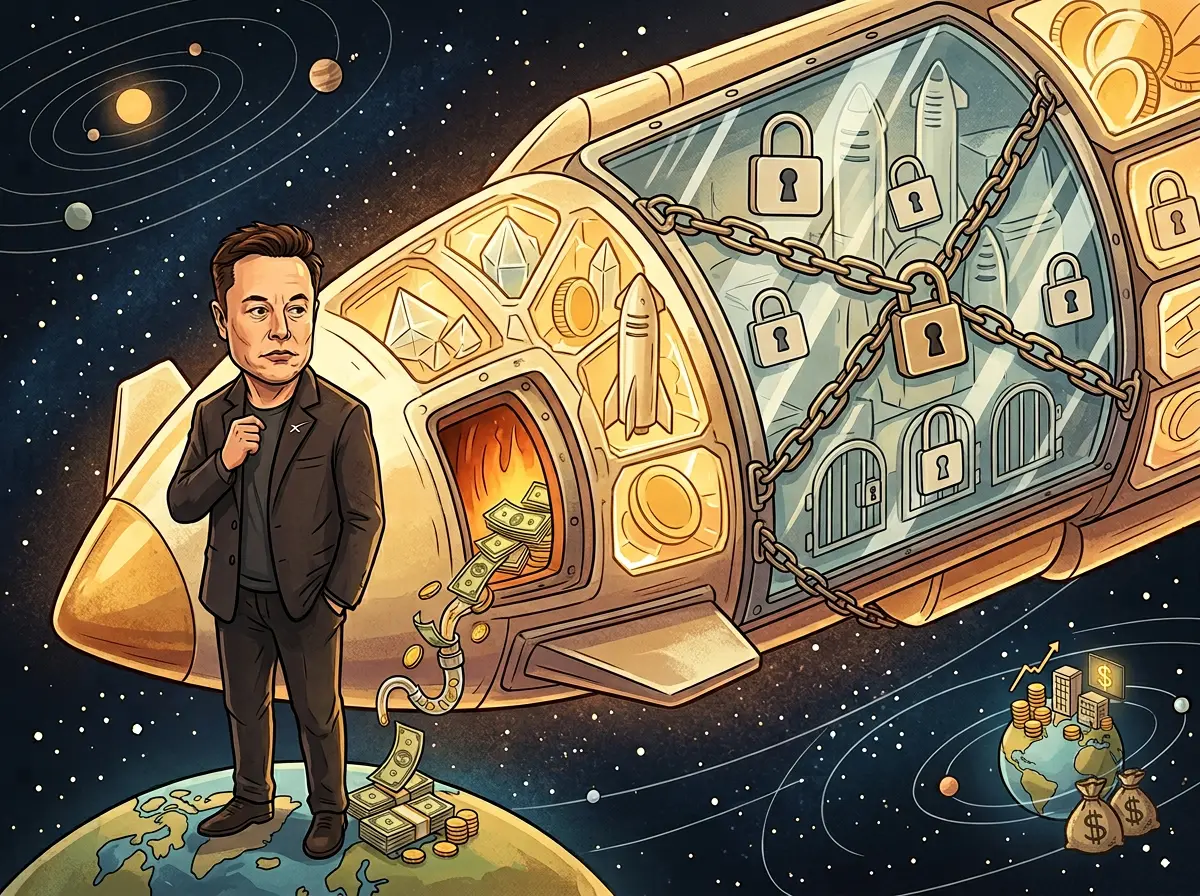
On June 12, SpaceX issued 555.6 million shares at $135 per share, raising $75 billion. The company’s valuation was set at $1.77 trillion. Musk’s net worth surpassed $1 trillion, making him the first trillionaire in history. OmniTools analysis says that due to poor liquidity of super-voting shares, lock-up terms, and the threat of selling that could undermine control, the proportion of cash Musk can actually realize each year is estimated to be less than 2%.
SpaceX IPO Confirmed Data
According to the S-1 filing and public market data:
IPO offer price: $135 per share
Shares issued: 555.6 million shares
Funds raised: $75 billion
Total valuation: $1.77 trillion
Total shares outstanding (implied): about 13.11 billion shares (1.77 trillion ÷ 135)
Free-float share ratio: about 4.2% (555.6 million ÷ 13.11 billion)
Musk voting power: about 85.1%; even after the IPO, it remains above 50%
S-1 also discloses: The S-1 warns investors about the risk of further equity dilution after listing, and lists water resources and chips and power as core risk factors.
Musk’s voting structure and cash-out constraints: OmniTools analysis
The S-1 filing confirms that Musk achieves control by holding Class B or Class C shares with super-voting rights. Voting power is typically 10 to 20 times that of common stock, while the actual economic interest proportion has not been disclosed in public coverage.
OmniTools runs three scenario estimates (assuming Musk’s economic interest is between 35% and 55%):
35% scenario: The value of SpaceX equity is about $619.5 billion, plus Tesla equity of about 13% and other non-listed assets; total net assets exceed $1 trillion
45% scenario: The value of SpaceX equity is about $796.5 billion, and total net assets are about $1.2 to $1.3 trillion
55% scenario: The value of SpaceX equity is about $973.5 billion, and total net assets are close to $1.5 trillion
OmniTools points out that all three scenarios surpass the trillion threshold. However, cash-out ability is constrained by three factors: lock-up terms prohibit selling immediately after the IPO; large-scale selling poses a threat to control; and market confidence issues caused by the founder’s selling. Using Amazon founder Bezos’s 2025 benchmark divestment pace of keeping control between 2% and 3% of his holdings, OmniTools estimates that under the 45% economic interest scenario, Musk’s yearly cash-out ceiling is about $16 billion to $24 billion, representing 1.6% to 2.4% of his trillion-dollar net worth.
Three cash-out hurdles for 4,400 employee millionaires
TechCrunch, citing the S-1 filing, confirms that about 4,400 employees are expected to become millionaires due to their equity plans (based on the lowest boundary estimate, the total value of employee holdings is at least $4.4 billion), setting a record for IPO wealth creation among technology companies (Facebook’s 2012 listing created about 1,000 millionaires; Snowflake’s 2020 listing had about 3,000 employees).
OmniTools says that going from paper wealth to a bank account requires three hurdles:
First hurdle: Lock-up period: In US IPO practice, employee holdings are typically locked up for 180 days, during which trading is prohibited
Second hurdle: Exercise price: If it’s stock options, employees must pay out of pocket to buy shares at the exercise price; only the difference between the exercise price and the issue price is the actual gain
Third hurdle: Tax obligations: Exercising creates a taxable event; after federal tax, state tax, and Alternative Minimum Tax (AMT) are layered, the amount actually received may be far lower than the paper number
xAI division confirms financial data
xAI division data confirmed in the S-1 filing:
xAI 2025 revenue: $3.2 billion
xAI 2025 loss: $6.4 billion
Annualized compute rental contracts: Anthropic $1.25 billion per month + Google $0.92 billion per month = annualized about $26.04 billion
OmniTools estimates annualized capital expenditures: about $30.8 billion (exceeding annualized revenue of $26 billion; the gap of about $4.8 billion would require external financing)
OmniTools also notes that the compute-power contracts’ terms for Anthropic and Google, renewal terms, and early termination conditions were not disclosed in the S-1 filing.
Frequently Asked Questions
What does SpaceX’s 4.2% float mean?
OmniTools analysis says that when the tradable stock pool is only 4.2% of total shares, even a small amount of net buying can drive a significant rise. Conversely, when the lock-up period ends and the remaining 96% of shares are gradually released, selling pressure will also be amplified. The S-1 filing has also warned investors that there may be additional equity dilution risk after listing, and this risk may be released in concentrated fashion when the lock-up expires.
If Anthropic and OpenAI were to list, how much would employee equity be worth?
OmniTools’ comparative analysis: Anthropic’s current valuation is $965 billion, and OpenAI’s valuation is $852 billion—both are private companies. Under an assumption of employee option pools of 10% to 15%, the total value of employee holdings would fall between $96.5 billion and $144.8 billion for the two companies, and between $85.2 billion and $127.8 billion, respectively—far exceeding SpaceX’s lowest estimate of $4.4 billion. But OmniTools reminds that whether AI companies’ high PS multiples (Anthropic about 32x, OpenAI about 34x, vs SpaceX about 9.8x) can be maintained in the secondary market remains an unverified question.
Does Musk’s “first trillionaire” title equal disposable trillion-dollar cash?
According to OmniTools analysis, bookkeeping trillion and disposable trillion are two different things. Constrained by the extremely poor liquidity of super-voting shares, lock-up terms, and the threat from large-scale selling that could undermine control, OmniTools estimates that Musk’s actual cash-out proportion each year is less than 2%. The S-1 filing confirms Musk holds super-voting shares; the specific amount of cash he can actually control depends on his actual economic interest proportion (not fully disclosed in the S-1).


