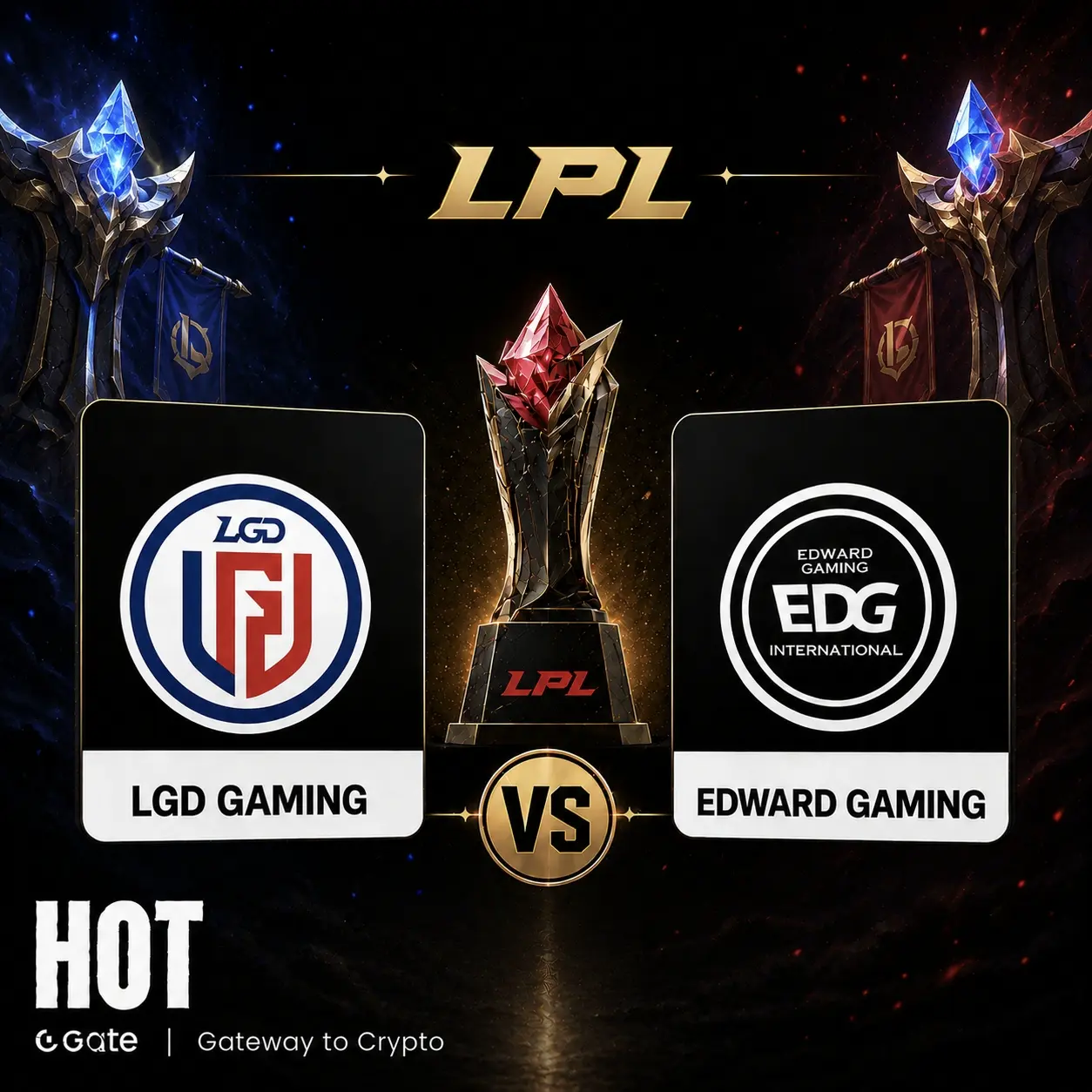
The core logic of a prediction market is “voting with money.” Unlike traditional polls or expert predictions, participants in a prediction market must express their judgment with real capital—meaning every probability figure corresponds to actual risk taking. A 55% vs. 46% distribution indicates the market overall believes EDG has an advantage, but not an overwhelming one. The 9-percentage-point gap falls within what prediction markets consider a “mild preference” range, far from a deterministic consensus.
Another noteworthy detail is that the two probabilities add up to 101%. This is not a data error; it’s caused by common prediction-market rounding differences or liquidity frictions. In sufficiently deep markets, the sum of option probabilities should approach 100% infinitely closely, while a 1% deviation precisely reflects that this event’s prediction market is still actively trading and the price-discovery mechanism has not fully converged yet.
The 2026 esports midsummer season is already underway, with major events like EWC, LPL, and LCK continuing back to back. Popular esports titles such as LoL, Dota 2, Counter-Strike, and Valorant are all getting underway one after another. Gate has launched a limited-time event, “电竞巅峰交易季”, to predict global esports showdowns and split 200,000 USDT
How do the two teams’ competitive conditions differ this season?
To understand why the prediction market is assigning EDG a 55% win rate, the first step is to examine how both teams have performed overall in this season’s LPL Summer Split.
As a traditional powerhouse in the LPL, EDG has maintained a high level of stability in tactical execution and team coordination this season. Key indicators such as their win rate in the summer split, average in-game economic lead, and dragon control rate are all in the upper-middle tier of the league. EDG’s advantage lies more in macro-level operations—they’re good at building incremental advantages through vision suppression and resource exchanges. This playstyle also tends to offer higher tolerance when facing mid-to-lower-tier teams.
LGD this season shows a more obvious “high ceiling, low floor” profile. In some matches, they can produce highly aggressive early-game tempo, using individual skill to create lane advantages and turn that into a snowball. But in other games, LGD’s decision-making and teamfight coordination show significant fluctuations. This inconsistency is reflected in the prediction market—specifically, it’s the core reason the market gives LGD a 46% win rate. The market acknowledges LGD’s explosive potential but doubts their ability to sustain it.
Does the historical head-to-head record have reference value?
LGD vs EDG’s historical matchups in the LPL are an important benchmark that cannot be ignored in the market pricing process.
Looking across multiple past seasons, EDG has generally held the upper hand in encounters against LGD. This historical advantage shows not only in the number of wins but also in match control—when facing LGD, EDG often limits the space for their core players to perform effectively, dragging the game into an operational tempo EDG is comfortable with.
However, historical data must be used cautiously in esports analysis. Esports teams change their rosters far more frequently than traditional sports; shifts in player form, understanding of the meta, and the coaching staff setup can all cause historical records to lose their direct analogy value. Both teams have adjusted their rosters this season, so the reference weight of past head-to-head matchups should give way to the current patch’s adaptability and recent form. The 55% vs. 46% distribution provided by the prediction market is essentially the market’s pricing consensus formed by combining historical information with present realities.
How will tactical style clashes affect the game trajectory?
From a tactical perspective, the main point of this match is the clash between two distinct styles.
EDG leans toward a “systematic” approach: early on, they focus on solid laning; mid-game, they gradually build advantages through vision and resource control; late-game, they close out using a mature teamfight framework. The upside of this style is strong predictability and a lower error rate. The downside is a lack of “one-wave-to-win” burst potential. Against opponents with exceptionally strong individual ability who are hot on form, EDG can end up in a passive position.
LGD is closer to a “talent-driven” approach: standout individual mechanics, strong lane pressure early, and the ability to disrupt the opponent’s rhythm through small-scale clashes. The advantage is an extremely high ceiling—once they enter their comfort zone, they can dismantle any opponent. The drawback is insufficient stability; if they get knocked early, it can lead to a full-game collapse.
A 55% vs. 46% prediction distribution, to some extent, reflects the market’s premium for “stability.” In a BO3 format, EDG’s systematic style offers a higher floor. LGD’s talent-driven burst may be tempting, but the market believes their likelihood of delivering it is slightly lower than EDG’s stable output.
Key player matchups and the market pricing logic
The flow of capital in prediction markets often responds to key player matchup situations.
In this match, the core player matchups on each side are an important dimension for market pricing. EDG’s core players have an edge in experience and big-match mentality—their decision-making in crucial moments has been validated across multiple seasons. LGD’s core players show more talent in mechanical ceiling and lane pressure, though their form fluctuations are more evident.
The market giving EDG a 9-percentage-point win-rate premium can be understood as a quantified expression of the market’s “experience premium” and “stability premium.” In a prediction market pricing mechanism, participants’ trading behavior absorbs and reflects factors such as players’ historical performance data, their recent form curves, and their matchup records against specific opponents into the final probability. While this pricing mechanism is not perfect, its “money-vote” nature gives it an information-integration efficiency that traditional analysis methods struggle to replace.
The value of prediction market data in esports
Having LPL events listed on a prediction market is itself a signal worth paying attention to in the industry.
Traditional esports analysis mainly relies on qualitative information such as expert interpretation, historical data, and player interviews. Prediction markets provide a brand-new dimension for esports analysis: a quantified market consensus. By observing how capital distributes across different options, analysts and audiences can obtain win-rate assessments grounded in real money—beyond personal bias.
The application value of prediction markets in esports also lies in their dynamism. Unlike traditional pre-match predictions, prediction markets adjust probabilities in real time as new information emerges—player status updates, BP strategy leaks, and even in-arena momentum can all trigger probability movements. This dynamic price-discovery mechanism means a prediction market is not only a “pre-match prediction” tool, but also a real-time information aggregator running throughout the entire match.
Gate’s ongoing布局 in prediction markets is bringing this mechanism to a broader user base. By including top esports events like the LPL as prediction market underlying assets, Gate not only enriches the platform’s product ecosystem but also offers esports fans a new way to participate and access information.
The relationship between prediction market win rates and real outcomes
It needs to be made clear that a prediction market win rate is not a “prophecy” of the match outcome; it is a measurement of the collective judgment of market participants.
A 55% win rate means: if this match were simulated 100 times, the market believes EDG would win about 55 of them. This is a probabilistic judgment, not a deterministic conclusion. LGD’s 46% win rate is similarly not to be ignored—in a single match, a 46% probability means LGD would win in nearly half of the simulated outcomes. From the standpoint of mathematical expectation, the 9-percentage-point gap is far from enough to justify a “sure-win” judgment.
For users who follow prediction markets, understanding the essence of probability matters more than chasing “which side might win your bet.” The core value of a prediction market is not to tell you “who will win,” but to show you “who the market thinks will win and by how much their win chances are.” The difference between the two is subtle but crucial: the former predicts outcomes, while the latter measures consensus level.
From esports prediction to a broader prediction market ecosystem
Although the LGD vs EDG event is just a regular matchup within the long LPL season, its presentation in prediction markets reflects a broader industry trend.
Prediction markets are expanding from crypto-native scenarios into broader real-world events—where prediction-market applications are being explored across areas such as sports events, political elections, economic indicators, and cultural entertainment. Esports, a young generation-focused domain, is naturally suited for prediction markets to grow: rules are transparent, outcomes are clear, the audience base is large, and participation willingness is strong.
Gate’s sustained investment in prediction markets is not only product innovation but also a new exploration in the digital age of the ancient proposition of “information aggregation and price discovery.” By bringing LPL events into the prediction market landscape, Gate is building infrastructure connecting esports culture with crypto finance—an infrastructure whose value may well exceed the outcome of any single match.
FAQ
Q1: How are win-rate data in Gate prediction markets formed?
Win-rate data in a prediction market is determined collectively by the trading behavior of all participants. Each participant buys the result they believe in with real capital; the market price then fluctuates, and the final probability distribution reflects the market’s overall collective judgment.
Q2: Does a 55% win rate mean EDG is guaranteed to win?
No. A 55% win rate means that, in the market’s view, EDG has a slightly higher chance to win, but there is still a 45% possibility that LGD wins. Probability is not a deterministic prophecy—it is a quantified expression of possible outcomes.
Q3: Will the win rate in a prediction market change as the match gets closer?
Yes. Prediction markets are dynamic: any new information that could affect the outcome—such as changes to the starting lineup or player status updates—can cause participants to adjust their trading behavior, thereby changing the win-rate distribution.
Q4: How do I participate in trading Gate prediction markets?
Log in to Gate, enter the event page, and click “立即报名”. Go to the Gate Polymarket esports section. Choose any esports event or championship prediction market. Complete your prediction trade to unlock weekly task rewards and accumulate ranked trading volume.
Q5: How does prediction market data help esports analysis?
Prediction markets provide a dynamic, real-money-based win-rate assessment tool. Compared with traditional expert analysis, they have higher information integration efficiency and fewer biases, making them a supplemental reference dimension for esports analysis.