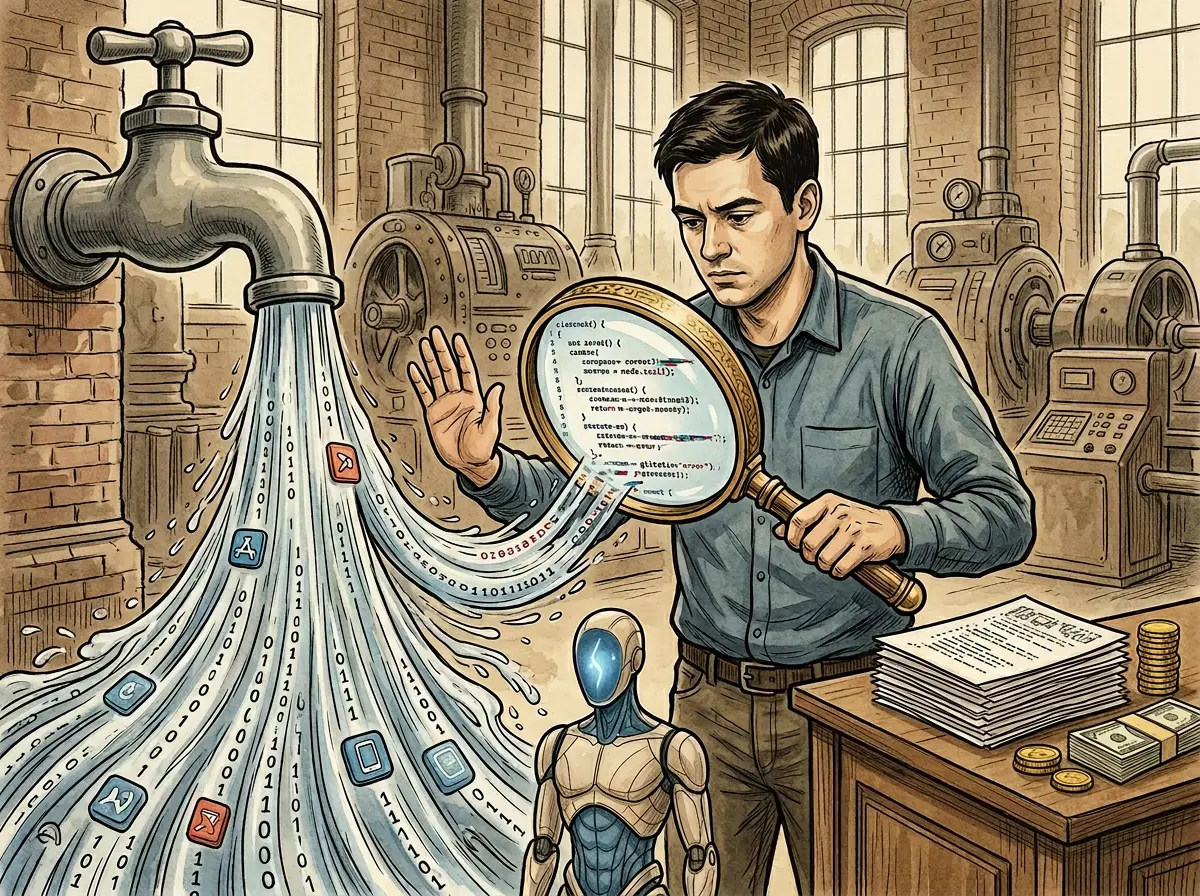
OpenAI co-founder Andrej Karpathy, who joined Anthropic last month, shared his assessment of Claude Fable 5 on June 9, calling it a performance leap with version-spanning significance, and describing its impact on productivity with the metaphor that “software flows out like running water.” However, Karpathy explicitly warned not to give up code reviews.
Karpathy’s Assessment of Fable 5’s Capability
Version-spanning performance leap: Karpathy confirmed that Fable 5 achieved a version-spanning performance leap, with its advantages especially pronounced when handling longer tasks. It can execute complex instructions effectively with almost no human intervention.
Complex debugging across long chains: Karpathy pointed out that when facing ambitious development goals, Fable 5 can quickly grasp intent and drive progress autonomously, for the first time making him feel a strong urge to not look at the code at all.
Clear warning (Karpathy’s exact words): He emphasized that you must not completely skip code review in production environments; this is his direct warning to users.
Underlying model explanation (Karpathy’s confirmation): Karpathy stated that Claude Fable 5 and Claude Mythos 5 share the same underlying model, and that Fable 5 adds additional safety protections on top of it.
Jevons Paradox: Karpathy’s Analytical Framework
In his commentary, Karpathy noted that when available software flows out like running water, the “Jevons Paradox” in the software domain will be triggered.
Definition of Jevons Paradox: When resource usage efficiency increases significantly, total demand for that resource can grow exponentially instead of decreasing, because the cost of using it drops sharply.
Karpathy’s application analysis (from his X platform comments): He said that this triggering effect will lead people to create vast numbers of “hyper-specific” single-use tools and massive test sets, ultimately driving exponential growth in overall software demand.
Confirmation Question: Safety Protection Mechanisms
Karpathy stated in his comments that the safety protection mechanisms configured for Claude Fable 5 at launch remain too sensitive and need further optimization. This assessment aligns with Anthropic’s official explanation in its Fable 5 launch announcement: Anthropic acknowledged that its current safety measures sometimes flag harmless requests as violations (overall trigger rate below 5%) and said it is working to improve them and reduce false positives as quickly as possible.
Frequently Asked Questions
What does the “Jevons Paradox” mentioned by Karpathy mean in AI code generation?
Based on Karpathy’s X platform comments, when AI makes software production costs approach zero, people’s demand for software will not decrease as a result—it will instead grow exponentially. He predicted this will lead developers to create more highly customized single-use tools and large-scale test sets, amplifying overall software consumption.
Why did Karpathy explicitly warn against completely skipping code review in production environments?
Karpathy said that although Fable 5’s capabilities made him feel, for the first time, the urge to not look at the code at all, he also explicitly warned that this approach should not be implemented in production environments. His warning matches Anthropic’s official recommendation—that even outputs from powerful models require human oversight to ensure reliability.
What is Karpathy’s specific view on Fable 5’s safety protection mechanisms?
Karpathy said in his comments that the safety protection mechanisms configured for Fable 5 at launch are too sensitive and need further optimization. Anthropic’s official announcement also confirmed that its safety measures sometimes flag harmless requests as violations, with a trigger rate below 5%, and stated that it is continuously improving them.


