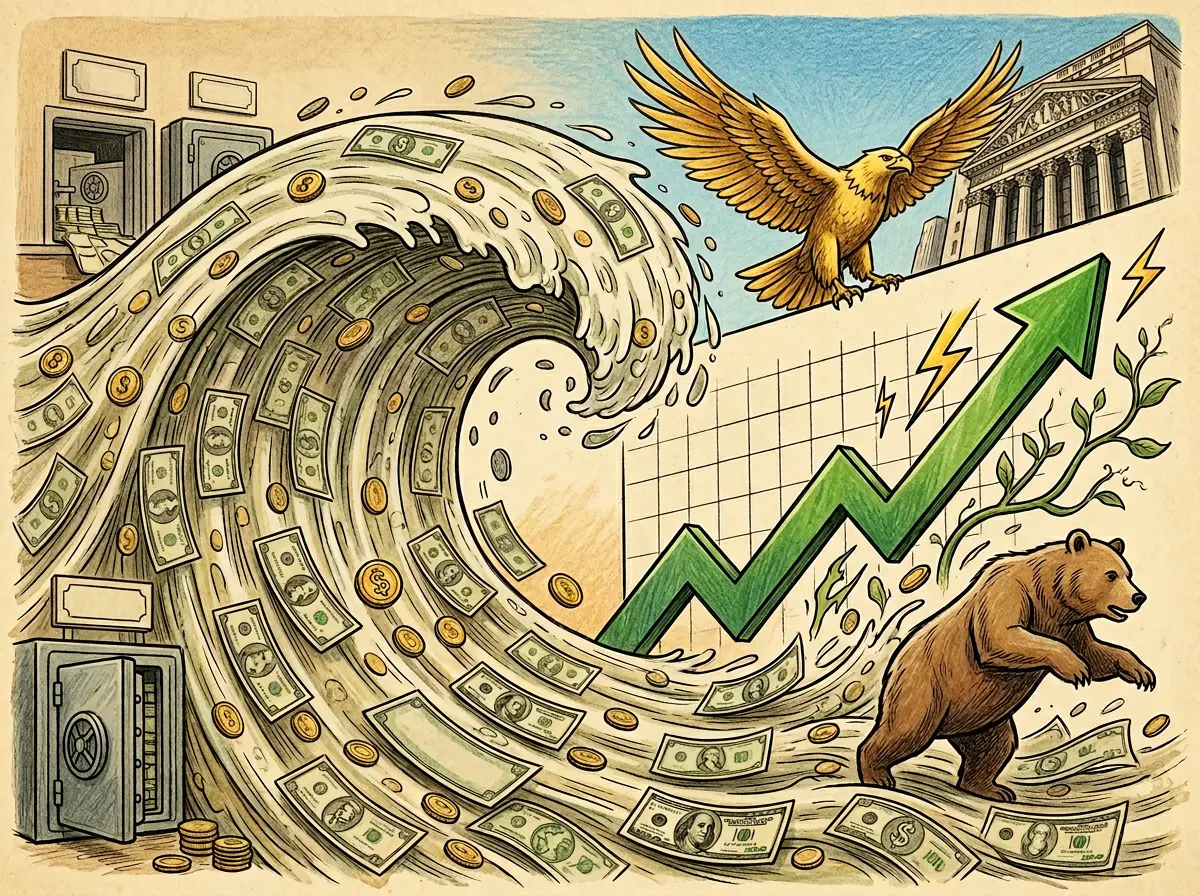
BlackRock global fixed income chief investment officer Rick Rieder said on June 16 that after U.S. President Trump announced an Iran nuclear talks agreement, the swift reaction in the stock market showed that roughly $8 to $9 trillion was moving out of money market funds and being reallocated to more active asset classes. Rieder also noted that last week’s SpaceX IPO forced investors to rebalance their portfolios, creating market momentum.
Rieder’s estimate of the size and flow of money market funds
Rieder estimates that the amount of funds currently held in money market funds is approximately between $8 and $9 trillion. He said the Iran talks agreement boosted market confidence and accelerated the flow of the above funds into equities.
Rieder’s characterization is “structural asset reallocation,” rather than short-term market-driven dynamics. He believes that when global capital simultaneously shifts out of defensive assets such as money market funds and short-duration bonds into risk assets such as stocks and growth equities, the conditions for the strong rally in U.S. stocks are already in place.
Rieder’s analysis of the Fed’s policy stance and rationale
Rieder said the Fed should avoid raising interest rates. He cited the following three reasons:
· Inflation in stubborn sectors such as healthcare, insurance, and education is not sensitive to borrowing costs, so rate hikes cannot effectively suppress prices in these areas
· Rate-sensitive sectors such as housing and automobiles are not currently facing significant price pressure, so there is not much urgency to raise rates
· Other central banks, including the European Central Bank, may not need to tighten policy as much as previously expected
Rieder believes that the Iran agreement could ease pressure from rising energy costs, giving major central banks around the world room to keep interest rates stable.
A double catalyst: the SpaceX IPO and confirmation of the U.S.-Iran agreement
Rieder specifically singled out SpaceX’s IPO as the starting point for market momentum. SpaceX conducted an initial public offering at a valuation of more than $10 billion (original text), forcing investors to reallocate funds within their portfolios to make room for new positions, creating structural rebalancing pressure. The Iran nuclear talks agreement further eliminated a geopolitical risk premium.
Rieder said the two catalysts acted in tandem, reinforcing the trend of funds moving from defensive assets into risk assets.
FAQs
Is the $8 to $9 trillion that Rieder mentioned the size of money market funds globally or in the U.S.?
Based on the article, Rieder’s estimate describes the “funds currently held in money market funds” as roughly between $8 and $9 trillion. The article does not explicitly distinguish whether this number refers to the global market or the U.S. market, and it does not provide the data source organization. The figure is Rieder’s personal estimate.
Why does Rieder think inflation in healthcare and health insurance is insensitive to rate hikes?
According to Rieder, healthcare and insurance, as well as education, are inflationary but industries that are not sensitive to borrowing costs. This means that prices in these industries are driven by structural supply-demand dynamics or regulatory factors rather than credit costs, so rising interest rates have limited impact on suppressing prices in these sectors.
How does the SpaceX IPO affect the allocation of money market funds?
Rieder’s logic is that large IPOs (such as SpaceX) attract institutional investors to subscribe, forcing them to free up positions in their portfolios to accommodate new shares. This “sell to buy” type of move itself is a signal of structural fund flows, indicating that the overall portfolio is shifting from defensive toward growth orientation.


