Bitcoin (BTC) rebounded to $63,000 on July 10, but momentum among bulls has since waned. US May PCE inflation was 4.1%, and the Kalshi prediction market indicates a 54% chance of rate hikes within the year; escalating US-Iran military conflict has led the US to attack 90 targets inside Iran, threatening navigation through the Strait of Hormuz again.
US-Iran Escalation: US Attacks 90 Targets, Iran Strikes Back Against Gulf Countries
According to US Central Command and AP reports, the US launched a new round of airstrikes inside Iran on Thursday, July 9, 2026, targeting 90 locations including airport runways, missile launch sites, air defense systems, and command and control networks. The US stated the strikes aim to "further weaken" Iran's ability to threaten freedom of navigation through the strait.
Iran responded with retaliations targeting US allies in the Middle East: Kuwait's military claimed to have shot down three ballistic missiles, one cruise missile, and ten drones, with debris causing one injury; Bahrain's alarms sounded three times; Qatar and Jordan were also hit by missile attacks, with Jordan's government spokesperson saying all incoming fire was intercepted. An Iranian official also claimed the US attacked areas near Iran’s only nuclear power plant in Bushehr.
Iran’s health ministry reported at least 14 deaths and 78 injuries over two days of airstrikes, mostly military personnel. Trump previously declared at the NATO Ankara summit that the ceasefire "has ended"; if conflict continues, energy transport through the Strait of Hormuz could face renewed disruption—this strait accounts for 20% of global oil and natural gas trade. Ship traffic increased from 233 vessels in May to 576 in June but is now again under threat.
Both sides announced plans to hold talks in Switzerland on Sunday, with official results pending.
Glassnode On-Chain Data: LTH Daily Losses Reach $280 Million
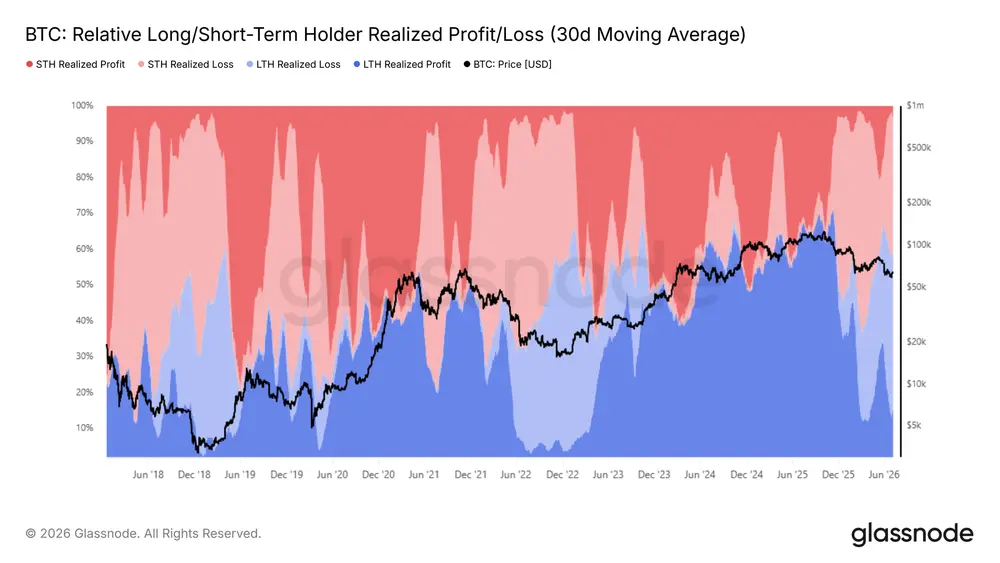 (Source: Glassnode)
According to the July 8 report from Glassnode, key on-chain and institutional metrics show: Long-term holders (LTH) realized losses as a percentage of total realized value (30-day moving average) have risen from 15% in early February 2026 to 43%, with daily realized losses reaching $280 million—the highest since December 2022. Glassnode states that before a significant cooling of LTH selling pressure, each market rebound could face heavy resistance.
Spot Bitcoin ETF net outflows have decreased from $193 million in early June to $89 million, but overall, outflows persist. ETF daily trading volume (30-day moving average) has shrunk to between $650 million and $950 million, about 80% below the peak in October 2025, indicating institutional confidence has yet to fully recover.
In derivatives markets, the put/call ratio has fallen to 0.56—the lowest since 2026—suggesting market panic premiums are easing, though traders still maintain defensive skew on options surfaces.
Kalshi Prediction Market Diverges from Fed Outlook: 54% Chance of Rate Hike This Year
According to Kalshi prediction market data, traders currently assign a 54% probability to the Federal Reserve raising interest rates this year (down from 56% the previous day). The chance of no rate cuts this year is about 76% (up from 68% on June 16—the day Fed Chair Kevin Warsh first presided over a meeting, jumping to 77%).
The June FOMC minutes showed "many participants" believe rates should stay within the current target range (3.50%-3.75%) or slightly lower by year-end, but "many others" think rates should be higher, indicating internal disagreement within the Fed on whether further hikes are necessary.
May PCE inflation rose to 4.1% year-over-year, the highest since April 2023. Ongoing Middle East tensions continue to push energy prices higher, further constraining the Fed’s room to cut rates.
Glassnode’s Three Key Bottom Indicators
Glassnode highlights three signals to watch for confirming a true bullish reversal in Bitcoin:
-
Cooling LTH Selling Pressure: Daily realized losses among long-term holders need to continue declining, indicating capitulation pressure is easing.
-
Stabilizing ETF Outflows and Rising Institutional Trading Volume: Spot Bitcoin ETF net outflows should turn into net inflows, with daily trading volume significantly expanding, signaling institutional demand is recovering.
-
Bitcoin Spot Price Holding Above $76,600: The spot price must stabilize above the true market mean to reflect a recovery in overall market cost basis.
Glassnode notes that despite US M2 money supply reaching a record $22.8 trillion, the Fed continues to reduce its balance sheet. All three signals need to align simultaneously to be considered a key indicator of a market bottom and potential bull market restart. These are Glassnode’s analytical insights.
FAQs
What is Glassnode’s overall assessment of Bitcoin’s current position?
According to the July 8 report, Bitcoin is currently in a "Bottom Building" phase, with spot prices remaining below the true market mean (about $76,600) and short-term holder cost basis (around $72,200) for five consecutive months. LTH daily realized losses are at $280 million—the highest since December 2022. Glassnode also warns that prices could further decline to support around $53,000 in an extreme scenario. These are the analysts’ views.
What is Kalshi’s forecast for the Fed’s rate hikes this year?
Based on Kalshi prediction market data (as of the report), traders estimate a 54% chance of the Fed raising rates this year, with about a 76% chance of no rate cuts. Internal Fed disagreements are also evident, with June minutes showing multiple members supporting higher rates by year-end. These are market-implied probabilities, subject to official Fed decisions.
How does the US-Iran military conflict impact the Strait of Hormuz and global energy markets?
Reports indicate the US has attacked 90 targets inside Iran, with Iran retaliating against Kuwait, Bahrain, Qatar, and Jordan. Navigation through the Strait of Hormuz is once again threatened, a critical chokepoint for 20% of global oil and natural gas trade. Rising energy prices could intensify US inflation pressures and influence Fed policy. Geopolitical developments remain subject to official statements.


