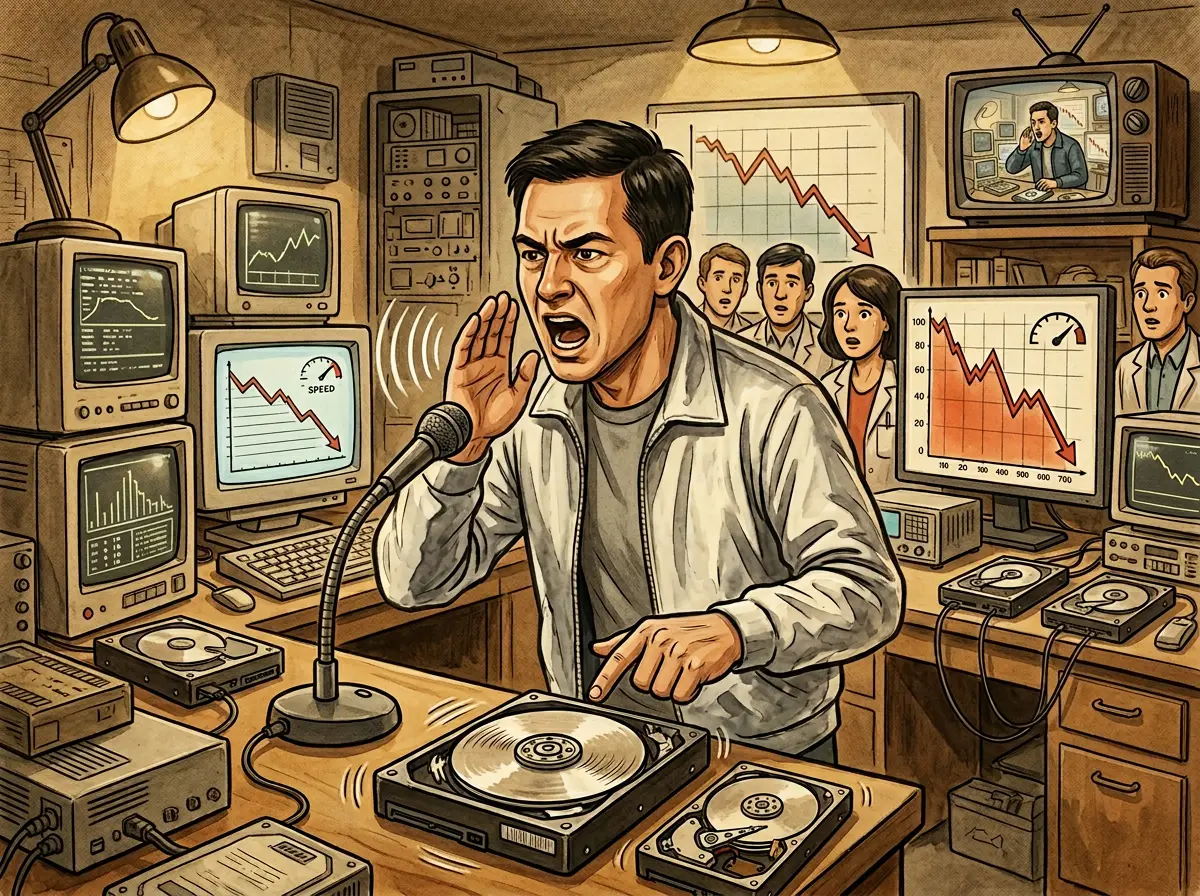
A lab experiment video shot at Sun Microsystems’ data center in December 2008 has surged back into popularity in mid-June, with a total of over 5.3 million views. The video’s main character, Brendan Gregg, roars at a JBOD mechanical hard disk drive (HDD) array; Sun Fishworks analytics tools show that the HDD latency numbers impacted by sound wave shock spike upward within the same second.
Test Logs from a Sun Microsystems Data Center Experiment in 2008
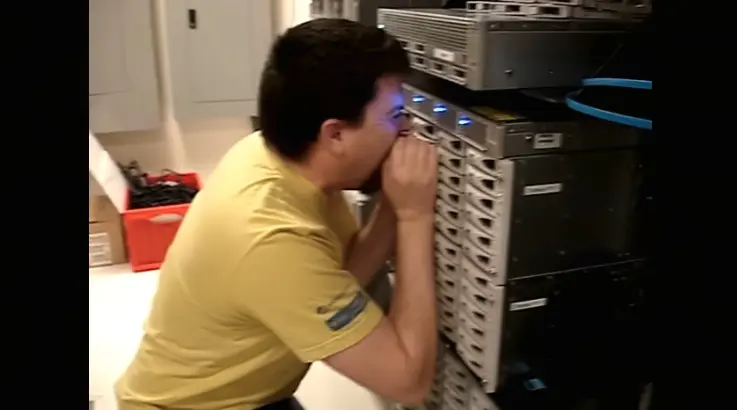 (Source: YouTube)
The video was uploaded by Gregg’s colleague Bryan Cantrill, with the recording date in December 2008. The experimental setup was a JBOD (Just a Bunch of Disks, a mechanical hard disk array directly chained together), and the monitoring tool was the Sun Fishworks analysis system, which can display each HDD’s read/write latency in real time.
The experimental results are immediately visible on the monitoring screen: when Gregg starts roaring, the latency numbers of certain HDDs rise instantly, while read/write speeds drop sharply; after Gregg stops roaring, the latency numbers return to normal. The monitoring display precisely marks which drives were affected and the severity of the impact.
The Physical Mechanism of HDD Heads Getting Lost: Nanoscale Suspension and Sound Conduction
An HDD’s read/write head hovers above the disk surface at only a few nanometers; the disk spins at high speed, with thousands of revolutions per minute. The system’s physical tolerance space is nearly zero.
When sound waves are conducted through air to the HDD enclosure and then into the interior via the enclosure’s structure, they cause tiny relative displacement between the disk and the head. Since the head must be precisely aligned with the magnetic tracks on the disk during read/write operations, any unexpected small offset triggers a re-positioning procedure, leading to higher latency and lower throughput. Data-center-grade HDDs are equipped with vibration-protection designs, but sudden, high-intensity sound pressure is still enough to break through the protection threshold.
CVE-2022-38392: A Case of Janet Jackson’s “Rhythm Nation” Resonating with 5400 RPM HDDs
Janet Jackson’s 1989 single “Rhythm Nation” was discovered by Microsoft engineers: the natural resonance frequency of a particular section of the song matches the mechanical resonance frequency of mainstream 5400 RPM laptop HDDs from that era. Playing the song on some laptops by the side can directly cause HDDs to crash. It’s not only the computer playing the song that can be affected—another laptop placed nearby may also be impacted. This case was formally included as a security vulnerability, CVE-2022-38392, in 2022, becoming one of the rare records of a vulnerability attributed to a pop song in hardware/software security history.
Background: Current Deployment of Mechanical HDDs in AI Data Centers
SSD (solid-state drives, with no rotating components) are nearly completely immune to sound waves and vibration, and their penetration in modern data centers has increased significantly. However, mechanical HDDs are still widely deployed in cold storage scenarios due to cost and per-unit capacity advantages.
The size of raw datasets needed for AI training can easily reach dozens to hundreds of TB, and a significant portion is still stored on mechanical disk arrays. Therefore, “sound waves slowing down HDDs” is not merely a historical curiosity, but a potential risk item in today’s infrastructure.
FAQs
Why are HDDs so sensitive to sound waves?
According to the article, the HDD read/write head hovers just a few nanometers above the disk surface, leaving the system with nearly zero physical tolerance. Sound waves propagate through air and the enclosure structure into the HDD, causing tiny relative displacement between the head and disk; any offset triggers a re-positioning procedure, leading to increased latency. This is a structural limitation under the physical laws of mechanical spinning disk drives, not a design flaw.
How did CVE-2022-38392 become an official security vulnerability?
According to the article, Microsoft engineers found that a specific frequency in Janet Jackson’s 1989 single “Rhythm Nation” matches the mechanical resonance frequency of 5400 RPM laptop HDDs, and playing it can cause HDDs to crash. Because this issue meets the definition of a security vulnerability (a systemic failure that can be triggered by external factors), it was formally added to the vulnerability database in 2022 under the identifier CVE-2022-38392.
Is there still a risk that mechanical HDDs in AI data centers could be affected by sound waves?
According to the article, although SSDs are immune to sound waves, mechanical HDDs are still widely used for cold storage due to their cost and capacity advantages, and a substantial portion of AI training datasets is also stored in mechanical disk arrays. Therefore, the phenomenon of sound waves affecting HDDs remains a potential risk for current infrastructure, not a purely historical event.


