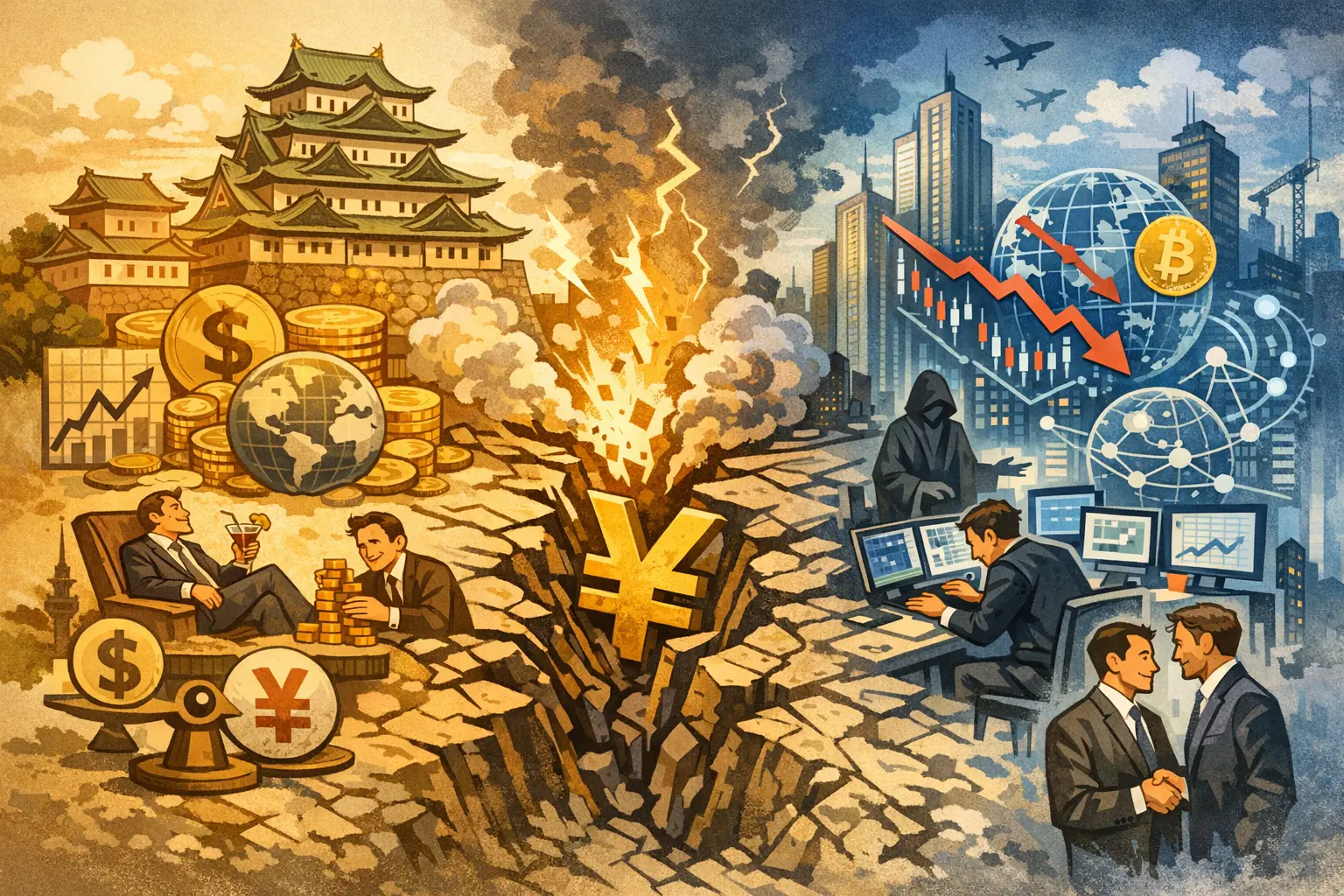
In June, the Bank of Japan announced it would raise its policy rate to 1%, the first time Japan has reached that level since 1995. 137Labs analysis shows that over the past twenty-plus years, large amounts of international capital borrowed Japanese yen at nearly zero cost and allocated to risk assets such as U.S. technology stocks, emerging market bonds, commodities, and global real estate; this “Yen Carry Trade” structure is one of the key underlying logics driving global asset price increases.
Three Structural Constraints Behind Japan’s Long-Running Low Interest Rate
137Labs’ article analysis argues that Japan’s 30-year era of ultra-low rates was not an active choice, but an equilibrium formed under three intertwined structural factors:
Aging population: Japan’s total population has continued to decline since peaking in 2008. The share of the working-age population has fallen, consumption growth has slowed, potential economic growth has declined, and investment returns have naturally decreased
Long-term low inflation: From 1998 to 2020, Japan’s core CPI rose by an average of less than 1%. Companies lacked incentives to raise prices and expand investment
Government debt size: IMF data shows Japan’s government debt has exceeded 250% of GDP, the highest level among major global developed economies. Ultra-low rates are not only a stimulus tool, but also a necessary condition for maintaining fiscal stability
Data Background for Improving Wage Growth and Rising Inflation
The key shift pushing Japan into a rate-hiking cycle is the formation of a wage-inflation virtuous cycle. Based on Japan’s spring labor-management wage negotiations (“shunto”) data: in 2024 wage growth was 5.1%, 5.2% in 2025, and about 5.26% in 2026—three consecutive years above 5%, the highest level in decades.
Japan’s Ministry of Health, Labour and Welfare data shows that in April 2026 nominal wages grew 3.5% year-on-year, and real wages have also continued to rise. Japan’s Ministry of Internal Affairs and Communications data confirms that Japan’s core CPI has been above the Bank of Japan’s 2% target level for multiple quarters.
Exchange-rate pressure is another factor triggering rate hikes: in 2024, the cumulative size of Japan’s foreign exchange market interventions exceeded ¥11 trillion, but the yen still remained weak, indicating that relying purely on intervention has become difficult to change market expectations.
The Operating Logic of the Yen Carry Trade: Low-Cost Funding and Global Capital Flows
137Labs analysis holds that the core logic of the yen carry trade is: borrow yen at close to zero cost, convert it into higher-yield currencies, and then invest in U.S. Treasuries or other risk assets. Interest-rate differential gains form steady profits; with leverage added, returns are further amplified. Data from the Bank for International Settlements (BIS) shows the yen has long ranked among the top three currencies globally by foreign exchange trading volume. A significant portion of this activity serves international capital allocation needs rather than Japan’s real economy.
Historically, during the late stages of the 1998 Asian financial crisis and throughout the 2008 global financial crisis, the yen carry trade saw large-scale unwinds. This led to a rapid yen appreciation and a significant rise in volatility across global markets. 137Labs notes that when Japan’s rate hikes raised funding costs from 0.25% to 1%, funding costs increased by four times. Institutional investors would need to reassess their leverage models; if many institutions adjust at the same time, it could trigger a collective deleveraging effect.
Common Questions
Why is the market so tense, even though Japan’s 1% rate is still low compared with other central banks globally?
According to 137Labs’ analytical framework, what financial markets are sensitive to has never been the current level, but the future direction. Over the past twenty years, the market formed a core consensus that “Japan will never enter a rate-hiking cycle,” which supported the entire yen carry trade system. When that consensus begins to wobble, even if the absolute level of 1% is still low, it means the underlying assumptions supporting carry trades are changing.
Why hasn’t the yen appreciated sharply after the rate hike?
Based on the foreign exchange market data cited in the article, the USD/JPY rate has spent most of 2024 to 2026 in the 150 to 160 range. The article’s analysis points out that as long as the U.S.-Japan interest-rate differential remains above 3 percentage points (U.S. rates above 4% and Japan at 1%), global capital still tends to allocate to dollar assets. The exchange-rate direction ultimately depends on how fast the U.S.-Japan interest-rate differential changes, not on the absolute size of Japan’s rate hikes.
What key time points in the future are most worth watching?
According to a Reuters survey, most institutions expect Japan’s interest rate to reach about 1.25% by the end of 2026, and to move closer to 1.5% in 2027. 137Labs’ analysis says the real turning point is when “Japan raises rates while the U.S. cuts rates at the same time,” which would significantly narrow the U.S.-Japan interest-rate differential and could affect global capital flows far more than Japan’s standalone rate hike.


