# USNetCapitalInflowsHitRecord884B

40.23K

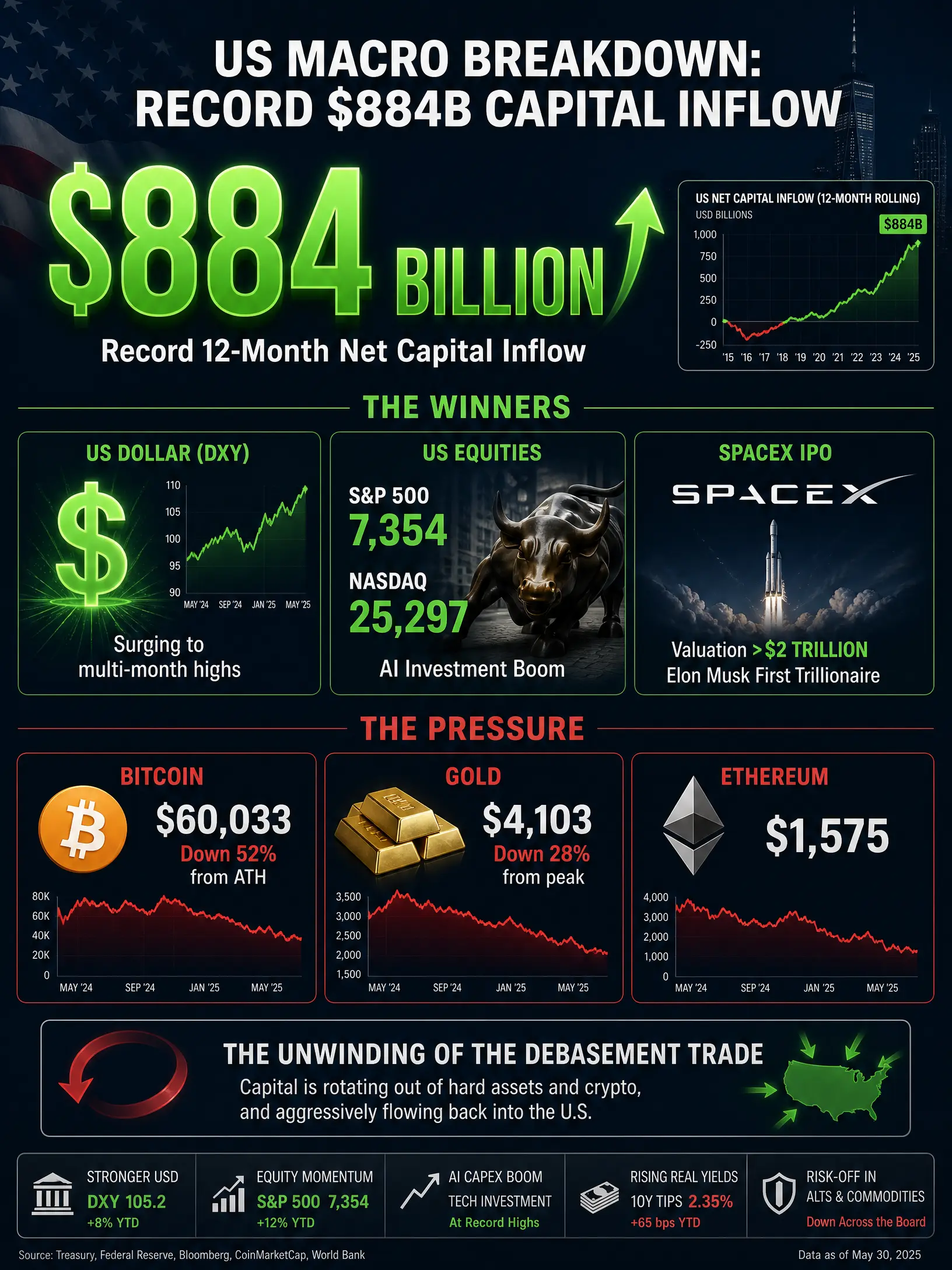
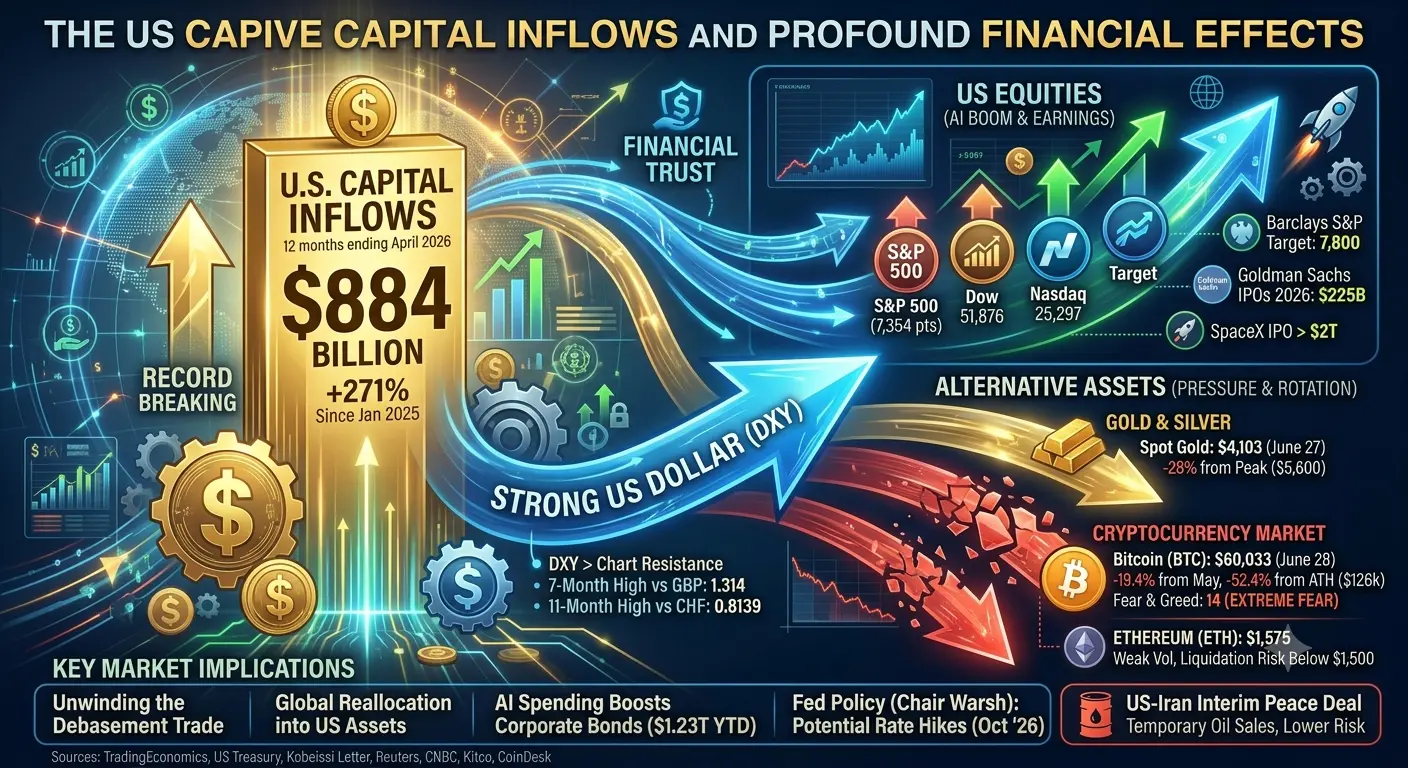
U.S. net capital inflows reached a record $884 billion over the 12 months ending April 2026. The metric reflects foreign capital entering U.S. markets through private and official purchases of American assets, having nearly tripled since early 2025. The 2021 peak of around $400 billion was less than half of current levels. Private sector purchases of U.S. stocks surged to a record $763 billion in April, deepening the global "bash by day, buy by night" pattern.

Bitcoin Was Never Designed to Compete With Artificial Intelligence
One of the biggest misconceptions dominating financial markets today is the belief that capital flowing into artificial intelligence somehow weakens the long-term investment case for Bitcoin.
In reality, these two assets are solving entirely different problems.
Artificial intelligence represents a technological growth story. Investors allocate capital to AI because they expect innovation, productivity gains, and long-term corporate expansion.
Bitcoin, however, was never designed to be a growth stock.
Bitcoin was designed to ope
BTC1.72%
post-image
post-image
post-image
  • Reward
  • 3
  • Repost
  • Share
EagleEye:
To The Moon 🌕
View More
#USNetCapitalInflowsHitRecord884B
**US Net Capital Inflows Hit Record 884 Billion as Foreign Investment Remains Strong**
The US Net Capital Inflows have reached a record 884 billion dollars, reflecting continued strong foreign interest in American assets. This substantial inflow underscores the enduring appeal of US markets as a destination for global capital despite shifting economic conditions.
Personally, I think this record level of inflows highlights the deep liquidity and perceived safety of US financial markets. Another important factor is how these flows can influence currency strengt
CryptoSelf
#USNetCapitalInflowsHitRecord884B
**US Net Capital Inflows Hit Record 884 Billion as Foreign Investment Remains Strong**
The US Net Capital Inflows have reached a record 884 billion dollars, reflecting continued strong foreign interest in American assets. This substantial inflow underscores the enduring appeal of US markets as a destination for global capital despite shifting economic conditions.
Personally, I think this record level of inflows highlights the deep liquidity and perceived safety of US financial markets. Another important factor is how these flows can influence currency strength, asset prices, and overall market liquidity. Right now, the data suggests that international investors continue to allocate heavily to the United States, potentially supporting risk assets and keeping financing conditions relatively favorable.
At the same time, such large capital movements can have wide-ranging effects on exchange rates and monetary policy considerations. Strong inflows may help offset domestic pressures and contribute to a more stable environment for both traditional and digital assets.
For investors, this development provides context for understanding broader capital flow dynamics. It may also support sentiment toward dollar-denominated assets and related markets, including those with exposure to US equities and fixed income.
The record inflows demonstrate the US market’s continued attractiveness on the global stage. Monitoring how these funds are deployed across asset classes could offer insights into future trends in both traditional finance and crypto.
**The surge in US net capital inflows to a record 884 billion dollars reinforces the country’s position as a preferred destination for international investment.** This strong demand for US assets can provide important tailwinds for market stability and liquidity. As these flows interact with domestic policy and economic data, they will likely remain a key variable for investors to watch in the coming period.
#PredictWorldCupWin40000U
#预测世界杯墨西哥VS南非
#我的Gate交易时刻
#预测世界杯阿根廷vs阿尔及利亚
repost-content-media
  • Reward
  • 25
  • Repost
  • Share
Venüs_:
LFG 🔥
View More
#USNetCapitalInflowsHitRecord884B
US Net Capital Inflows Reach Historic 884 Billion Dollars, Signaling Continued Global Confidence in American Markets
The United States has recorded a historic milestone in international capital movements, with net capital inflows climbing to 884 billion dollars, the highest level ever reported. The record highlights sustained global demand for US financial assets and reinforces the country's position as the world's leading destination for international investment. Despite ongoing geopolitical uncertainty, elevated interest rates, and slowing growth across sev
BTC1.72%
ETH0.37%
post-image
post-image
  • Reward
  • 2
  • Repost
  • Share
ybaser:
To The Moon 🌕2026 GOGOGO 👊To The Moon 🌕2026 GOGOGO 👊To The Moon 🌕
View More
Stocks closed higher across the board with technology leading the charge. The S&P 500 rose 1.17 percent to settle at 7,440.33, while the Nasdaq 100 outperformed with a 2.25 percent gain to 29,774.75, driven by strength in AI-focused megacap names. The Dow Jones Industrial Average added 0.59 percent to finish at 52,182.08. The VIX fell 0.9 points to 17.5, signaling easing volatility and a more comfortable risk environment for equity investors.
In the rates and dollar space, the Treasury yield curve showed a modest flattening dynamic. The 2-year yield rose 3.9 basis points to 4.11 percent, while
US500-0.08%
NAS100-0.13%
US300.04%
post-image
post-image
post-image
  • Reward
  • 25
  • Repost
  • Share
Psycho:
LFG 🔥
View More
#USNetCapitalInflowsHitRecord884B
The United States has recorded an astonishing $884 billion in net capital inflows, signaling continued global demand for U.S. assets despite ongoing economic uncertainty.
This surge highlights:
• Strong foreign investment appetite
• Confidence in U.S. financial markets
• Increased demand for Treasury securities and equities
• The dollar’s continued role as the world’s primary reserve currency
For global markets, massive capital inflows into the U.S. can influence interest rates, liquidity conditions, and risk sentiment across equities, bonds, and cryptocurren
  • Reward
  • 10
  • Repost
  • Share
Vortex_King:
To The Moon 🌕
View More
#USNetCapitalInflowsHitRecord884B
Global capital always seeks one thing above all else—confidence. The latest report showing U.S. net capital inflows reaching a record $884 billion is more than an impressive statistic; it reflects how international investors continue to view the United States as a primary destination for long-term investment, even during periods of economic uncertainty.
Capital inflows of this magnitude rarely occur by chance. They are typically driven by a combination of strong institutional confidence, attractive financial markets, relatively stable economic conditions, and
post-image
  • Reward
  • 27
  • Repost
  • Share
Venüs_:
To The Moon 🌕
View More
Global Financial Instability Serves as Next Major Catalyst for Bitcoin Rally According to Cathie Wood
The international investment landscape is experiencing a subtle reassessment of digital assets as prominent asset management executives highlight the distinct macroeconomic roles of emerging technology and decentralized networks. ARK Invest chief executive officer Cathie Wood recently noted that while the massive rise of artificial intelligence has successfully captured public attention and diverted capital away from the digital currency sector, Bitcoin retains a highly specialized and irrepla
BTC1.68%
  • Reward
  • 13
  • Repost
  • Share
Sazib_Akash:
2026 GOGOGO 👊
View More
#USNetCapitalInflowsHitRecord884B
Global Capital Is Flowing Toward the United States at an Unprecedented Pace
International capital flows have always been one of the clearest indicators of investor confidence, and the latest surge in U.S. net capital inflows demonstrates that global investors continue viewing the United States as one of the world's most attractive destinations for long-term investment. Large cross-border capital movements rarely occur without strong underlying reasons. They often reflect confidence in economic resilience, financial stability, institutional strength, and the l
post-image
  • Reward
  • 22
  • Repost
  • Share
Leeessa:
To The Moon 🌕
View More
#USNetCapitalInflowsHitRecord884B
The United States is witnessing one of the largest waves of foreign investment in modern financial history. According to the latest Treasury International Capital (TIC) report, net capital inflows into the United States reached a record $884 billion over the twelve months ending April 2026, a figure that has nearly tripled since the beginning of 2025.
The April report alone showed $26.1 billion in net inflows, with private foreign investors purchasing $164.4 billion in long-term US securities and foreign official institutions adding another $41.6 billion. Acc
HighAmbition
#USNetCapitalInflowsHitRecord884B
The United States is witnessing one of the largest waves of foreign investment in modern financial history. According to the latest Treasury International Capital (TIC) report, net capital inflows into the United States reached a record $884 billion over the twelve months ending April 2026, a figure that has nearly tripled since the beginning of 2025.
The April report alone showed $26.1 billion in net inflows, with private foreign investors purchasing $164.4 billion in long-term US securities and foreign official institutions adding another $41.6 billion. According to The Kobeissi Letter, private purchases of US equities climbed to an all-time high of $763 billion, while official institutions accumulated a record $121 billion.
This is not simply another economic data release. It represents a major shift in global capital allocation and signals where the world's largest investors currently see the best combination of growth, liquidity, stability, and returns.
Why Capital Is Flooding Into the United States
Global investors are increasingly concentrating capital in the United States because of several powerful macroeconomic trends occurring simultaneously.
The US economy remains relatively resilient compared with many other developed economies. Corporate earnings continue exceeding expectations, labor markets remain stable, productivity growth is accelerating, and the artificial intelligence revolution is creating entirely new investment opportunities across technology, cloud computing, semiconductors, software, robotics, and data-center infrastructure.
At the same time, higher US interest rates continue attracting global capital into Treasury securities and dollar-denominated assets.
Investors seeking both yield and safety are finding the US market increasingly attractive.
Foreign institutions are effectively voting with their money, and that vote is overwhelmingly favoring American assets.
The Dollar Is Becoming the Biggest Winner
When hundreds of billions of dollars flow into the United States, demand for the US dollar naturally increases.
The Dollar Index (DXY) has already broken above several key technical levels and is approaching its strongest monthly performance in almost a year. The dollar recently reached multi-month highs against major global currencies, highlighting the scale of international demand.
This matters because the dollar sits at the center of nearly every global financial market.
A stronger dollar generally supports US financial assets while creating challenges for commodities, emerging markets, and speculative investments. As global investors convert foreign currencies into dollars to purchase US assets, additional upward pressure can develop across the currency market.
Historically, periods of significant dollar strength often coincide with tighter financial conditions worldwide.
US Equities Continue Absorbing Global Liquidity
US stocks remain one of the primary beneficiaries of this enormous capital migration.
The S&P 500 is trading around 7,354, the Dow Jones Industrial Average near 51,876, and the Nasdaq Composite around 25,297.
Wall Street remains highly optimistic.
Barclays recently increased its S&P 500 target to 7,800 while projecting earnings-per-share of $337 for 2026. Some analysts now expect the index could approach 8,800 during 2027 if current growth trends continue.
Technology remains the dominant sector attracting capital.
US equity funds attracted approximately $38.37 billion in a single week, while technology-focused funds absorbed a record $21.46 billion.
The AI boom continues driving unprecedented spending on chips, cloud infrastructure, software development, and advanced computing systems.
Corporate bond issuance has already surpassed $1.23 trillion this year as major technology firms continue raising capital to finance AI expansion.
Gold Is Losing Some of Its Momentum
One of the clearest consequences of these capital inflows has been pressure on precious metals.
Gold currently trades around $4,103 per ounce, significantly below its January 2025 peak near $5,600. Silver has also retreated from previous highs and remains below $59 per ounce.
The reason is relatively straightforward.
When investors can earn attractive returns from equities, Treasury securities, and dollar assets, the urgency to hold defensive assets often decreases. Stronger dollar performance also creates additional resistance for commodity prices because most global commodities are priced in US dollars.
Despite recent weakness, many analysts still expect long-term support for gold from central-bank buying, inflation concerns, reserve diversification, and geopolitical uncertainty.
What Does This Mean for the Crypto Market?
This is where the story becomes particularly important for cryptocurrency investors.
Historically, Bitcoin and the broader crypto market tend to perform best when global liquidity is expanding, financial conditions are easing, and investors are actively seeking higher-risk assets.
The current environment is almost the opposite.
A stronger dollar, higher interest rates, record capital inflows into US equities, and persistent institutional demand for Treasury securities all create competition for investment capital that might otherwise flow into cryptocurrencies.
Every dollar moving into US stocks, bonds, or money-market funds is a dollar not immediately flowing into Bitcoin, Ethereum, or alternative digital assets.
This helps explain why Bitcoin has struggled despite continued institutional adoption.
Bitcoin Remains at a Critical Decision Point
Bitcoin is currently trading around $60,033, approximately 19.4% below its May high of $74,524 and more than 52% below its October 2025 all-time high near $126,000.
The most important support zone remains between $59,000 and $60,000.
This area has become the line separating a potential stabilization phase from the possibility of further downside movement.
Key resistance levels remain:
• $61,500-$62,000
• $64,000-$68,000
• $72,000-$75,000
Major support levels remain:
• $59,000-$60,000
• $56,500-$55,500
• $52,000-$50,000
ETF flows continue playing a major role. Recent Bitcoin ETF outflows, combined with weaker market sentiment and reduced speculative activity, have limited recovery attempts.
As long as capital continues favoring US equities and dollar assets, Bitcoin may struggle to regain sustained momentum.
Ethereum and Altcoins Face Even Greater Pressure
Ethereum is currently trading near $1,575, while Solana remains around $68, XRP near $1.03, and Dogecoin around $0.074.
Historically, altcoins tend to outperform only after Bitcoin establishes a strong and stable uptrend. Since Bitcoin itself remains under pressure from macroeconomic conditions, capital flows into higher-risk crypto assets have remained limited.
If the dollar continues strengthening and global liquidity remains constrained, altcoins could continue underperforming relative to both Bitcoin and traditional financial assets.
The Key Indicator Every Crypto Trader Should Watch
The most important chart in global markets right now may not be Bitcoin.
It may be the US Dollar Index (DXY).
If DXY continues rising alongside strong capital inflows and firm Federal Reserve policy expectations, risk assets could remain under pressure.
However, if dollar strength begins fading, Treasury yields stabilize, and ETF inflows return, Bitcoin could benefit significantly from renewed liquidity.
This is why monitoring capital flows has become just as important as monitoring crypto-specific metrics.
l
The record $884 billion flowing into the United States represents one of the strongest votes of confidence in American financial markets in recent years. Global investors continue favoring US stocks, Treasury securities, technology companies, and dollar-denominated assets over most alternatives.
For crypto investors, this creates a challenging but highly informative environment.
As long as money continues rotating toward US equities and the dollar, Bitcoin, Ethereum, gold, and other alternative assets may face periodic pressure. However, market cycles eventually change, and capital allocation trends can shift rapidly once monetary conditions begin easing.
For now, the combination of record capital inflows, dollar strength, resilient US equities, and cautious institutional positioning remains one of the most important macro themes shaping the future direction of the cryptocurrency market.
@Gate_Square #USNetCapitalInflowsHitRecord884B
repost-content-media
  • Reward
  • 2
  • Repost
  • Share
ybaser:
2026 GOGOGO 👊
View More
#USNetCapitalInflowsHitRecord884B
The United States is witnessing one of the largest waves of foreign investment in modern financial history. According to the latest Treasury International Capital (TIC) report, net capital inflows into the United States reached a record $884 billion over the twelve months ending April 2026, a figure that has nearly tripled since the beginning of 2025.
The April report alone showed $26.1 billion in net inflows, with private foreign investors purchasing $164.4 billion in long-term US securities and foreign official institutions adding another $41.6 billion. Acc
post-image
post-image
post-image
  • Reward
  • 25
  • Repost
  • Share
BabaJi:
To The Moon 🌕
View More
Load More

Join 40 M users in our growing community

⚡️ Join 40 M users in the crypto craze discussion
💬 Engage with your favorite top creators
👍 See what interests you
  • Pinned