# USEndsLatestStrikesOnIran

1.54M

CENTCOM concluded a 90-minute night strike on Iran on July 15, targeting command centers, air defense sites, missile and drone facilities, and coastal surveillance systems across multiple locations including Bandar Abbas. Trump warned of expanding strikes to bridges and power plants if Iran does not return to negotiations. Iran has already launched retaliatory strikes on U.S. targets in Bahrain and Kuwait.

📢 Gate Square | 5/8 Hot Discussion: #美伊冲突再升级
$BTC
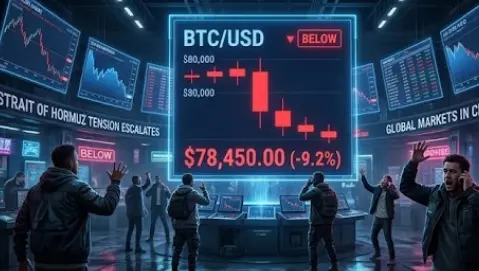
Bitcoin Below $80,000: A Breakdown or a Setup for the Next Rally?
Financial markets have entered a phase where headlines move faster than fundamentals. The recent escalation in geopolitical tensions has triggered a wave of risk aversion across global markets, pushing investors toward caution and placing renewed pressure on speculative assets. Bitcoin's drop below the $80,000 level reflects this broader shift in sentiment rather than a fundamental change in the long-term digital asset narrative.
The key question facing the market today is
BTC-0.22%
SoominStar
📢 Gate Square | 5/8 Hot Discussion: #美伊冲突再升级
$BTC
Bitcoin Below $80,000: A Breakdown or a Setup for the Next Rally?
Financial markets have entered a phase where headlines move faster than fundamentals. The recent escalation in geopolitical tensions has triggered a wave of risk aversion across global markets, pushing investors toward caution and placing renewed pressure on speculative assets. Bitcoin's drop below the $80,000 level reflects this broader shift in sentiment rather than a fundamental change in the long-term digital asset narrative.
The key question facing the market today is simple:
Was the move below $80,000 a sign of weakness, or was it a reaction driven by fear?
Historically, Bitcoin has demonstrated an extraordinary ability to absorb external shocks. Regulatory uncertainty, economic crises, geopolitical conflicts, and aggressive monetary tightening have all tested the market before. Yet each cycle has reinforced one important reality: periods of extreme fear often create the foundation for future recoveries.
Several forces are currently influencing Bitcoin's direction.
Global investors are monitoring geopolitical developments with increasing concern.
Traditional markets are experiencing heightened volatility.
Expectations surrounding interest rates continue to evolve.
Institutional capital remains highly sensitive to macroeconomic uncertainty.
These factors have created an environment where short-term price movements are driven more by sentiment than by long-term fundamentals.
However, Bitcoin's broader investment thesis remains unchanged.
Institutional adoption continues to expand.
Digital assets remain an important component of modern financial markets.
Long-term supply dynamics continue to support scarcity.
Global demand for alternative stores of value has not disappeared.
If geopolitical tensions stabilize and market confidence gradually returns, Bitcoin could reclaim the $80,000 level faster than many participants currently expect. Conversely, continued uncertainty may extend the period of consolidation and volatility.
My personal view is that Bitcoin is experiencing a stress test rather than a structural breakdown.
The market is not asking whether Bitcoin has value.
The market is asking how much uncertainty investors are willing to tolerate before confidence returns.
Throughout financial history, moments of maximum uncertainty have often preceded periods of maximum opportunity.
Whether Bitcoin moves above $80,000 in the immediate future or requires additional time, one reality remains clear:
The battle between fear and conviction is once again determining the direction of the market.

repost-content-media
  • Reward
  • 6
  • Repost
  • Share
ThisIsTranslateContent::
Hurry up and get on board! 🚗
View More
📢 Gate Square | 5/8 Hot Discussion: #美伊冲突再升级
$BTC
Bitcoin Below $80,000: A Breakdown or a Setup for the Next Rally?
Financial markets have entered a phase where headlines move faster than fundamentals. The recent escalation in geopolitical tensions has triggered a wave of risk aversion across global markets, pushing investors toward caution and placing renewed pressure on speculative assets. Bitcoin's drop below the $80,000 level reflects this broader shift in sentiment rather than a fundamental change in the long-term digital asset narrative.
The key question facing the market today is
BTC-0.22%
post-image
post-image
post-image
  • Reward
  • 13
  • Repost
  • Share
Roselyn:
To The Moon 🌕
View More
ETH Hundred-Billion Liquidation “Nuclear Bomb”! 1,700 Life-or-Death Crisis — Rebound or Waterfall?
Brother Wan’s View: A short-term oversold rebound, but the medium-term bearish trend remains unchanged—1,700 will decide the fate of bulls and bears.
Geopolitical black swans sparked panic: US-Iran negotiations broke down, the Nasdaq and BTC plunged, and ETH got smashed down to 1,700. Liquidation charts show that falling below 1,649 triggers liquidation of over 480 million positions; below 1,634 adds another 454 million. The 1,700–1,650 range has become a graveyard for long positions. RSI is over
ETH2.29%
NDAQ3.80%
BTC-0.22%
  • Reward
  • Comment
  • Repost
  • Share
#美伊谈判博弈 The US-Iran renewed ceasefire agreement causes Bitcoin to plummet; how does the international situation affect the crypto market?
Recently, the Middle East situation has once again become the focus of global financial market attention. On May 28, multiple international media reported that negotiators from the US and Iran had reached a memorandum of understanding (MOU) to extend the current ceasefire for 60 days. The agreement also includes restarting nuclear negotiations and restoring normal shipping through the Strait of Hormuz, but final approval still requires US President Trump’s e
BTC-0.21%
ThisIsTranslateContent:
#美伊谈判博弈 The US-Iran renewed ceasefire agreement causes Bitcoin to plummet; how does the international situation affect the crypto market?
Recently, the Middle East situation has once again become the focus of global financial market attention. On May 28, multiple international media reported that negotiators from the US and Iran had reached a memorandum of understanding (MOU) to extend the current ceasefire for 60 days. The agreement also includes restarting nuclear negotiations and restoring normal shipping through the Strait of Hormuz, but final approval still requires US President Trump’s endorsement.
In theory, extending the ceasefire should mean reduced war risk, and global markets should welcome a wave of risk appetite recovery. However, unexpectedly, Bitcoin experienced a significant pullback after the news, breaking below $75k, with many leveraged longs being liquidated. Why did seemingly positive news fail to boost the crypto market? How exactly does the international situation influence Bitcoin and the entire crypto market?
1. The game behind the US-Iran ceasefire agreement
According to publicly available information, this 60-day ceasefire is not a true peace agreement but more like a “buffer period” to buy time for further negotiations.
The agreement involves:
- Extending the current ceasefire for 60 days;
- Restarting Iran nuclear negotiations;
- Restoring shipping through the Strait of Hormuz;
- Partially lifting port and shipping restrictions on Iran;
- Discussing the possibility of lifting some sanctions in the future.
Meanwhile, the US Treasury announced new sanctions on entities and ships involved in Iran’s oil trade. This means: the ceasefire is real, but strategic confrontation has not ended. The market sees not “war ending,” but “war temporarily paused.” This uncertainty is precisely what financial markets dislike most.
2. Why didn’t Bitcoin rally on positive news?
Many investors tend to view Bitcoin as “digital gold.” But in fact, over the past few years, Bitcoin has increasingly resembled a high-volatility risk asset.
When market risk appetite rises: tech stocks go up; AI concepts rise; cryptocurrencies rise;
When market risk appetite declines: tech stocks fall; cryptocurrencies often fall even faster.
Therefore, Bitcoin is not purely a safe-haven asset but has attributes of: risk assets; macro liquidity assets; and some safe-haven qualities.
After the ceasefire announcement, the market began reassessing the future global economic environment.
Investors found that: if the Strait of Hormuz reopens, oil supply will gradually normalize.
This means: oil prices may fall; inflation pressures ease; Fed rate cut expectations re-emerge. Funds started to withdraw from the safe-haven trades that had previously surged due to war, entering a phase of re-pricing.
In the short term, this rebalancing of funds actually puts pressure on Bitcoin.
3. What truly influences the crypto market is liquidity, not war
Looking back at recent market trends:
- Russia-Ukraine war outbreak
After the Russia-Ukraine conflict in 2022, Bitcoin did not continue to rise. Instead, amid aggressive Fed rate hikes, Bitcoin declined from high levels.
- Escalation of the Israel-Palestine conflict
From 2023 to 2024, Middle East tensions worsened. But the core reasons driving Bitcoin to break new highs are not war, but:
- US spot ETF approval;
- Improved global liquidity;
- Continuous inflow of institutional funds.
The current US-Iran situation follows the same logic. What truly determines Bitcoin’s price is not whether the US and Iran cease fire, but how the ceasefire impacts:
- Oil prices;
- Inflation;
- Federal Reserve policies;
- Global dollar liquidity.
War is just the fuse. Liquidity is the fuel that determines the direction.
4. The importance of the Strait of Hormuz is underestimated
The Strait of Hormuz accounts for about one-fifth of global oil transportation. In recent months of conflict, the market’s biggest concern was not direct clashes between Iran and the US, but the long-term closure of the Strait.
If the strait remains blocked: international oil prices soar; global inflation rebounds; Fed rate hikes are delayed; risk assets are sold off. One of the key points of the ceasefire agreement now is to restore navigation through the Strait of Hormuz.
Therefore, what the market is actually trading is: the future trend of global energy prices, not just geopolitical news.
5. How to view Bitcoin’s future trend?
In the short term, the crypto market may remain volatile. The reason is simple: the ceasefire agreement has not yet been finalized; there are significant political disagreements within the US; ongoing military friction and sanctions escalation risks between the US and Iran; markets are reassessing the future pace of rate cuts.
Thus, in the coming weeks: any news about Iran nuclear negotiations, the Strait of Hormuz, or US sanctions could trigger sharp crypto market swings.
But in the longer term, the core factors that determine Bitcoin’s bull or bear trend remain unchanged: global monetary policies; ETF capital inflows; institutional allocation demand; macro liquidity environment. Geopolitical events can cause short-term fluctuations but are unlikely to determine long-term trends.
6. Conclusion
The 60-day extension of the US-Iran ceasefire is essentially a temporary easing of geopolitical risks. But for Bitcoin, the market’s focus has never been just on the war itself, but on how the war influences energy prices, inflation levels, and global liquidity.
From this perspective, the chain of influence of the international situation on the crypto market is actually very clear: war → oil prices → inflation → Fed policies → global liquidity → Bitcoin price.
Therefore, when a major international event occurs, investors should not only watch the battlefield but also pay more attention to capital flows and monetary policy changes behind the scenes. Because ultimately, what drives Bitcoin up or down is often not the news itself, but how the news changes market expectations for future liquidity. $BTC
repost-content-media
  • Reward
  • 21
  • Repost
  • Share
Yajing:
To The Moon 🌕
View More
#美伊冲突再升级
US-Iran Tensions Escalate: BTC Falls Below $80K, Oil Explodes Higher, NFP Data in Focus
Global financial markets entered a fresh wave of volatility on May 8 after geopolitical tensions between the United States and Iran intensified near the Strait of Hormuz. Reports surrounding US military responses to Iranian activity immediately triggered panic across equities, crypto, commodities, and risk-sensitive assets.
The timing of this geopolitical shock could not be more critical because it arrived only hours before the highly anticipated US Non-Farm Payrolls (NFP) report — a macro event
BTC-0.22%
XAU0.05%
post-image
post-image
  • Reward
  • 2
  • Repost
  • Share
Yajing:
To The Moon 🌕
View More
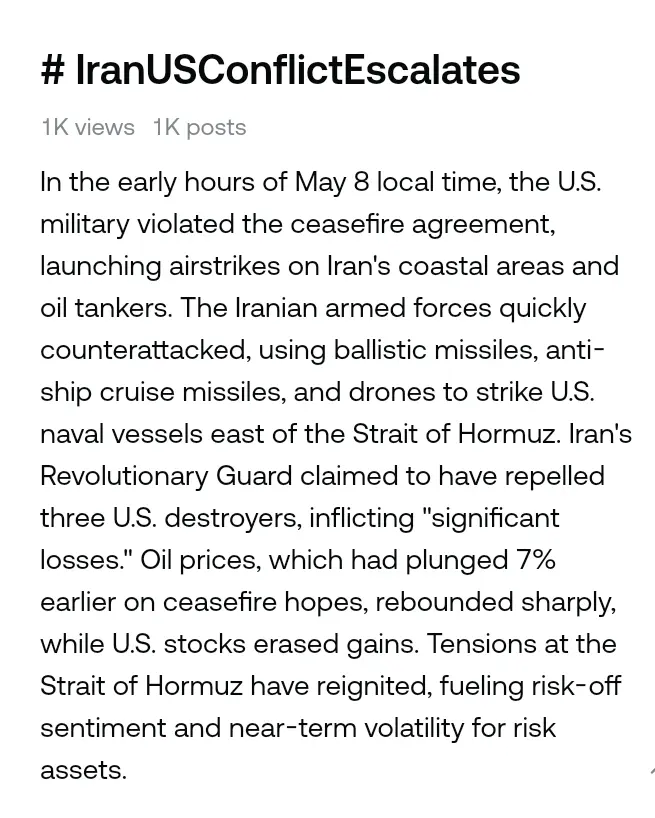
#IranUSConflictEscalates 📢 Gate Square | 5/8 Hot Discussion: #美伊冲突再升级
The market is entering one of the most dangerous phases of 2026 because this is no longer only about inflation, rate cuts, or Bitcoin momentum. What we are witnessing now is the collision of geopolitics, energy markets, liquidity conditions, and risk sentiment all at the same time. Most traders still underestimate how quickly global narratives can change when military tension enters the Strait of Hormuz, which remains one of the most strategically important oil routes on Earth.
The recent confrontation between the United St
post-image
post-image
  • Reward
  • 3
  • Repost
  • Share
Yajing:
To The Moon 🌕
View More
#美伊冲突再升级
US-Iran Tensions Escalate: BTC Falls Below $80K, Oil Explodes Higher, NFP Data in Focus
Global financial markets entered a fresh wave of volatility on May 8 after geopolitical tensions between the United States and Iran intensified near the Strait of Hormuz. Reports surrounding US military responses to Iranian activity immediately triggered panic across equities, crypto, commodities, and risk-sensitive assets.
The timing of this geopolitical shock could not be more critical because it arrived only hours before the highly anticipated US Non-Farm Payrolls (NFP) report — a macro event
BTC-0.22%
XAU0.05%
  • Reward
  • Comment
  • Repost
  • Share
#IranUSConflictEscalates
#美伊冲突再升级 — Markets Enter a High-Risk Volatility Zone
Global markets are once again being dominated by geopolitical fear after reports of renewed military confrontation near the Strait of Hormuz triggered a sharp shift in investor sentiment. What initially appeared to be easing tensions quickly reversed into another risk-off event, sending shockwaves across oil, equities, and crypto markets.
The Strait of Hormuz remains one of the most strategically important energy routes in the world. Any military escalation around this region instantly impacts oil supply expectatio
BTC-0.22%
ETH2.27%
post-image
post-image
post-image
post-image
  • Reward
  • 9
  • Repost
  • Share
Yusfirah:
LFG 🔥
View More
#美伊冲突再升级
US-Iran Tensions Escalate: BTC Falls Below $80K, Oil Explodes Higher, NFP Data in Focus
Global financial markets entered a fresh wave of volatility on May 8 after geopolitical tensions between the United States and Iran intensified near the Strait of Hormuz. Reports surrounding US military responses to Iranian activity immediately triggered panic across equities, crypto, commodities, and risk-sensitive assets.
The timing of this geopolitical shock could not be more critical because it arrived only hours before the highly anticipated US Non-Farm Payrolls (NFP) report — a macro event
BTC-0.22%
XAU0.05%
post-image
post-image
post-image
post-image
  • Reward
  • 25
  • Repost
  • Share
Pheonixprincess:
To The Moon 🌕
View More
#美伊冲突再升级
US-Iran Tensions Escalate: BTC Falls Below $80K, Oil Explodes Higher, NFP Data in Focus
Global financial markets entered a fresh wave of volatility on May 8 after geopolitical tensions between the United States and Iran intensified near the Strait of Hormuz. Reports surrounding US military responses to Iranian activity immediately triggered panic across equities, crypto, commodities, and risk-sensitive assets.
The timing of this geopolitical shock could not be more critical because it arrived only hours before the highly anticipated US Non-Farm Payrolls (NFP) report — a macro event
BTC-0.22%
XAU0.05%
HighAmbition
#美伊冲突再升级
US-Iran Tensions Escalate: BTC Falls Below $80K, Oil Explodes Higher, NFP Data in Focus
Global financial markets entered a fresh wave of volatility on May 8 after geopolitical tensions between the United States and Iran intensified near the Strait of Hormuz. Reports surrounding US military responses to Iranian activity immediately triggered panic across equities, crypto, commodities, and risk-sensitive assets.
The timing of this geopolitical shock could not be more critical because it arrived only hours before the highly anticipated US Non-Farm Payrolls (NFP) report — a macro event capable of reshaping Federal Reserve rate-cut expectations and short-term market direction globally.
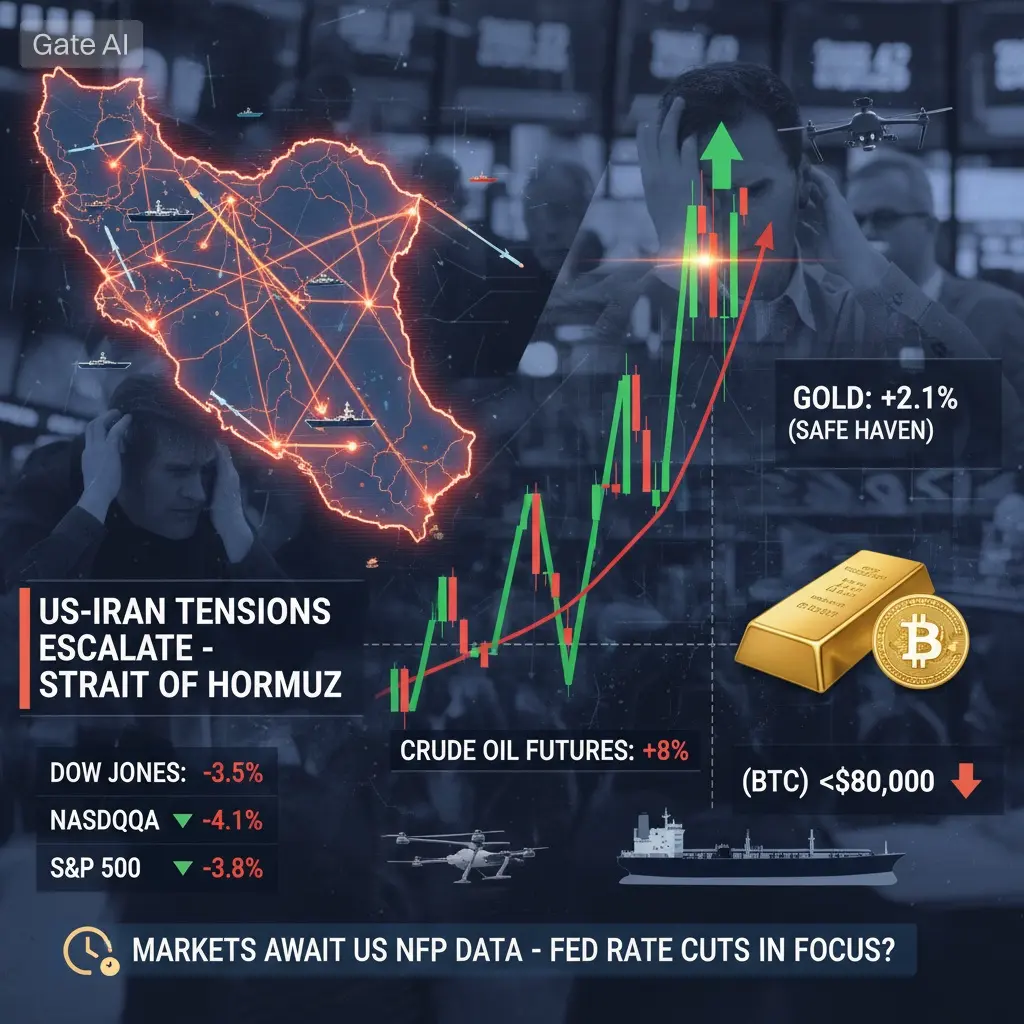
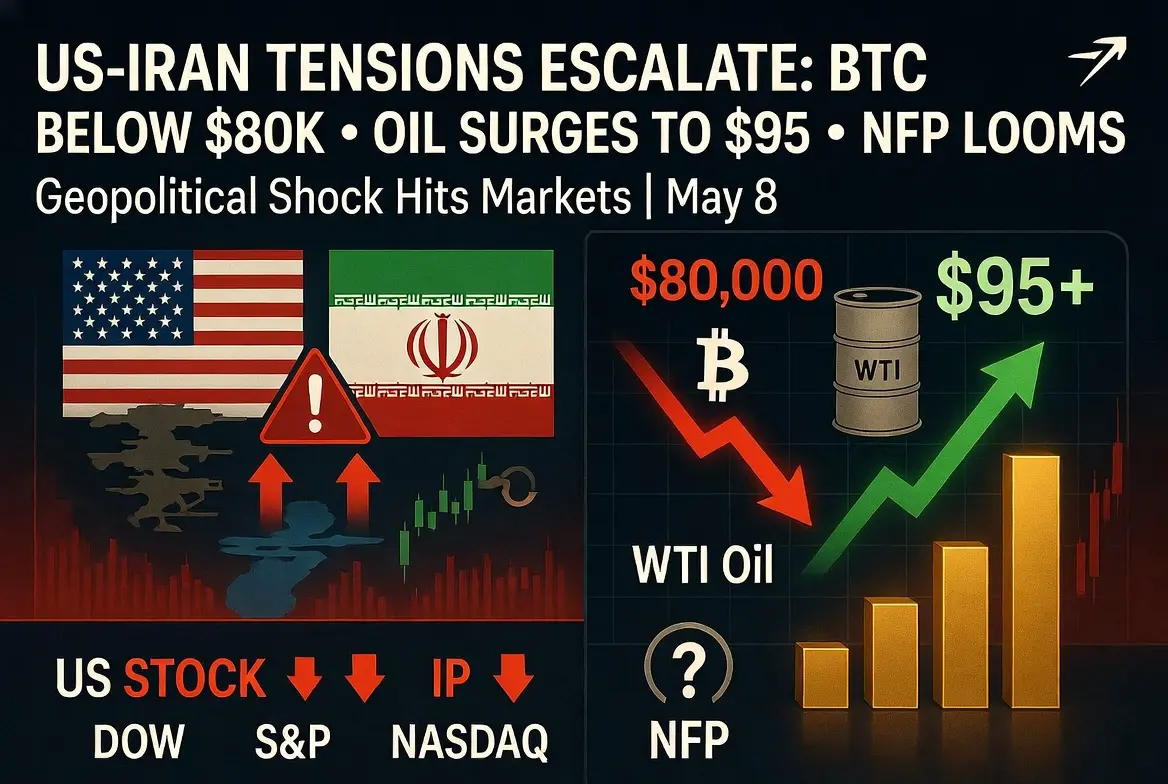
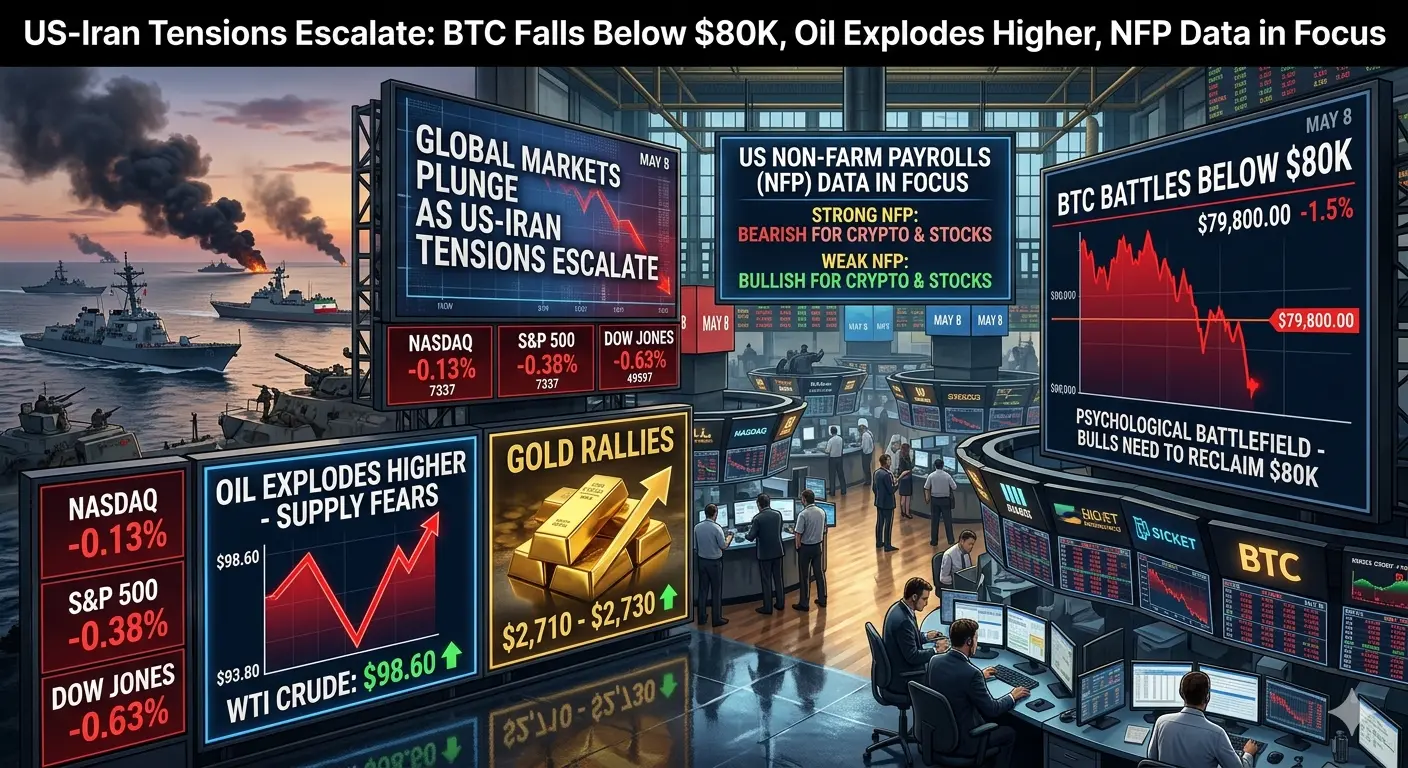
US-Iran fears quickly pushed markets into a classic “risk-off” environment: • US stocks erased intraday gains • Nasdaq and S&P 500 futures weakened sharply • Bitcoin dropped below the critical $80,000 level • Gold strengthened on safe-haven demand • Oil prices exploded higher in a violent V-shaped reversal
At the center of the discussion now stands one major question:
Can the bulls regain control, or is deeper volatility still ahead?
━━━━━━━━━━━━━━ 1️⃣ Will the US-Iran situation escalate further? What key developments are markets watching? ━━━━━━━━━━━━━━
The Strait of Hormuz remains one of the most important energy corridors globally, responsible for nearly 20% of worldwide oil shipments. Any military escalation in this region instantly impacts energy markets and inflation expectations.
Current market fears include: • Supply disruption risks • Military retaliation scenarios • Higher energy inflation • Reduced global risk appetite • Delayed Federal Reserve easing
Because of these fears, Wall Street reversed lower despite earlier bullish momentum.
Dow Jones: • Fell around -0.63% • Dropped nearly -313 points • Hovered near 49,597
S&P 500: • Slipped roughly -0.38% • Lost around -28 points • Traded near 7,337
Nasdaq: • Pulled back approximately -0.13% • Tech profit-taking accelerated • Risk sentiment weakened sharply
If tensions continue escalating: • Oil could surge toward $100+ • Inflation fears may intensify • Stocks and crypto may remain under pressure • Safe-haven demand for gold could accelerate
However, if diplomacy stabilizes conditions: • Oil prices could cool rapidly • Equity markets may rebound • Crypto sentiment could improve significantly
For now, markets remain extremely headline-sensitive.
━━━━━━━━━━━━━━ Oil’s Massive V-Shaped Reversal ━━━━━━━━━━━━━━
Oil became the strongest immediate winner from the geopolitical shock.
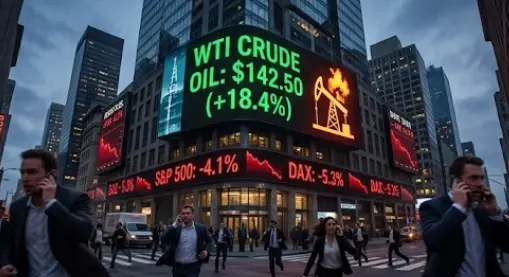
WTI crude initially traded weak before reversing violently higher as traders priced in supply disruption risks.
Current Oil Action: • WTI trading near $94–$95 • Intraday swings from ~$93.80 to above $98.60 • Brent crude also surged sharply
This V-shaped reversal reflects: • Panic short covering • Aggressive geopolitical repricing • Fear of supply interruptions
Bullish Oil Scenario: • WTI targets: $98–$100 • Brent targets: $100–$105
Bearish Oil Scenario: • Diplomatic de-escalation could trigger sharp pullbacks
Energy markets are now moving almost entirely on geopolitical headlines.
━━━━━━━━━━━━━━ Gold Strengthens on Fear Demand ━━━━━━━━━━━━━━
Gold also benefited from the geopolitical uncertainty.
Spot gold traded near: • $4,710–$4,730 • Up roughly +0.3% to +0.8% intraday
Investors are rotating toward defensive assets because of: • Rising geopolitical instability • Inflation fears • Market uncertainty • Volatile Treasury yields
If tensions worsen further: • Gold may push toward fresh highs • Institutional hedging demand could rise significantly
━━━━━━━━━━━━━━ 2️⃣ Can Bitcoin withstand the pressure and reclaim $80K? ━━━━━━━━━━━━━━
Bitcoin faced immediate selling pressure as traders reduced exposure to volatile assets.
BTC dropped below the major psychological $80,000 zone and currently fluctuates around: • $79,800–$80,300 • Daily decline roughly -0.5% to -2%
The breakdown below $80K triggered: • Long liquidations • Panic selling • Short-term bearish momentum
However, larger market structure still matters greatly.
Key BTC Support Levels: • $79,500 • $78,200 • $76,800 • $75,000 major psychological support
Key BTC Resistance Levels: • $80,000 immediate barrier • $81,500 short-term resistance • $83,000 breakout zone • $85,000 bullish continuation target
Bullish BTC Scenario: If BTC quickly reclaims and holds above $80K: • Short liquidations could fuel upside momentum • Bulls may target $83K–$85K • Sentiment may recover rapidly
Bearish BTC Scenario: If sellers maintain pressure below $80K: • BTC may revisit $78K–$76K • Altcoins could face sharper volatility • Fear sentiment may increase
Institutional demand through ETFs and long-term accumulation still remains active despite short-term panic.
Historically, geopolitical shocks often create temporary crypto volatility before larger macro trends resume.
━━━━━━━━━━━━━━ 3️⃣ Will tonight’s NFP data be bullish or bearish? How will it affect Fed rate-cut expectations? ━━━━━━━━━━━━━━
Tonight’s Non-Farm Payrolls report may become the biggest volatility catalyst of the week.
Markets are closely watching: • Payroll growth • Unemployment rate • Wage inflation • Labor-force participation
The data could significantly reshape Federal Reserve expectations.
━━━━━━━━━━━━━━ Strong NFP Scenario — Bearish for Crypto & Risk Assets ━━━━━━━━━━━━━━
If jobs data comes in hotter than expected: • Inflation fears may remain elevated • The Fed could delay rate cuts • Treasury yields may rise • The US dollar could strengthen
Potential market reaction: • BTC could revisit $78K or lower • Nasdaq volatility may increase • High-risk assets may weaken further
Combined with rising oil prices, strong labor data would create a difficult environment for bulls.
━━━━━━━━━━━━━━ Weak NFP Scenario — Bullish for Crypto & Stocks ━━━━━━━━━━━━━━
If payroll data disappoints: • Markets may expect faster Fed easing • Bond yields could cool • Liquidity expectations may improve • Risk appetite could recover
Potential market reaction: • BTC may reclaim $80K+ • Nasdaq could rebound strongly • Altcoins may stabilize
Under this scenario: • BTC upside targets become $83K–$85K again • Short squeezes may accelerate bullish momentum
However, geopolitical headlines could still override macro optimism at any moment.
━━━━━━━━━━━━━━ Final Market Outlook ━━━━━━━━━━━━━━
Markets are currently facing a dangerous combination of: • Geopolitical instability • Oil volatility • Federal Reserve uncertainty • Labor-market pressure • Rising inflation fears • Fragile risk sentiment
The US-Iran escalation shocked markets at a highly sensitive moment. Bitcoin’s battle near $80K reflects growing uncertainty across speculative assets, while oil’s explosive rally highlights how quickly geopolitical risk can reshape inflation expectations.
For now: • Oil remains highly sensitive to military headlines • Gold continues benefiting from fear demand • Stocks remain fragile • Bitcoin stands at a critical psychological battlefield
The next 24–48 hours — driven by NFP data and any new diplomatic developments — may decide whether bulls regain control or whether global markets enter a deeper corrective phase.
repost-content-media
  • Reward
  • 1
  • Repost
  • Share
Yusfirah:
To The Moon 🌕
Load More

Join 40 M users in our growing community

⚡️ Join 40 M users in the crypto craze discussion
💬 Engage with your favorite top creators
👍 See what interests you
  • Pinned